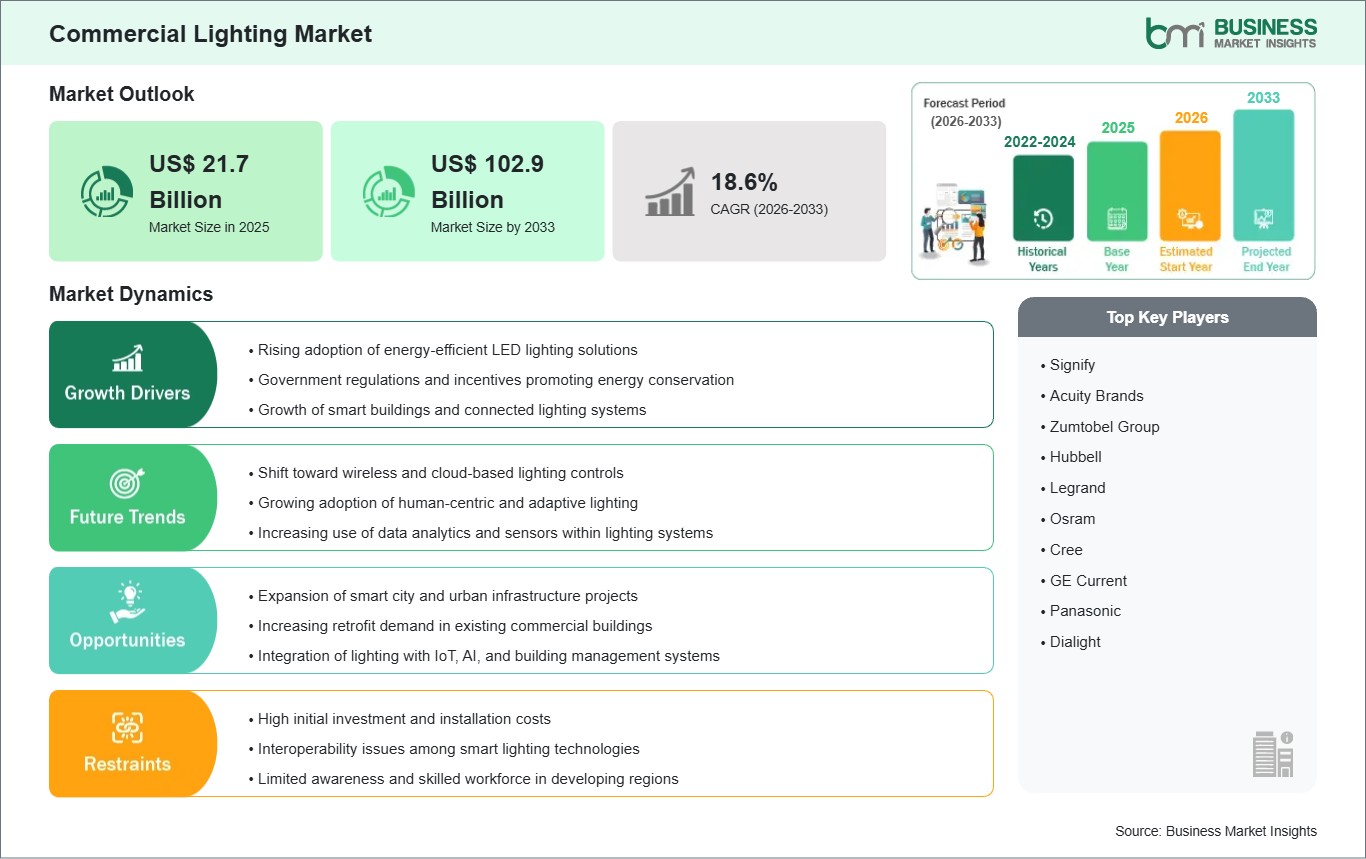
The commercial lighting market size is expected to reach US$102.9 billion by 2033 from US$21.7 billion in 2025. The market is estimated to record a CAGR of 18.57% from 2026 to 2033.
The global commercial lighting market growth is driven by increasing smart city developments, heightened focus on energy efficiency, rising adoption of LED and integrated control systems, and widespread transition from traditional to connected lighting solutions. Key challenges include interoperability issues between technologies and high initial installation costs. The market spans hardware, software, and services across new and retrofit installations, with indoor applications holding a major share. Market analysis indicates strong growth across regions, particularly in the Asia Pacific, where infrastructure modernization and smart lighting deployments are accelerating demand. Governments worldwide emphasize energy consumption reduction, boosting the adoption of advanced lighting systems in commercial spaces.
The commercial lighting market is expected to evolve toward fully integrated, intelligent ecosystems combining lighting, sensors, data analytics, and building management systems. Demand will increasingly be shaped by sustainability mandates, ESG compliance, and carbon-reduction targets set by governments and corporations. Retrofit projects will continue to outpace new installations, as existing commercial buildings seek cost savings and regulatory compliance. Advancements in IoT, AI-based lighting controls, and human-centric lighting will further enhance value propositions. As prices decline and standards mature, adoption barriers are expected to reduce, creating long-term growth opportunities across offices, retail, hospitality, and public infrastructure.

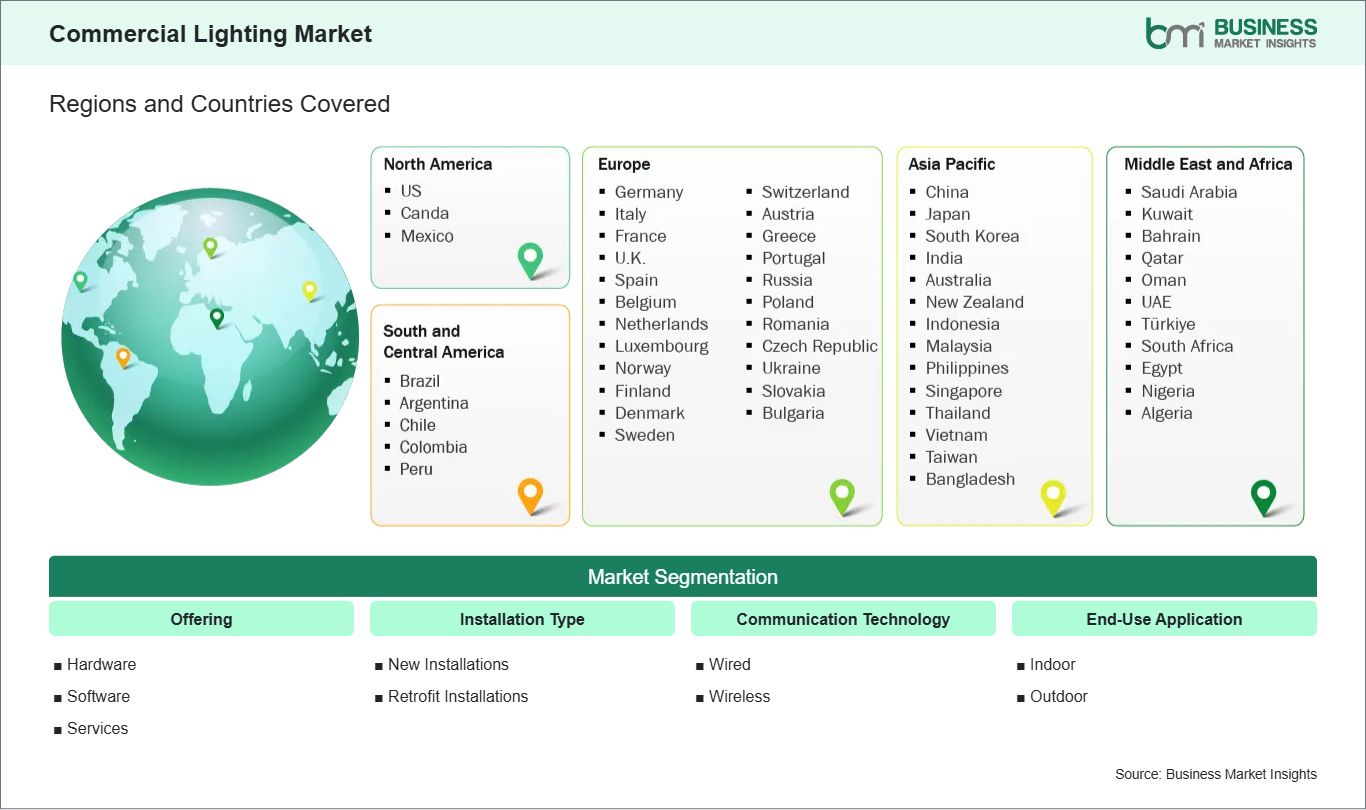
Key segments that contributed to the derivation of the Commercial lighting market analysis are Type, Deployment, and Application.
A key driver of the global commercial lighting market is the growing emphasis on energy efficiency and smart infrastructure. Governments worldwide are enforcing strict energy-consumption regulations and offering incentives to replace traditional lighting with LED and smart lighting systems. Commercial buildings consume a significant share of electricity, prompting facility owners to adopt solutions that reduce operating costs and carbon emissions. Smart lighting systems integrated with sensors, IoT, and building management platforms enable automated control, daylight harvesting, and occupancy-based lighting, delivering substantial energy savings. Additionally, declining LED prices and improved performance—such as longer lifespan and lower maintenance—accelerate adoption across offices, retail spaces, healthcare facilities, and public infrastructure, strengthening sustained market growth.
The rapid expansion of smart city initiatives and large-scale retrofit projects in emerging economies presents a significant opportunity for the commercial lighting market. Developing regions, particularly in Asia Pacific, the Middle East, and Latin America, are investing heavily in modernizing commercial infrastructure to support urbanization and digital transformation. Retrofitting existing buildings with smart, wireless lighting systems is cost-effective and faster than new construction, making it highly attractive. These projects create demand for advanced lighting hardware, software, and services, including connected controls and data analytics. As standardization improves and installation costs decline, vendors can unlock long-term revenue by offering scalable, intelligent lighting solutions tailored to urban sustainability goals.
By Offering, the market is segmented into Hardware, Software, and Services. The Hardware segment dominated the market in 2025. Due to the large-scale adoption of LED luminaires, lamps, drivers, and control devices. Hardware accounts for the majority of project costs in both new and retrofit installations, driven by energy-efficiency regulations and widespread replacement of conventional lighting systems.
By Installation Type, the market is segmented into New Installations, Retrofit Installations. The Retrofit Installations segment held the largest share of the market in 2025. Retrofit installations lead the market as commercial buildings increasingly upgrade existing lighting systems to reduce energy consumption and meet sustainability norms. Retrofitting LEDs and smart controls offers faster ROI compared to new installations, making it the preferred choice for offices, retail spaces, and public infrastructure.
By Communication Technology, the market is segmented into Wired, Wireless. The Wireless segment held the largest share of the market in 2025. Wireless communication dominates due to easier deployment, lower installation costs, and flexibility compared to wired systems. Technologies such as Zigbee, Bluetooth, and Wi-Fi support smart lighting, remote monitoring, and IoT integration, accelerating adoption across commercial buildings, especially in retrofit and smart building projects.
By End-Use Application, the market is segmented into Indoor, Outdoor. The Indoor segment held the largest share of the market in 2025. Indoor lighting holds the largest share as commercial spaces such as offices, retail stores, hospitals, hotels, and educational institutions require continuous, high-quality illumination. Demand is driven by productivity enhancement, aesthetics, energy savings, and the rapid shift toward smart and human-centric lighting solutions.

| Report Attribute | Details |
|---|---|
| Market size in 2025 | US$ 21.7 Billion |
| Market Size by 2033 | US$ 102.9 Billion |
| Global CAGR (2026 - 2033) | 18.6% |
| Historical Data | 2022-2024 |
| Forecast period | 2026-2033 |
| Segments Covered | By Offering
|
|
Regions and Countries Covered
| |
| North America | US, Canada, Mexico |
| Europe | Belgium, Austria, Finland, Denmark, Greece, Poland, Romania, Russia, Ukraine, Czech Republic, Slovakia, Bulgaria, Italy, Luxembourg, Germany, Switzerland, France, Netherlands, Norway, Portugal, Spain, Sweden, United Kingdom |
| Asia-Pacific | Australia, China, India, Japan, South Korea, Indonesia, Malaysia, Philippines, Singapore, Thailand, Vietnam, Bangladesh, New Zealand, Taiwan |
| South and Central America | Brazil, Argentina, Peru, Chile, Colombia |
| Middle East and Africa | Bahrain, Kuwait, Oman, Qatar, Saudi Arabia, United Arab Emirates, Turkiye, South Africa, Egypt, Algeria, Nigeria |
| Market leaders and key company profiles |
|
The "Commercial Lighting Market Size and Forecast (2022–2033)" report provides a detailed analysis of the market covering below areas:
The geographical scope of the Commercial lighting market report is divided into five regions: North America, Asia Pacific, Europe, Middle East & Africa, and South & Central America. The Commercial lighting market in Asia Pacific is expected to grow significantly during the forecast period.
The Asia-Pacific Commercial lighting market is segmented into China, Japan, South Korea, India, Australia, New Zealand, Indonesia, Malaysia, the Philippines, Singapore, Thailand, Vietnam, Taiwan, Bangladesh, and the Rest of Asia. The Asia Pacific commercial lighting market is the largest and fastest-growing globally, driven by rapid urbanization, industrialization, and infrastructure development. Countries such as China, India, Japan, and South Korea are investing heavily in smart city projects, energy-efficient buildings, and modern commercial facilities. The rising adoption of LED lighting, wireless controls, and IoT-enabled solutions is accelerating retrofit and new installation projects.
Government initiatives promoting sustainability and energy conservation, along with declining LED costs, further boost market growth. The region also benefits from a large commercial construction pipeline, making it a key hub for manufacturers and service providers targeting high-volume, technologically advanced lighting solutions.

The Commercial lighting market is evaluated by gathering qualitative and quantitative data post primary and secondary research, which includes important corporate publications, association data, and databases. A few of the key developments in the Commercial lighting market are:
The Commercial Lighting Market is valued at US$ 21.7 Billion in 2025, it is projected to reach US$ 102.9 Billion by 2033.
As per our report Commercial Lighting Market, the market size is valued at US$ 21.7 Billion in 2025, projecting it to reach US$ 102.9 Billion by 2033. This translates to a CAGR of approximately 18.6% during the forecast period.
The Commercial Lighting Market report typically cover these key segments-
The historic period, base year, and forecast period can vary slightly depending on the specific market research report. However, for the Commercial Lighting Market report:
The Commercial Lighting Market is populated by several key players, each contributing to its growth and innovation. Some of the major players include:
The Commercial Lighting Market report is valuable for diverse stakeholders, including:
Essentially, anyone involved in or considering involvement in the Commercial Lighting Market value chain can benefit from the information contained in a comprehensive market report.
Please tell us your area of interest
(Market Segments/ Regions and Countries/ Companies)