Market Summary
Executive Summary and Global Market Analysis
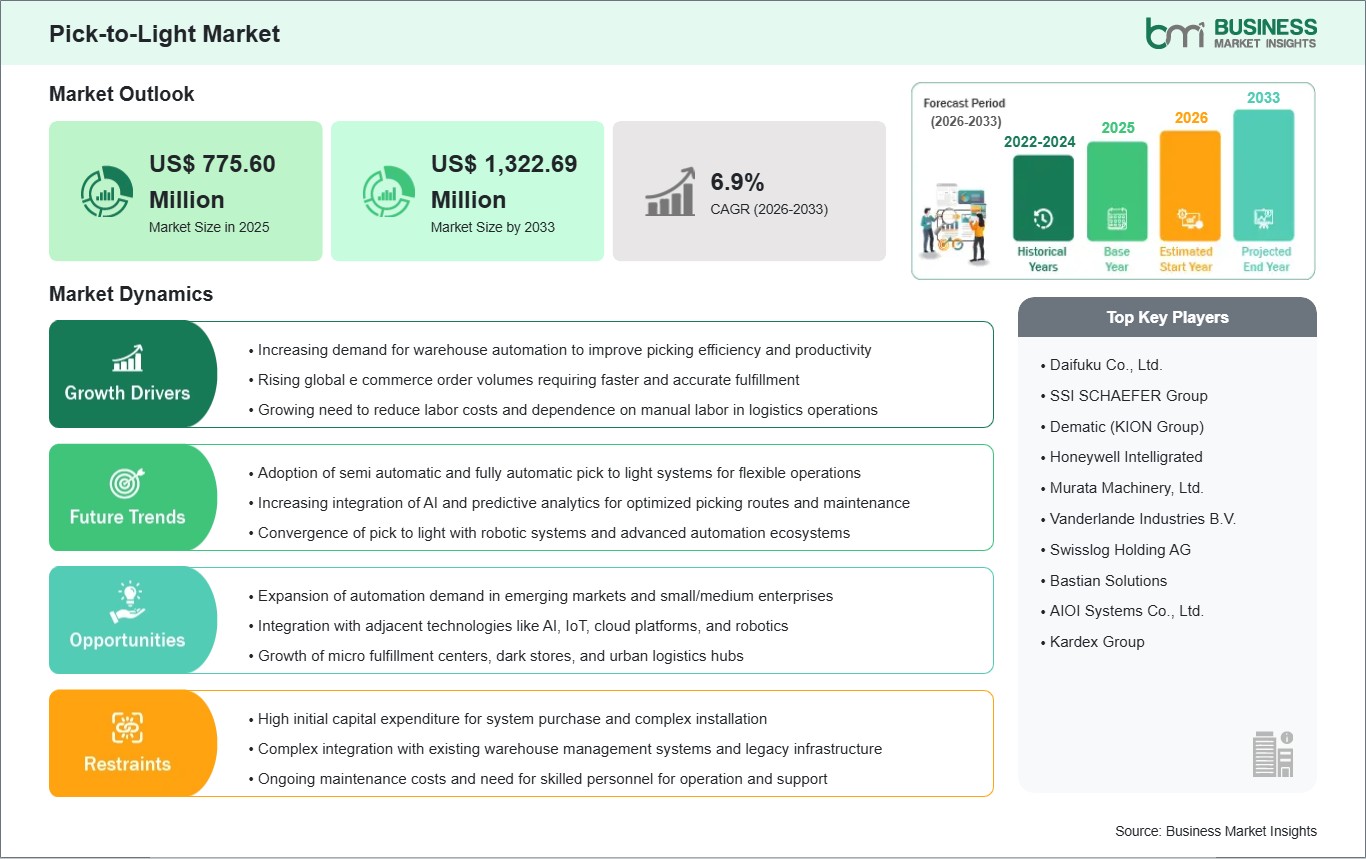
Pick-to-light (PTL) systems refer to a specialized category of light-directed warehouse automation technologies designed to enhance the accuracy and velocity of order fulfillment. By utilizing alphanumeric displays and high-visibility LED indicators mounted directly on storage racks or workstations, these systems guide operators to the precise location of required items and specify the exact quantity to be retrieved. This technology is fundamental to high-volume distribution environments, particularly in e-commerce and pharmaceutical logistics, where it minimizes human error and significantly reduces the training time required for seasonal or temporary labor. Market expansion is being propelled by the global omnichannel retail surge and by the rising institutional demand for semi-automated solutions that provide a balanced ROI between manual picking and fully autonomous robotic systems.
However, several factors may restrain market progression. The high initial capital intensity associated with hardware procurement and the installation of kilometers of specialized wiring or wireless nodes remains a primary hurdle for small and medium-sized enterprises. The industry also faces technical challenges regarding situational awareness fatigue, where operators may become overly reliant on visual cues, potentially leading to a decrease in overall inventory mindfulness. Additionally, retrofitting legacy warehouse facilities often presents significant structural obstacles, requiring extensive modifications to existing racking and electrical infrastructure that can disrupt ongoing operations. These hurdles, compounded by the increasing competition from alternative technologies, such as pick-by-voice and augmented reality (AR) glasses, necessitate a strategic focus on system modularity and seamless integration with existing warehouse management systems (WMS).
Despite these hurdles, the market outlook remains favorable. Opportunities are emerging through the adoption of wireless and IoT-enabled light modules, which offer greater flexibility for dynamic warehouse reconfigurations compared to traditional wired architectures. The expansion of put-to-light applications, where lights guide the sorting of items into specific customer orders, is gaining traction as a method to optimize multi-SKU consolidation. Furthermore, the growth of hybrid automation aligns with institutional goals for operational resilience, as PTL systems are increasingly integrated with autonomous mobile robots (AMRs) to create end-to-end automated workflows. Collectively, these innovations position the pick-to-light market for sustained long-term development as a cornerstone of the modern, data-driven logistics landscape.
Segment Analysis
Pick-to-Light Market Segmentation
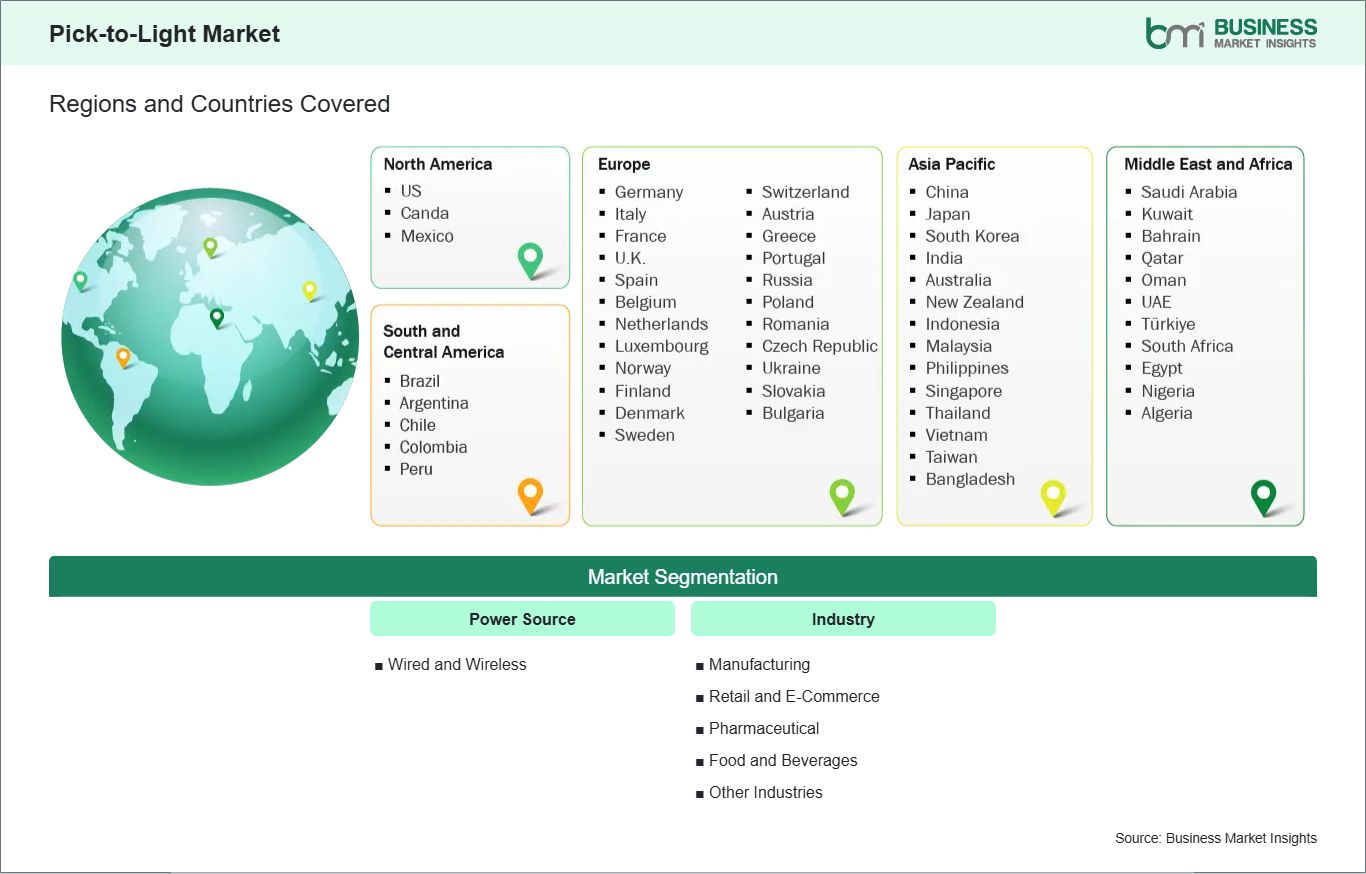
Key segments that contributed to the derivation of the Pick-to-Light market analysis are power source and industry.
- By Power Source, the market is segmented into Wired and Wireless.
- By Industry, the market is divided into Manufacturing, Retail and E-Commerce, Pharmaceutical, Food and Beverages, and Others.
Market Forces
Pick-to-Light Market Drivers and Opportunities
Rising Demand for Accuracy and Efficiency in Order Fulfillment
The pick to light market is being driven by the growing need for accuracy, speed, and efficiency in warehouse and distribution operations. With the rapid expansion of e-commerce and omnichannel retail, companies are under pressure to process high volumes of orders with minimal errors and faster turnaround times. Pick to light systems provide clear visual guidance to workers, reducing picking mistakes, improving throughput, and streamlining workflows. The rising complexity of global supply chains and increasing demand for same-day or next-day delivery are amplifying adoption, as businesses seek solutions that enhance productivity and customer satisfaction. Labor shortages in logistics are also reinforcing demand, since pick to light systems reduce training time and enable less experienced workers to achieve high accuracy quickly. Additionally, industries such as automotive, pharmaceuticals, and electronics are adopting these systems to manage complex, high-value inventory with precision. Collectively, e-commerce growth, supply chain complexity, and the need for operational efficiency are propelling sustained expansion in the global pick to light market.
Rising Integration of Smart Technologies and Flexible Designs
Opportunities in the pick‑to‑light market are expanding through the integration of IoT, AI, and modular system designs. Smart pick‑to‑light solutions equipped with sensors and cloud connectivity enable real‑time inventory tracking, predictive analytics, and seamless integration with warehouse management systems (WMS). AI‑driven platforms are creating new pathways for adoption by optimizing picking routes, reducing downtime, and enhancing workforce productivity. Modular and scalable designs are gaining traction, allowing businesses to tailor systems to specific warehouse layouts and adapt quickly to changing demand. The growing emphasis on sustainability is encouraging the development of energy‑efficient LED systems that reduce power consumption and environmental impact. Additionally, the expansion of micro‑fulfillment centers and automated warehouses is opening lucrative opportunities, as pick‑to‑light systems complement robotics and automated storage solutions. Vendors who focus on cost‑effective, interoperable, and digitally enabled systems are well‑positioned to capture growth. The convergence of smart functionality, modular innovation, and sustainability underscores a transformative trajectory for the global pick‑to‑light market.
Size and Share Analysis
Pick-to-Light Market Size and Share Analysis
The Pick-to-Light market demonstrates steady growth, with size and share analysis revealing evolving trends and competitive positioning among key players. The report examines subsegments categorized within power source and industry, offering insights into their contribution to overall market performance.
Based on Industry, the Manufacturing subsegment holds a strong presence in the market. Pick‑to‑light systems here are indispensable for assembly lines and production processes, improving accuracy and efficiency. The Retail and E‑Commerce subsegment is essential for order fulfillment and inventory management, supporting fast‑paced operations. The Pharmaceutical subsegment anchors demand in regulated environments, ensuring precision and compliance in drug handling. The Food and Beverages subsegment is critical for packaging and distribution, where speed and accuracy are vital. The Others category includes diverse industries such as automotive and electronics, where pick‑to‑light enhances productivity and reduces errors.
Report Coverage
Pick-to-Light Market Report Coverage and Deliverables
The "Pick-to-Light Market Size and Forecast (2022 - 2033)" report provides a detailed analysis of the market covering below areas:
- Market size and forecast at global, regional, and country levels for all market segments covered under the scope
- Market trends, as well as drivers, restraints, and opportunities
- Market analysis covering key trends, global and regional framework, major players, and recent developments
- Market concentration, heat map analysis, prominent players, and recent developments
- Detailed company profiles, including SWOT analysis
Geographic Insights
Pick-to-Light Market Geographic Insights
The geographical scope of the Pick-to-Light market report is divided into five regions: North America, Asia Pacific, Europe, Middle East & Africa, and South & Central America.
North America maintains a preeminent position within the global industry, established by a mature logistics infrastructure and the early, widespread adoption of advanced warehouse management systems (WMS). The regional landscape is characterized by high-density clusters of major e-commerce fulfillment centers and a robust retail sector, particularly in the United States, where the transition toward Omnichannel Fulfillment and Micro-Fulfillment Centers (MFCs) has become a strategic priority. This market leadership is further supported by significant institutional investments in automation to mitigate persistent labor shortages and rising operational costs, with the region accounting for a substantial share of global revenue.
Technological progression in the United States and Canada is largely driven by a decisive shift toward Wireless and IoT-Enabled Pick-to-Light (PTL) Systems. These advanced solutions utilize wireless radio frequency (RF) communication to obviate complex wiring requirements, allowing for rapid reconfiguration of warehouse layouts in response to seasonal demand fluctuations. Furthermore, the region is witnessing an increasing utilization of Hybrid Systems combining PTL with Voice-Picking and Augmented Reality (AR).
Industry Activity
Recent Developments
The Pick-to-Light market is evaluated by gathering qualitative and quantitative data post primary and secondary research, which includes important corporate publications, association data, and databases. A few of the key developments in the Pick-to-Light market are:
- In January 2025, Qualcomm Technologies and VusionGroup unveiled EdgeSense, a shelf‑edge solution powered by Qualcomm`s ultra‑low power Bluetooth SoC. The system integrates digital shelf capabilities with dynamic pricing, product location, and pick‑to‑light functionality to enhance order accuracy and inventory management. Demonstrated at NRF 2025, EdgeSense highlights Qualcomm`s role in catalyzing AI‑driven retail innovation, strengthening the adoption of pick‑to‑light technology in connected store environments.
- In July 2024, Instacart and Schnuck Markets announced the chainwide rollout of Carrot Tags’ pick‑to‑light functionality across nearly all Schnucks stores. The software integrates with electronic shelf labels to enable flashing lights that guide Instacart shoppers, improving order accuracy and fulfillment speed. Partnering with ESL provider Aperion, the solution enhances customer satisfaction and supports Schnucks’ broader digital transformation strategy, marking a significant advancement in retail pick‑to‑light applications.
Trust & Transparency
Research Methodology
The market analysis combines proprietary research with secondary data from government agencies, company disclosures, regulatory filings, industry databases and expert interviews. Market estimates are validated through data triangulation, cross-market benchmarking and analyst
review.
View Full Research Methodology
Key Sources Referred:
World Bank & Global Trade IndicatorsWorld Trade Organization (WTO)(International Monetary Fund )IMFInternational Trade Administration (ITA)Company websiteCompany annual reportsCompany investor presentations