
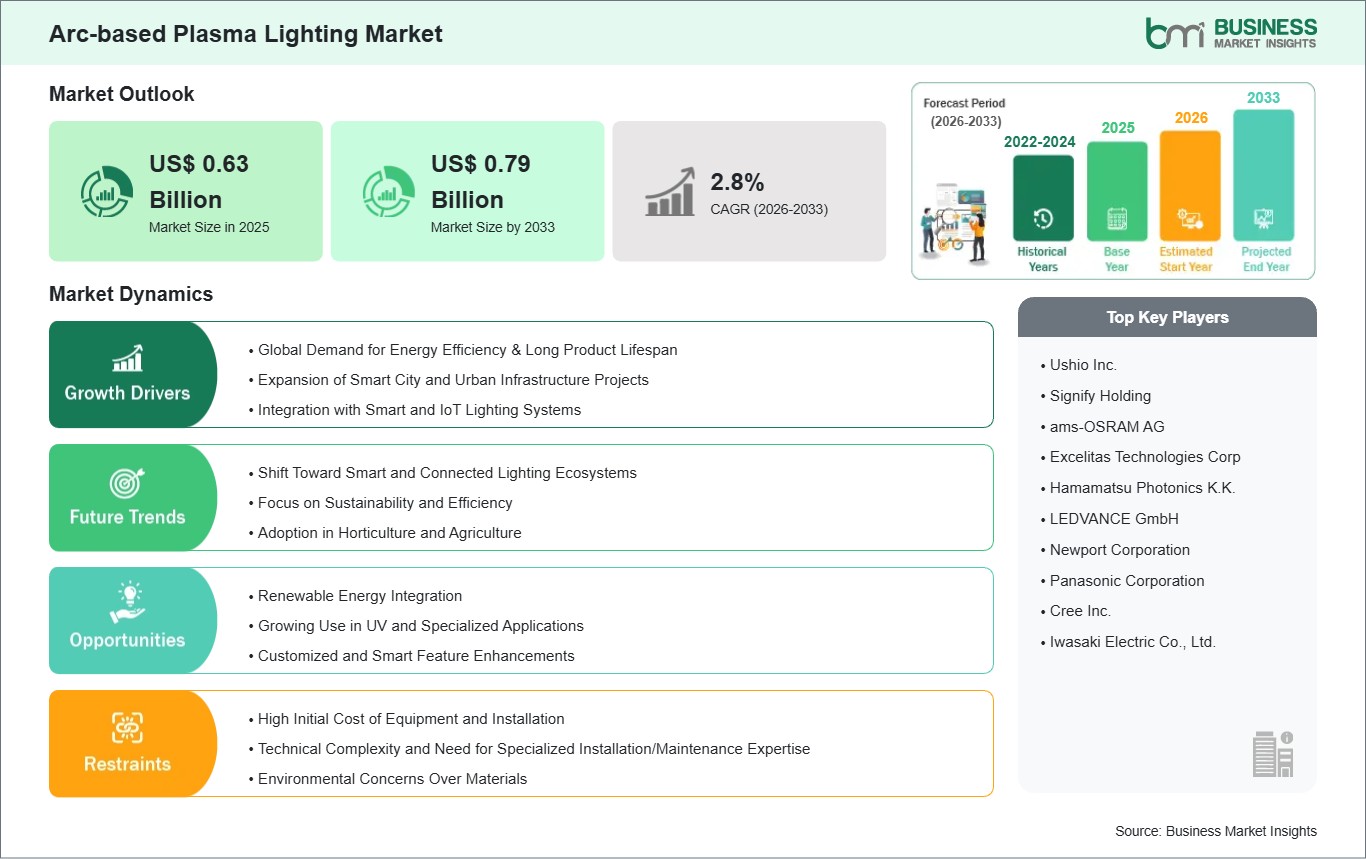
The arc-based plasma lighting market size is expected to reach US$ 0.79 billion by 2033 from US$ 0.63 billion in 2025. The market is estimated to record a CAGR of 2.8% from 2026 to 2033.
Arc-based plasma lighting refers to advanced illumination systems that generate light by sustaining an electric arc through ionized gas (plasma), producing high-intensity, full-spectrum light with excellent color rendering and stability compared to conventional sources like incandescent or basic HID lamps. These systems often use xenon or other noble gas arc lamps that deliver luminous output resembling natural daylight, making them suitable where precise and powerful lighting is required. Arc plasma lights are used across a broad range of applications including industrial and commercial facilities, urban infrastructure and smart street lighting, agriculture and horticulture where full-spectrum lighting supports plant growth, entertainment and projection systems, and precision scientific or medical settings requiring stable, high-quality light.
Global demand for arc-based plasma lighting is driven by energy-efficiency mandates, sustainability goals, and urbanization, which spur investments in advanced lighting solutions. Growth factors include regulatory incentives for eco-friendly technologies, expansion of smart city projects, industrial automation needs, and the increasing adoption of high-intensity lighting in specialized commercial and research applications. Competition from LEDs and high upfront costs remain challenges, but the niche value of plasma lighting in specific high-performance contexts sustains market growth worldwide.

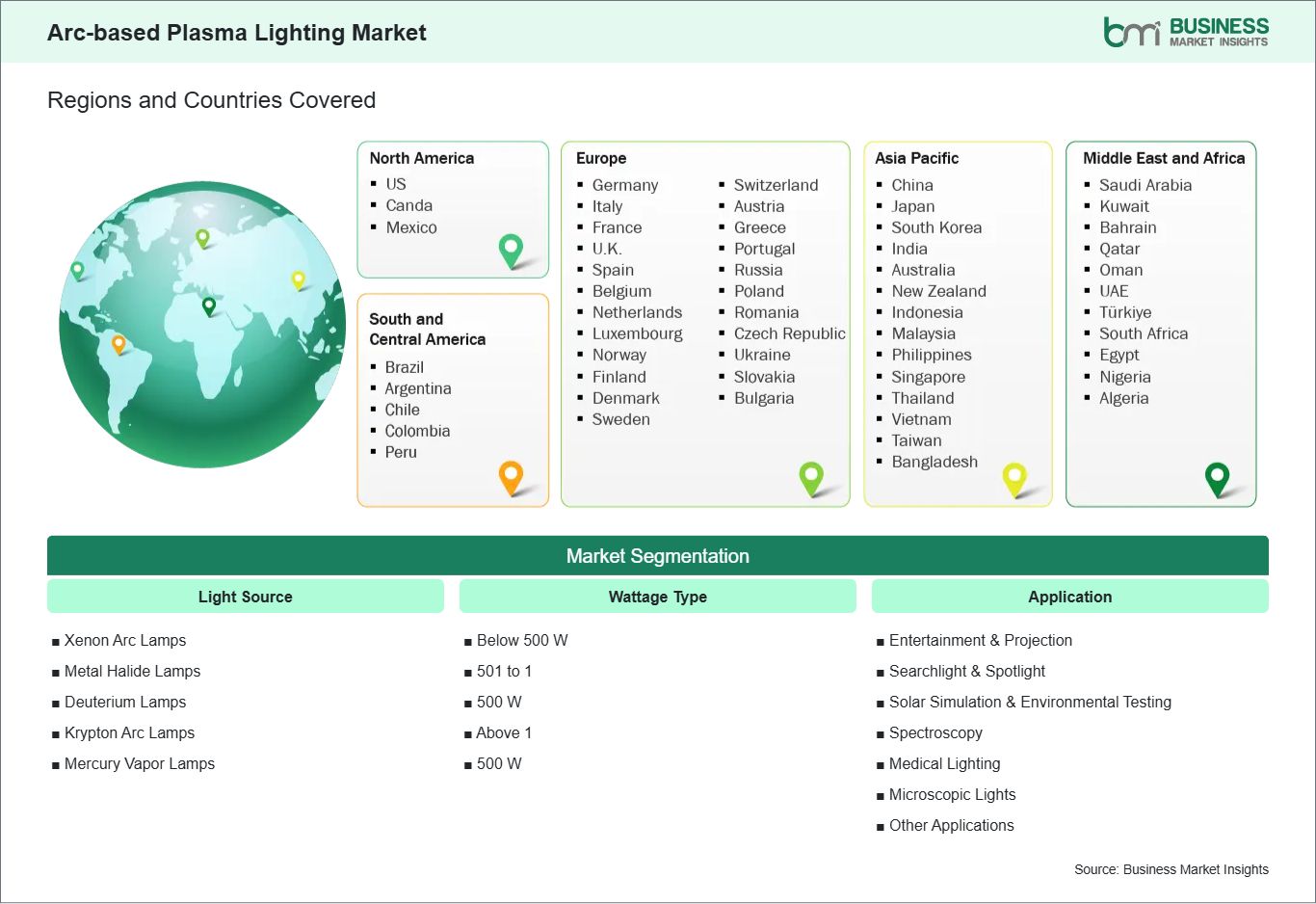
Key segments that contributed to the derivation of the arc-based plasma lighting market analysis are light source, wattage type, and application.
The global push for energy efficiency and sustainable solutions is a key driver for the arc-based plasma lighting market. As industries and municipalities face rising electricity costs and stricter environmental regulations, technologies that provide high illumination while minimizing energy consumption have become increasingly valuable. Arc-based plasma lights excel in this context by delivering intense, uniform light using significantly less energy than conventional lighting solutions such as metal halide or high-pressure sodium lamps. Beyond efficiency, these lights boast an extended operational lifespan, often lasting tens of thousands of hours longer than traditional lamps. This durability reduces the frequency of replacements, cutting maintenance costs and minimizing operational disruptions, particularly in large-scale industrial, commercial, and outdoor applications.
Moreover, growing awareness of carbon footprint reduction and sustainable energy practices is prompting governments and corporations to adopt energy-efficient lighting solutions, further boosting demand. The combination of superior lighting performance, lower energy expenditure, and longevity positions arc-based plasma lights as a strategic investment, driving market growth and encouraging adoption across sectors prioritizing both cost savings and environmental responsibility.
The growth of horticulture and indoor farming is emerging as a key driver for the arc-based plasma lighting market due to the increasing demand for high-efficiency, full-spectrum lighting solutions that can optimize plant growth. As traditional agriculture faces challenges from urbanization, climate change, and limited arable land, indoor farming and controlled-environment agriculture (CEA) are gaining traction worldwide. These setups require advanced lighting systems that can mimic natural sunlight to enhance photosynthesis, improve crop yields, and accelerate growth cycles. Arc-based plasma lighting offers high-intensity, uniform light with a broad spectrum, making it particularly suitable for horticultural applications. Its energy efficiency and long lifespan reduce operational costs for indoor farms, which is critical for profitability.
Furthermore, the rising adoption of vertical farming and hydroponics in urban centers has amplified the need for reliable, scalable, and precise lighting technologies, further boosting market demand. As consumers increasingly seek fresh, locally grown produce, the integration of plasma lighting in indoor horticulture is expected to become a standard, reinforcing market expansion.
By light source, the market is segmented into Xenon arc lamps, metal halide lamps, deuterium lamps, krypton arc lamps, and mercury vapor lamps. The Xenon arc lamps segment held the largest share of the market in 2025. The adoption of Xenon arc lamps increases due to their high-intensity light, long lifespan, energy efficiency, superior color rendering, reliability, versatility in applications, reduced maintenance, and growing industrial, automotive, and projection demand.
By wattage type, the market is divided into below 500 W, 501 to 1,500 W, and above 1,500 W. The above 1,500 W segment held the largest share of the market in 2025. Key factors driving adoption of above 1,500 W in arc-based plasma lighting include high luminous efficiency, longer lifespan, reduced maintenance, superior brightness for industrial applications, and growing demand in sports arenas and large-scale facilities.
By application, the market is segmented into entertainment & projection, searchlight & spotlight, solar simulation & environmental testing, spectroscopy, medical lighting, microscopic lights, and others. The entertainment & projection segment held the largest share of the market in 2025. Enhanced arc-based plasma lighting in entertainment and projection applications is driven by higher electrical current, optimized gas composition, precise electrode design, effective cooling, and advanced power modulation, boosting brightness, color accuracy, and stability.
| Report Attribute | Details |
|---|---|
| Market size in 2025 | US$ 0.63 Billion |
| Market Size by 2033 | US$ 0.79 Billion |
| Global CAGR (2026 - 2033) | 2.8% |
| Historical Data | 2022-2024 |
| Forecast period | 2026-2033 |
| Segments Covered | By Light Source
|
|
Regions and Countries Covered
| |
| North America | US, Canada, Mexico |
| Europe | Belgium, Austria, Finland, Denmark, Greece, Poland, Romania, Russia, Ukraine, Czech Republic, Slovakia, Bulgaria, Italy, Luxembourg, Germany, Switzerland, France, Netherlands, Norway, Portugal, Spain, Sweden, United Kingdom |
| Asia-Pacific | Australia, China, India, Japan, South Korea, Indonesia, Malaysia, Philippines, Singapore, Thailand, Vietnam, Bangladesh, New Zealand, Taiwan |
| South and Central America | Brazil, Argentina, Peru, Chile, Colombia |
| Middle East and Africa | Bahrain, Kuwait, Oman, Qatar, Saudi Arabia, United Arab Emirates, Turkiye, South Africa, Egypt, Algeria, Nigeria |
| Market leaders and key company profiles |
|
The "Arc-based Plasma Lighting Market Size and Forecast (2022–2033)" report provides a detailed analysis of the market covering below areas:
The geographical scope of the arc-based plasma lighting market report is divided into five regions: North America, Asia Pacific, Europe, Middle East & Africa, and South & Central America. The arc-based plasma lighting market in Asia Pacific is expected to grow significantly during the forecast period.
The Asia-Pacific arc-based plasma lighting market is segmented into China, Japan, South Korea, India, Australia, New Zealand, Indonesia, Malaysia, the Philippines, Singapore, Thailand, Vietnam, Taiwan, Bangladesh, and the Rest of Asia. The demand for arc-based plasma lighting in the Asia Pacific region has been rising significantly due to several key factors. Rapid urbanization and infrastructure development are driving the need for energy-efficient and long-lasting lighting solutions in cities, commercial spaces, and industrial facilities. Arc-based plasma lighting offers high luminous efficacy, superior color rendering, and lower maintenance costs compared to conventional lighting, making it an attractive choice for large-scale projects.
Additionally, the region’s growing automotive and sports stadium sectors are adopting plasma lighting for its ability to provide uniform, high-intensity illumination. Increasing environmental awareness and stringent government regulations on energy consumption and carbon emissions are also pushing industries to switch to more sustainable lighting technologies. Moreover, technological advancements in plasma lighting systems have reduced installation complexity and operational costs, further boosting adoption across residential, commercial, and public infrastructure applications in countries like China, India, Japan, and Southeast Asia.

The arc-based plasma lighting market is evaluated by gathering qualitative and quantitative data post primary and secondary research, which includes important corporate publications, association data, and databases. A few of the key developments in the arc-based plasma lighting market are:
The Arc-based Plasma Lighting Market is valued at US$ 0.63 Billion in 2025, it is projected to reach US$ 0.79 Billion by 2033.
As per our report Arc-based Plasma Lighting Market, the market size is valued at US$ 0.63 Billion in 2025, projecting it to reach US$ 0.79 Billion by 2033. This translates to a CAGR of approximately 2.8% during the forecast period.
The Arc-based Plasma Lighting Market report typically cover these key segments-
The historic period, base year, and forecast period can vary slightly depending on the specific market research report. However, for the Arc-based Plasma Lighting Market report:
The Arc-based Plasma Lighting Market is populated by several key players, each contributing to its growth and innovation. Some of the major players include:
The Arc-based Plasma Lighting Market report is valuable for diverse stakeholders, including:
Essentially, anyone involved in or considering involvement in the Arc-based Plasma Lighting Market value chain can benefit from the information contained in a comprehensive market report.
Please tell us your area of interest
(Market Segments/ Regions and Countries/ Companies)