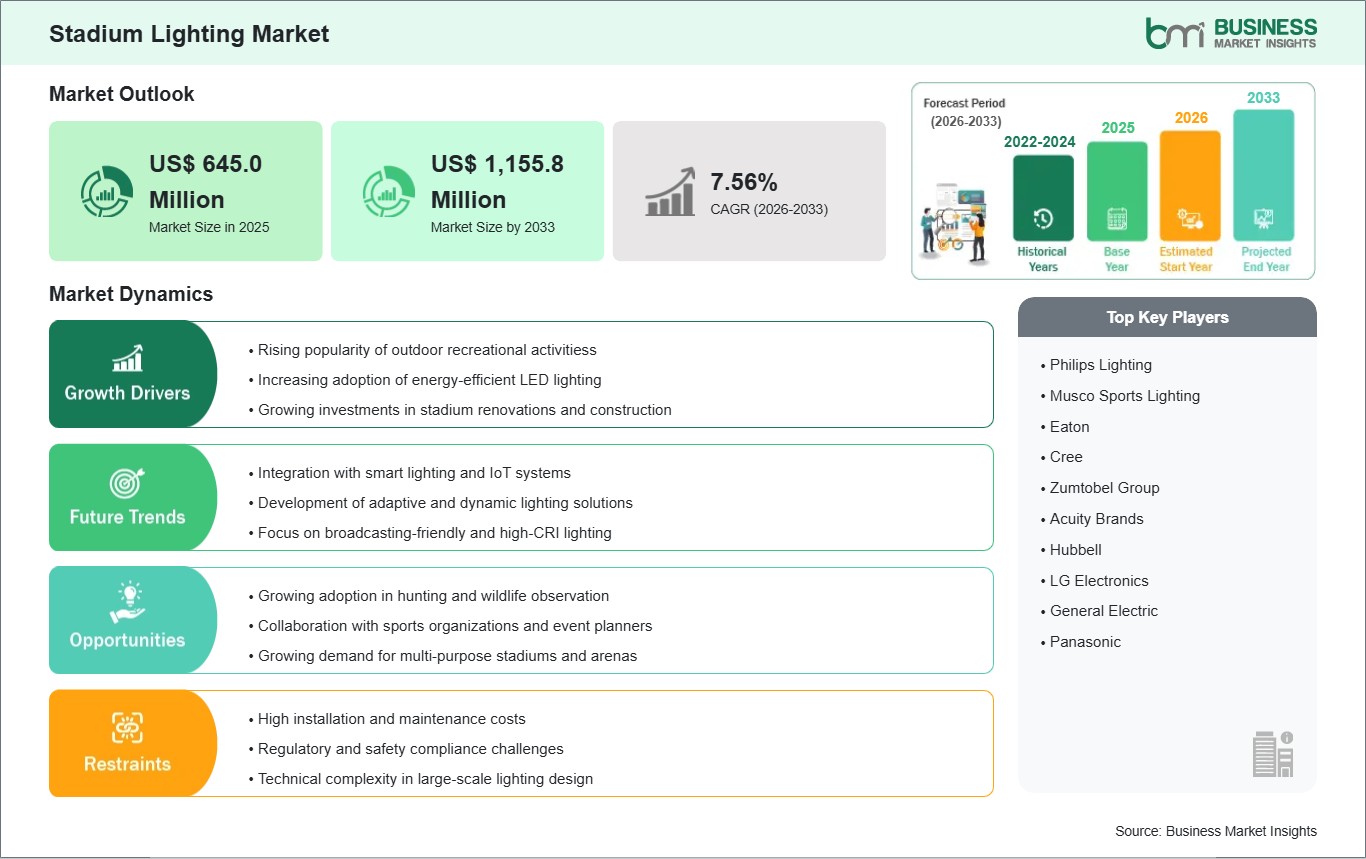
The Stadium Lighting Market size is expected to reach US$ 1,155.8 million by 2033 from US$ 645. million in 2025. The market is estimated to record a CAGR of 7.56% from 2026 to 2033.
The global stadium lighting market is growing steadily as sports venues, entertainment arenas, and multi-purpose facilities invest in better lighting solutions. These systems are essential for professional and recreational venues. They provide even lighting for sporting events, concerts, and large gatherings while meeting broadcasting standards for high-definition television coverage. Technological progress is fueling market growth. LED lighting has become the top choice due to its energy efficiency, long lifespan, low maintenance needs, and excellent brightness control. Smart lighting solutions that include IoT-enabled controls, adaptive dimming, and automated scheduling improve operational efficiency and cut electricity costs.
Integration with advanced control systems allows for dynamic lighting effects, color adjustments, and emergency lighting features, which boost audience engagement and safety. The market benefits from rising investments in stadium renovations, new sports complexes, and growing global interest in football, cricket, and multi-sport events. Concerns about sustainability and government rules on energy use are also speeding up the shift toward eco-friendly and cost-effective lighting solutions. Moreover, major events such as international tournaments and championships are prompting stadium operators to upgrade their lighting to meet broadcasting, regulatory, and spectator demands, increasing the need for reliable and modern lighting systems worldwide.

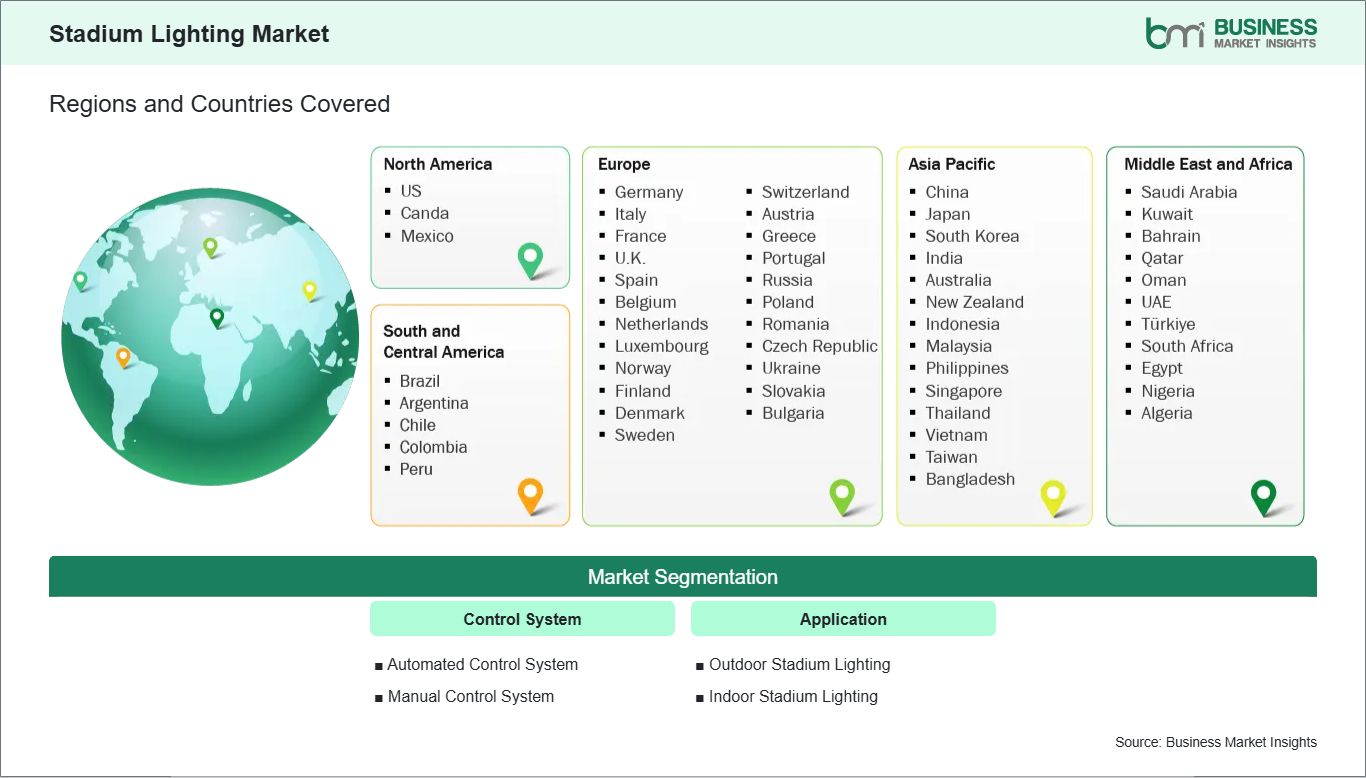
Key segments that contributed to the derivation of the stadium lighting market analysis are control system and application.
The global stadium lighting market is being propelled by a growing worldwide interest in outdoor recreational activities. Across continents, more individuals are engaging in hiking, trekking, birdwatching, and nature excursions as part of an expanding outdoor lifestyle trend. This broader participation elevates the demand for binoculars, spotting scopes, and rangefinders that enable clearer views over long distances making quality optics a staple item in outdoor gear portfolios. Manufacturers are responding by introducing lightweight and rugged models tailored for all levels of outdoor adventurers. Parallel to this trend, adventure and experiential tourism sectors have intensified worldwide, with travelers seeking immersive natural experiences. Tour operators increasingly include sports optics in their curated packages, enhancing customer satisfaction and familiarity with advanced viewing equipment. This integration helps convert occasional users into repeat buyers, sustaining long‑term market growth.
Concurrent improvements in digital platforms make specialty outdoor gear more accessible, with online sales channels showcasing high‑performance optics to a global audience. E‑commerce penetration supports both consumer education and purchase convenience, broadening market reach beyond traditional brick‑and‑mortar outlets. Collectively, these factors nurture a vibrant ecosystem in which outdoor recreation and sports optics mutually reinforce one another’s popularity.
Worldwide adoption of sports optics in hunting and wildlife observation continues to be a key demand driver for the market. Enthusiasts and professionals alike seek precision and enhanced visibility when tracking and observing fauna in natural habitats, which fuels investment in optical products such as riflescopes, thermal optics, and high‑magnification binoculars. These tools help users detect movement at distances that the naked eye cannot reliably capture, enhancing both safety and success rates in field activities. In wildlife observation, the appeal of capturing detailed views of animals without disturbance has expanded participation in birdwatching, safari tourism, and ecological study groups. As awareness of biodiversity strengthens globally, optics brands are aligning product features with the needs of ethical observers emphasizing clarity, low‑light performance, and durability. This shift reflects a broader cultural priority on responsible engagement with nature.
Advancements in optics technology including digital enhancements, stabilization systems, and multi‑coated lenses are making high‑end performance more attainable for a broader consumer base. At the same time, educational outreach by conservation organizations underscores the role of quality optics in research, documentation, and citizen science. Together, these patterns support sustained adoption of sports optics across varied hunting and wildlife observation applications.
The Stadium Lighting Market demonstrates steady growth, with size and share analysis highlighting evolving trends and competitive dynamics among key players. The report examines subsegments categorized within control system and application, offering insights into their contribution to overall market performance.
Control System, the automated control system subsegment dominated the market in 2025, driven by ease of operation, energy efficiency, and integration with smart lighting systems.
In terms of Application, the outdoor stadium lighting subsegment dominated the market in 2025, driven by the increasing number of outdoor sports facilities and demand for high-performance lighting for night events.
| Report Attribute | Details |
|---|---|
| Market size in 2025 | US$ 645.0 Million |
| Market Size by 2033 | US$ 1,155.8 Million |
| Global CAGR (2026 - 2033) | 7.56% |
| Historical Data | 2022-2024 |
| Forecast period | 2026-2033 |
| Segments Covered | By Control System
|
|
Regions and Countries Covered
| |
| North America | US, Canada, Mexico |
| Europe | Belgium, Austria, Finland, Denmark, Greece, Poland, Romania, Russia, Ukraine, Czech Republic, Slovakia, Bulgaria, Italy, Luxembourg, Germany, Switzerland, France, Netherlands, Norway, Portugal, Spain, Sweden, United Kingdom |
| Asia-Pacific | Australia, China, India, Japan, South Korea, Indonesia, Malaysia, Philippines, Singapore, Thailand, Vietnam, Bangladesh, New Zealand, Taiwan |
| South and Central America | Brazil, Argentina, Peru, Chile, Colombia |
| Middle East and Africa | Bahrain, Kuwait, Oman, Qatar, Saudi Arabia, United Arab Emirates, Turkiye, South Africa, Egypt, Algeria, Nigeria |
| Market leaders and key company profiles |
|
The "Stadium Lighting Market Size and Forecast (2022 - 2033)" report provides a detailed analysis of the market covering below areas:
The geographical scope of the Stadium Lighting Market report is divided into North America, Asia Pacific, Europe, Middle East & Africa, and South & Central America. North America held the largest share in 2025.
Regional adoption of stadium lighting varies based on sports infrastructure development, broadcasting standards, and investment in entertainment venues. North America dominates the market, driven by the United States and Canada, where professional sports leagues, universities, and municipal stadiums invest heavily in LED and smart lighting systems. High standards for live broadcasting and fan experience are key drivers of adoption in this region.
Asia Pacific is a fast-growing market due to large-scale sports infrastructure expansion, rising stadium construction, and increasing international sporting events. China, India, Japan, and South Korea are upgrading existing stadiums with energy-efficient LED solutions and smart lighting controls for multi-purpose arenas and football stadiums.
Europe emphasizes sustainability and compliance with energy regulations, with Germany, the United Kingdom, and France investing in LED upgrades, dynamic lighting, and smart control systems to enhance visibility and reduce energy consumption.
Middle East & Africa is adopting stadium lighting for modern sports complexes, leisure facilities, and football arenas, particularly in the UAE, Saudi Arabia, and South Africa, driven by hosting international tournaments and tourism-related infrastructure.
South & Central America is gradually upgrading stadiums and sports facilities with advanced LED lighting, with Brazil, Mexico, and Chile investing in illumination solutions for football stadiums, multi-purpose arenas, and Olympic-standard facilities to enhance spectator experience and meet international broadcasting requirements.

The Stadium Lighting Market is evaluated by gathering qualitative and quantitative data post primary and secondary research, which includes important corporate publications, association data, and databases. A few of the key developments in the spatial light Modulator market are:
The Stadium Lighting Market is valued at US$ 645.0 Million in 2025, it is projected to reach US$ 1,155.8 Million by 2033.
As per our report Stadium Lighting Market, the market size is valued at US$ 645.0 Million in 2025, projecting it to reach US$ 1,155.8 Million by 2033. This translates to a CAGR of approximately 7.56% during the forecast period.
The Stadium Lighting Market report typically cover these key segments-
The historic period, base year, and forecast period can vary slightly depending on the specific market research report. However, for the Stadium Lighting Market report:
The Stadium Lighting Market is populated by several key players, each contributing to its growth and innovation. Some of the major players include:
The Stadium Lighting Market report is valuable for diverse stakeholders, including:
Essentially, anyone involved in or considering involvement in the Stadium Lighting Market value chain can benefit from the information contained in a comprehensive market report.
Please tell us your area of interest
(Market Segments/ Regions and Countries/ Companies)