Market Summary
Executive Summary and Global Market Analysis
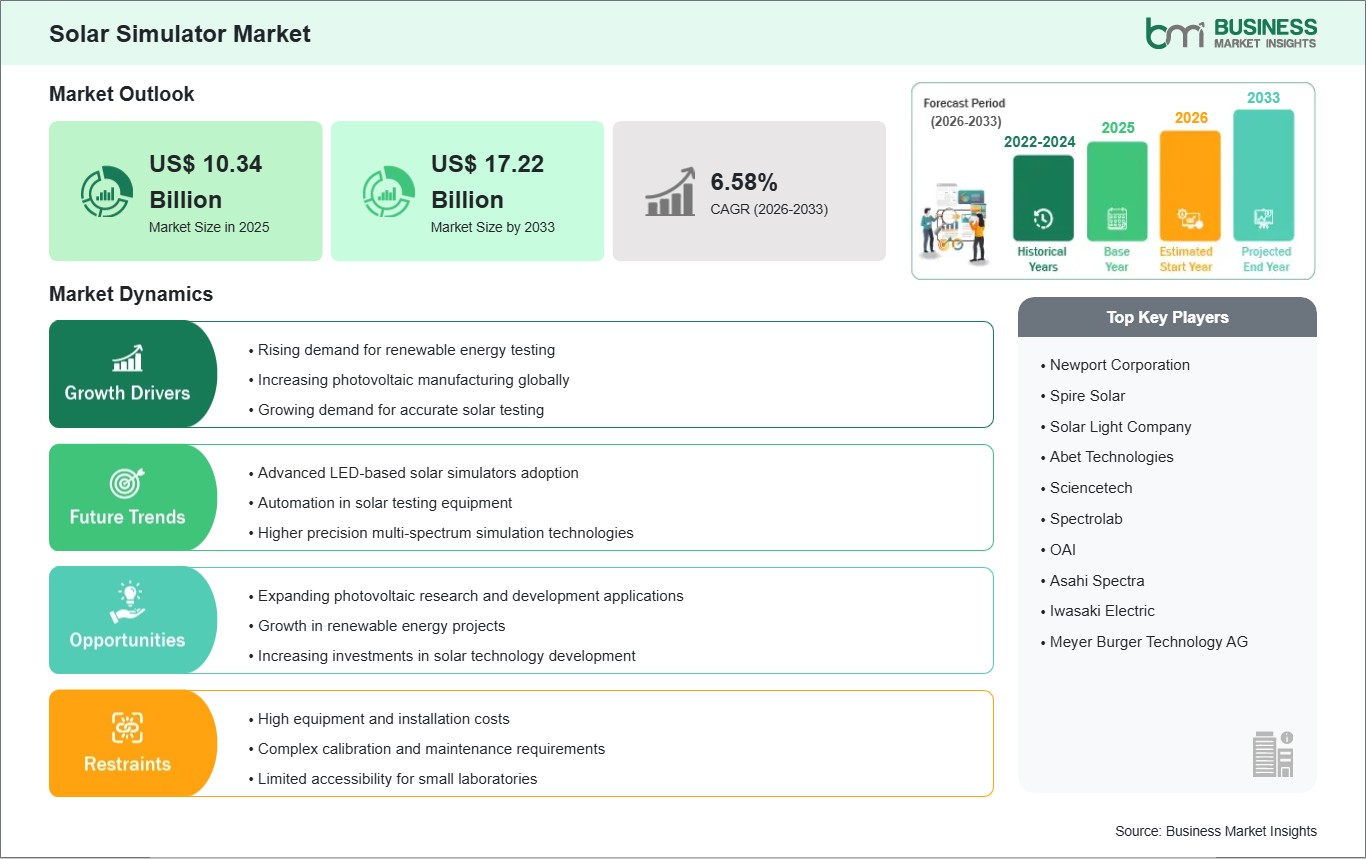
The global solar simulator market is becoming increasingly significant as the photovoltaic (PV) industry continues to evolve and the need for reliable testing solutions intensifies. Solar simulators are laboratory-based systems engineered to reproduce natural sunlight conditions, allowing manufacturers, research organizations, and testing facilities to assess the efficiency, reliability, and operational behavior of solar cells and modules. With solar power installations expanding worldwide, the demand for accurate performance validation tools is rising across production plants, quality assurance laboratories, and certification bodies. Advancements in photovoltaic technologies, including high-efficiency crystalline silicon, thin-film technologies, and emerging materials such as perovskite cells, are creating new requirements for advanced simulation capabilities. Equipment manufacturers are therefore focusing on improving spectral consistency, light uniformity, and stability to meet stringent industry testing standards.
The growing transition toward LED-based solar simulators has also improved system efficiency, reduced maintenance requirements, and enabled greater flexibility in laboratory testing environments compared to traditional xenon lamp technologies. Additionally, rising investment in renewable energy research is strengthening the demand for sophisticated solar testing equipment. Universities, technology institutes, and private research centers are expanding their photovoltaic research capabilities. At the same time, international testing and certification frameworks are encouraging solar manufacturers to adopt advanced simulation systems to ensure consistent product quality and compliance with global performance standards.
Segment Analysis
Solar Simulator Market Segmentation
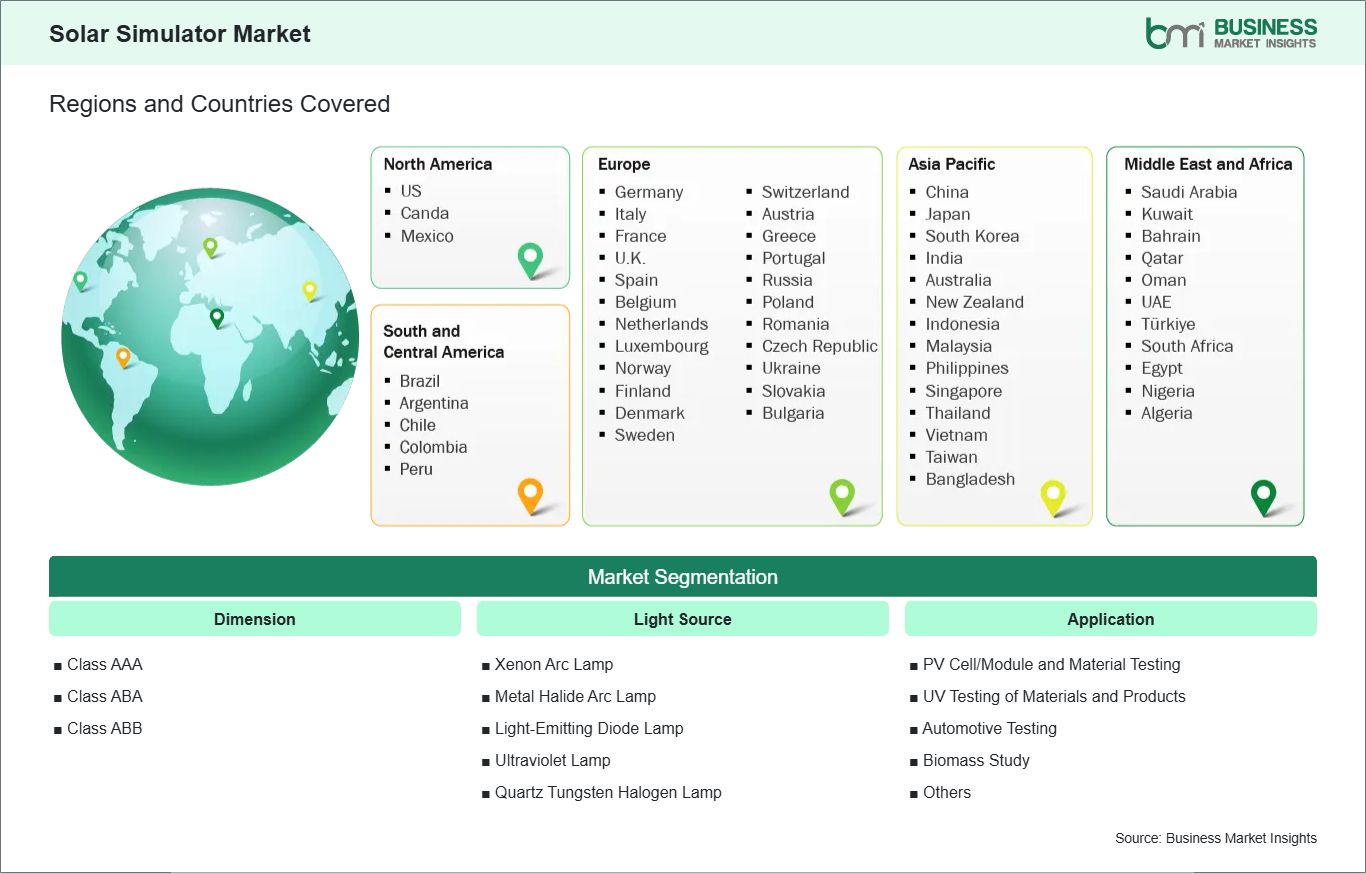
Key segments that contributed to the derivation of the solar simulator market analysis are dimension, light source, and application.
- Dimension, the solar simulator market is segmented into Class AAA, Class ABA, and Class ABB. The Class AAA segment dominated the market in 2025.
- Light source, the solar simulator market is categorized into xenon arc lamp, metal halide arc lamp, light-emitting diode (led) lamp, ultraviolet (UV) lamp, and quartz tungsten halogen (QTH) lamp. The xenon arc Lamp segment dominated the market in 2025.
- Application, the solar simulator market is classified into PV cell/module and material testing, UV testing of materials and products, automotive testing, biomass study, and others. The PV cell/module and material testing segment dominated the market in 2025.
Market Forces
Solar Simulator Market Drivers and Opportunities
Rising demand for renewable energy testing
The market for solar simulators is gaining momentum due to the growing need for accurate performance assessment in renewable energy systems. As solar technology continues to expand, manufacturers and testing laboratories are increasingly relying on high-precision simulation tools to ensure photovoltaic (PV) panels meet efficiency, durability, and reliability standards. Solar simulators are essential for replicating natural sunlight conditions, enabling thorough quality control and certification processes. The surge in solar energy deployment worldwide has intensified the need for comprehensive testing solutions. Simulators allow developers to model environmental conditions, optimize panel efficiency, and detect potential defects before large-scale implementation. This proactive approach minimizes failures and supports consistent energy output, making solar simulators a critical part of the renewable energy supply chain. Additionally, stricter industry standards and performance regulations are reinforcing simulator adoption. Independent testing facilities, research labs, and manufacturing partners increasingly rely on these systems to verify product quality and compliance, solidifying their role as a cornerstone in renewable energy testing.
Expanding photovoltaic research and development applications
The role of solar simulators in photovoltaic research and development is growing along with innovation in solar materials and cell designs. High-performance simulators are used more often to replicate different light spectra, temperatures, and irradiance levels. This provides researchers with controlled environments to test next-generation PV technologies. Emerging areas like tandem cells, perovskite materials, and bifacial modules depend on precise simulation to validate experimental results. By offering repeatable and accurate test conditions, simulators help shorten R&D cycles, cut prototyping costs, and speed up the development of more efficient solar technologies. Additionally, research into hybrid energy systems and integrated renewable solutions continues to expand the use of simulators. Researchers and developers use these tools to improve designs, assess performance in varied conditions, and increase competitiveness in the fast-changing solar market. This growing focus on research remains a key factor driving global demand for solar simulators.
Size and Share Analysis
Solar Simulator Market Size and Share Analysis
The Solar Simulator Market demonstrates steady growth, with size and share analysis highlighting evolving trends and competitive dynamics among key players. The report examines subsegments categorized within dimension, light source, and application, offering insights into their contribution to overall market performance.
Dimension, the Class AAA subsegment dominated the market in 2025, driven by high accuracy, reliability, and compliance with international standards for solar simulation.
Based on Light source, the xenon arc lamp subsegment dominated the market in 2025, driven by broad spectral match, stability, and widespread use in PV testing and material research.
In terms of Application, the PV Cell/Module and material testing subsegment dominated the market in 2025, driven by increasing demand for quality assurance in solar panels and materials development.
Report Coverage
Solar Simulator Market Report Coverage and Deliverables
The "Solar Simulator Market Size and Forecast (2022 - 2033)" report provides a detailed analysis of the market covering below areas:
- Solar Simulator Market size and forecast at global, regional, and country levels for all the key market segments covered under the scope
- Solar Simulator Market trends, as well as drivers, restraints, and opportunities
- Solar Simulator Market analysis covering key trends, global and regional framework, major players, regulations, and recent developments
- Industry landscape and competition analysis covering market concentration, heat map analysis, prominent players, and recent developments for the Solar Simulator Market
- Detailed company profiles, including SWOT analysis
Geographic Insights
Solar Simulator Market Geographic Insights
The geographical scope of the Solar Simulator Market report is divided into North America, Asia Pacific, Europe, Middle East & Africa, and South & Central America. North America held the largest share in 2025.
The global solar simulator market shows clear regional trends influenced by technology use, renewable energy policies, and research facilities. North America leads the market due to strong investments in renewable energy research and development, cutting-edge photovoltaic research centers, and extensive cooperation among universities, national laboratories, and private solar tech companies. The high use of modern solar simulators in labs and manufacturing sites ensures thorough performance testing and quality checks, strengthening the region's position in innovation and precision testing.
Asia Pacific is a fast-growing market because of major solar manufacturing centers, government-led renewable energy initiatives, and rising use of solar simulators for product development and quality control. Countries like China, India, and South Korea are putting money into high-precision simulation gear to aid both module production and research projects. The region enjoys a large skilled workforce and a cost-effective manufacturing environment, making solar testing systems easier to obtain.
Europe is working to incorporate solar simulators into research institutions and industrial labs to promote high-efficiency solar technologies. This effort is driven by environmental rules and sustainability goals.
The Middle East and Africa mainly use solar simulators to help develop local photovoltaic projects and renewable energy research, especially in areas with growing solar infrastructure.
South and Central America are slowly building testing capabilities to support local solar manufacturing and regional renewable energy projects, showing a rising focus on quality checks and technology use.
Industry Activity
Recent Developments
The Solar Simulator Market is evaluated by gathering qualitative and quantitative data post primary and secondary research, which includes important corporate publications, association data, and databases. A few of the key developments in the solar simulator market are:
- In August 2024, Innovations in Optics, Inc. announced that it launched the LumiSun‑50 LED solar simulator, a compact Class A+A+A+ compliant system designed for precise solar simulation with adjustable irradiance and broad spectral range for research and industrial testing applications.
- In August 2023, EternalSun Spire (Eternal Sun B.V.) announced that it introduced its LED Light Soaker solar simulator, a steady‑state LED‑based solar simulator with adjustable irradiance and precise temperature control, suitable for testing various PV technologies including perovskite and thin film modules.
Trust & Transparency
Research Methodology
The market analysis combines proprietary research with secondary data from government agencies, company disclosures, regulatory filings, industry databases and expert interviews. Market estimates are validated through data triangulation, cross-market benchmarking and analyst
review.
View Full Research Methodology
Key Sources Referred:
World Health Organization (WHO) Organisation for Economic Cooperation and Development (OECD) The World Bank Group Worldometer The Lancet International Bar Association International Trade Administration