
Human Centric Lighting Market Outlook: Size, Share, Trends, Growth Analysis, Competitive Landscape & Forecast, 2026-2033

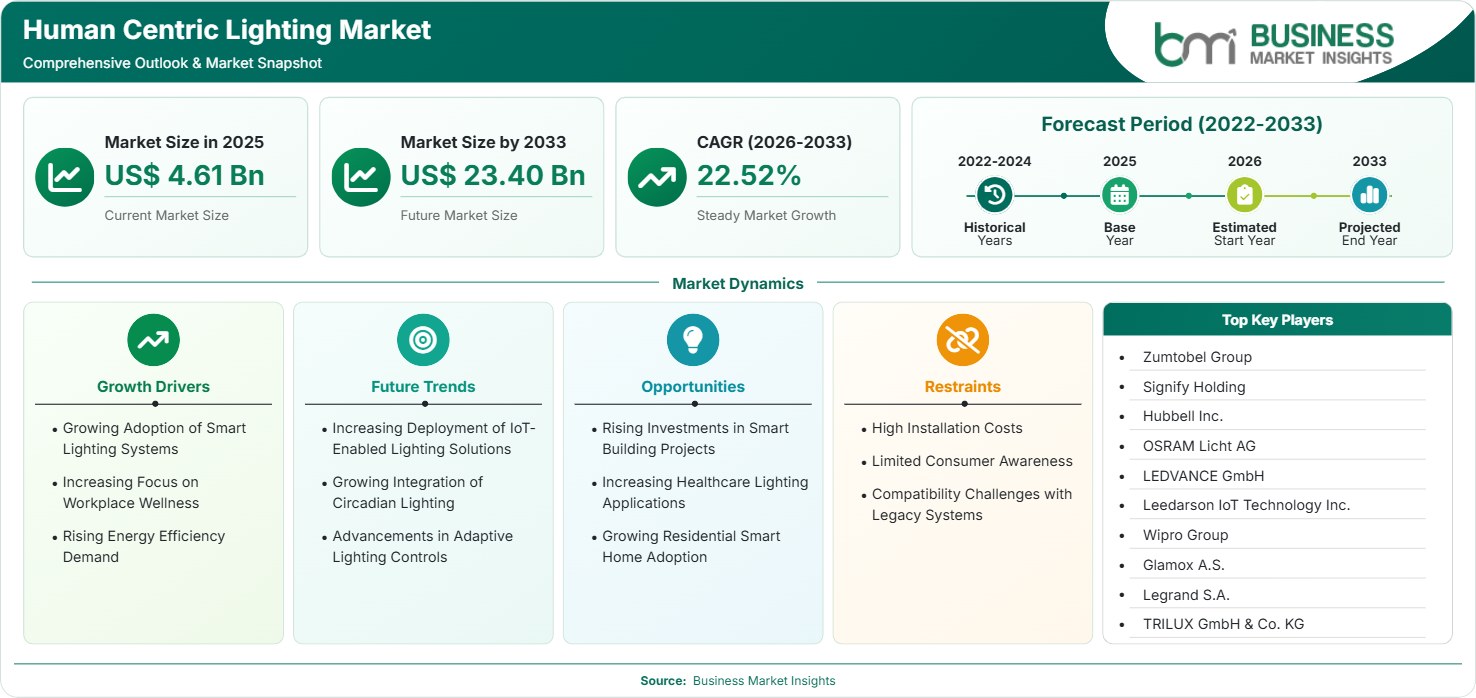
The Human Centric Lighting Market size was valued at US$ 4.61 Billion in 2025 and is projected to reach US$ 23.40 Billion by 2033, growing at a CAGR of 22.52% during 2026–2033, driven by smart building adoption, wellness-focused lighting solutions, energy efficiency requirements, and increasing opportunities in healthcare, residential, and commercial applications.

Report Coverage
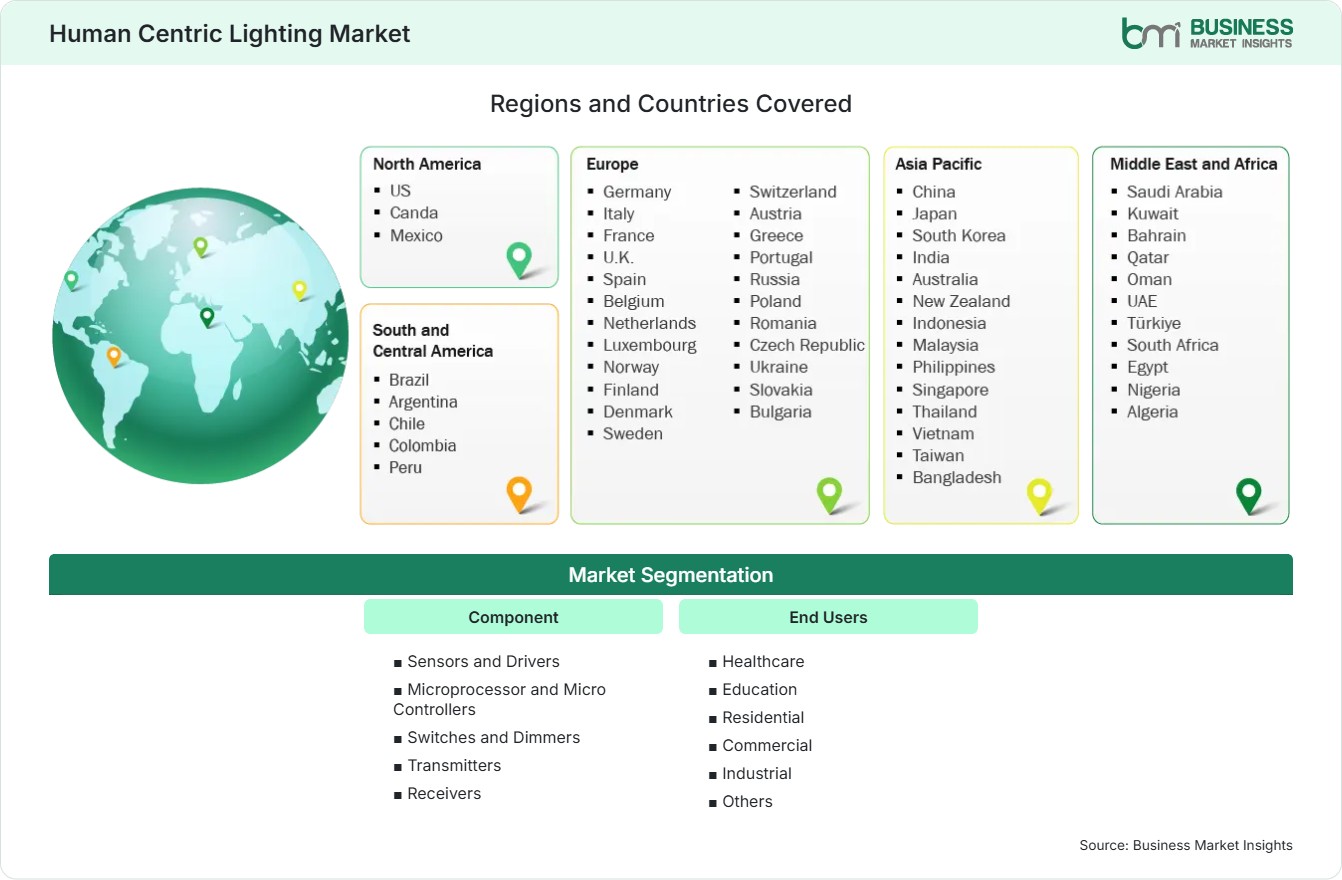
  • Component: Sensors and Drivers, Microprocessor and Micro Controllers, Switches and Dimmers, Transmitters, Receivers
  • End Users: Healthcare, Education, Residential, Commercial, Industrial, Others
US$ 4.61 Bn Market size in 2025
US$ 23.40 Bn Market Size by 2033
22.52% CAGR, 2026 - 2033
2026-2033 Forecast Period

AI Overview

Human Centric Lighting Market Summary

  • North America Region: North America holds 32%–35% share in 2025, expanding at a 20%–23% CAGR during 2026–2033 through smart infrastructure investments, healthcare modernization, workplace wellness programs, and connected lighting adoption. The US market analysis indicates strong adoption, supported by commercial retrofits and smart building initiatives, with a CAGR of 21%–24% from 2026–2033.
  • Fastest Growing Region: Asia Pacific accounts for 28%–31% share in 2025, advancing at a 24%–27% CAGR during 2026–2033 due to urbanization, smart city projects, rising disposable income, and increasing demand for energy-efficient lighting technologies across residential and commercial environments.
  • Leading Segment: Healthcare end users represent 30%–33% share in 2025, growing at a 23%–26% CAGR during 2026–2033 as hospitals integrate circadian lighting systems to improve patient comfort, recovery environments, staff productivity, and operational efficiency.
  • High Growth Segment: Sensors and Drivers components capture 27%–30% share in 2025, registering a 25%–28% CAGR during 2026–2033 due to increasing automation, IoT integration, adaptive illumination systems, and demand for intelligent lighting control infrastructure.
  • Key Market Opportunity: Growing integration of human centric lighting with IoT platforms, artificial intelligence, and building management systems creates opportunities for customized lighting experiences, energy optimization, healthcare improvements, and next-generation smart environments.
  • Major Market Players: Zumtobel Group AG, Signify Holding, Hubbell Incorporated, OSRAM Licht AG, LEDVANCE GmbH, Leedarson IoT Technology Inc., Wipro Limited, Glamox AS, Legrand SA, TRILUX GmbH & Co. KG.
Strategic Insights

Human Centric Lighting Market: Strategic Insights

Human Centric Lighting Market Strategic Framework
FREE PDF
Request your free sample
Request free sample
Stakeholder View

Key Takeaways

  • The value chain is shifting from traditional lighting manufacturers toward integrated technology ecosystems involving LED producers, sensor developers, software providers, and building automation companies that enable intelligent lighting solutions.
  • Healthcare facilities, corporate offices, and educational institutions represent high-potential application areas as organizations increasingly prioritize occupant wellness, productivity enhancement, and evidence-based environmental design principles.
  • Innovation focus is moving toward AI-enabled lighting controls, advanced sensors, wireless connectivity, and adaptive systems capable of automatically adjusting illumination based on occupancy, activity, and biological requirements.
  • Asia Pacific presents a strong investment opportunity due to rapid urban development, smart building expansion, and increasing adoption of sustainable infrastructure across China, Japan, India, and Southeast Asian economies.
  • Strategic partnerships and acquisitions are increasing as established lighting companies seek capabilities in IoT connectivity, digital controls, and software-driven lighting management platforms to strengthen competitive positioning.
  • Sustainability-driven construction practices and green certification requirements are encouraging developers to incorporate advanced lighting systems into new commercial and residential projects.
Geographic Outlook

Human Centric Lighting Market Regional Highlights

North America Human Centric Lighting Market

North America accounted for 32%–35% share in 2025, with growth projected at a 20%–23% CAGR during 2026–2033. The region benefits from advanced commercial infrastructure, healthcare modernization, and strong adoption of smart building technologies. The Human Centric Lighting Market share remains supported by increasing workplace wellness investments and energy efficiency regulations across the US and Canada. Growing demand for connected lighting systems is encouraging manufacturers to develop integrated solutions combining sensors, controls, and analytics platforms.

  • The US and Canada are adopting intelligent lighting solutions through commercial renovation projects, with enterprises prioritizing employee comfort, productivity improvement, and sustainable building operations.
  • Healthcare facilities across North America are integrating circadian lighting systems to enhance patient environments, improve staff wellbeing, and support advanced hospital infrastructure modernization initiatives.
  • Government energy efficiency programs are encouraging replacement of conventional systems with connected LED-based solutions, creating favorable conditions for technology suppliers and lighting solution providers.
  • Expansion of smart office buildings is increasing demand for automated illumination systems that adjust color temperature and intensity according to occupancy patterns and user preferences.

US Human Centric Lighting Market

The US represented 27%–30% share of North America in 2025, expanding at a 21%–24% CAGR during 2026–2033. Strong construction activity, corporate sustainability goals, and healthcare infrastructure upgrades are supporting adoption. The market growth in the country is influenced by increasing workplace wellness initiatives, smart building investments, and demand for energy-efficient lighting management platforms. Commercial offices, hospitals, and educational facilities remain key deployment areas.

  • Corporate offices are increasingly implementing adaptive lighting environments to improve employee experience, reduce energy consumption, and align with modern workplace design standards.
  • Healthcare providers are investing in patient-centric lighting systems that support recovery environments, staff productivity, and improved facility management through automated controls.
  • Green building certifications and sustainability commitments are encouraging developers to include advanced lighting technologies in new construction and renovation projects.
  • Technology partnerships between lighting companies and automation providers are accelerating deployment of connected solutions across commercial and institutional facilities.

Europe Human Centric Lighting Market

Europe held 25%–28% share in 2025, growing at a 19%–22% CAGR during 2026–2033 due to stringent energy efficiency regulations and sustainability-focused construction practices. Germany, the UK, and Nordic countries represent leading markets, while France and the Netherlands demonstrate strong adoption potential. The Human Centric Lighting Market analysis indicates that European demand is supported by smart workplace development, healthcare applications, and emphasis on occupant wellbeing.

  • Germany is adopting advanced lighting systems through industrial automation projects, energy optimization initiatives, and sustainable commercial building development programs.
  • Nordic countries are increasing adoption due to greater focus on natural lighting simulation, employee wellness, and energy-efficient infrastructure solutions.
  • European healthcare institutions are deploying circadian lighting technologies to improve patient comfort and optimize operational environments.
  • Government sustainability policies are encouraging businesses to upgrade traditional lighting infrastructure with intelligent and connected alternatives.

Asia Pacific Human Centric Lighting Market

Asia Pacific accounted for 28%–31% share in 2025, recording the highest growth rate of 24%–27% CAGR during 2026–2033. Rapid urbanization, smart city development, and increasing construction activity are driving adoption across China, Japan, India, and Southeast Asian markets. The Human Centric Lighting Market trends are influenced by rising demand for smart homes, energy-efficient buildings, and technology-enabled workplace environments.

  • China is expanding adoption through smart city initiatives, commercial construction growth, and increasing deployment of intelligent building management systems.
  • Japan is focusing on healthcare and residential applications where advanced lighting supports ageing populations and improved indoor living environments.
  • India is witnessing rising demand from premium residential projects, offices, and educational institutions integrating smart lighting technologies.
  • Southeast Asian countries are attracting investments through urban infrastructure development and increasing adoption of sustainable building solutions.
  • Regional manufacturers are strengthening capabilities in connected lighting components, sensors, and IoT-based control platforms.

Rest of World Human Centric Lighting Market

South and Central America together contributed 7%–10% share in 2025, while the Middle East and Africa accounted for 5%–8% share, with combined regional expansion estimated at a 18%–21% CAGR during 2026–2033. Adoption is supported by commercial construction, hospitality developments, and healthcare modernization. Brazil, UAE, Saudi Arabia, and South Africa represent important growth markets as sustainable infrastructure investments increase.

  • Middle Eastern countries are integrating intelligent lighting solutions into luxury hospitality, commercial complexes, and smart city developments.
  • Brazil is adopting advanced lighting systems through commercial upgrades, energy-saving initiatives, and modernization of public infrastructure.
  • Saudi Arabia is creating opportunities through large-scale urban development projects requiring efficient and automated building technologies.
  • South Africa is witnessing demand from healthcare facilities and commercial users seeking improved energy management solutions.
  • Hospitality projects across emerging markets are incorporating adaptive lighting to enhance customer experiences and operational efficiency.
Global Market Geography
FREE PDF
Request your free sample
Request free sample
Segment Analysis

Human Centric Lighting Market Segmentation

Component

The component segment represented 55%–58% share in 2025, expanding at a 23%–26% CAGR during 2026–2033. The Human Centric Lighting Market scope within components is expanding due to increasing demand for automation, connected controls, and intelligent illumination systems. Sensors, processors, and control devices enable personalized lighting experiences across commercial, residential, and institutional environments while improving energy management capabilities.

  • Sensors and Drivers: These components enable automated brightness adjustment, occupancy detection, and environmental monitoring, supporting adaptive lighting systems across smart buildings and wellness-focused applications.
  • Microprocessor and Micro Controllers: These technologies provide processing capabilities for intelligent lighting operations, enabling real-time adjustments, connectivity functions, and integration with advanced building management platforms.
  • Switches and Dimmers: These solutions allow users to customize illumination intensity and create flexible lighting environments suitable for residential, commercial, and institutional applications.
  • Transmitters: Transmitter technologies support wireless communication between lighting devices and control systems, improving scalability, flexibility, and operational efficiency in connected environments.
  • Receivers: Receivers facilitate reliable signal processing and coordination between lighting components, supporting seamless automation and enhanced user control capabilities.

End Users

The end user segment accounted for 42%–45% share in 2025, growing at a 21%–24% CAGR during 2026–2033. Adoption is increasing as organizations prioritize wellbeing, productivity, and sustainable infrastructure. Healthcare, education, and commercial facilities are becoming major deployment areas where advanced lighting improves user experience and supports operational efficiency. The segment continues to benefit from evolving architectural standards.

  • Healthcare: Hospitals and healthcare facilities use adaptive lighting systems to support patient recovery, staff comfort, and improved indoor environmental conditions.
  • Education: Schools and universities are adopting intelligent lighting solutions to create productive learning environments and enhance student concentration through optimized illumination.
  • Residential: Homeowners are integrating smart lighting technologies to personalize indoor environments, improve comfort, and enhance energy management through connected systems.
  • Commercial: Offices and business facilities are deploying advanced lighting solutions to improve employee wellness, reduce energy costs, and support sustainable workplace designs.
  • Industrial: Industrial facilities are implementing intelligent lighting systems to improve operational visibility, workplace safety, and energy efficiency across manufacturing environments.
Market Forces

Human Centric Lighting Market Dynamics

Key Market Drivers

Growing Adoption of Smart Lighting Systems

The rise in the use of IoT-enabled lights, sensors, and other lighting control mechanisms is fueling the Human Centric Lighting market growth in both commercial and institutional buildings. The International Energy Agency emphasizes the significance of efficient lighting technologies as a means of minimizing electricity usage, hence making it easier to embrace intelligent systems. Increasingly high demands for personalized lighting, connectivity, and environmental monitoring have been influencing the Human Centric Lighting trends. Adaptive lighting is increasingly being adopted by companies as a means of enhancing energy savings while at the same time increasing occupant satisfaction.

Increasing Focus on Workplace Wellness

Health, comfort, and increased employee productivity have become crucial aspects in the corporate environment, leading to the demand for new lighting solutions that consider the biological processes of people. Circadian lighting principles are now used as part of design practices in workplaces to improve indoor environment and make employees' experience more comfortable. The Human Centric Lighting market trends is facilitated by the investments that companies are making into the creation of wellness-focused office environment and sustainable workplaces. Science-based approach to lighting design is being applied in corporate buildings where the satisfaction and productivity of employee matter.

Rising Energy Efficiency Demand

The rising need for energy conservation and sustainable goals will drive the acceptance of more advanced lighting technologies in several industries. LED lighting solutions will be installed in place of the traditional lighting system through the incorporation of smart controls with a view to cutting down expenses incurred. The adoption trend of HCL products will be reinforced by rising needs for energy efficiency especially among larger commercial buildings and industries. Smart controls, occupancy sensors, and automated scheduling capabilities will help achieve electricity savings while still providing comfortable conditions for users. Green building and environmentally friendly goals will also drive lighting technology adoption.

Key Market Opportunities

Rising Investments in Smart Building Projects

As there is an increase in investments in the area of smart buildings, it opens up possibilities for lighting companies to implement adaptive lighting systems with overall building automation systems. Increasingly, developers are using connected technologies in commercial, residential, and mixed-use buildings. According to Human Centric Lighting Market Forecast Reports, there are increasing opportunities because of the adoption of intelligent infrastructure in urban development areas. This integration helps in creating customized lighting environments while conserving resources.

Increasing Healthcare Lighting Applications

Healthcare institutions have huge potential due to increased awareness among hospitals and care facilities of the effect of lighting on the wellbeing of patients and the productivity of the staff. Lighting solutions that mimic the natural cycle of daylight have been implemented in order to create comfortable conditions of healing and operation. Increasing spending on healthcare infrastructure development in emerging and advanced countries opens up new possibilities for application. Manufacturers of lighting solutions concentrate on patient rooms, therapy rooms, and other specific areas of health facilities. Integration with healthcare facility management systems generates even more opportunities for customizing lighting controls.

Growing Residential Smart Home Adoption

The growth in smart home ecosystems has led to new prospects for personalization through adaptive lighting in residential settings. There is an increasing uptake by consumers of devices that offer the possibility of remote control, automation, and personalized environment indoors. With integration of voice assistants and home automation systems along with mobile applications, accessibility and interaction have been made easier. Intelligent lighting options are being integrated into premium housing projects as a value proposition, offering more comfort and energy management. Efforts are being made to develop affordable solutions to cater to more than just the luxury segment.

Market Restraints and Challenges

High Installation Costs

Factor: The high initial investment required for advanced sensors, control systems, and integrated lighting infrastructure can limit adoption among cost-sensitive customers. Impact: High costs of installation can cause delays in the implementation of the existing system, especially in small-scale commercial buildings and residential settings due to small budget allocations for technological investments. Complicated installation procedures and need for special skills will raise the cost of implementation even higher. Despite the fact that energy savings in the long run will yield economic advantages, initial costs still represent a drawback. This issue is solved by companies through modularity and better installation techniques.

Limited Consumer Awareness

Factor: Limited understanding of biological lighting benefits and available technology solutions restricts broader market penetration among residential and commercial users. Impact: The lower level of awareness can lead to less investment and slower adoption rates when compared to the more traditional forms of lighting. Consumers continue to be driven mainly by energy savings and not health considerations, which would decrease the need for sophisticated lighting systems. Educational campaigns, demonstrations, and collaboration efforts are needed in order to educate about benefits such as increased productivity and health-conscious environment. Manufacturers of lighting systems have already started designing easy-to-use solutions.

Company Analysis

Competitive Landscape

The Human Centric Lighting Market analysis highlights a competitive environment shaped by established lighting manufacturers, technology providers, and automation specialists. Companies are focusing on connected solutions, intelligent controls, and application-specific lighting systems to strengthen market positions. Strategic partnerships, product innovation, and digital transformation initiatives are becoming key competitive factors.

Company Name

Overview

Products and Services relevant to this market

Zumtobel Group AG

Global lighting solutions provider specializing in professional illumination systems and architectural lighting technologies.

Human-centric lighting solutions, LED systems, lighting controls, and connected illumination platforms for commercial applications.

Signify Holding

Leading lighting technology company offering intelligent and sustainable lighting solutions worldwide.

Philips-branded smart lighting, connected LED systems, IoT-enabled controls, and wellness-focused illumination technologies.

Hubbell Incorporated

Manufacturer of electrical and lighting products serving commercial, industrial, and infrastructure markets.

Advanced lighting fixtures, controls, sensors, and connected solutions supporting intelligent building environments.

OSRAM Licht AG

Lighting technology company focused on semiconductor-based solutions and advanced illumination technologies.

LED components, sensors, optical technologies, and intelligent lighting systems for diverse applications.

LEDVANCE GmbH

International lighting provider offering professional and consumer lighting products.

LED lighting systems, smart controls, connected lighting solutions, and energy-efficient illumination products.

Leedarson IoT Technology Inc.

IoT technology company specializing in smart lighting and connected device solutions.

Smart lighting products, wireless controls, sensors, and IoT-based lighting management solutions.

Wipro Limited

Technology services company providing digital solutions and smart infrastructure capabilities.

Connected lighting integration, automation platforms, IoT services, and smart building technology solutions.

Glamox AS

European lighting company focused on professional lighting applications.

Workplace lighting, healthcare lighting systems, LED solutions, and intelligent lighting controls.

Legrand SA

Electrical and digital infrastructure specialist providing connected building solutions.

Lighting management systems, smart controls, switches, and building automation technologies.

TRILUX GmbH & Co. KG

German lighting manufacturer specializing in professional lighting systems.

LED lighting solutions, human-centric lighting concepts, controls, and workplace illumination systems.

Trust & Transparency

Research Methodology

The market analysis combines proprietary research with secondary data from government agencies, company disclosures, regulatory filings, industry databases and expert interviews. Market estimates are validated through data triangulation, cross-market benchmarking and analyst review.

View Full Research Methodology

Questions Answered

Frequently Asked Questions

What is covered in the Human Centric Lighting Market Report?

The report provides insights into market dynamics, technology developments, segmentation trends, competitive strategies, regional opportunities, and growth factors influencing future industry expansion.

What role does sustainability play in adoption?

Sustainability initiatives encourage replacement of conventional lighting with efficient LED-based systems featuring smart controls that reduce energy consumption while supporting green building certifications and environmental objectives.

How do connected technologies influence Human Centric Lighting solutions?

Connected technologies enable automated brightness adjustment, color temperature control, occupancy detection, and integration with building management systems, allowing users to create customized lighting environments based on activities and preferences.

Which applications are expected to create new demand opportunities?

Healthcare facilities, corporate offices, educational institutions, hospitality spaces, and premium residential projects are expected to generate strong demand as organizations focus on occupant comfort, productivity, and sustainable building operations.

What factors are accelerating adoption of Human Centric Lighting Market systems?

Adoption is increasing due to smart building development, wellness-focused workplace designs, energy efficiency requirements, and growing integration of sensors, IoT platforms, and automated lighting controls across commercial and institutional environments.

Access the Full Human Centric Lighting Market Report

Get segment-level forecasts, regional estimates, competitive benchmarking, company profiles and downloadable Excel datasets.

Access the full Human Centric Lighting Market Report
350 pages PDF & Excel | 2026-08-06