
Solar Silicon Wafer Market Outlook: Size, Share, Trends, Growth Analysis, Competitive Landscape & Forecast, 2026–2033

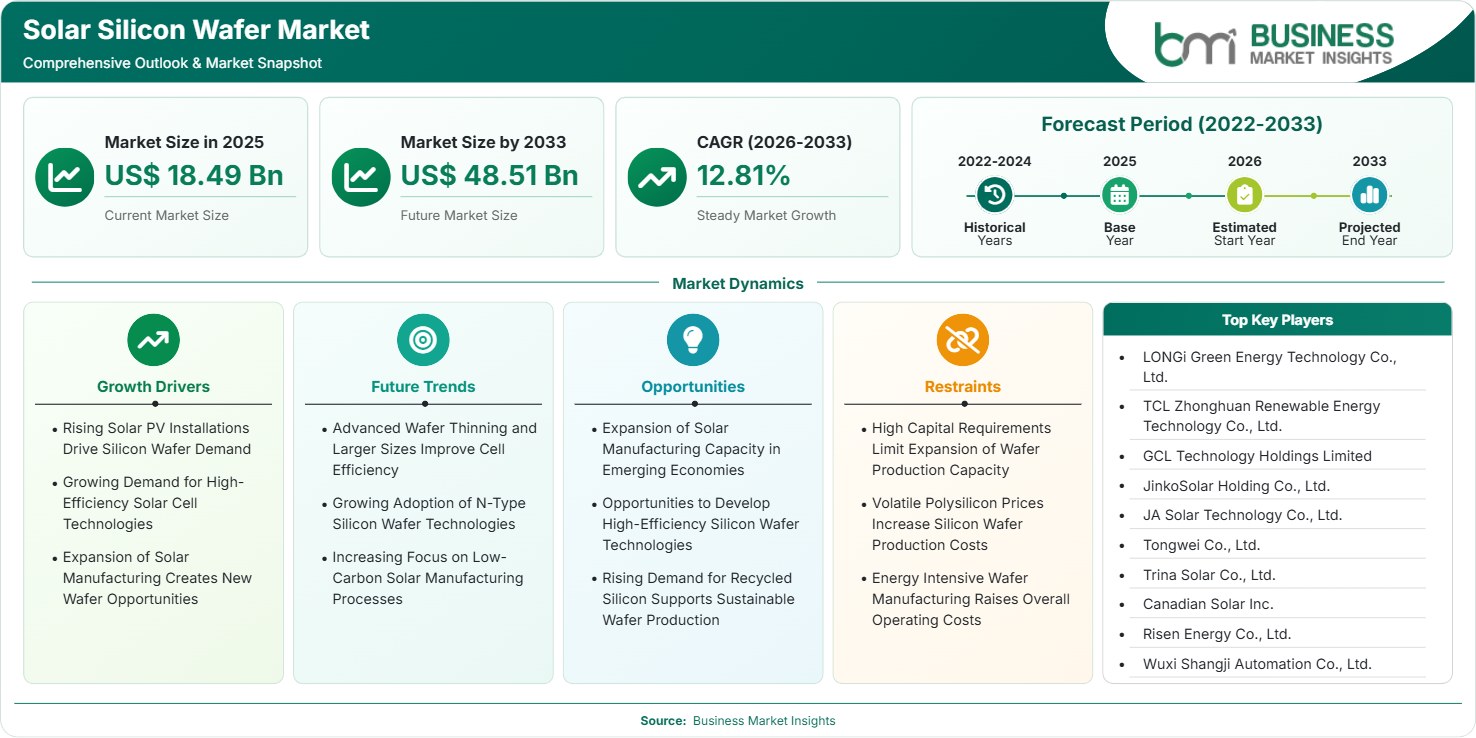
The Solar Silicon Wafer Market size was valued at US$ 18.49 Billion in 2025 and is projected to reach US$ 48.51 Billion by 2033, growing at a CAGR of 12.81% during 2026–2033, driven by solar PV expansion, high-efficiency cells, manufacturing capacity additions, and wafer technology improvements.

Report Coverage
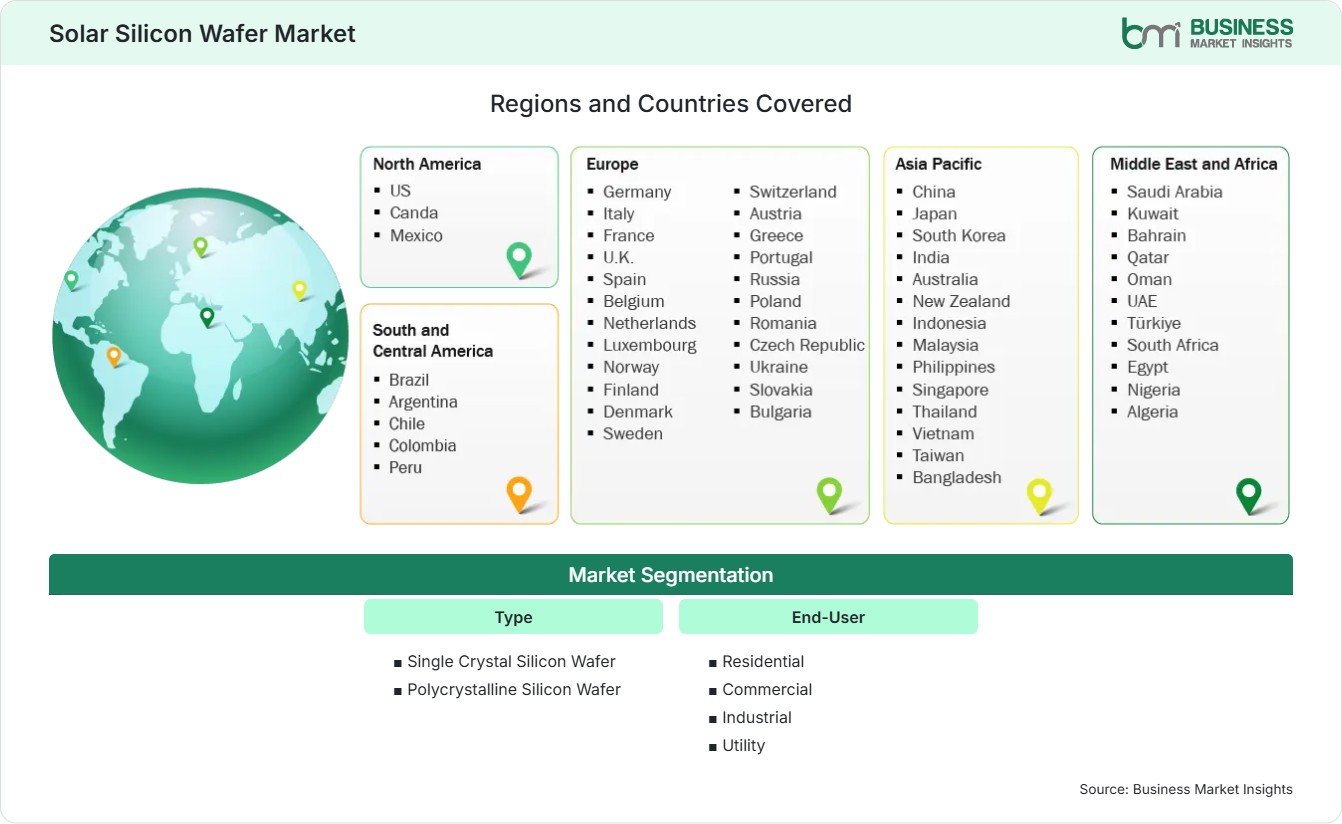
  • Type: Single Crystal Silicon Wafer, Polycrystalline Silicon Wafer
  • End-User: Residential, Commercial, Industrial, Utility
US$ 18.49 Bn Market size in 2025
US$ 48.51 Bn Market Size by 2033
12.81% CAGR, 2026 - 2033
2026-2033 Forecast Period

AI Overview

Solar Silicon Wafer Market Summary

  • North America: North America holds a 12%–16% share in 2025, growing at a 10.5%–11.8% CAGR during 2026–2033, supported by domestic solar manufacturing, supply-chain localization, utility-scale installations, and demand for higher-efficiency wafers. The U.S. market remains the regional leader, with a 10.8%–12.0% CAGR, supported by manufacturing incentives, utility-scale solar deployment, and efforts to diversify photovoltaic supply chains.
  • Fastest Growing Region: Asia Pacific holds a 72%–78% share in 2025 and records a 13.2%–14.5% CAGR, driven by concentrated solar manufacturing capacity, cell production expansion, domestic photovoltaic demand, technology upgrades, and continued investment in high-efficiency wafer production.
  • Leading Segment: Single Crystal Silicon Wafer holds a 82%–88% share in 2025, expanding at a 13.0%–14.0% CAGR, supported by higher conversion efficiency, compatibility with advanced cell architectures, manufacturing scale, and continued preference for high-performance photovoltaic modules.
  • High Growth Segment: Utility end users account for a 48%–54% share in 2025, with a 13.5%–14.6% CAGR, supported by large solar installations, power procurement programs, falling generation costs, and increasing deployment of centralized renewable generation.
  • Key Market Opportunity: Higher-efficiency wafer architectures, thinner wafer formats, manufacturing localization, recycled silicon inputs, and emerging photovoltaic markets provide manufacturers with opportunities to improve yields, lower material intensity, and diversify supply.
  • Major Market Players: LONGi Green Energy Technology Co., Ltd., TCL Zhonghuan Renewable Energy Technology Co., Ltd., GCL Technology Holdings Limited, JinkoSolar Holding Co., Ltd., JA Solar Technology Co., Ltd., Tongwei Co., Ltd., Trina Solar Co., Ltd., Canadian Solar Inc., Risen Energy Co., Ltd., and Wuxi Shangji Automation Co., Ltd.
Strategic Insights

Solar Silicon Wafer Market: Strategic Insights

Solar Silicon Wafer Market Strategic Framework
FREE PDF
Request your free sample
Request free sample
Stakeholder View

Key Takeaways

  • Value chains are focused on polysilicon, ingot production, wafer cutting, cell fabrication, and modules integration, and therefore the efficiency of production and reliable upstream supply are competitive factors.
  • Single crystal wafers have the best commercial prospects as cell designs are still dominated by high efficiency cells and still require quality wafer technology that is easy to cut and compatible with photovoltaic cell production technologies.
  • Wafers are developing in the direction of thinner wafers, better surface, less breakage, bigger sizes, and improved utilization of material, and wafer producers now have to balance efficiency improvements with manufacturing yields.
  • Asia Pacific is the leading market for investments as supply chains, production ecosystem, solar power installation, and technology development allow building capacities and quick commercialization of products.
  • Competitive positioning is increasingly determined by manufacturing scale, cost control, technological efficiency, long-term customer relationships, and the ability to manage cyclical pricing pressure across the photovoltaic value chain.
  • Recycled silicon and material-efficiency initiatives can become important differentiation areas as wafer manufacturers seek to reduce resource intensity, improve supply resilience, and align production with increasingly stringent sustainability expectations.
Geographic Outlook

Solar Silicon Wafer Market Regional Highlights

North America Solar Silicon Wafer Market

North America accounts for a 12%–16% share in 2025 and North America Solar Silicon Wafer Market forecast to expand at a 10.5%–11.8% CAGR through 2033. The region is strengthening its photovoltaic manufacturing base while reducing dependence on concentrated overseas supply chains. The Solar Silicon Wafer Market share is supported by domestic solar deployment, manufacturing incentives, utility procurement, and demand for reliable access to photovoltaic materials.

  • Domestic photovoltaic manufacturing initiatives are encouraging greater regional sourcing of wafers, cells, and modules, creating opportunities for suppliers capable of meeting quality, traceability, and delivery requirements.
  • Utility-scale solar remains an important demand channel as developers continue adding renewable generation capacity and seek increasingly efficient modules to improve project economics and land utilization.
  • The U.S. remains the principal regional market, supported by manufacturing investment, renewable power procurement, grid expansion, and stronger attention to photovoltaic supply-chain resilience.
  • Canada provides additional demand through utility-scale renewable projects, distributed solar adoption, and increasing interest in domestic clean-energy manufacturing capabilities.

US Solar Silicon Wafer Market

The U.S. Market represents approximately 9%–12% of global demand in 2025, with a 10.8%–12.0% CAGR through 2033. Manufacturing localization, renewable electricity demand, and supply-chain diversification are strengthening the domestic photovoltaic ecosystem. The Solar Silicon Wafer Market growth is supported by utility-scale installations and increasing interest in resilient access to critical photovoltaic inputs.

  • Domestic production strategies are encouraging greater investment across the photovoltaic value chain, creating opportunities for wafer suppliers that can provide consistent quality and dependable supply.
  • Utility-scale installations remain central to wafer demand because large projects require substantial module volumes and increasingly favor high-efficiency products to improve generation performance.
  • Demand for advanced wafers is increasing as manufacturers seek compatibility with newer cell architectures, tighter quality control, thinner designs, and improved material utilization.

Europe Solar Silicon Wafer Market

Europe Solar Silicon Wafer Market holds a 6%–10% share in 2025 and is projected to grow at a 9.0%–10.5% CAGR through 2033. Germany and Italy remain important markets, while France and Spain provide additional photovoltaic demand. Germany is estimated at a 9.2%–10.5% CAGR, while Spain records approximately 10.0%–11.2% CAGR, supported by renewable deployment and supply-chain diversification.

  • European manufacturers and policymakers are placing greater emphasis on resilient photovoltaic supply chains, creating opportunities for wafer suppliers with traceable production and consistent technical specifications.
  • Germany maintains strong demand through established solar manufacturing capabilities, distributed generation, industrial decarbonization, and continued investment in renewable electricity infrastructure.
  • Spain offers attractive growth because large-scale solar deployment remains important to electricity-sector decarbonization, supporting demand for efficient modules and associated wafer inputs.
  • France provides additional opportunity through renewable capacity expansion, industrial energy transition, and growing demand for domestically resilient photovoltaic supply chains.

Asia Pacific Solar Silicon Wafer Market

Asia Pacific Solar Silicon Wafer Market accounts for a 72%–78% share in 2025 and is expected to expand at a 13.2%–14.5% CAGR through 2033. China remains the dominant production and consumption center, while India, Southeast Asia, and other manufacturing locations continue expanding.
The region benefits from integrated supply chains, large photovoltaic manufacturing ecosystems, technology investment, and strong solar deployment.

  • China remains the central manufacturing hub, supported by integrated polysilicon, ingot, wafer, cell, and module production capabilities that allow manufacturers to manage costs and production coordination.
  • India provides strong expansion potential as domestic photovoltaic manufacturing capacity develops alongside rising solar deployment, creating opportunities for localized wafer and upstream material production.
  • Southeast Asia is attracting manufacturing interest as companies seek diversified production footprints, improved supply resilience, and access to international photovoltaic markets.
  • Japan and South Korea remain relevant through advanced materials, manufacturing technologies, high-efficiency cell development, and demand for technically consistent photovoltaic inputs.

Rest of World Solar Silicon Wafer Market

South and Central America account for a 3%–5% share in 2025, growing at a 10.0%–11.5% CAGR through 2033. Brazil remains the leading regional market, supported by utility-scale and distributed solar development. Mexico also provides opportunities through renewable generation and industrial electricity demand, while other markets gradually expand photovoltaic adoption. The Middle East and Africa represent approximately 4%–6% share in 2025, expanding at a 10.5%–12.0% CAGR through 2033. Saudi Arabia and the United Arab Emirates remain leading markets, supported by large renewable energy programs and expanding utility-scale solar capacity. South Africa provides additional demand as renewable generation investment increases and electricity systems diversify.

  • Brazil provides the strongest South American opportunity because utility-scale and distributed solar deployment creates sustained demand for efficient photovoltaic modules and their upstream wafer requirements.
  • Mexico offers growth through renewable power projects and industrial electricity consumption, although manufacturing development remains less integrated than in major Asian photovoltaic centers.
  • Saudi Arabia is developing a substantial solar pipeline, creating long-term demand for high-efficiency modules and supporting opportunities across photovoltaic supply and manufacturing chains.
  • The UAE benefits from large solar projects and clean-energy investment, while South Africa provides additional regional potential through renewable capacity additions and energy diversification.
Global Market Geography
FREE PDF
Request your free sample
Request free sample
Segment Analysis

Solar Silicon Wafer Market Segmentation

Type

Single Crystal Silicon Wafer holds a 82%–88% share in 2025 and is projected to grow at a 13.0%–14.0% CAGR through 2033. Its dominance reflects higher efficiency, stronger compatibility with advanced cell architectures, and established manufacturing scale. Polycrystalline wafers retain applications where cost considerations remain more important than maximum conversion efficiency.

  • Single Crystal Silicon Wafer: High-purity single-crystal wafers support advanced solar cells through better efficiency potential, consistent material properties, improved performance, and compatibility with modern photovoltaic manufacturing processes.
  • Polycrystalline Silicon Wafer: Polycrystalline wafers remain relevant in cost-sensitive applications, where established manufacturing processes, lower material requirements, and economical module designs support continued demand.

End-User

Utility end users represent a 48%–54% Solar Silicon Wafer Market share in 2025 and are projected to grow at a 13.5%–14.6% CAGR through 2033. Large photovoltaic projects consume substantial module volumes and increasingly favor high-efficiency wafer technologies. Commercial and industrial applications provide additional demand, while residential installations support distributed solar adoption across developed and emerging markets.

  • Residential: Residential solar systems create wafer demand through rooftop installations, driven by electricity-cost management, distributed generation, energy independence, and growing availability of efficient photovoltaic modules.
  • Commercial: Commercial installations increasingly use solar generation to manage electricity expenditure and sustainability objectives, supporting demand for efficient modules across offices, retail properties, warehouses, and commercial facilities.
  • Industrial: Industrial users deploy solar to offset energy consumption and improve power-cost management, creating demand for reliable, high-output photovoltaic modules and associated high-efficiency wafer technologies.
  • Utility: Utility-scale projects require large module volumes and increasingly prioritize higher conversion efficiency, supporting strong wafer demand as developers seek improved generation output and optimized project economics.
Market Forces

Solar Silicon Wafer Market Dynamics

Key Market Drivers

Rising Solar PV Installations Drive Silicon Wafer Demand

Solar photovoltaic deployment remains the fundamental source of wafer demand because every crystalline-silicon module requires a substantial upstream flow of wafer material.
Continued expansion of utility, commercial, and residential installations is increasing requirements for both wafer volume and manufacturing capacity. As module manufacturers pursue higher output from limited project areas, wafer specifications are becoming more closely linked to cell efficiency and module performance. This relationship supports the Solar Silicon Wafer Market growth across established and emerging photovoltaic markets.

Growing Demand for High-Efficiency Solar Cell Technologies

Higher-efficiency photovoltaic cells are increasing the importance of wafer quality, thickness control, surface properties, and compatibility with advanced cell architectures. Manufacturers are increasingly seeking wafers that support improved conversion efficiency while reducing material consumption and maintaining production yields. The Solar Silicon Wafer Market trends increasingly reflect the relationship between wafer engineering and cell-level performance. Technology improvements can also strengthen pricing differentiation when wafers deliver measurable efficiency or manufacturing advantages without imposing disproportionate production costs.

Expansion of Solar Manufacturing Creates New Wafer Opportunities

Expansion of solar manufacturing capacity is creating additional requirements for upstream wafer production, particularly where governments and manufacturers seek stronger domestic or regional supply chains. New cell and module facilities require stable access to consistent wafer volumes, encouraging closer coordination between upstream and downstream producers. Manufacturers are also evaluating production footprints according to electricity availability, logistics, raw material access, labor costs, and proximity to major photovoltaic markets. This creates opportunities for efficient wafer facilities with scalable production systems and strong quality management.

Key Market Opportunities

Expansion of Solar Manufacturing Capacity in Emerging Economies

Emerging economies provide an opportunity to establish wafer manufacturing closer to expanding photovoltaic markets, reducing dependence on long-distance supply chains and improving delivery flexibility. Countries developing domestic solar industries can create demand across polysilicon, ingot, wafer, cell, and module production. Local manufacturing also provides opportunities to adapt product specifications to regional customer requirements and procurement standards. The opportunity is particularly relevant where renewable-energy deployment is accompanied by industrial policy aimed at increasing domestic clean-energy production.

Opportunities to Develop High-Efficiency Silicon Wafer Technologies

Highly efficient wafer production enables manufacturers to develop competitive advantage via innovation rather than sheer volume of production alone. Thinner wafers, higher quality of crystals, bigger size, greater accuracy in cutting and lower breakage rates help decrease material intensity and facilitate high-end cell design. Manufacturers can also enhance their competitive position by employing greater automation and higher quality control in order to minimize wastage. This possibility exists when wafer parameters are optimized to meet the demands of new cell designs.

Rising Demand for Recycled Silicon Supports Sustainable Wafer Production

Recycled silicon provides an opportunity to reduce resource intensity within photovoltaic manufacturing while improving the utilization of material recovered from production waste and end-of-life streams. As sustainability requirements become more prominent, manufacturers may increasingly evaluate recycled feedstock alongside conventional material inputs. Over time, recycled silicon could become more relevant to procurement decisions where customers seek lower material intensity, stronger supply resilience, and improved environmental performance across the photovoltaic value chain.

Market Restraints and Challenges

High Capital Requirements Limit Expansion of Wafer Production Capacity

Factor: Wafer manufacturing requires substantial investment in crystal growth, slicing, cleaning, handling, automation, utilities, and quality-control infrastructure. Impact: High capital intensity can delay capacity expansion and increase financial exposure during periods of weak photovoltaic pricing or lower equipment utilization. This creates a persistent challenge for manufacturers attempting to expand without creating excess supply.

Volatile Polysilicon Prices Increase Silicon Wafer Production Costs

Factor: Polysilicon is one of the most important upstream inputs, which makes wafer manufacturing highly dependent on changes in the prices, supply, and other factors associated with the availability of raw materials. Impact: It leads to cost fluctuations that might narrow margins for wafers, complicate purchasing planning, and cause uncertainties regarding capacity investments. This limitation becomes particularly significant when capacity increases faster than downstream demand.

Company Analysis

Competitive Landscape

The competitive environment is shaped by manufacturing scale, wafer efficiency, production yield, technology development, supply-chain integration, and relationships with major cell manufacturers. The Solar Silicon Wafer Market analysis indicates that leading companies are increasingly competing through thinner wafers, advanced cell compatibility, manufacturing efficiency, and broader geographic supply capabilities.

Company Name

Overview

Products and Services relevant to this market

LONGi Green Energy Technology Co., Ltd.

Vertically integrated solar technology company with extensive capabilities across crystalline-silicon photovoltaic manufacturing.

Monocrystalline silicon wafers, high-efficiency solar cells, photovoltaic modules, and integrated clean-energy technologies.

TCL Zhonghuan Renewable Energy Technology Co., Ltd.

Major photovoltaic materials manufacturer focused on crystalline silicon and advanced wafer manufacturing capabilities.

Monocrystalline silicon wafers, silicon materials, photovoltaic manufacturing equipment, and related technical solutions.

GCL Technology Holdings Limited

Integrated renewable-materials company with significant capabilities in polysilicon and photovoltaic upstream manufacturing.

Polysilicon, silicon materials, wafer-related products, and technologies supporting crystalline-silicon photovoltaic production.

JinkoSolar Holding Co., Ltd.

Vertically integrated solar manufacturer with established capabilities spanning wafers, cells, and modules.

Monocrystalline silicon wafers, high-efficiency cells, photovoltaic modules, and integrated solar solutions.

JA Solar Technology Co., Ltd.

Global photovoltaic manufacturer with integrated production capabilities and a strong focus on high-efficiency solar technologies.

Silicon wafers, solar cells, photovoltaic modules, and advanced photovoltaic manufacturing technologies.

Tongwei Co., Ltd.

Large-scale photovoltaic manufacturer with strong upstream materials and cell-production capabilities.

High-purity polysilicon, crystalline-silicon products, solar cells, and photovoltaic manufacturing solutions.

Trina Solar Co., Ltd.

Integrated solar technology company serving utility, commercial, and distributed photovoltaic markets.

Silicon wafers, solar cells, photovoltaic modules, trackers, and integrated solar energy solutions.

Canadian Solar Inc.

Global solar energy company combining photovoltaic manufacturing with project development capabilities.

Solar wafers, cells, photovoltaic modules, system solutions, and renewable energy project services.

Risen Energy Co., Ltd.

Photovoltaic manufacturer focused on integrated production and high-efficiency solar technology development.

Silicon wafers, solar cells, photovoltaic modules, and related renewable energy solutions.

Wuxi Shangji Automation Co., Ltd.

Equipment and photovoltaic manufacturing company with capabilities supporting crystalline-silicon production processes.

Silicon wafer manufacturing equipment, photovoltaic production machinery, and related automation technologies.

Trust & Transparency

Research Methodology

The market analysis combines proprietary research with secondary data from government agencies, company disclosures, regulatory filings, industry databases and expert interviews. Market estimates are validated through data triangulation, cross-market benchmarking and analyst review.

View Full Research Methodology

Questions Answered

Frequently Asked Questions

What is the long-term scope of photovoltaic wafer technology?

Future development will focus on thinner wafers, higher material quality, improved production yields, advanced cell compatibility, greater automation, and manufacturing processes designed to reduce material intensity without compromising performance.

What role can recycle silicon play in Solar Silicon Wafer Market report?

Recycled silicon can improve material utilization and support circular manufacturing by recovering usable material from production and end-of-life streams, provided purity and processing economics remain suitable for wafer production.

How can wafer manufacturers improve production economics?

Manufacturers can improve economics through thinner wafer designs, higher slicing yields, automated handling, reduced breakage, improved equipment utilization, efficient material use, and stronger coordination across upstream and downstream production.

Why are single-crystal wafers preferred for advanced solar cells?

Single-crystal wafers provide material consistency and efficiency characteristics that align well with advanced cell architectures, making them the preferred substrate for high-performance photovoltaic manufacturing.

What factors will shape silicon wafer demand through 2033?

Solar installation growth, cell-efficiency improvements, manufacturing capacity expansion, wafer thickness reductions, and the transition toward advanced photovoltaic architectures will remain the main demand factors.

Access the Full Solar Silicon Wafer Market Report

Get segment-level forecasts, regional estimates, competitive benchmarking, company profiles and downloadable Excel datasets.

Access the full Solar Silicon Wafer Market Report
350 pages PDF & Excel | 2026-08-19
Similar Research

Related Market Reports