
Lithium Silicon Battery Market Outlook: Size, Share, Trends, Growth Analysis, Competitive Landscape & Forecast, 2026-2033

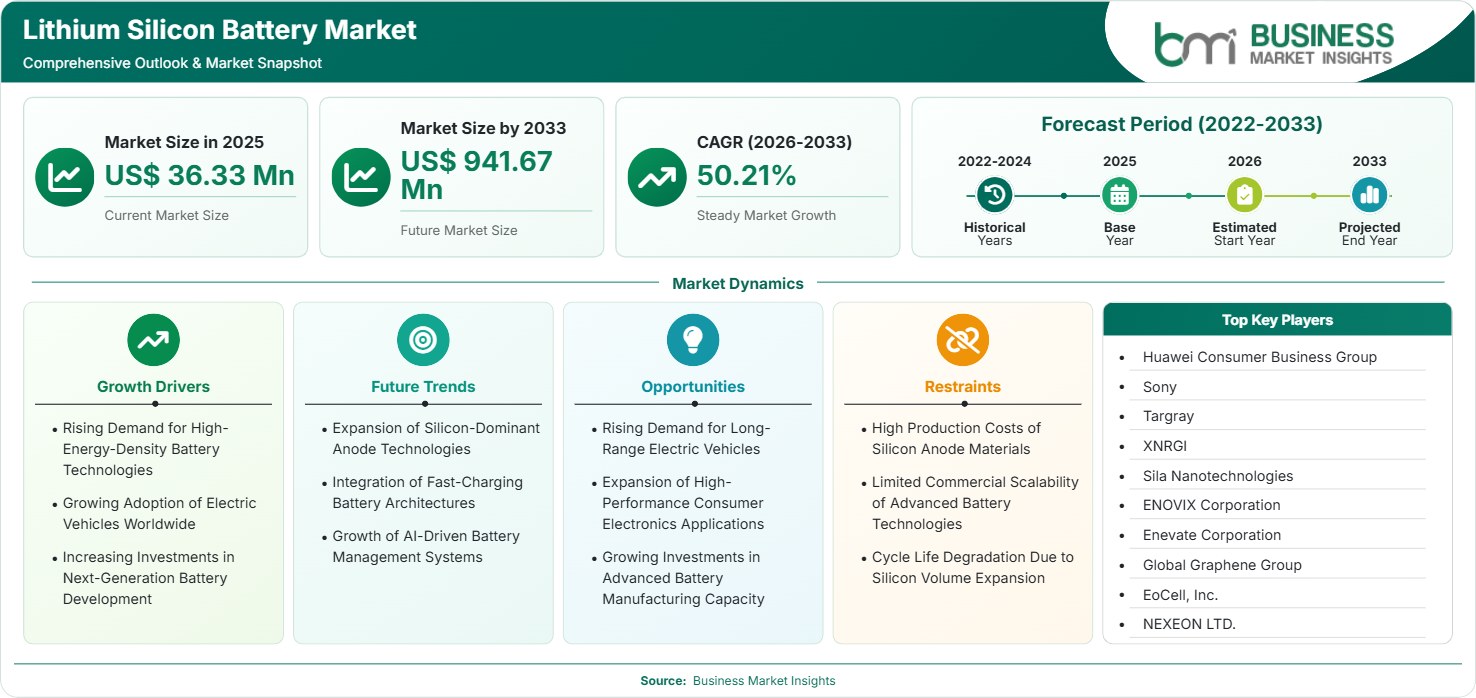
The Lithium Silicon Battery Market size was valued at US$ 36.33 Million in 2025 and is projected to reach US$ 941.67 Million by 2033, growing at a CAGR of 50.21% during 2026–2033. Rising demand for high-energy-density batteries, increasing electric vehicle adoption, growing investments in next-generation battery technologies, and the expansion of advanced energy storage applications are supporting global market growth.

Report Coverage
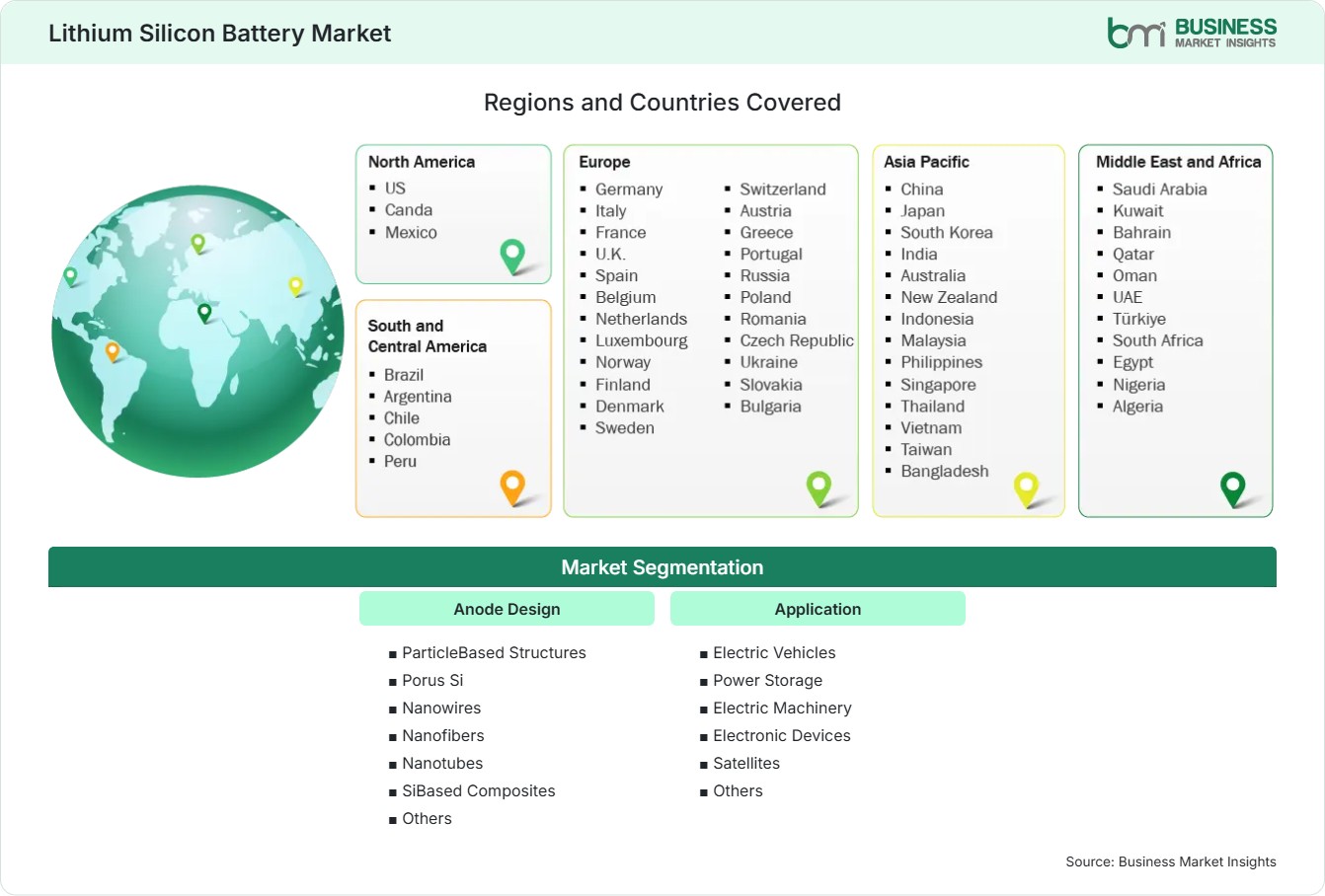
  • Anode Design: ParticleBased Structures, Porus Si, Nanowires, Nanofibers, Nanotubes, SiBased Composites, Others
  • Application: Electric Vehicles, Power Storage, Electric Machinery, Electronic Devices, Satellites, Others
US$ 36.33 Mn Market size in 2025
US$ 941.67 Mn Market Size by 2033
50.21% CAGR, 2026 - 2033
2026-2033 Forecast Period

AI Overview

Lithium Silicon Battery Market Summary

  • North America Region: North America holds a market share of 38%–41% in 2025, growing with a CAGR of 49.0%–50.5% during 2026–2033. Strong investments in battery innovation, expanding EV manufacturing, and growing demand for advanced energy storage systems continue supporting regional leadership. The U.S. lithium silicon battery market is expected to register a CAGR of 49.5%–51.0%.
  • Fastest Growing Region: Asia Pacific accounts for 31%–34% share in 2025 and is projected to grow at a CAGR of 51.5%–53.0% through 2033. Expanding battery manufacturing capacity, increasing EV production, and rising investments in energy storage technologies continue driving regional growth.
  • Leading Segment: Si-Based Composites represent 32%–35% share in 2025 and are expected to grow at a CAGR of 50.8%–52.3% through 2033. Their ability to improve energy density while enhancing battery stability continues supporting segment dominance.
  • High Growth Segment: Electric Vehicles account for 42%–45% share in 2025 and are forecast to grow at a CAGR of 52.0%–53.5% during 2026–2033. Increasing demand for longer battery range and higher-performance energy storage solutions continues accelerating segment growth.
  • Key Market Opportunity: Expansion of electric mobility, aerospace electrification, advanced consumer electronics, and grid-scale energy storage is creating substantial growth opportunities.
  • Major Market Players: Huawei Consumer Business Group, Sony, Targray, XNRGI, Sila Nanotechnologies, ENOVIX Corporation, Enevate Corporation, Global Graphene Group, EoCell, Inc., and NEXEON LTD.
Strategic Insights

Lithium Silicon Battery Market: Strategic Insights

Lithium Silicon Battery Market Strategic Framework
FREE PDF
Request your free sample
Request free sample
Stakeholder View

Key Takeaways

  • Lithium silicon batteries are emerging as a highly attractive next-generation energy storage technology.
  • Si-based composite anodes remain the leading design approach due to improved stability and scalability.
  • Electric vehicles represent the largest application segment owing to demand for longer range and higher energy density.
  • Battery manufacturers continue investing heavily in silicon-anode development and commercialization programs.
  • Consumer electronics companies are exploring lithium silicon batteries to improve device performance and battery life.
  • North America remains the leading lithium silicon battery market due to strong innovation ecosystems and battery technology investments.
  • Asia Pacific is projected to experience the fastest growth driven by battery manufacturing expansion and EV production.
  • Advanced mobility, aerospace, and grid storage applications are expected to create significant long-term opportunities.
Geographic Outlook

Lithium Silicon Battery Market Regional Highlights

North America Lithium Silicon Battery Market

North America accounts for 38%–41% Lithium Silicon Battery Market share in 2025 and is projected to grow at a CAGR of 49.0%–50.5% through 2033. Strong investments in battery research, increasing EV adoption, and expanding advanced manufacturing capabilities continue supporting regional leadership.

  • Battery technology companies continue investing in commercialization of silicon-anode technologies to improve energy density and reduce charging times.
  • Automotive manufacturers are increasingly evaluating lithium silicon batteries for next-generation electric vehicle platforms.
  • Government support for domestic battery supply chains continues encouraging innovation and manufacturing expansion.
  • Energy storage developers are exploring advanced lithium silicon batteries for high-performance storage applications.
  • Research institutions continue focusing on improving silicon-anode cycle life, efficiency, and scalability.
  • Venture capital investments remain strong across advanced battery technology startups and commercialization initiatives.

US Lithium Silicon Battery Market

The United States contributes approximately 87%–91% of North American revenue and is expected to register a CAGR of 49.5%–51.0% through 2033. Significant battery innovation activity, growing EV investments, and strong technology commercialization efforts continue supporting market leadership.

  • Advanced battery developers are accelerating efforts to scale production and commercial deployment of silicon-based battery technologies.
  • Automotive companies continue collaborating with battery innovators to improve electric vehicle performance and range capabilities.
  • Research initiatives remain focused on addressing silicon expansion and battery durability challenges.
  • Investments in domestic battery manufacturing infrastructure continue supporting market expansion.
  • Increasing demand for high-performance energy storage solutions remains a major growth contributor.

Europe Lithium Silicon Battery Market

Europe represents 22%–25% of global revenue in 2025 and is anticipated to expand at a CAGR of 49.8%–51.3% through 2033. Strong sustainability initiatives, increasing EV production, and growing battery innovation activities continue supporting regional growth. Germany remains the leading market while Poland demonstrates stronger growth momentum.

  • Germany continues leading regional demand through extensive automotive electrification programs and battery technology investments.
  • Poland is among the fastest-growing markets and is estimated to register a CAGR of 51.8%–53.3% during the forecast period due to expanding battery manufacturing and supply chain investments.
  • Battery developers continue focusing on higher energy-density cell technologies for automotive and industrial applications.
  • Government support for sustainable mobility and battery production remains a key growth driver.
  • Consumer electronics manufacturers are increasingly evaluating advanced battery technologies for premium devices.
  • Energy storage projects continue creating opportunities for next-generation battery deployment.

Asia Pacific Lithium Silicon Battery Market

Asia Pacific accounts for 31%–34% of global revenue in 2025 and is expected to achieve the fastest CAGR of 51.5%–53.0% through 2033. Expanding EV manufacturing, strong battery production capabilities, and increasing investments in advanced energy storage continue supporting robust regional growth.

  • China remains the largest regional market due to its leadership in battery manufacturing, EV production, and energy storage development.
  • India is projected to achieve approximately 53.0%–54.5% CAGR, supported by increasing investments in battery manufacturing and electric mobility infrastructure.
  • Battery producers continue investing in next-generation silicon-anode technologies to differentiate product offerings.
  • Consumer electronics manufacturing growth continues generating demand for high-performance battery solutions.
  • Government incentives for clean mobility and battery localization are supporting industry expansion.
  • Increasing renewable energy deployment is encouraging broader energy storage innovation and adoption.

Rest of World Lithium Silicon Battery Market

Rest of World accounts for 6%–9% of global revenue in 2025 and is projected to expand at a CAGR of 48.5%–50.0% through 2033. Growing energy transition initiatives, battery technology investments, and electrification programs continue supporting market growth.

  • Brazil continues generating demand through growing adoption of energy storage systems and electric transportation technologies.
  • The UAE is witnessing increased interest in advanced battery solutions for energy infrastructure and sustainable mobility projects.
  • Saudi Arabia is expected to achieve approximately 49.5%–51.0% CAGR through 2033, supported by technology investments and clean energy initiatives.
  • Energy storage deployment is creating opportunities for innovative battery technologies across multiple sectors.
  • Governments are increasingly supporting next-generation energy technologies to strengthen industrial diversification efforts.
  • Expansion of sustainable transportation ecosystems continues supporting long-term demand growth.
Global Market Geography
FREE PDF
Request your free sample
Request free sample
Segment Analysis

Lithium Silicon Battery Market Segmentation

Anode Design

The anode design segment represents the core technological foundation of lithium silicon batteries and plays a decisive role in determining battery performance, energy density, charging speed, and cycle life. The segment accounts for approximately 32%–35% share in 2025 and is projected to grow at a CAGR of 50.8%–52.3% through 2033. The expanding Lithium Silicon Battery Market scope is supported by increasing demand for next-generation battery technologies, growing electric vehicle adoption, and ongoing investments in advanced materials research.

  • Particle-Based Structures: Particle-based silicon anodes continue gaining adoption due to their relatively straightforward manufacturing processes and compatibility with existing battery production technologies.
  • Porous Si: Porous silicon structures are increasingly utilized because they help accommodate silicon expansion during charging and discharging cycles, improving overall battery stability.
  • Nanowires, Nanofibers, and Nanotubes: These advanced nanostructures offer enhanced electrical conductivity, improved lithium-ion transport, and greater structural resilience, making them attractive for high-performance battery applications.
  • Si-Based Composites: Si-based composites dominate the segment due to their ability to combine high energy density with enhanced mechanical stability, helping address challenges associated with silicon expansion and degradation.
  • Others: Additional designs include hybrid silicon architectures, advanced coatings, and emerging engineered anode materials under development for next-generation battery systems.

Application

Application diversity continues expanding as lithium silicon batteries move from research and development stages toward commercial deployment across multiple industries. This segment accounts for approximately 42%–45% share in 2025 and is expected to register a CAGR of 52.0%–53.5% through 2033. Current Lithium Silicon Battery Market trends indicate increasing utilization in high-performance mobility and energy storage applications.

  • Electric Vehicles: Electric vehicles remain the leading segment due to increasing demand for longer driving range, faster charging, and improved battery performance.
  • Power Storage: Energy storage systems are increasingly evaluating lithium silicon batteries to enhance storage capacity, efficiency, and operational flexibility.
  • Electric Machinery: Industrial machinery and electric equipment manufacturers are exploring advanced battery solutions to improve productivity and operating duration.
  • Electronic Devices: Consumer electronics applications continue creating demand for batteries capable of delivering longer runtime, compact designs, and improved performance.
  • Satellites: Aerospace and satellite applications increasingly require lightweight, high-energy-density battery technologies capable of supporting demanding operating environments.
  • Others: Additional applications include defense systems, advanced aviation platforms, robotics, medical devices, and emerging mobility technologies.
Market Forces

Lithium Silicon Battery Market Dynamics

Key Market Drivers

Rising Demand for High-Energy-Density Battery Technologies

The growing need for energy storage devices that offer high energy density, longevity, and improved charging efficiency continues to drive innovation in battery technology. Traditional lithium-ion batteries have limitations in energy storage capacity; therefore, there is room to develop silicon-anode battery designs that can enhance battery performance. Different industries, including transport, consumer electronics, aviation, and energy storage sectors, are continuously searching for batteries that will be more efficient and able to operate for longer periods. Lithium silicon batteries seem to be a promising alternative because of their high energy storage capabilities.

Growing Adoption of Electric Vehicles Worldwide

The global transition toward electric mobility is creating significant demand for next-generation battery technologies. Automotive manufacturers continue seeking battery solutions capable of extending driving range, reducing charging times, and improving overall vehicle performance. Lithium silicon batteries offer promising advantages compared to traditional lithium-ion systems due to their ability to store more energy while maintaining compact form factors. Governments worldwide are supporting electric vehicle adoption through incentives, emission reduction targets, and infrastructure investments, further strengthening demand for advanced battery technologies.

Increasing Investments in Next-Generation Battery Development

Firms engaged in battery production, tech firms, automobile producers, and scientific organizations have made substantial investments in developing next-generation batteries. Substantial investment is made in the development of silicon-anodes’ endurance, scalability, manufacturability, and commercialization capability. Technology development in this industry continues to be stimulated through partnership and investment programs. With ongoing investments, innovations and commercialization are expected to grow substantially in the coming years.

Key Market Opportunities

Rising Demand for Long-Range Electric Vehicles

Consumers increasingly expect electric vehicles to provide driving ranges comparable to conventional vehicles while supporting fast charging capabilities. Lithium silicon batteries offer considerable potential to improve range and battery performance, making them highly attractive for future EV platforms. Automotive manufacturers are actively evaluating silicon-anode technologies to gain competitive advantages in vehicle performance and efficiency. This trend is expected to create substantial growth opportunities for battery developers and material suppliers.

Expansion of High-Performance Consumer Electronics Applications

Manufacturers of smartphones, laptops, wearable devices, tablets, and other portable electronics continue seeking battery technologies capable of supporting higher performance and longer battery life. Lithium silicon batteries can enable thinner devices while delivering improved energy storage capacity. As consumer demand for premium electronic products continues increasing, opportunities for advanced battery technologies are expected to expand significantly.

Growing Investments in Advanced Battery Manufacturing Capacity

Governments and private organizations are increasingly investing in battery manufacturing infrastructure to strengthen supply chains and support electrification initiatives. New production facilities and commercialization programs are creating favorable conditions for broader deployment of lithium silicon battery technologies. Long-term Lithium Silicon Battery Market Forecasts remain highly favorable as manufacturing capacity expansion accelerates globally and supports large-scale commercialization efforts.

Market Restraints and Challenges

High Production Costs of Silicon Anode Materials

Factor: Manufacturing advanced silicon-anode batteries often involves specialized materials, complex engineering processes, advanced coatings, and sophisticated production techniques. These factors contribute to higher manufacturing costs compared to conventional battery technologies.

Impact: Elevated production expenses can limit widespread adoption during the early commercialization stages and create pricing challenges for manufacturers. Cost reduction efforts remain critical for achieving broader market penetration and large-scale deployment.

Limited Commercial Scalability of Advanced Battery Technologies

Factor: Despite substantial technological progress, many lithium silicon battery technologies continue facing challenges related to manufacturing scalability, long-term cycle stability, and large-scale production efficiency. Commercialization requires overcoming technical and operational barriers while maintaining consistent product performance.

Impact: Scalability limitations may slow mass-market adoption and delay commercialization timelines. Companies must continue investing in research, production optimization, and supply chain development to achieve sustainable large-scale deployment across key application sectors.

Company Analysis

Competitive Landscape

The Lithium Silicon Battery Market analysis is characterized by intense competition among battery technology developers, advanced materials innovators, energy storage manufacturers, and next-generation battery commercialization companies. Market participants are focusing on silicon-anode technologies, high-energy-density battery architectures, fast-charging solutions, advanced material engineering, and scalable manufacturing processes to strengthen their market positions. Rising demand for electric vehicles, high-performance consumer electronics, aerospace applications, and grid-scale energy storage systems continues driving innovation across the market. Companies are investing heavily in research and development, pilot production facilities, strategic partnerships, and commercialization programs to accelerate adoption of lithium silicon battery technologies.

Company Name

Overview

Products and Services relevant to this market

Huawei Consumer Business Group

Consumer technology company focused on smartphones, wearable devices, and advanced battery technologies.

High-performance batteries, consumer electronics power solutions, energy storage technologies, and advanced battery integration solutions.

Sony

Electronics manufacturer with expertise in battery technology and portable energy solutions.

Rechargeable batteries, advanced lithium-based battery systems, portable energy storage technologies, and consumer electronics applications.

Targray

Materials and supply chain company serving battery manufacturing and energy storage industries.

Silicon anode materials, battery raw materials, specialty chemicals, battery supply chain solutions, and energy storage materials.

XNRGI

Advanced battery technology company focused on next-generation energy storage systems.

Silicon-based battery technologies, high-energy-density cells, battery innovation platforms, and advanced storage solutions.

Sila Nanotechnologies

Battery materials company specializing in silicon-anode innovations.

Silicon anode materials, battery performance enhancement technologies, energy-dense battery components, and EV battery solutions.

ENOVIX Corporation

Advanced battery manufacturer focusing on silicon-anode battery architectures.

Silicon-anode batteries, high-capacity energy storage solutions, consumer electronics batteries, and advanced battery systems.

Enevate Corporation

Battery technology company developing silicon-dominant anode technologies.

Fast-charging battery technology, silicon-anode solutions, EV battery innovations, and advanced energy storage systems.

Global Graphene Group

Materials technology company focused on advanced battery and graphene-based solutions.

Silicon-based battery materials, advanced anode technologies, energy storage materials, and battery performance solutions.

EoCell, Inc.

Battery innovation company focused on high-performance energy storage solutions.

Advanced lithium battery technologies, silicon-anode systems, energy storage platforms, and specialty battery products.

NEXEON LTD.

Developer of silicon anode materials for next-generation lithium-ion batteries.

Silicon anode materials, battery performance enhancement technologies, EV battery solutions, and advanced energy storage materials.

Trust & Transparency

Research Methodology

The market analysis combines proprietary research with secondary data from government agencies, company disclosures, regulatory filings, industry databases and expert interviews. Market estimates are validated through data triangulation, cross-market benchmarking and analyst review.

View Full Research Methodology

Questions Answered

Frequently Asked Questions

How do lithium silicon batteries differ from conventional lithium-ion batteries?

Lithium silicon batteries utilize silicon-based anodes instead of traditional graphite-dominant anodes, enabling significantly higher lithium storage capacity, improved energy density, longer potential driving range, and enhanced battery performance characteristics.

What does this Lithium Silicon Battery Market Report cover?

This report covers anode design analysis, application assessment, regional trends, competitive landscape evaluation, market drivers, opportunities, restraints, challenges, and future growth prospects through 2033.

Why are Electric Vehicles the leading application segment?

Electric vehicles represent the leading application because automakers require batteries capable of delivering longer driving ranges, faster charging capabilities, improved energy efficiency, and enhanced overall vehicle performance.

Which anode design segment dominates the market?

Si-Based Composites dominate the market due to their ability to deliver higher energy density while improving structural stability, cycle life, and commercial manufacturability compared to other silicon-anode architectures.

What is driving growth in the Lithium Silicon Battery market?

Rising demand for high-energy-density battery technologies, growing adoption of electric vehicles worldwide, increasing investments in next-generation battery development, and expanding requirements for advanced energy storage solutions are major factors driving market growth.

Access the Full Lithium Silicon Battery Market Report

Get segment-level forecasts, regional estimates, competitive benchmarking, company profiles and downloadable Excel datasets.

Access the full Lithium Silicon Battery Market Report
350 pages PDF & Excel | 2026-08-31
Similar Research

Related Market Reports