
Micro Battery Market Outlook: Size, Share, Trends, Growth Analysis, Competitive Landscape & Forecast, 2026-2033

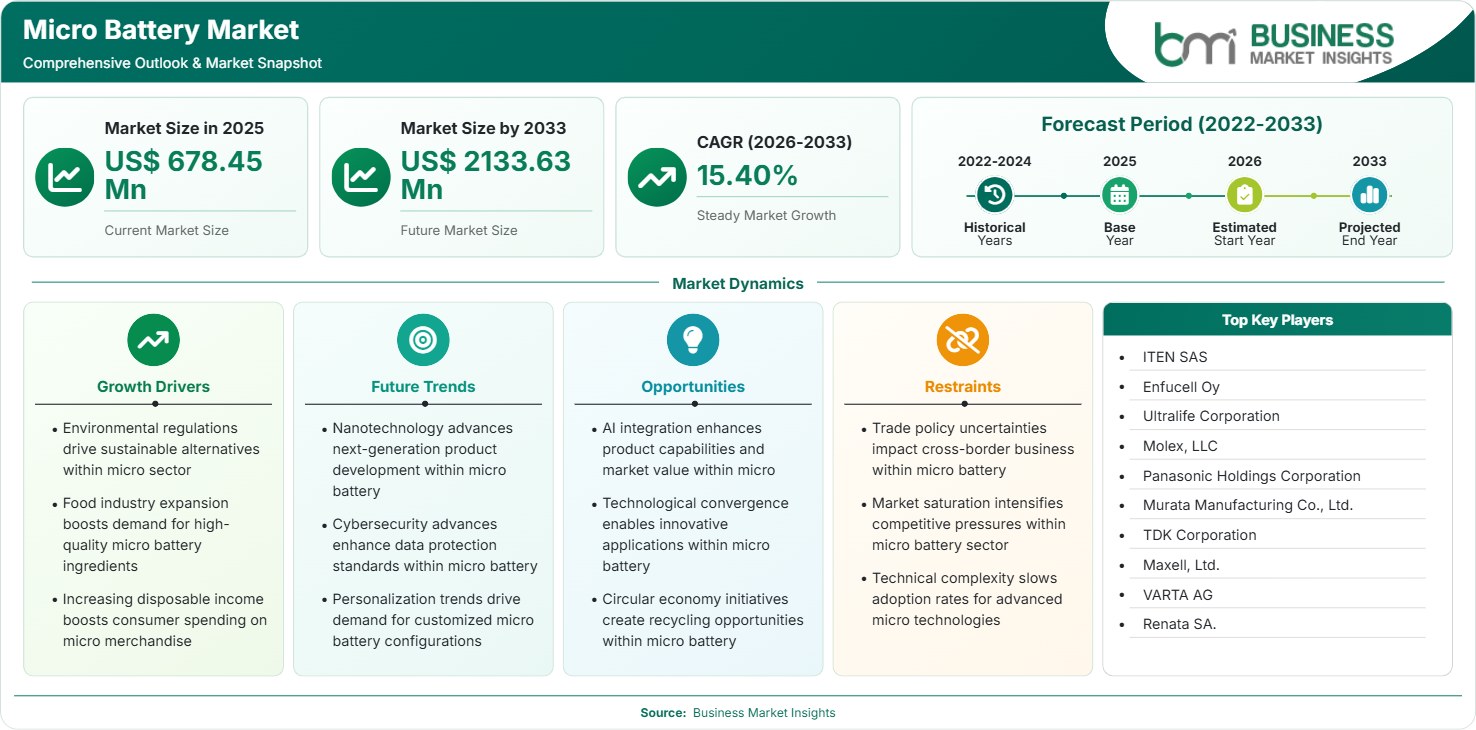
The Micro Battery Market size was valued at US$ 678.45 million in 2025 and is projected to reach US$ 2133.63 million by 2033, growing at a CAGR of 15.40% during 2026–2033, supported by expanding wearable electronics adoption, miniaturized medical devices, wireless sensor deployment, solid-state battery innovation, and increasing investment in ultra-compact energy storage technologies.

Report Coverage
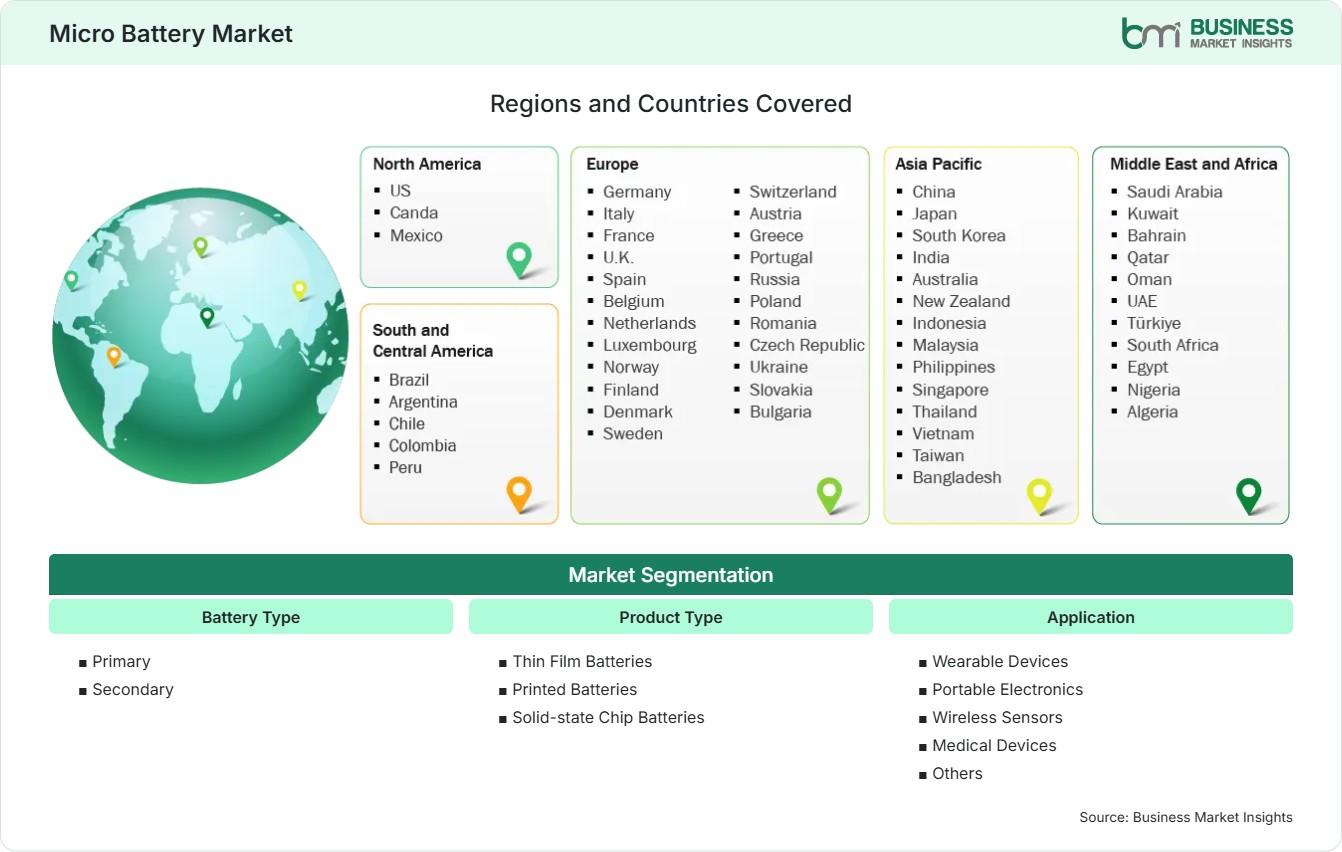
  • Battery Type: Primary, Secondary
  • Product Type: Thin Film Batteries, Printed Batteries, Solid-state Chip Batteries
  • Application: Wearable Devices, Portable Electronics, Wireless Sensors, Medical Devices, Others
US$ 678.45 Mn Market size in 2025
US$ 2133.63 Mn Market Size by 2033
15.40% CAGR, 2026 - 2033
2026-2033 Forecast Period

AI Overview

Micro Battery Market Summary

  • North America Region: Holds a market share of 34%–37% in 2025, growing at a CAGR of 14.0%–14.8% during 2026–2033. Growth is supported by wearable healthcare innovation, medical monitoring systems, industrial IoT deployment, defense electronics modernization, and investment in advanced battery manufacturing ecosystems. U.S. demand benefits from healthcare digitization and IoT proliferation, expanding at an estimated 14.2%–15.0% CAGR through 2033.
  • Fastest Growing Region: Asia Pacific accounts for 29%–32% share in 2025 and is expected to expand at 17.2%–18.0% CAGR during 2026–2033. Semiconductor manufacturing expansion, consumer electronics leadership, smart factory deployment, battery research funding, and large-scale electronics production continue creating strong long-term demand.
  • Leading Segment: Secondary batteries represent 54%–58% share in 2025 and advance at 15.8%–16.5% CAGR during 2026–2033. Rechargeability, extended lifecycle, compatibility with wearables, increasing sensor deployment, sustainability priorities, and improvements in energy density support accelerated commercial adoption globally.
  • High Growth Segment: Medical devices contribute 18%–21% share in 2025 and grow at 17.5%–18.4% CAGR during 2026–2033. Rising chronic disease monitoring, implantable technologies, remote diagnostics, patient-centric healthcare systems, and stringent reliability requirements stimulate premium battery demand.
  • Key Market Opportunity: Growing deployment of battery-powered edge computing sensors, electronic skin technologies, smart patches, and connected healthcare platforms creates opportunities for ultra-thin, flexible, high-energy-density storage solutions worldwide.
  • Major Market Players: ITEN SAS, Enfucell Oy, Ultralife Corporation, Molex, LLC, Panasonic Holdings Corporation, Murata Manufacturing Co., Ltd., TDK Corporation, Maxell, Ltd., VARTA AG, and Renata SA.
Strategic Insights

Micro Battery Market: Strategic Insights

Micro Battery Market Strategic Framework
FREE PDF
Request your free sample
Request free sample
Stakeholder View

Key Takeaways

  • The value chain is increasingly integrated around advanced materials suppliers, semiconductor packaging firms, device manufacturers, and specialized battery developers focused on miniature power solutions.
  • Medical wearables, implantable electronics, and wireless sensing platforms present the strongest long-term revenue opportunities due to reliability requirements and premium pricing structures.
  • Innovation is shifting toward solid-state architectures, flexible battery formats, printable designs, and higher-density rechargeable technologies that enable thinner and lighter devices.
  • Asia Pacific presents the strongest manufacturing expansion opportunity, while North America remains attractive for healthcare-focused commercialization and advanced technology deployment.
  • Strategic partnerships between battery specialists, healthcare technology providers, semiconductor firms, and IoT ecosystem participants are accelerating product development cycles.
  • Sustainability requirements are encouraging rechargeable solutions and improved battery lifecycle management, creating differentiation opportunities for advanced technology providers.
Geographic Outlook

Micro Battery Market Regional Highlights

North America Micro Battery Market

North America represents 34%–37% of the global market in 2025 and is projected to expand at 14.0%–14.8% CAGR through 2033. The region benefits from mature healthcare infrastructure, strong medical device innovation, and rapid industrial IoT adoption. The Micro Battery Market share remains supported by extensive R&D spending, advanced semiconductor capabilities, and defense electronics demand. Battery developers continue investing in solid-state technologies and miniaturized energy storage platforms to meet increasingly stringent performance requirements across healthcare and industrial applications.

  • Healthcare wearables and remote patient monitoring systems continue generating substantial demand for compact rechargeable energy storage technologies.
  • Industrial IoT deployments across logistics, manufacturing, and utilities accelerate consumption of miniature batteries designed for long operational lifecycles.
  • Defense modernization initiatives support adoption of compact power systems integrated into portable communications and sensing platforms.
  • Venture funding for solid-state battery developers strengthens commercialization prospects for next-generation energy storage technologies.
  • Advanced semiconductor packaging capabilities improve integration of miniature batteries into compact electronic assemblies.

US Micro Battery Market

The United States accounts for approximately 78%–82% of North American Micro Battery Market demand in 2025 and advances at 14.2%–15.0% CAGR. Strong healthcare technology investment, growing remote diagnostics adoption, and leadership in connected medical devices support sustained expansion. Universities, national laboratories, and private firms remain active in battery research. The country also benefits from increasing demand for smart industrial systems and wireless sensing infrastructure that require dependable, long-lasting miniature power sources integrated into compact devices.

  • Connected healthcare platforms increasingly require reliable rechargeable batteries capable of supporting continuous monitoring functions.
  • Federal support for domestic electronics and semiconductor manufacturing strengthens supply chain resilience for battery-integrated products.
  • Smart logistics infrastructure deployment expands requirements for compact asset-tracking and sensing technologies.
  • Industrial automation initiatives create additional demand for low-maintenance wireless sensor networks.

Europe Micro Battery Market

Europe captures 24%–27% Micro Battery Market share in 2025 and is expected to record 14.5%–15.3% CAGR through 2033. Germany remains the leading market, while Nordic countries and Switzerland demonstrate faster adoption of specialized healthcare and industrial applications. Regional sustainability priorities favor rechargeable technologies and advanced materials innovation. Strong collaboration among research institutions, battery developers, and electronics manufacturers supports commercialization of solid-state and flexible battery technologies across medical, industrial, and consumer electronics sectors.

  • Germany leads regional revenues through industrial electronics strength and advanced manufacturing capabilities.
  • Switzerland supports premium healthcare device development requiring highly reliable miniature energy storage systems.
  • Finland benefits from specialized printed battery innovation and wireless sensing applications.
  • European sustainability frameworks encourage adoption of rechargeable battery technologies and circular economy initiatives.
  • Cross-border research programs accelerate solid-state battery commercialization activities.

Asia Pacific Micro Battery Market

Asia Pacific accounts for 29%–32% of global Micro Battery Market revenue in 2025 and is forecast to expand at 17.2%–18.0% CAGR, the fastest among all regions. China, Japan, South Korea, and Taiwan remain critical manufacturing hubs for consumer electronics and semiconductors. India emerges as a high-growth market due to electronics manufacturing expansion. Strong production ecosystems, supply chain integration, and significant R&D investments support widespread adoption across wearables, medical devices, wireless sensors, and portable electronics applications.

  • Japan maintains leadership in advanced materials and miniature battery innovation supporting global electronics supply chains.
  • China drives large-scale demand through extensive consumer electronics and IoT device manufacturing.
  • South Korea benefits from semiconductor leadership and growing wearable technology production.
  • India records among the strongest regional growth trajectories supported by electronics manufacturing incentives.
  • Increasing smart factory investments stimulate wireless sensor deployment across industrial sectors.

Rest of World Micro Battery Market

Rest of World contributes 8%–10% share in 2025 and is projected to grow at 15.0%–15.8% CAGR. South and Central America increasingly adopt connected healthcare technologies and industrial monitoring systems. Brazil remains the leading regional market.

Middle East and Africa adoption is supported by smart infrastructure investments, digital healthcare initiatives, and industrial modernization programs. Gulf countries demonstrate stronger growth prospects as technology investments accelerate and connected device deployments expand across healthcare, logistics, and utility sectors.

  • Brazil leads regional demand through expanding healthcare technology deployment and industrial digitalization projects.
  • Mexico benefits from electronics manufacturing integration supporting connected device production.
  • Gulf Cooperation Council countries invest heavily in smart city and digital healthcare initiatives.
  • South Africa demonstrates increasing adoption of wireless sensing solutions for industrial monitoring applications.
  • Regional IoT infrastructure expansion creates long-term opportunities for compact energy storage providers.
Global Market Geography
FREE PDF
Request your free sample
Request free sample
Segment Analysis

Micro Battery Market Segmentation

Battery Type

Battery Type accounts for a fundamental share of industry revenues. Secondary batteries hold 54%–58% market share in 2025 and are projected to grow at 15.8%–16.5% CAGR. Growing demand for rechargeable solutions, sustainability objectives, and integration into wearables support expansion. The Micro Battery Market scope continues broadening as device manufacturers prioritize longer operating life and improved energy density.

  • Primary: Preferred in applications requiring long shelf life, low maintenance, and dependable operation, particularly within medical patches, backup systems, and disposable sensing devices.
  • Secondary: Increasingly adopted across wearables, connected sensors, and portable electronics because rechargeability improves lifecycle economics and sustainability performance.

Product Type

Product innovation remains central to competitive differentiation. Thin film and solid-state technologies continue attracting investment as manufacturers pursue higher energy density and miniaturization. This segment represents a critical growth engine with an estimated 15.6%–16.4% CAGR supported by advanced packaging and semiconductor integration requirements.

  • Thin Film Batteries: Enable compact form factors and flexible integration, supporting smart cards, medical devices, and miniaturized electronics requiring lightweight energy storage.
  • Printed Batteries: Well suited for disposable electronics, smart labels, and wireless sensors where flexibility, low cost, and scalability provide operational advantages.
  • Solid-state Chip Batteries: Gain momentum through superior safety, improved energy density, and compatibility with advanced wearable and healthcare applications.

Application

Applications continue diversifying across consumer, healthcare, and industrial sectors. The Micro Battery Market trends increasingly reflect demand from connected medical technologies and IoT ecosystems. Medical devices account for 18%–21% share in 2025 and are expected to expand at 17.5%–18.4% CAGR, making them the fastest-growing application category.

  • Wearable Devices: Smartwatches, fitness trackers, and health monitoring products require compact batteries delivering reliable power and extended operating duration.
  • Portable Electronics: Earbuds, compact communication devices, and accessories drive consistent demand for miniaturized rechargeable energy storage solutions.
  • Wireless Sensors: Industrial monitoring, logistics tracking, and environmental sensing applications benefit from long-life miniature batteries supporting autonomous operation.
  • Medical Devices: Implantables, diagnostic tools, and remote monitoring systems require highly reliable batteries with stringent safety and performance characteristics.
Market Forces

Micro Battery Market Dynamics

Key Market Drivers

Expansion of wearable and connected healthcare ecosystems

Wearable device adoption continues accelerating globally as healthcare providers increasingly utilize remote monitoring technologies. WHO-supported digital health initiatives and broader chronic disease management programs encourage deployment of connected medical devices. Such systems require miniature, light-weight, and efficient energy storage devices which must run without any interruptions. There is an increasing demand for smart watches, hearing aids, bio-sensors, and medical patches that are adding up to the potential for commercialization. Device makers are focusing more on re-chargeable and energy dense devices, thus reducing maintenance costs and adding advanced features. Digital healthcare is increasing in both developed and developing nations.

Rapid deployment of industrial IoT and wireless sensing networks

Manufacturing, logistics, utilities, and infrastructure operators are deploying wireless sensor networks to improve operational visibility and predictive maintenance capabilities. Battery-powered sensing devices often operate in locations where wired power is impractical. This leads to the growing significance of small batteries that can provide long-term performance. The presence of Industry 4.0 solutions and investments in intelligent factories helps increase the application of batteries in an industrial setting. Low-power electronics and communication protocols help enhance the performance of the batteries. The greater density of sensors on industrial equipment raises the need for effective power supplies.

Advances in solid-state and ultra-miniaturized battery technologies

Research and development activity continues improving energy density, safety performance, and charging characteristics. Companies are investing heavily in solid-state architectures to overcome limitations associated with conventional miniature batteries. Such designs help to develop batteries that can provide more power density, better thermal stability, and good integration in semiconductor packages. These developments help to create wearable devices, implantable devices, and miniature IoT devices of the future. The commercial success of technological pioneers shows increasing market maturity for the development of new batteries. Better manufacturing processes and advances in material sciences contribute further to overcoming commercialization challenges.

Key Market Opportunities

Next-generation medical implants and smart therapeutic devices

Healthcare systems increasingly adopt implantable and body-worn technologies capable of delivering continuous monitoring and therapeutic functionality. Highly compact power supplies that have high reliability and longevity are required for these devices. Demographics in favor of elderly people along with growing cases of chronic diseases ensure continuous growth of demand. Suppliers of batteries that meet all regulatory standards and provide better energy density are well poised to enjoy premium value offerings. Incorporation of artificial intelligence in the diagnostic and monitoring equipment makes the devices more functional, thus leading to higher demands for energy supplies.

Printed electronics and smart packaging applications

Printed batteries have become more important in terms of smart labels, connected packaging, and disposable sensors. The retail industry, the pharmaceutical industry, and the logistics industry keep looking for technologies that allow smart packaging able to monitor the conditions and quality of products. Flexible battery technology has much in common with such needs. Micro Battery Market Forecasts indicate strong potential for innovative suppliers capable of delivering scalable, low-cost printed energy storage technologies supporting high-volume deployment scenarios across diverse industries.

Edge computing and autonomous sensor infrastructure

Edge computing architectures increasingly depend on distributed sensing platforms capable of processing and transmitting data locally. Many deployments occur in remote or space-constrained environments where compact batteries remain essential. The sensor footprint for utilities, transport infrastructures, environmental surveillance systems, and manufacturing plants is increasing. These developments are generating new opportunities for batteries that perform well during prolonged operations and operate under conditions of reduced power consumption. As businesses desire increased intelligent performance and decision-making in real time, the need for reliable miniaturized energy storage will increase.

Market Restraints and Challenges

High production complexity and Cost pressures

Factor: high production complexity, elevated manufacturing costs, and slower commercialization timelines. These challenges can limit adoption in highly price-sensitive consumer applications.

Impact: Emerging technologies such as solid-state and printed batteries often face scaling constraints during early commercialization stages. Manufacturers must balance performance improvements against production economics while maintaining strict reliability standards. Competitive pressures from alternative power technologies further intensify cost management requirements, creating challenges for suppliers seeking broad market penetration without compromising performance characteristics.

Factor: Supply chain concentration Impact: Availability risks

Factor: The industry remains dependent on specialized materials, semiconductor packaging expertise, and geographically concentrated manufacturing capabilities, with a concentrated supply chain.

Impact: Heightened exposure to disruptions affecting production continuity and component availability. Geopolitical uncertainties, trade restrictions, and raw material volatility can influence procurement strategies and operating costs. Device manufacturers increasingly seek diversified sourcing arrangements to reduce risk exposure. However, establishing alternative supply chains for advanced miniature batteries often requires significant qualification efforts and technical validation. These dynamics create operational complexity while potentially slowing deployment schedules across critical end-use applications.

Company Analysis

Competitive Landscape

The competitive environment reflects ongoing Micro Battery Market analysis focused on solid-state innovation, rechargeable technologies, printed battery development, and healthcare-oriented energy storage solutions.

Company Name

Overview

Products and Services relevant to this market

ITEN SAS

French specialist focused on solid-state micro energy storage technologies and semiconductor-compatible battery integration.

Solid-state micro batteries, SMD battery platforms, energy storage solutions for IoT and electronics.

Enfucell Oy

Finnish innovator recognized for printable battery technologies serving flexible electronics applications.

Printed batteries, smart packaging power solutions, disposable electronics energy systems.

Ultralife Corporation

U.S.-based battery manufacturer serving industrial, medical, and communications sectors.

Miniature batteries, power systems, portable energy solutions, specialized electronics batteries.

Molex, LLC

Global electronics connectivity provider supporting integrated miniature power solutions.

Battery connectors, integrated electronic assemblies, miniature device power components.

Panasonic Holdings Corporation

Major battery manufacturer with extensive expertise across consumer and industrial applications.

Coin cells, rechargeable batteries, miniature energy storage products.

Murata Manufacturing Co., Ltd.

Leading electronics company with longstanding micro battery capabilities and component integration expertise.

Micro batteries, electronic components, power solutions for compact devices.

TDK Corporation

Technology leader investing in advanced battery materials and next-generation storage technologies.

Solid-state batteries, miniature rechargeable batteries, electronic energy solutions.

Maxell, Ltd.

Japanese battery producer expanding presence in miniature primary battery applications.

Coin batteries, micro batteries, specialty energy storage products.

VARTA AG

European battery manufacturer serving healthcare, consumer electronics, and industrial markets.

Button cells, rechargeable micro batteries, hearing aid batteries.

Renata SA

Swiss specialist known for precision miniature batteries supporting healthcare and electronic devices.

Coin cells, medical device batteries, watch batteries, miniature power systems.

Trust & Transparency

Research Methodology

The market analysis combines proprietary research with secondary data from government agencies, company disclosures, regulatory filings, industry databases and expert interviews. Market estimates are validated through data triangulation, cross-market benchmarking and analyst review.

View Full Research Methodology

Questions Answered

Frequently Asked Questions

What does a Micro Battery Market Report typically evaluate?

A comprehensive Micro Battery Market Report examines technology developments, competitive positioning, regional demand patterns, application trends, supply chain dynamics, and future growth opportunities across key segments.___________________________________________________________________________

How are sustainability objectives influencing industry strategies?

Manufacturers increasingly prioritize rechargeable chemistries, lifecycle optimization, material efficiency, and recycling initiatives to meet regulatory expectations and customer sustainability requirements.___________________________________________________________________________

Which application category presents the strongest growth potential?

Medical devices represent the strongest growth opportunity because of expanding digital healthcare ecosystems, aging populations, and increasing deployment of remote patient monitoring technologies.___________________________________________________________________________

What technology is expected to transform future product development?

Solid-state battery technology is expected to play a major role due to higher safety, improved energy density, enhanced miniaturization potential, and compatibility with advanced semiconductor packaging processes.________________________________________________________________________

What factors are driving demand for miniature batteries in healthcare applications?

Growing adoption of wearable monitors, implantable devices, remote diagnostics, and connected therapeutic systems requires compact, reliable, and long-lasting energy storage solutions capable of supporting continuous operation.

Access the Full Micro Battery Market Report

Get segment-level forecasts, regional estimates, competitive benchmarking, company profiles and downloadable Excel datasets.

Access the full Micro Battery Market Report
350 pages PDF & Excel | 2026-08-31