Market Summary
Executive Summary and Global Market Analysis
Flexible batteries are lightweight and bendable energy storage systems designed for compact and versatile electronic devices. These batteries provide continuous power for products that require curved, foldable, or space-saving designs. Their flexibility allows them to be integrated into modern electronics where traditional rigid batteries limit design options. The growth of wearable technology, connected sensors, and compact medical electronics is changing battery design needs. Manufacturers are focusing more on thin profiles, mechanical flexibility, and reliable power output for the next generation of devices. The shift towards portable and always-connected electronics has boosted interest in flexible energy storage solutions in both industrial and consumer markets. Thin-film batteries are widely used because they fit well with small electronic parts. Printed batteries are attracting commercial interest for disposable and smart packaging that needs low-profile power sources. Secondary batteries are still popular where long life cycles and the ability to recharge are crucial for device operation. Improvements in material engineering and electrolyte development are enhancing flexibility, energy storage, and thermal stability. Innovations now enable batteries to bend and twist repeatedly without losing significant performance. Research on polymer-based electrolytes and stretchable conductive materials is also helping to expand options for new electronic formats. The competitive landscape shows ongoing investment in flexible electronics and energy storage development. Companies are focusing on making production more efficient, creating thinner battery designs, and ensuring compatibility with connected devices. To stand out, products are increasingly judged on charging speed, mechanical strength, safety features, and their ability to integrate across different electronic applications.
Segment Analysis
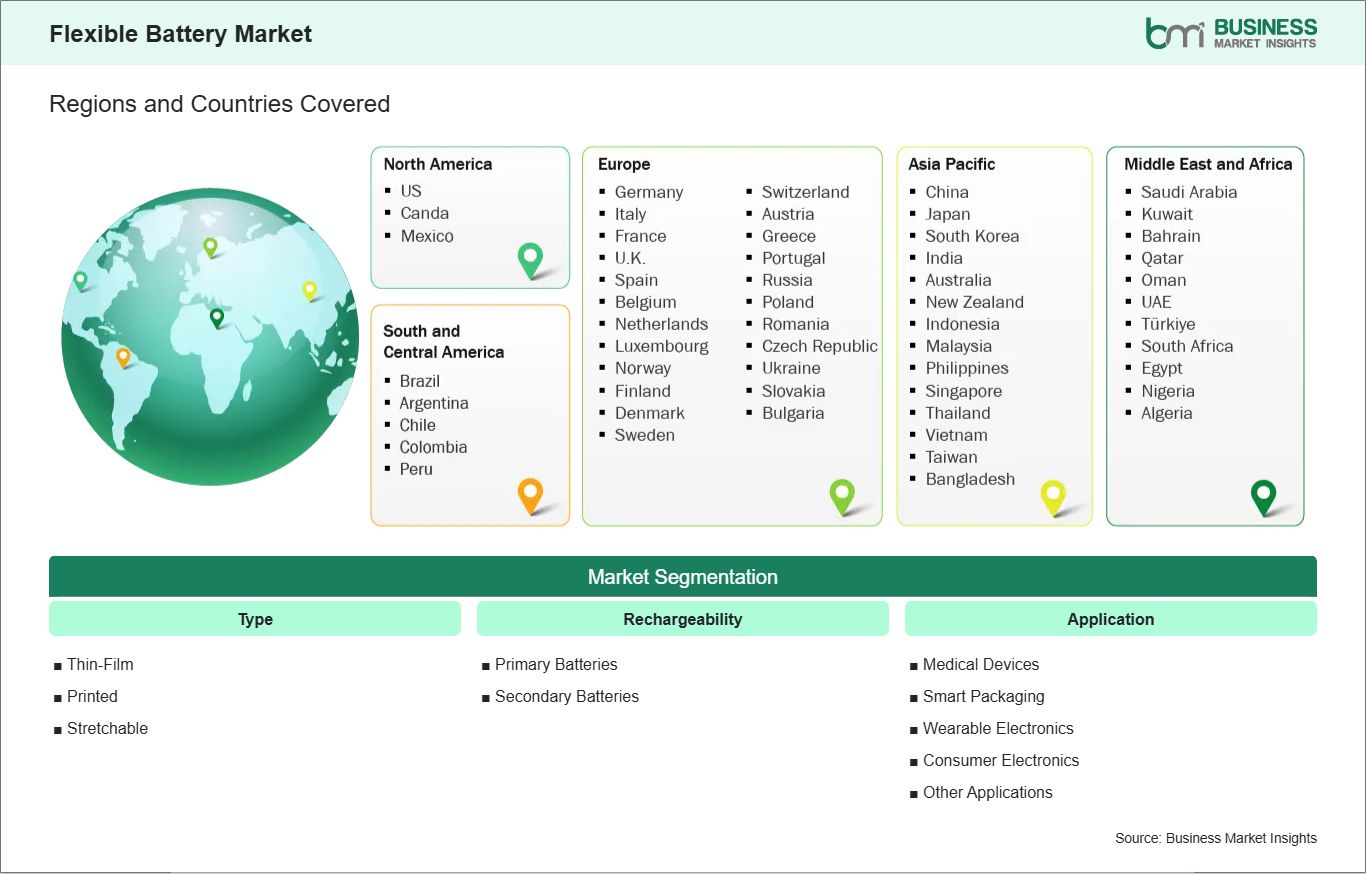
Flexible Battery Market Segmentation
The flexible batteries market demonstrates diversified adoption across flexible electronics, healthcare technologies, and compact connected systems.
By Type
- Thin-Film – Supports compact electronics requiring lightweight and ultra-thin battery configurations.
- Printed – Enables scalable production for disposable and smart labeling applications.
- Stretchable – Accommodates deformable electronics and wearable sensor integration.
By Rechargeability
- Primary Batteries – Suitable for short-duration and single-use electronic applications.
- Secondary Batteries – Preferred for continuous-use devices demanding repeated charging cycles.
By Application
- Medical Devices – Powers lightweight monitoring systems and wearable healthcare technologies.
- Smart Packaging – Facilitates tracking, sensing, and interactive packaging functions.
- Wearable Electronics – Enhances ergonomic device designs through flexible power integration.
- Consumer Electronics – Supports foldable and portable electronic product architectures.
- Other Applications – Expands usage across industrial sensors and connected embedded systems.
Market Forces
Flexible Battery Market Drivers and Opportunities
Rising Integration of Wearable and Connected Electronics
Wearable devices, smart sensors, and portable medical systems need power sources that can easily fit into small designs. Traditional batteries often limit how products can be designed and how comfortable they are to use. This is pushing manufacturers to use thinner and bendable options. Flexible batteries solve these problems by allowing easy integration into curved and small electronic setups. The shift toward constantly connected consumer and industrial devices has increased the need for reliable, compact energy storage solutions. Flexible batteries ensure uninterrupted operation in smartwatches, fitness trackers, and biosensors while keeping designs efficient. The growing use of IoT-enabled electronics in healthcare and consumer markets further strengthens their long-term importance.
Expansion of Smart Packaging and Printed Electronics
Advances in printed electronics are making it easier to integrate flexible batteries into interactive packaging. Smart labels, tracking systems, and condition-monitoring solutions increasingly need thin and disposable power sources that take up little space. Printed flexible batteries meet these needs through scalable manufacturing and low-profile design. Future commercial opportunities look promising in retail logistics, pharmaceutical monitoring, and smart packaging systems. Manufacturers are looking into combining batteries with communication technologies and sensing components to improve supply chain visibility. Ongoing innovation in printable conductive materials and inexpensive production methods is likely to expand application possibilities across various industries.
Size and Share Analysis
Flexible Battery Market Size and Share Analysis
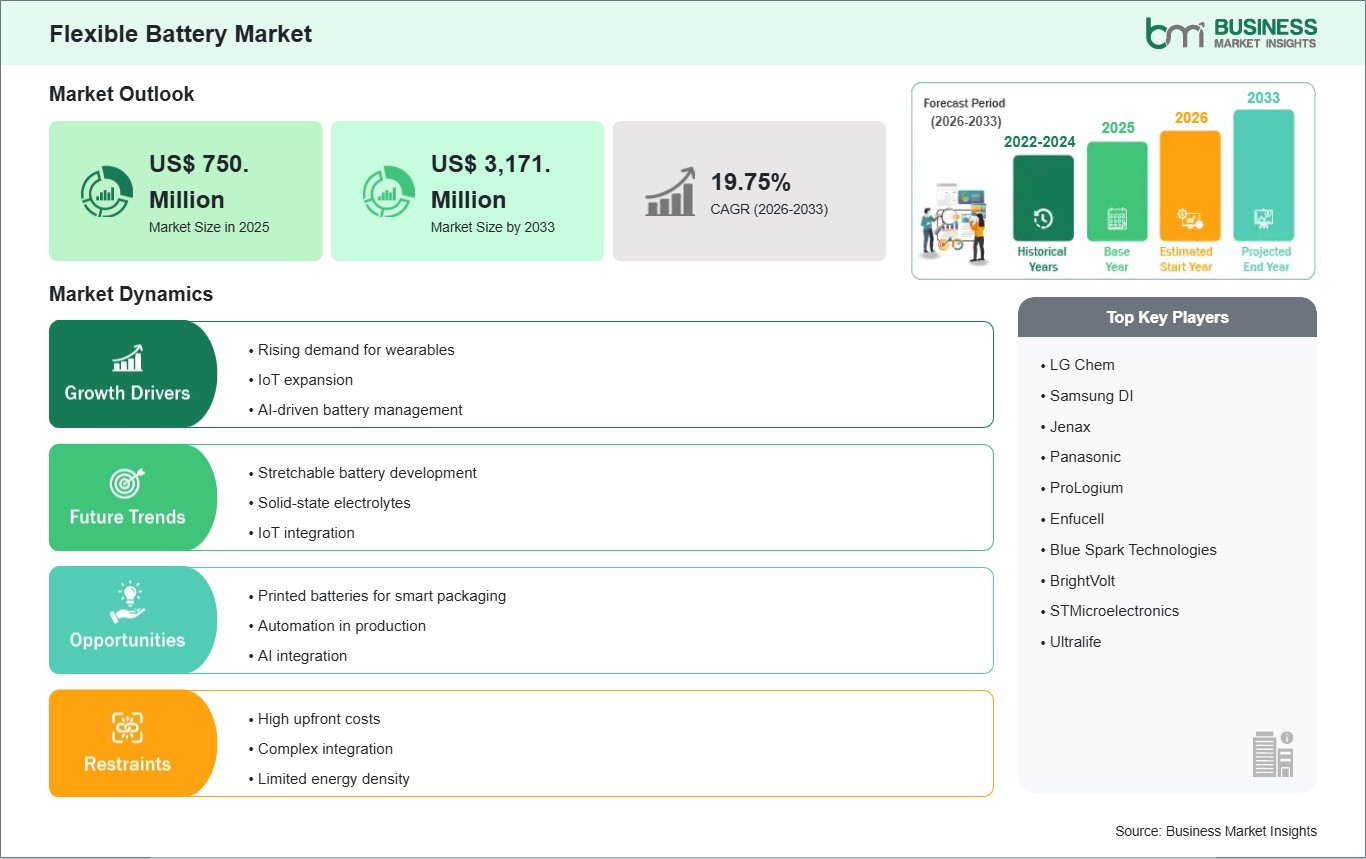
The Flexible Battery Market is projected to grow from US$ 750.0 Million in 2025 to US$ 3,171.0 Million by 2033 , registering a CAGR of 19.75% from 2026 to 2033. Market expansion shows a growing use of compact power systems in wearable electronics, connected healthcare technology, and smart packaging solutions. Product innovation emphasizes flexibility, safety, and miniaturization. This approach supports broader commercial use. Thin-film batteries hold a strong market position because they work well with lightweight and space-restricted electronic products.
Secondary batteries are widely used in the industry because their rechargeable designs let devices run for long periods. Printed battery technologies are attracting interest for disposable electronics and smart labeling systems that require affordable production. Wearable electronics are a key application area, driven by ongoing product innovation and consumer demand for small connected devices. Medical devices are increasingly using flexible batteries for monitoring systems and portable diagnostic tools. Smart packaging applications are also gaining popularity as logistics and retail sectors look for digitally connected tracking and verification solutions.
Report Coverage
Flexible Battery Market Report Coverage and Deliverables
The "Flexible Battery Market Size and Forecast (2022-2033)" report provides a detailed analysis of the market covering below areas:
- Market size and forecast at global, regional, and country levels for all market segments covered under the scope
- Market trends, as well as drivers, restraints, and opportunities
- Market analysis covering key trends, global and regional framework, major players, regulations, and recent developments
- Industry landscape and competition analysis covering market concentration, heat map analysis, prominent players, and recent developments for the Flexible Battery market
- Detailed company profiles, including SWOT analysis
Geographic Insights
Flexible Battery Market Geographic Insights
The flexible battery market displays different regional adoption patterns influenced by electronics manufacturing abilities, trends in healthcare digitalization, and improvements in compact energy storage technologies. Global commercialization continues as manufacturers seek thinner, lighter, and more adaptable battery systems for next-generation connected devices. Product development focuses on improving flexibility, charging efficiency, and durability. North America experiences steady market activity because of the widespread use of wearable electronics and portable healthcare systems. The demand for compact monitoring devices and connected consumer gadgets shapes product development priorities in the region. Research initiatives that explore new materials and flexible lithium-ion designs also help improve technology and boost commercialization efforts. Asia Pacific maintains strong industry momentum, supported by its electronics manufacturing base and rising production of smart consumer devices. Countries in this region continue to prioritize battery innovation, printed electronics, and foldable device technologies. Expanding industrial capabilities and ongoing investment in compact energy storage solutions promote greater integration in medical electronics and connected sensors. Europe is increasing market involvement through technological research and sustainable battery development projects. The demand for lightweight electronics and smart industrial applications boosts regional efforts for commercialization. Emerging markets in the Middle East, Africa, and South and Central America are gradually increasing adoption due to better digital connectivity, improvements in healthcare, and wider use of portable electronic technologies.
Industry Activity
Recent Developments
The Flexible Battery market is evaluated by gathering qualitative and quantitative data post primary and secondary research, which includes important corporate publications, association data, and databases. A few of the key developments in the Flexible Battery market are:
- In March 2026, Chinese scientists developed a flexible and safe organic lithium-ion battery that could be suitable for use in wearable electronics and in extreme conditions. The breakthrough stemmed from an innovative organic cathode material that enables efficient and stable performance across an extreme temperature range, from far below freezing to as hot as 80 degrees Celsius (176 degrees Fahrenheit).
- In October 2025, Physical Sciences Inc (PSI) completed the acquisition of a 67,400 square foot battery manufacturing facility in Methuen, Massachusetts, as it expanded their research, development, and production of advanced energy technologies to meet urgent national defense requirements.
Trust & Transparency
Research Methodology
The market analysis combines proprietary research with secondary data from government agencies, company disclosures, regulatory filings, industry databases and expert interviews. Market estimates are validated through data triangulation, cross-market benchmarking and analyst
review.
View Full Research Methodology
Key Sources Referred:
World Bank – Global Trade Indicators World Trade Organization (WTO) International Monetary Fund (IMF) International Trade Administration (ITA) Company Websites Company Annual Reports Company Investor Presentations