
Flow Battery Market Outlook: Size, Share, Trends, Growth Analysis, Competitive Landscape & Forecast, 2026-2033

Historic Data: 2022-2024   |   Base Year: 2025   |   Forecast Period: 2026-2033
Report Content: Market Scope, Market Segmentation, Market Dynamics, and Competitive Analysis

Report Coverage:
  • Type (Redox, Hybrid)
  • Material (Vanadium, Zinc Bromine, Organic, All-iron, Hydrogen Bromide)
  • Storage (Large Scale, Small Scale, Grid-Connected, Off-grid)

No. of Pages: 400
Report Code: BMIPUB00035393
Category: Electronics and Semiconductor
Flow Battery Market

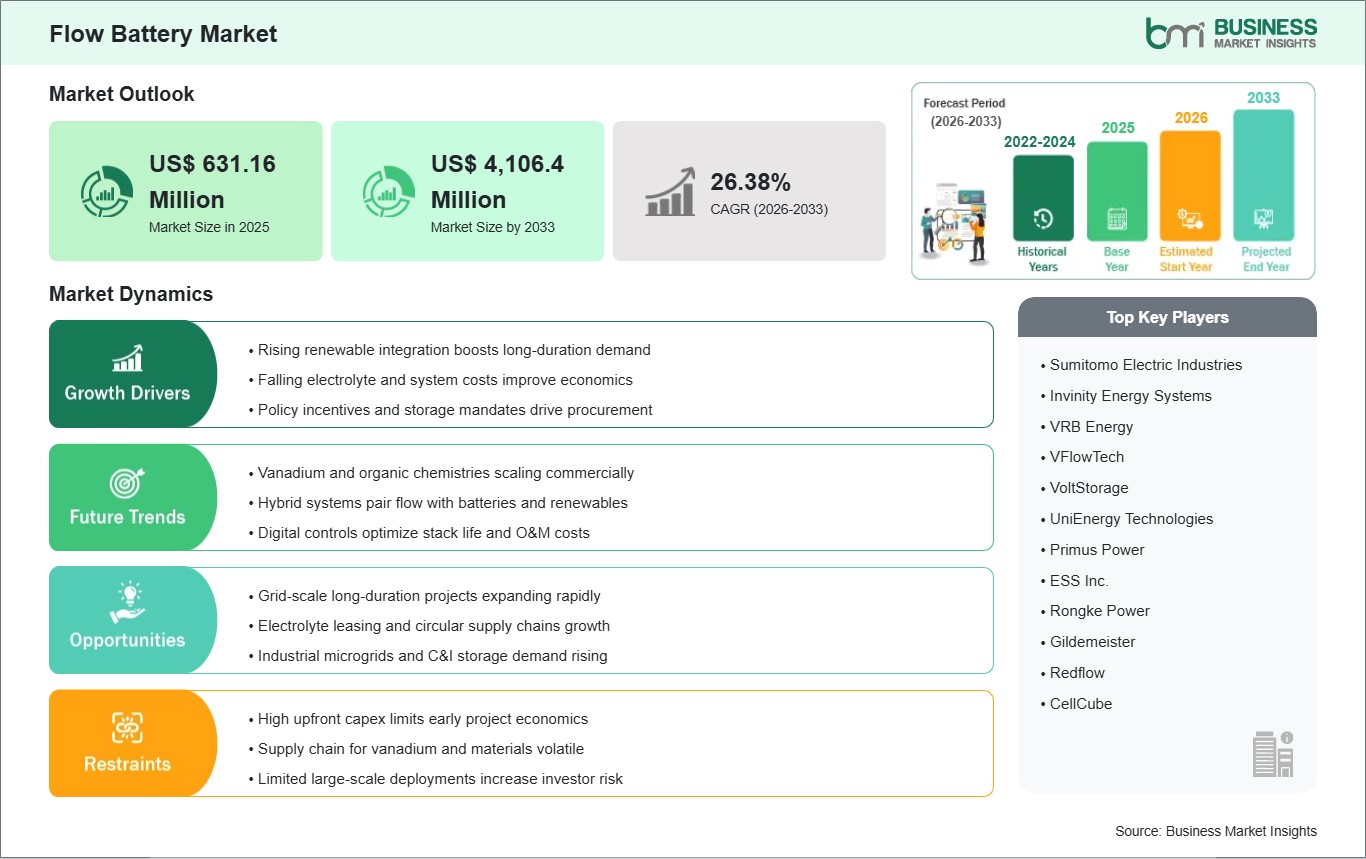
The Flow Battery Market size is expected to reach US$ 4,106.4 Million by 2033 from US$ 631.16 Million in 2025.The market is estimated to record a CAGR of 26.38% from 2026 to 2033.

Executive Summary and Global Market Analysis:

Flow batteries are rechargeable systems that store electrical energy using liquid electrolytes that flow through external tanks. Their design allows for separate increases in power capacity and energy duration, which makes them ideal for applications that need long-duration storage, flexibility, and long battery life. The modernization of power grids and the integration of renewable energy continue to drive the use of these systems in both large-scale and smaller storage environments. Energy operators are seeking technologies that can help with load balancing, managing the ups and downs of renewable energy, and ensuring a reliable backup power supply. The industry is also putting more focus on improving grid resilience and energy security in industrial and commercial projects.

In the market, redox configurations remain popular for their reliable operation and suitability for large installations. Vanadium-based systems are especially noted for their long discharge times and minimal degradation. Grid-connected systems account for a significant share of deployment efforts as utilities seek scalable storage systems that work well with renewable energy sources. Improvements in technology are boosting system efficiency, optimizing electrolytes, and managing costs more effectively. Manufacturers are exploring other chemical options, such as organic, zinc bromine, and all-iron materials, to enhance sustainability and reduce reliance on specialized raw materials. Developments in membrane design, stack construction, and digital monitoring systems are also improving operational reliability and ease of maintenance. The competitive landscape in this sector features a mix of unique technologies, partnerships, and expanded manufacturing capabilities. Companies are focusing on bringing projects to market, developing local supply chains, and improving how renewable energy systems work together. Competition increasingly hinges on the cost over a product's life, safety features, and the reliability of long-duration storage for utility, industrial, and remote power needs.

Flow Battery Market - Strategic Insights:

global-market-strategic-framework
Get more information on this report

Flow Battery Market Segmentation Analysis:

The market is segmented by type, material composition, and storage configuration across industrial and utility applications.

By Type

  • Redox – Supports stable long-duration discharge performance across utility-scale storage environments.
  • Hybrid – Enables compact configurations with enhanced operational flexibility for distributed applications.

By Material

  • Vanadium – Delivers high cycling durability with reliable electrolyte stability.
  • Zinc Bromine – Provides adaptable storage capacity for commercial backup systems.
  • Organic – Encourages sustainable battery development using alternative chemical formulations.
  • All-iron – Reduces material dependency through abundant raw material utilization.
  • Hydrogen Bromide – Supports high-power density applications requiring rapid response characteristics.

By Storage

  • Large Scale – Facilitates grid stabilization and renewable integration projects.
  • Small Scale – Addresses localized energy storage and backup requirements.
  • Grid-Connected – Strengthens utility infrastructure through continuous power management.
  • Off-grid – Expands electricity access across isolated and remote operating environments.
Flow Battery Market Drivers and Opportunities:

Expansion of Renewable Energy Storage Infrastructure

The shift to renewable electricity generation has increased the need for long-duration energy storage technologies. Solar and wind systems often produce inconsistent output patterns, causing operational challenges for grid operators. Flow batteries provide flexible discharge duration and scalable storage, which helps balance electricity needs in utility networks and industrial energy systems.  As renewable energy use grows in both developed and emerging economies, infrastructure planners are focusing on storage technologies that can ensure continuous power distribution. Flow battery systems meet these goals with their long cycle life and reduced overheating risks. Their suitability for large-scale renewable projects enhances their importance in energy transition efforts and utility modernization plans.

Advancements in Alternative Electrolyte Technologies

Material innovation in electrolyte chemistry is opening the door to more commercial opportunities in various energy storage applications. Developers are looking into organic compounds, iron-based systems, and hybrid setups to improve sustainability and lower material costs. These developments promote product variety while supporting safer and more environmentally friendly storage solutions. Future opportunities are likely to arise from local manufacturing and decentralized power setups. Expanding electrification projects in remote industrial areas and rural energy networks may lead to more chances for compact and modular systems. Ongoing improvements in electrolyte recycling and system efficiency could enhance long-term market presence in commercial and utility sectors.

Flow Battery Market Size and Share Analysis:

The Flow Battery Market is projected to grow from US$ 631.16 Million in 2025 to US$ 4,106.4 Million by 2033 , registering a CAGR of 26.38% from 2026 to 2033.

Flow Battery Market was valued at USD 0.62 Billion in 2025 and is projected to reach USD 3.26 Billion by 2033, registering a CAGR of 23.1% during the forecast period. The industry outlook shows increased focus on long-duration storage systems that support renewable integration and grid flexibility needs. Improvements in technology and updates to energy infrastructure continue to drive commercial deployment in utility and industrial settings. Redox flow batteries have strong market visibility because of their operational stability and suitability for large-scale installations. Vanadium-based systems attract interest due to their extended cycle performance and reliability. Hybrid technologies are also gaining traction for applications that need compact designs and flexible storage options. Grid-connected applications account for a significant portion of deployment activity as utilities enhance their capabilities for integrating renewable energy. Large-scale storage systems help with load balancing, peak shaving, and ensuring backup power continuity. Off-grid applications are becoming more important for remote infrastructure projects that need reliable and scalable electricity storage solutions.

Flow Battery Market Report Highlights:

Report Attribute Details
Market size in 2025 US$ 631.16 Million
Market Size by 2033 US$ 4,106.4 Million
Global CAGR (2026 - 2033)26.38%
Historical Data 2022-2024
Forecast period 2026-2033
Segments Covered By Type
  • Redox
  • Hybrid
By Material
  • Vanadium
  • Zinc Bromine
  • Organic
  • All-iron
  • Hydrogen Bromide
By Storage
  • Large Scale
  • Small Scale
  • Grid-Connected
  • Off-grid
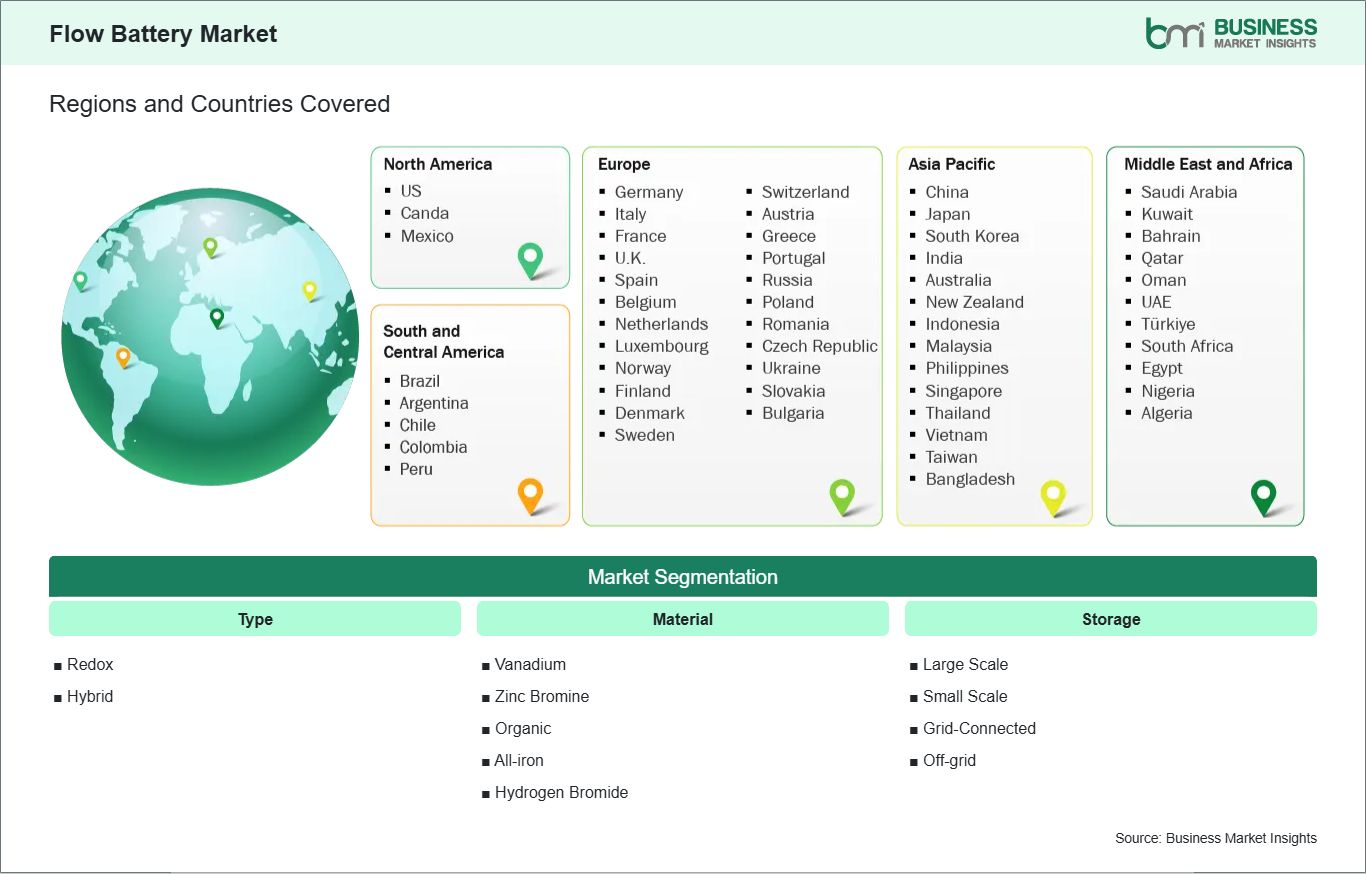
Regions and Countries Covered
North America US, Canada, Mexico
Europe Germany, Italy, France, U.K., Spain, Belgium, Netherlands, Luxembourg, Norway, Finland, Denmark, Sweden, Switzerland, Austria, Greece, Portugal, Russia, Poland, Romania, Czech Republic, Ukraine, Slovakia, Bulgaria
Asia-Pacific China, Japan, South Korea, India, Australia, New Zealand, Indonesia, Malaysia, Philippines, Singapore, Thailand, Vietnam, Taiwan, Bangladesh
South and Central America Brazil, Argentina, Chile, Colombia, Peru
Middle East and Africa Saudi Arabia, United Arab Emirates, Kuwait, Bahrain, Qatar, Oman, Turkiye, South Africa, Egypt, Nigeria, Algeria
Market leaders and key company profiles
  • Sumitomo Electric Industries
  • Invinity Energy Systems
  • VRB Energy
  • VFlowTech
  • VoltStorage
  • UniEnergy Technologies
  • Primus Power
  • ESS Inc.
  • Rongke Power
  • Gildemeister
  • Redflow
  • CellCube
Get more information on this report

Flow Battery Market Report Coverage and Deliverables:

The " Flow Battery Market Size and Forecast (2022-2033)" report provides a detailed analysis of the market covering below areas:

  • Market size and forecast at global, regional, and country levels for all market segments covered under the scope
  • Market trends, as well as drivers, restraints, and opportunities
  • Market analysis covering key trends, global and regional framework, major players, regulations, and recent developments
  • Industry landscape and competition analysis covering market concentration, heat map analysis, prominent players, and recent developments for the Flow battery market
  • Detailed company profiles, including SWOT analysis

Flow Battery Market Geographic Insights:

The flow battery market shows different regional adoption patterns influenced by priorities for integrating renewables, modernizing electricity infrastructure, expanding industrial electrification programs, and meeting long-duration storage needs. Energy transition policies and grid reliability goals continue to shape deployment strategies for utility operators, commercial facilities, and decentralized energy networks around the world. North America is seeing strong activity in implementation, supported by grid modernization efforts and utility-scale renewable projects. Regional energy operators are looking into long-duration storage technologies to improve grid flexibility and backup power resilience. Industrial facilities and public utilities are increasingly choosing storage systems that can handle fluctuating renewable generation while ensuring continuous operation during peak demand. Asia Pacific is advancing as a leading region for manufacturing and deployment thanks to its growing renewable infrastructure and electrification investments. Countries in the area are enhancing energy storage capabilities to support urban growth, industrial expansion, and stable transmission. Local manufacturing programs and government-supported clean energy initiatives are also promoting broader use of alternative battery technologies and scalable storage solutions. Europe is placing significant focus on integrating sustainable energy and reducing carbon emissions, leading to ongoing investment in improved storage technologies. Regulatory support for renewable adoption and energy efficiency drives long-duration storage deployment across utility and industrial sectors. Emerging markets in the Middle East, Africa, and South America are slowly exploring flow battery systems for remote electrification, microgrid development, and energy diversification efforts.

global-market-geography
Get more information on this report

Flow Battery Market Research Report Guidance:

  • The report includes qualitative and quantitative data for the flow battery market across type, material, storage, and geography.
  • The report starts with the key takeaways (chapter 2), highlighting the key trends and outlook of the flow battery market.
  • Chapter 3 focuses on the research methodology of the study.
  • Chapter 4 includes ecosystem analysis.
  • Chapter 5 highlights the major industry dynamics in the flow battery market, including factors that are driving the market, prevailing deterrents, potential opportunities, as well as future trends. Impact analysis of these drivers and restraints is also covered in this section.
  • Chapter 6 discusses the flow battery market scenario, in terms of historical market revenues, and forecast till the year 2033.
  • Chapters 7 to 10 cover flow battery market segments by type, material, storage, and geography across North America, Europe, Asia Pacific, Middle East and Africa, and South and Central America. They cover the market revenue, forecast, and factors driving the market.
  • Chapter 11 describes the competitive analysis along with the heat map analysis for the key players operating in the market.
  • Chapter 12 describes the industry landscape analysis. It provides detailed descriptions of business activities such as market initiatives, new developments, mergers, and joint ventures globally, along with a competitive landscape.
  • Chapter 13 provides detailed profiles of the major companies operating in the flow battery market. Companies have been profiled on the basis of their key facts, business descriptions, products and services, financial overview, SWOT analysis, and key developments.
  • Chapter 14, i.e., the appendix, is inclusive of a brief overview of the company, list of abbreviations, and disclaimer.

Flow Battery Market News and Key Development:

The flow battery market is evaluated by gathering qualitative and quantitative data post primary and secondary research, which includes important corporate publications, association data, and databases. A few of the key developments in the flow battery market are:

  • May 2026: Invinity Energy Systems selected by FlexBase Group to design a GWh-scale vanadium flow battery system in Switzerland, positioned as one of the world’s largest flow battery projects supporting AI-driven data center infrastructure and grid stabilization initiatives.
  • September 2024: ESS Tech and Energy Storage Industries secured public and private funding support for construction of a large-scale iron flow battery manufacturing facility in Queensland, Australia, aimed at accelerating long-duration energy storage deployment across the region.

Key Sources Referred:

  • International Energy Agency
  • S. Department of Energy
  • International Renewable Energy Agency
  • Energy Storage Association
  • European Association for Storage of Energy
  • National Renewable Energy Laboratory
  • Sandia National Laboratories
  • Electric Power Research Institute Top of Form
The List of Companies - Flow Battery Market
  • Sumitomo Electric Industries
  • Invinity Energy Systems
  • VRB Energy
  • VFlowTech
  • VoltStorage
  • UniEnergy Technologies
  • Primus Power
  • ESS Inc.
  • Rongke Power
  • Gildemeister
  • Redflow
  • CellCube
Frequently Asked Questions
How big is the Flow Battery Market?

The Flow Battery Market is valued at US$ 631.16 Million in 2025, it is projected to reach US$ 4,106.4 Million by 2033.

What is the CAGR for Flow Battery Market by (2026 - 2033)?

As per our report Flow Battery Market, the market size is valued at US$ 631.16 Million in 2025, projecting it to reach US$ 4,106.4 Million by 2033. This translates to a CAGR of approximately 26.38% during the forecast period.

What segments are covered in this report?

The Flow Battery Market report typically cover these key segments-

  • Type (Redox, Hybrid)
  • Material (Vanadium, Zinc Bromine, Organic, All-iron, Hydrogen Bromide)
  • Storage (Large Scale, Small Scale, Grid-Connected, Off-grid)

What is the historic period, base year, and forecast period taken for Flow Battery Market?

The historic period, base year, and forecast period can vary slightly depending on the specific market research report. However, for the Flow Battery Market report:

  • Historic Period : 2022-2024
  • Base Year : 2025
  • Forecast Period : 2026-2033
  • Who are the major players in Flow Battery Market?

    The Flow Battery Market is populated by several key players, each contributing to its growth and innovation. Some of the major players include:

  • Sumitomo Electric Industries
  • Invinity Energy Systems
  • VRB Energy
  • VFlowTech
  • VoltStorage
  • UniEnergy Technologies
  • Primus Power
  • ESS Inc.
  • Rongke Power
  • Gildemeister
  • Redflow
  • CellCube
  • Who should buy this report?

    The Flow Battery Market report is valuable for diverse stakeholders, including:

    • Investors: Provides insights for investment decisions pertaining to market growth, companies, or industry insights. Helps assess market attractiveness and potential returns.
    • Industry Players: Offers competitive intelligence, market sizing, and trend analysis to inform strategic planning, product development, and sales strategies.
    • Suppliers and Manufacturers: Helps understand market demand for components, materials, and services related to concerned industry.
    • Researchers and Consultants: Provides data and analysis for academic research, consulting projects, and market studies.
    • Financial Institutions: Helps assess risks and opportunities associated with financing or investing in the concerned market.

    Essentially, anyone involved in or considering involvement in the Flow Battery Market value chain can benefit from the information contained in a comprehensive market report.

    Available Report Formats

    pdf-format excel-format pptx-format
    Buy Now
    Sales Assistance
    +1 646 791 7070 (US & UK)
    Customization Form

    Please tell us your area of interest
    (Market Segments/ Regions and Countries/ Companies)