
3D Printed Battery Market Outlook: Size, Share, Trends, Growth Analysis, Competitive Landscape & Forecast, 2026-2033

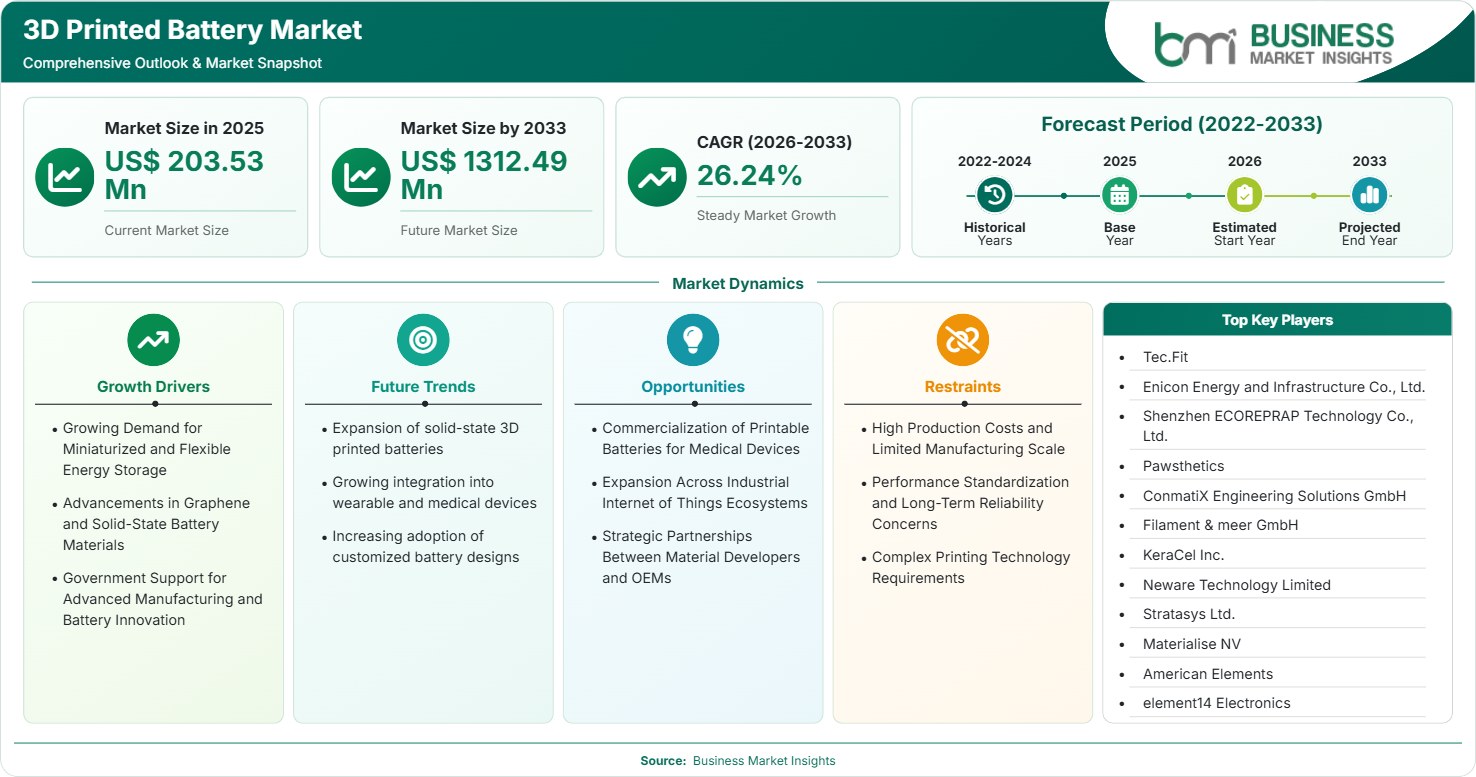
The 3D Printed Battery Market size was valued at US$ 203.53 Million in 2025 and is projected to reach US$ 1312.49 Million by 2033, growing at a CAGR of 26.24% during 2026–2033. Increasing demand for miniaturized energy storage, rapid advances in additive manufacturing, graphene-based materials, and expanding wearable electronics applications are accelerating commercialization while investments in solid-state technologies create new long-term revenue opportunities.

Report Coverage
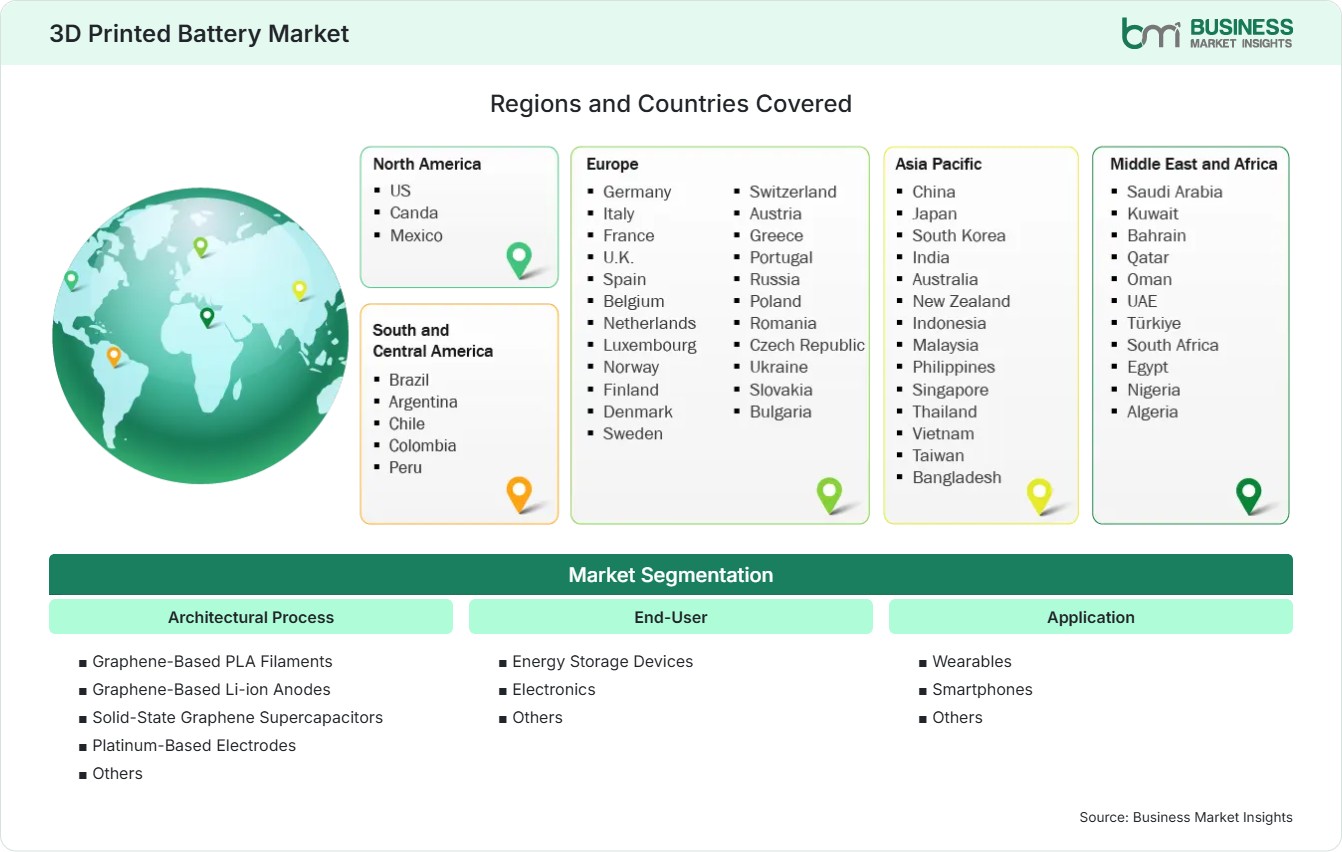
  • Architectural Process: Graphene-Based PLA Filaments, Graphene-Based Li-ion Anodes, Solid-State Graphene Supercapacitors, Platinum-Based Electrodes, Others
  • End-User: Energy Storage Devices, Electronics, Others
  • Application: Wearables, Smartphones, Others
US$ 203.53 Mn Market size in 2025
US$ 1312.49 Mn Market Size by 2033
26.24% CAGR, 2026 - 2033
2026-2033 Forecast Period

01 AI Overview

3D Printed Battery Market Summary

  • North America Region: North America holds a market share of 36%–39% in 2025, expanding at a CAGR of 24%–26% during 2026–2033. Strong defense research, semiconductor manufacturing investments, advanced battery innovation ecosystems, government funding, and expanding industrial prototyping continue strengthening commercial deployment across multiple high-value applications. The U.S. market benefits from advanced additive manufacturing infrastructure, extensive research partnerships, and growing commercialization initiatives, supporting a 24%–26% CAGR through 2033.
  • Fastest Growing Region: Asia Pacific accounts for 27%–30% market share in 2025 and is projected to register a 27%–29% CAGR during 2026–2033. Expanding electronics manufacturing, government-backed battery programs, increasing automation investments, regional supply-chain localization, and rapid consumer electronics production continue creating favorable long-term business opportunities.
  • Leading Segment: Electronics represents 44%–47% market share in 2025 while advancing at a 25%–27% CAGR through 2033. Growing demand for compact energy storage, flexible electronic devices, lightweight batteries, advanced manufacturing capabilities, and continuous product innovation are supporting stronger commercial adoption across consumer and industrial sectors.
  • High Growth Segment: Wearables contributes 38%–41% market share in 2025 and is forecast to expand at a 28%–30% CAGR during 2026–2033. Rising health monitoring adoption, flexible device development, personalized medical technologies, smart textiles, and continuous battery miniaturization encourage manufacturers to accelerate investments in next-generation printable energy storage solutions.
  • Key Market Opportunity: Rising commercialization of solid-state printable batteries for medical devices, aerospace electronics, defense equipment, industrial sensors, and Internet of Things platforms enables manufacturers to develop customized high-performance energy storage with scalable production economics.
  • Major Market Players: Tec.Fit, Enicon Energy and Infrastructure Co., Ltd., Shenzhen ECOREPRAP Technology Co., Ltd., Pawsthetics, ConmatiX Engineering Solutions GmbH, Filament & meer GmbH, KeraCel Inc., Neware Technology Limited, Stratasys Ltd., Materialise NV, American Elements, element14 Electronics, and Blackstone Resources AG.
02 Strategic Insights

3D Printed Battery Market: Strategic Insights

3D Printed Battery Market Strategic Framework
FREE PDF
Request your free sample
Request free sample
03 Stakeholder View

Key Takeaways

1. The industry is transitioning from laboratory-scale innovation toward integrated manufacturing ecosystems where material suppliers, additive manufacturing technology providers, battery developers, software companies, and end-product manufacturers collaborate to accelerate commercialization while improving production efficiency and quality assurance.

2. Key opportunities are driven by wearable electronics, medical devices, industrial sensors, and consumer electronics, where printable batteries offer flexibility, compact designs, and efficient manufacturing.

3. Innovation is focused on graphene materials, printable solid-state electrolytes, advanced electrodes, AI-driven print optimization, and automated quality monitoring to improve battery performance and production efficiency.

4. Asia Pacific is becoming an increasingly attractive investment destination because expanding electronics manufacturing, government incentives supporting advanced batteries, localized supply-chain development, and growing research commercialization collectively strengthen long-term production capabilities and export competitiveness.

5. Venture capital, technology licensing, research partnerships, and acquisitions are accelerating innovation in printable battery materials, manufacturing platforms, and intellectual property.

6. Sustainability is driving competition through recyclable materials, reduced waste, digital production, and energy-efficient manufacturing processes.

04 Geographic Outlook

3D Printed Battery Market Regional Highlights

North America 3D Printed Battery Market

North America accounted for 36%–39% of the 3D Printed Battery Market share in 2025 and is projected to expand at a CAGR of 24%–26% during 2026–2033. The region maintains leadership through advanced additive manufacturing capabilities, extensive battery research programs, strong venture capital funding, and growing commercialization of customized energy storage solutions

  • United States leads through research collaborations, battery manufacturing investments, and commercialization across healthcare, aerospace, and defense sectors.
  • Canada advances battery innovation through clean technology investments and advanced manufacturing research.
  • Industrial automation supports additive manufacturing adoption in battery production, improving customization and efficiency.
  • Wearable devices, defense electronics, and industrial sensors are increasing demand for compact high-performance printable batteries.

US 3D Printed Battery Market

The United States represented 79%–82% of North American revenue in 2025 and is forecast to register a CAGR of 24%–26% through 2033. Strong federal funding, extensive patent activity, advanced manufacturing infrastructure, and leading battery research institutions reinforce commercialization efforts in 3D Printed Battery Market.

  • Federal battery initiatives are driving investments in research, pilot manufacturing, and commercialization partnerships.
  • Wearable healthcare, implants, and monitoring devices are increasing demand for flexible, lightweight miniature batteries.
  • Aerospace applications are exploring printable batteries for satellites, drones, and advanced avionics.
  • Venture capital and startups are accelerating innovation in battery materials, conductive inks, and solid-state technologies.

Europe 3D Printed Battery Market

Europe held 25%–28% market share in 2025 and is projected to grow at a 23%–25% CAGR through 2033. Growth is driven by sustainability regulations, advanced manufacturing, and battery investments, with Germany leading and the Netherlands and Nordic countries accelerating additive battery technology adoption.

  • Germany leads through industrial expertise, automotive innovation, and research partnerships supporting advanced battery manufacturing.
  • The Netherlands is growing through battery innovation, advanced manufacturing investments, and industry-academia collaboration.
  • European sustainability regulations are promoting additive manufacturing for efficient and eco-friendly battery production.
  • Medical, industrial, and aerospace sectors are increasing demand for customized compact battery solutions.

Asia Pacific 3D Printed Battery Market

Asia Pacific accounted for 27%–30% of global revenue in 2025 and is expected to grow at a 27%–29% CAGR through 2033. Growth is driven by electronics manufacturing, battery production, semiconductor investments, and innovation programs, with China leading and South Korea and India showing strong investment momentum in 3D Printed Battery Market.

  • China leads due to strong electronics manufacturing, battery supply chains, and investments in additive battery technologies.
  • South Korea shows rapid growth through battery innovation, semiconductor expertise, and flexible electronics research.
  • India is expanding through manufacturing incentives, electronics growth, startups, and research initiatives.
  • Wearables, smart devices, industrial sensors, and healthcare technologies are increasing demand for printable batteries.
  • Local supply chain investments are reducing import dependency and accelerating battery technology commercialization.

Rest of World 3D Printed Battery Market

The Rest of World region held 8%–10% market share in 2025 and is expected to grow at a 22%–24% CAGR through 2033. Growth is supported by industrial modernization, electronics manufacturing, healthcare adoption, automation, and advanced manufacturing investments across South & Central America and the Middle East & Africa.

  • Brazil leads through industrial research, manufacturing modernization, and collaboration with global technology providers.
  • The UAE shows strong growth through Industry 4.0, smart manufacturing, and industrial innovation investments.
  • Government support for technology transfer and research partnerships is strengthening regional competitiveness.
  • Industrial monitoring, connected systems, and healthcare technologies are increasing demand for customized printable batteries.
Global Market Geography
FREE PDF
Request your free sample
Request free sample
05 Segment Analysis

3D Printed Battery Market Segmentation

Architectural Process

The Architectural Process segment accounted for 46%–49% of the market in 2025 and is anticipated to expand at a CAGR of 25%–27% during 2026–2033. Continuous innovation in printable electrode materials, conductive polymers, graphene composites, and precision additive manufacturing is improving battery performance and production flexibility. The 3D Printed Battery Market scope continues to expand as manufacturers develop advanced material architectures for customized energy storage applications across electronics, healthcare, and industrial sectors.

  • Graphene-Based PLA Filaments: Graphene-enhanced PLA filaments improve conductivity, structural integrity, and print precision, enabling manufacturers to produce lightweight battery components with greater design flexibility for wearable electronics, educational prototypes, and advanced research applications.
  • Graphene-Based Li-ion Anodes: Printable graphene-based lithium-ion anodes support higher electrical conductivity, improved charge-discharge efficiency, and enhanced mechanical stability, making them increasingly attractive for compact electronic devices requiring customized battery geometries and optimized energy performance.
  • Solid-State Graphene Supercapacitors: Solid-state graphene supercapacitors enable rapid charging, superior cycling stability, and flexible structural integration, supporting next-generation wearable devices, industrial sensors, and smart electronics demanding reliable high-power energy storage.
  • Platinum-Based Electrodes: Platinum-based printable electrodes provide exceptional electrochemical stability, corrosion resistance, and precision performance, making them suitable for medical devices, laboratory equipment, aerospace electronics, and specialized industrial sensing environments requiring consistent reliability.

End-User

The End-User segment represented 44%–47% of total revenue in 2025 and is expected to register a CAGR of 25%–27% during 2026–2033. Increasing commercialization across consumer electronics, medical technology, industrial automation, and smart connected devices continues strengthening adoption. The 3D Printed Battery Market trends demonstrate growing demand for application-specific energy storage solutions capable of supporting lightweight designs, rapid prototyping, and customized manufacturing requirements.

  • Energy Storage Devices: Grid-support technologies, portable backup systems, and distributed energy storage increasingly adopt additive manufacturing to develop customized battery configurations that improve production efficiency while enabling compact, lightweight, and application-specific energy solutions.
  • Electronics: Consumer electronics manufacturers increasingly integrate printable batteries into compact devices, flexible displays, smart sensors, and connected products to improve space utilization, reduce assembly complexity, and accelerate product innovation cycles.

Application

The Application segment accounted for 42%–45% market share in 2025 and is forecast to grow at a CAGR of 27%–29% during 2026–2033. Expanding use of miniaturized electronics, personalized healthcare devices, industrial IoT systems, and intelligent consumer products continues driving commercial demand. Manufacturers increasingly prioritize flexible battery integration, lightweight construction, and customized product development to meet evolving application requirements across diverse industries in 3D Printed Battery Market.

  • Wearables: Wearable devices increasingly require compact, lightweight, and flexible power sources that seamlessly integrate with smartwatches, fitness trackers, smart textiles, and medical monitoring systems while maintaining reliable long-term operational performance.
  • Smartphones: Smartphone manufacturers continue exploring printable batteries to optimize internal space utilization, support innovative device architectures, enhance design flexibility, and enable future generations of foldable and ultra-thin mobile devices.
06 Market Forces

3D Printed Battery Market Dynamics

Key Market Drivers

Growing Demand for Miniaturized and Flexible Energy Storage

The rapid expansion of wearable electronics, implantable medical devices, smart sensors, and Internet of Things (IoT) platforms is significantly increasing demand for compact and customizable energy storage technologies. The 3D Printed Battery Market growth is supported by manufacturers seeking batteries that fit complex product geometries without compromising performance. According to the International Energy Agency (IEA), connected devices continue to expand across industrial and consumer environments, requiring smaller, lightweight power sources. Additive manufacturing enables precise battery architectures while reducing production waste and accelerating prototyping. These capabilities improve product development cycles, support personalized device manufacturing, and enhance energy efficiency, making printable batteries an attractive solution for next-generation electronic applications.

Advancements in Graphene and Solid-State Battery Materials

Ongoing studies on graphene electrodes, printable electrolytes, and solid-state batteries have been contributing to increased efficiency in additive-manufactured batteries. Increased conductivity, heat resistance, and high energy density have made printable batteries match the performance of regular batteries in specific cases. Universities, research centers, and manufacturing companies are spending a lot of resources on developing materials to address previous inefficiencies. Multi-material printing has led to increased accuracy and customization in battery design. This has greatly contributed to the commercial viability of the technology across sectors such as aerospace, healthcare, defense, and consumer electronics.

Government Support for Advanced Manufacturing and Battery Innovation

North American, European, and Asia Pacific governments are still providing investments in advanced manufacturing, battery innovation initiatives, and development of their local supply chains. Governmental funding of additive manufacturing, battery commercialization, and sustainable production is speeding up the implementation of innovations. Organizations such as the U.S. Department of Energy and the European Commission promote collaborative research which allows enhancing manufacturability and performance of batteries. Growing interest from the side of policymakers to waste-reducing production processes and manufacturing also adds to the industrial confidence. Printable batteries are increasingly benefiting from public-private cooperation and investment programs due to their importance to strategic industries.

Key Market Opportunities

Commercialization of Printable Batteries for Medical Devices

Medical technology manufacturers increasingly require compact energy storage solutions capable of supporting implantable devices, biosensors, diagnostic equipment, and wearable healthcare products. Printable batteries enable customized dimensions and lightweight construction while improving patient comfort and device integration. Growing healthcare digitization and remote patient monitoring create favorable market conditions for advanced battery technologies. The 3D Printed Battery Market Forecasts indicate sustained investment opportunities as medical device developers collaborate with additive manufacturing specialists to commercialize application-specific battery designs. Regulatory emphasis on innovative healthcare technologies further encourages long-term product development and commercialization across global medical markets.

Expansion Across Industrial Internet of Things Ecosystems

The implementation of Industrial IoT is being extended to include industries such as manufacturing, logistics, energy, and infrastructure, creating a need for portable power supply units to support distributed sensor networks. With printable batteries, there is an added benefit of designing devices in flexible ways and integrating batteries in unique products. Customized battery solutions are becoming a necessity in smart factories, predictive maintenance systems, and industrial equipment requiring specific performance qualities. Manufacturing companies adopting this technology can benefit from the industry's digitalization.

Strategic Partnerships Between Material Developers and OEMs

Increasingly, strategic collaborations among battery material vendors, additive manufacturing firms, electronic component makers, and research centers are being established to accelerate commercialization. Joint development arrangements provide access to proprietary material systems, cutting-edge printing systems, and manufacturing systems. Collaborations mitigate the risks of technology development while expediting product validation in sectors such as health care, aerospace, and consumer electronics. Firms that can combine materials science know-how and manufacturing systems are expected to have stronger competitive positions as commercialization spreads across valuable industrial sectors.

Market Restraints and Challenges

High Production Costs and Limited Manufacturing Scale

Factor: Advanced print materials, highly precise manufacturing machinery and processes still prove costly relative to traditional battery manufacturing techniques. Impact: The high cost of production makes widespread commercialization difficult, especially when considering consumer markets where cost is an important factor. Production issues persist for manufacturers as they strive to reconcile the performance of the material used with economic considerations of production. High research and development costs, the need for a specialized labor force and low production volume make commercialization risky. Until economies of scale come into play and material costs drop, usage will be limited to premium sectors like healthcare, aerospace, military and industrial electronics.

Performance Standardization and Long-Term Reliability Concerns

Factor: The development of printable batteries continues to advance, leading to inconsistencies in the materials, printing process, electrochemical efficiency, and longevity of the products produced from such manufacturing processes. Impact: The lack of standards makes it difficult for consumers to determine whether they can be relied upon and whether they comply with all necessary regulations. It is necessary for manufacturers to prove consistency, safety, and efficient production of the devices before they can be widely marketed. Additional certification for use in medicine, aviation, and industry increases the timeline for commercialization.

07 Company Analysis

Competitive Landscape

The competitive environment remains highly innovation-driven as companies invest in advanced materials, precision additive manufacturing, and customized energy storage technologies. The 3D Printed Battery Market analysis indicates that strategic collaborations between battery developers, material suppliers, and 3D printing technology providers are accelerating commercialization across healthcare, aerospace, industrial automation, and consumer electronics.

Company Name

Overview

Products and Services Relevant to this Market

Tec.Fit

Develops advanced additive manufacturing solutions with expertise in customized engineering applications supporting rapid prototyping and industrial innovation for specialized energy storage developments.

3D printing solutions, engineering support, customized manufacturing services, battery prototype development, and advanced fabrication technologies for printable energy storage applications.

Enicon Energy and Infrastructure Co., Ltd.

Focuses on innovative energy technologies and infrastructure solutions supporting next-generation battery development and advanced manufacturing initiatives across industrial sectors.

Energy storage technologies, battery engineering solutions, infrastructure support, advanced manufacturing integration, and customized energy system development.

Shenzhen ECOREPRAP Technology Co., Ltd.

Specializes in professional 3D printing equipment and manufacturing technologies serving industrial, research, and commercial additive manufacturing applications worldwide.

Industrial 3D printers, additive manufacturing systems, printing materials, prototyping solutions, and technical support for advanced manufacturing environments.

Pawsthetics

Provides specialized additive manufacturing services and customized fabrication technologies supporting rapid product development across multiple engineering applications.

Customized 3D printing services, rapid prototyping, engineering fabrication, design optimization, and precision manufacturing solutions.

ConmatiX Engineering Solutions GmbH

German engineering company specializing in advanced additive manufacturing, industrial design optimization, and innovative engineering solutions for high-performance applications.

Engineering consulting, additive manufacturing optimization, industrial prototyping, customized production systems, and advanced engineering services.

Filament & meer GmbH

Develops specialized additive manufacturing materials with emphasis on high-performance filaments for industrial and research applications.

Engineering-grade filaments, conductive materials, specialty printing materials, material development, and additive manufacturing support services.

KeraCel Inc.

Develops proprietary 3D printed solid-state battery technologies focused on improving energy density, manufacturing scalability, and battery safety.

Solid-state printable batteries, ceramic electrolyte technologies, advanced battery design, customized energy storage, and battery research solutions.

Neware Technology Limited

Global supplier of battery testing equipment and laboratory systems supporting battery development, validation, and quality assurance worldwide.

Battery testing systems, laboratory equipment, charge-discharge analyzers, quality control solutions, and battery performance evaluation services.

Stratasys Ltd.

Global leader in industrial additive manufacturing offering advanced hardware, software, and materials supporting precision manufacturing across numerous industries.

Industrial 3D printers, additive manufacturing software, engineering materials, production systems, and digital manufacturing solutions.

Materialise NV

Provides advanced additive manufacturing software and engineering services supporting product development, simulation, and industrial production optimization.

Additive manufacturing software, engineering services, digital manufacturing platforms, medical printing technologies, and industrial production solutions.

American Elements

International manufacturer of advanced materials supplying high-purity metals, graphene materials, nanomaterials, and specialty chemicals for research and manufacturing.

Graphene materials, conductive powders, specialty chemicals, advanced battery materials, nanomaterials, and customized material solutions.

element14 Electronics

Global electronics distributor supplying components, development tools, and engineering solutions supporting research and advanced product development.

Electronic components, development kits, engineering tools, battery components, prototyping products, and industrial electronics solutions.

Blackstone Resources AG

Focuses on advanced battery technologies and sustainable energy storage innovations with investments in next-generation battery manufacturing platforms.

Battery technologies, energy storage systems, advanced manufacturing solutions, battery research, and sustainable energy innovation services.

10 Trust & Transparency

Research Methodology

The market analysis combines proprietary research with secondary data from government agencies, company disclosures, regulatory filings, industry databases and expert interviews. Market estimates are validated through data triangulation, cross-market benchmarking and analyst review.

View Full Research Methodology

11 Questions Answered

Frequently Asked Questions

Which technology area offers the strongest long-term investment potential?

Graphene-enabled materials, printable solid-state batteries, AI-assisted manufacturing optimization, advanced conductive inks, and flexible energy storage platforms are expected to attract substantial investment due to their ability to improve battery performance and manufacturing scalability.

What should buyers evaluate before purchasing a 3D Printed Battery Market Report?

Buyers should assess market methodology, competitive benchmarking, technology coverage, regional analysis, segmentation depth, forecast assumptions, company profiles, and strategic insights to ensure the report aligns with business planning and investment requirements.

How does additive manufacturing improve battery production?

Additive manufacturing reduces material waste, enables customized geometries, shortens prototype development cycles, supports digital manufacturing workflows, and allows manufacturers to produce complex battery structures that conventional fabrication methods cannot easily achieve.

Which industries are expected to generate the strongest future demand for 3D Printed Battery Market?

Healthcare, consumer electronics, aerospace, defense, industrial automation, and smart manufacturing are expected to remain the leading demand generators because these industries increasingly require compact, lightweight, and application-specific battery configurations.

What factors are accelerating commercial adoption of printable batteries?

Growing demand for flexible electronics, wearable devices, medical sensors, industrial IoT systems, and lightweight aerospace components is increasing the need for customized energy storage solutions. Advances in additive manufacturing and conductive materials further support commercial adoption.

Access the Full 3D Printed Battery Market Report

Get segment-level forecasts, regional estimates, competitive benchmarking, company profiles and downloadable Excel datasets.

Access the full 3D Printed Battery Market Report
350 pages PDF & Excel | 2026-08-12