
Quantum Batteries Market Outlook: Size, Share, Trends, Growth Analysis, Competitive Landscape & Forecast, 2026-2033

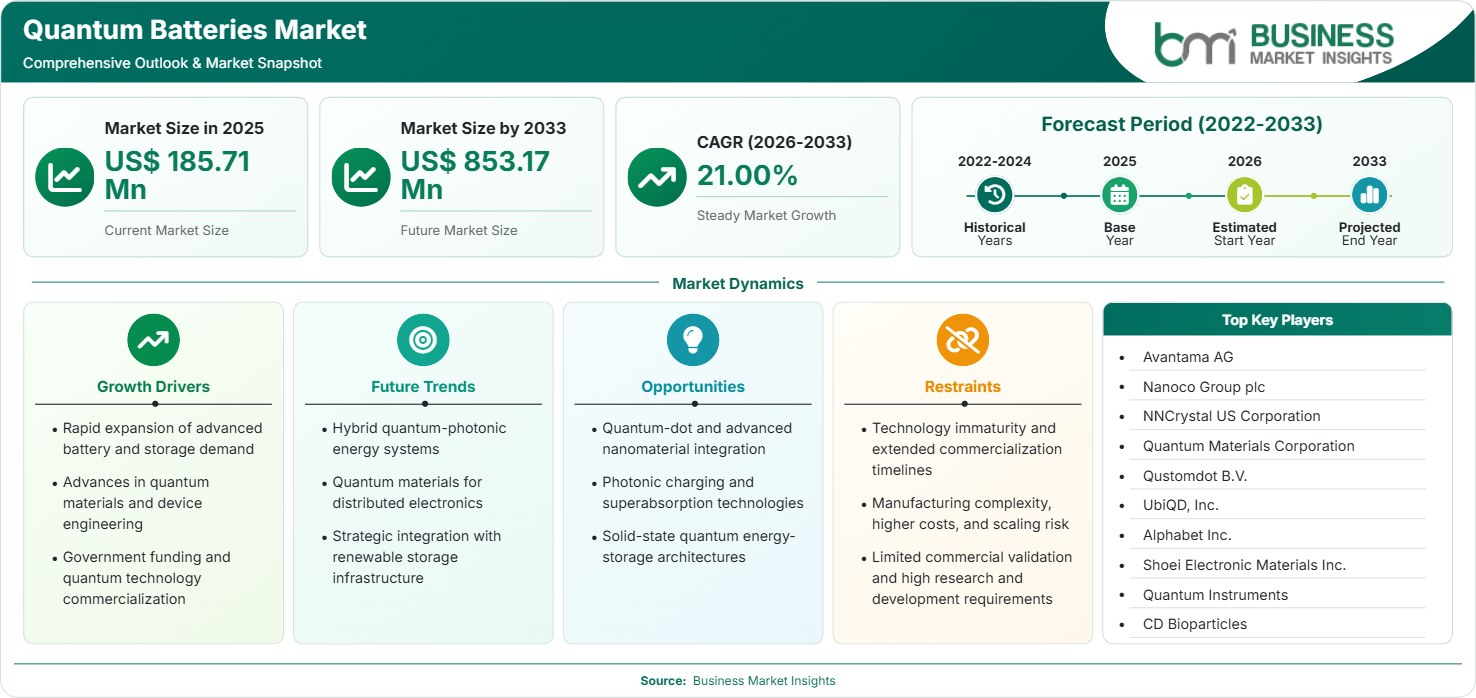
The Quantum Batteries Market size was valued at US$ 185.71 Million in 2025 and is projected to reach US$ 853.17 Million by 2033, growing at a CAGR of 21.00% during 2026–2033, driven by quantum materials innovation, ultra-fast charging research, advanced energy storage demand, and photonic device commercialization opportunities.

Report Coverage
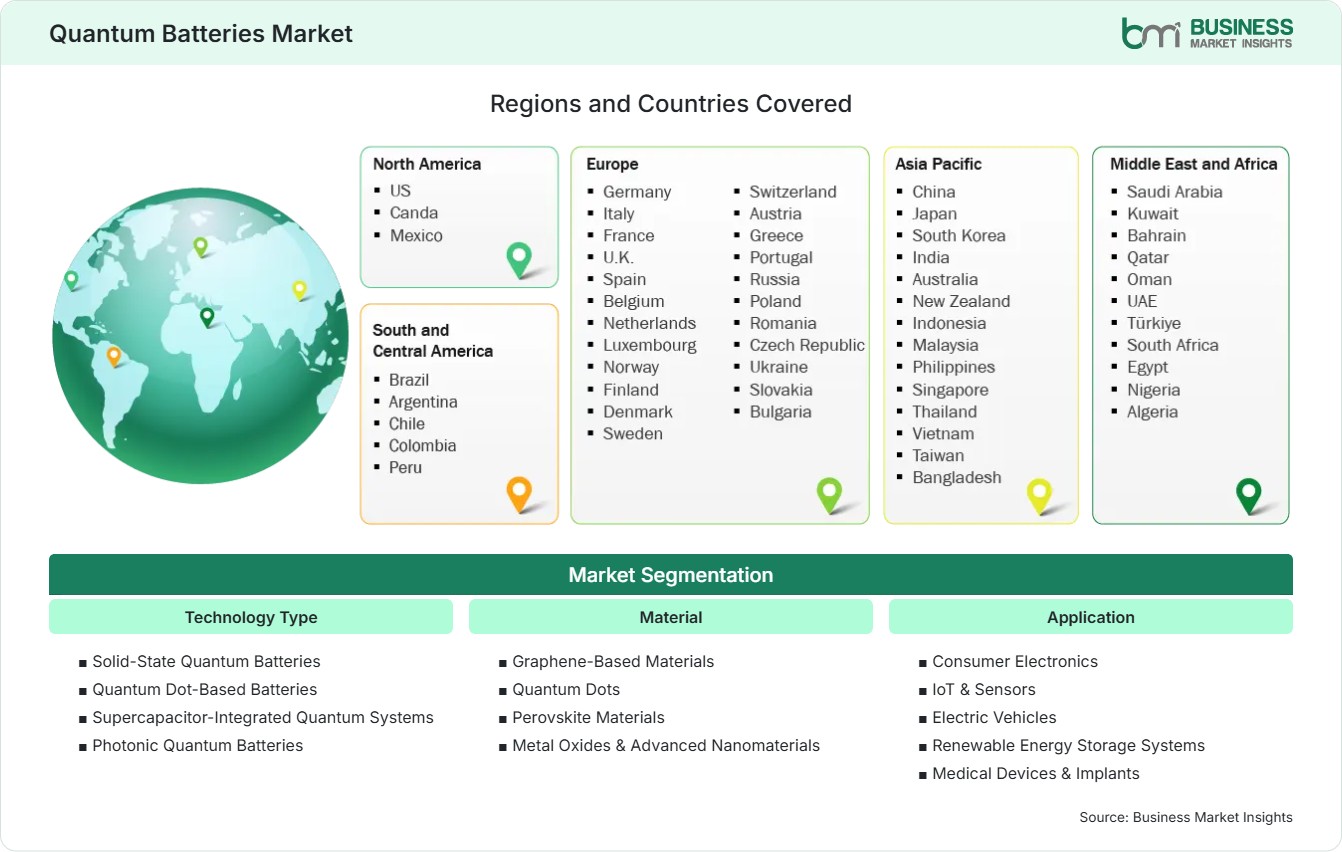
  • Technology Type: Solid-State Quantum Batteries, Quantum Dot-Based Batteries, Supercapacitor-Integrated Quantum Systems, Photonic Quantum Batteries
  • Material: Graphene-Based Materials, Quantum Dots, Perovskite Materials, Metal Oxides & Advanced Nanomaterials
  • Application: Consumer Electronics, IoT & Sensors, Electric Vehicles, Renewable Energy Storage Systems, Medical Devices & Implants
US$ 185.71 Mn Market size in 2025
US$ 853.17 Mn Market Size by 2033
21.00% CAGR, 2026 - 2033
2026-2033 Forecast Period

AI Overview

Quantum Batteries Market Summary

  • North America Region: North America holds a 32%–35% Quantum Batteries Market share in 2025 and is growing at a 19%–21% CAGR, supported by quantum R&D, advanced materials, federal funding, semiconductor expertise, and commercialization partnerships. The US market advances at a 20%–22% CAGR as federal quantum programs, nanomaterial research, semiconductor investment, and energy-storage innovation accelerate prototype development and industrial collaboration.
  • Fastest Growing Region: Asia Pacific holds a 35%–38% share in 2025 and records a 23%–25% CAGR, supported by battery manufacturing depth, quantum research programs, semiconductor ecosystems, electric mobility, consumer electronics, and renewable-energy storage deployment.
  • Leading Segment: Quantum Dot-Based Batteries hold a 34%–37% share of the Quantum Batteries Market in 2025 and expand at a 20%–22% CAGR, benefiting from tunable electronic properties, nanoscale engineering, scalable synthesis, photonic integration, and compatibility with emerging energy-harvesting architectures.
  • High Growth Segment: Photonic Quantum Batteries represent a 12%–15% share in 2025 and advance at a 25%–28% CAGR, driven by superabsorption research, optical charging, microcavity architectures, coherent energy storage, and ultra-fast charging potential.
  • Key Market Opportunity: Opportunities center on integrating quantum materials with solid-state architectures, photonic charging systems, sensors, edge devices, and specialized electronics requiring rapid charging, compact energy storage, and improved energy-management performance.
  • Major Market Players: Avantama AG, Nanoco Group plc, NNCrystal US Corporation, Quantum Materials Corporation, Qustomdot B.V., UbiQD, Inc., Alphabet Inc., Shoei Electronic Materials Inc., Quantum Instruments, and CD Bioparticles.
Strategic Insights

Quantum Batteries Market: Strategic Insights

Quantum Batteries Market Strategic Framework
FREE PDF
Request your free sample
Request free sample
Stakeholder View

Key Takeaways

  • The value chain is forming around quantum-material suppliers, nanofabrication specialists, photonic-system developers, quantum hardware researchers, battery integrators, and end-use device manufacturers. Commercial differentiation will increasingly depend on reproducible materials, device-level integration, intellectual property, and manufacturing yield rather than laboratory demonstrations alone.
  • Quantum dot-based systems provide a nearer-term commercialization pathway because quantum dots already support mature research and commercial applications in sensing, displays, photovoltaics, and photonics. Their material tunability creates opportunities for hybrid storage and energy-harvesting architectures.
  • Research is moving toward collective charging mechanisms rather than simply increasing electrode capacity. Superabsorption, coherent energy transfer, superconducting qubits, photonic cavities, and engineered nanoscale interactions are becoming central research directions. A 2026 experimental study demonstrated quantum charging advantage in a superconducting solid-state system containing up to 12 battery cells.
  • Asia Pacific offers the strongest industrialization case because China, Japan, South Korea, and other regional economies combine electronics manufacturing, battery supply chains, semiconductor capabilities, and expanding energy-storage deployment. China represented around 60% of global new battery-storage capacity additions in 2025.
  • Capital is increasingly flowing toward enabling quantum-material platforms rather than finished quantum batteries. UbiQD secured US$20 million in Series B funding in April 2025, while Europe and the US expanded public quantum programs, strengthening the financing environment for materials and infrastructure providers.
  • Early revenue opportunities are more likely to emerge in specialized electronics, sensors, photonic systems, and quantum hardware than mass-market vehicles. Suppliers that can demonstrate reliability at wafer, device, and module levels will be better positioned for later battery commercialization.
Geographic Outlook

Quantum Batteries Market Regional Highlights

North America Quantum Batteries Market

North America accounted for 32% to 35% of the Quantum Batteries Market in 2025 and is expected to grow at 19% to 21% during 2033. Some of the strengths of the North American region include advanced semiconductor research, government-led quantum initiatives, funding, laboratories, and existing capacity in nanomaterials. While the United States is the leading contributor, Canada is focusing on its academics and quantum computing abilities. Companies in North America are focusing on scalable materials, quantum information systems, photonic design, and energy applications. Public funding reduces early-stage technology risk, while partnerships among universities, laboratories, startups, and industrial technology providers accelerate experimental validation and intellectual property development.

  • Research programs on quantum science conducted at the federal level enhance laboratory facilities and encourage experimentation with superconductive systems, quantum sensors, photonic technology, and advanced materials for energy storage devices
  • Knowledge of semiconductors enables North American firms to develop fabrication, packaging, characterization, and integration capabilities for electronics, thus reducing the time for the transition of quantum-battery technology from the lab stage to the prototype stage.
  • Venture capital is now interested in enabling quantum technologies such as materials, photonics, sensors, and computing equipment, which increases business opportunities for companies operating between the science and production stages.
  • The region’s strong data-center, aerospace, defense, medical, and advanced-electronics industries create early specialized applications where compact, fast-charging energy technologies can justify premium development costs.

US Quantum Batteries Market

The US accounts for 65% to 70% of North America’s activities in 2025 and a 20% to 22% CAGR through 2033. Backed by the federal government, national labs, semiconductor capability, and university-level research, the commercialization process is involved. The Department of Energy awarded US$625 million in funding to five National Quantum Information Science Research Centers to enhance the research environment for quantum hardware and enablers. The Quantum Batteries Market is also driven by demand for high-performance batteries, edge computing, defense electronics, and photonic components.

  • Government funding helps mitigate risks in technology development through multi-university research, state-of-the-art manufacturing, quantum sensing, and hardware development, which are avenues for technological validation open to material firms.
  • Silicon Valley and other US technology centers afford access to semiconductor design, venture capital, software, photonics, and strategic corporate relationships.
  • Applications in defense, aerospace, healthcare, and computing provide high-end markets where energy density, fast charging, thermal management, and form factor can overcome the premium cost of materials.

Europe Quantum Batteries Market

The Europe region was valued between 24%-27% of the Quantum Batteries Market in 2025 and is expected to grow at a CAGR of 20%-22% through 2033. Countries like Germany, the United Kingdom, France, and the Netherlands offer excellent research and materials environments, while countries like Switzerland provide expertise on quantum dots. The Quantum Strategy adopted by the European Commission in July 2025 aims to make Europe a leader by 2030 through research, infrastructure, ecosystems, dual-use applications, and quantum skills.

  • Germany leads regional industrial integration through automotive, battery, semiconductor, and advanced-manufacturing capabilities, creating opportunities for quantum-enabled energy technologies in mobility and industrial electronics.
  • The United Kingdom benefits from strong quantum research and nanomaterials expertise, with companies developing quantum dots and photonic materials that can support future quantum energy-storage architectures.
  • France combines public research institutions, aerospace capabilities, nuclear expertise, and quantum programs, creating demand for specialized energy systems serving scientific and high-performance technology applications.
  • The Netherlands is attractive for quantum materials and semiconductor innovation because its research ecosystem connects photonics, nanotechnology, precision manufacturing, and advanced electronics.

Asia Pacific Quantum Batteries Market

Asia Pacific held a market share of 35% to 38% in the Quantum Batteries Market in 2025 and is projected to have the highest regional CAGR of 23% to 25% through 2033. China takes the lead in battery production and installations, and Japan and South Korea add to the mix by bringing in their prowess in electronics, materials science, and automobile technologies. China accounted for around 60% of global battery storage installations in 2025 and thus provides an excellent base for commercializing future storage innovations.

  • China’s battery manufacturing scale provides a potential industrial platform for integrating quantum materials into advanced storage products once technical reliability, economics, and manufacturing compatibility reach commercial thresholds.
  • Japan combines precision materials, electronics, automotive engineering, and quantum research, making it well positioned for specialized solid-state, photonic, and quantum-dot energy-storage development.
  • South Korea’s semiconductor, display, and battery industries create a strong environment for quantum-dot and photonic integration, particularly where materials can be incorporated into compact electronic architectures.
  • Australia’s rapidly expanding battery-storage market creates a potential test environment for advanced storage concepts, particularly for renewable-energy integration and grid flexibility.

Rest of World Quantum Batteries Market

Rest of World comprises 7%–10% of the market in 2025 and is expected to grow at a CAGR of 17%–19% till 2033. The potential exists in South & Central America, particularly in solar generation, distributed storage, and electrification. The Chile Quantum Batteries Market has become a significant storage market due to batteries' ability to store excess solar generation and meet peak demand. Brazil is a major electronics & energy market, while Mexico has its linkages to North America.

The Middle East and Africa have emerging prospects due to government-led expansion of renewable generation, grid, and energy security infrastructure. The significance of Saudi Arabia lies in the rapid addition of battery storage in 2025 alongside large-scale project development.

  • Chile’s solar resources and growing storage deployment create a favorable environment for testing advanced energy-storage architectures capable of improving renewable integration and reducing curtailment.
  • Brazil offers a large consumer base, industrial ecosystem, renewable-energy potential, and research institutions that can support longer-term adoption of advanced materials and storage technologies.
  • Saudi Arabia is developing large renewable and storage projects, creating opportunities for high-performance technologies where reliability, energy management, and long-duration operation are commercially valuable.
  • Mexico can benefit from proximity to US electronics and automotive supply chains, creating opportunities for advanced battery components and quantum-enabled materials integration.
Global Market Geography
FREE PDF
Request your free sample
Request free sample
Segment Analysis

Quantum Batteries Market Segmentation

Technology Type

The technology Type segment is spearheaded by Quantum Dot-Based Batteries, with a market share of 34%-37% in 2025 and a CAGR of 20%-22% from 2026 to 2033. This is because quantum dots have tunable optical and electrical properties, and the other three technology types address other applications.

  • Solid-State Quantum Batteries: Solid-state architectures reduce dependence on liquid electrolytes and support compact designs, improved safety potential, and integration with advanced quantum materials for specialized electronic devices.
  • Quantum Dot-Based Batteries: Quantum dots offer tunable electronic states, scalable nanomaterial engineering, and compatibility with photonic systems, creating opportunities for energy harvesting, charging, sensing, and nanoscale storage.
  • Supercapacitor-Integrated Quantum Systems: Hybrid systems combine rapid power delivery with quantum-enabled energy-management concepts, targeting applications requiring frequent cycling, short charging intervals, and high instantaneous power.
  • Photonic Quantum Batteries: Photonic architectures exploit light-matter interactions and collective effects to investigate ultra-fast charging, energy storage, and controlled discharge in microcavity-based systems.

Material

Materials are one of the key innovation segments, with Quantum Dots comprising around 34%-37% of the materials segment's activity in 2025 and driving a 20%-22% CAGR for the Quantum Batteries Market during 2026-2033. Materials engineering is responsible for energy transfer, stability, scalability, coherence, and compatibility.

  • Graphene-Based Materials: Graphene supports high electrical conductivity, large surface area, mechanical strength, and lightweight structures, making it useful for electrodes, interfaces, hybrid architectures, and nanoscale energy-management systems.
  • Quantum Dots: Quantum dots provide size-dependent electronic and optical behavior that can be engineered for energy conversion, charge transfer, photonic coupling, and specialized quantum-device architectures.
  • Perovskite Materials: Perovskites offer strong light absorption and tunable electronic properties, supporting research into photonic charging, energy conversion, and compact quantum-enabled energy systems.
  • Metal Oxides & Advanced Nanomaterials: Metal oxides and engineered nanomaterials provide controllable electronic structures, chemical stability, and surface properties suitable for electrodes, interfaces, catalysts, and quantum-device integration.

Application

Application is led by Consumer Electronics, where compact devices create demand for rapid charging, miniaturization, and differentiated energy management. The segment represented a 34%–37% share of application-oriented opportunities in 2025 and is associated with a 20%–22% CAGR of the Quantum Batteries Market through 2026–2033.

  • Consumer Electronics: Smartphones, wearables, tablets, displays, and portable electronics provide early opportunities for compact energy architectures requiring fast charging, low weight, and efficient power management.
  • IoT & Sensors: Distributed sensors require small power sources with reliable operation, supporting quantum-enabled energy harvesting and storage concepts for connected infrastructure and autonomous devices.
  • Electric Vehicles (EVs): EVs offer a long-term application opportunity where ultra-fast charging, energy density, thermal performance, and cycle stability could create meaningful differentiation from conventional battery platforms.
  • Renewable Energy Storage Systems: Grid and distributed-storage systems can benefit from advanced charging and energy-management architectures as renewable penetration increases and storage durations become longer.
  • Medical Devices & Implants: Implantable and medical electronics require compact, reliable, and potentially long-lived power sources, creating opportunities for highly specialized quantum-enabled storage technologies.
Market Forces

Quantum Batteries Market Dynamics

Key Market Drivers

Rapid Expansion of Advanced Battery and Storage Demand

Battery demand has created a large-scale technological development ecosystem in which new chemistries can be developed to address the shortcomings of traditional lithium-ion technology. According to the IEA, global battery demand in the energy sector grew to 1 TWh in 2024, while EV battery demand exceeded 950 GWh. In 2025, global battery storage capacity increased to 108 GW, 40% more than in 2024. Such figures enable investments in new types of batteries capable of faster charging rates, higher power density, greater durability, or better compatibility with renewable power sources. Quantum Batteries Market growth is therefore positively affected by the broader quest to differentiate storage technologies. While still in their early stages of development, quantum batteries benefit from growing battery demand due to their commercial value.

Advances in Quantum Materials and Device Engineering

The area of materials science has been responsible for converting quantum batteries into experimental reality. According to research conducted in 2025, organic microcavities, quantum wells, quantum dots, perovskites, superconductors, and many other types of solid-state materials can serve as platforms for quantum batteries. Quantum dots would be especially useful because their optical and electrical properties can be modified by particle size, chemistry, doping, and surface chemistry. One example is Nanoco Technologies, which manufactures cadmium-free quantum dots for sensing, displays, photovoltaics, and photonics. This expertise can readily translate to the adjacent quantum energy field through improved material quality and synthesis. Quantum Batteries Market trends increasingly reflect a convergence among nanomaterials, photonics, quantum information science, and advanced semiconductor processing, rather than isolated battery chemistry development.

Government Funding and Quantum Technology Commercialization

Public investment is reducing the financing gap between fundamental quantum research and industrial technology development. The US Department of Energy committed US$625 million to renew five National Quantum Information Science Research Centers, while the European Commission launched a Quantum Strategy focused on research, infrastructure, ecosystem development, dual-use technology, and skills. These programs create infrastructure and talent that can support quantum battery research even when energy storage is not the sole funding objective. Quantum Batteries Market growth will benefit from this proximity to quantum computing, photonics, sensing, and materials research projects. The issue becomes even more significant when discussing new technologies, since specialized fabrication, cryogenic, spectroscopic, cleanroom, and quantum measurement facilities may pose major obstacles for individual startups.

Key Market Opportunities

Hybrid Quantum-Photonic Energy Systems

A photonic system architecture offers one of the clearest paths to unique quantum battery behavior, owing to the potential for collective interactions between light and artificial emitters. Investigations into superabsorption provide insight into the role of collective quantum physics in boosting charging efficiency in particular architectures, while microcavity designs enable improved light-matter coupling. The commercial potential extends beyond merely serving as a replacement for existing batteries. Photonic quantum batteries would first find use in areas of optics and quantum processing where rapid energy transfer or optical charging is highly valuable. It is in this context that Quantum Batteries Market Forecasts should be considered. Companies able to provide systems incorporating optical cavities, semiconducting material, control electronics, and thermal management systems can profit even as energy storage technology remains impractical.

Quantum Materials for Distributed Electronics

IoT devices, sensors, wearables, medical devices, and edge electronics constitute promising markets for quantum-dot applications due to their focus on small size, low maintenance, and consistent access to energy sources. Quantum dots, graphene, perovskites, and metal oxides can be integrated into energy harvesters, supercapacitors, and solid-state configurations to create hybrid systems. Such systems may employ quantum-enabled materials technology without requiring a full theoretical model of a quantum battery. This reduces risks associated with commercialization and enables product lines between the two ends of the spectrum for materials companies and device manufacturers. Expansion of Nanoco across sensing, photonics, healthcare, wearables, and quantum technology highlights possibilities with quantum dot applications.

Strategic Integration With Renewable Storage Infrastructure

Grid storage provides a long-term opportunity because the scale of renewable deployment requires technologies capable of rapid response, flexible duration, and frequent cycling. According to the IEA, global energy storage capacity is expected to rise sixfold to 1,500 GW by 2030 if the path to a clean energy transition is to be met. It is doubtful that quantum batteries will be able to help with utility-scale energy storage anytime soon, but there may be some contributions from quantum materials and concepts for charging future modules for high-power applications, energy harvesting, and storage. A good route to commercial success will probably be in modular systems that combine classical and quantum-enabled parts.

Market Restraints and Challenges

Technology Immaturity; Impact: Extended Commercialization Timelines

Factor: quantum batteries remain primarily an emerging research field, with practical devices still limited compared with mature lithium-ion and solid-state battery platforms. Experimental work has demonstrated promising quantum charging effects, but translating those effects into durable, room-temperature, manufacturable energy-storage products requires progress across materials, coherence, control, packaging, and energy extraction.

Impact: commercialization timelines can extend because laboratory performance does not automatically translate into useful energy density, cycle life, efficiency, or cost at system scale. The research literature itself describes the field as being in its infancy, despite progress across organic microcavities, quantum dots, perovskites, and superconducting materials. Investors must therefore distinguish scientific proof-of-concept milestones from commercially validated battery performance and avoid applying conventional battery learning curves prematurely.

Manufacturing Complexity; Impact: Higher Costs and Scaling Risk

Factor: quantum-enabled devices may require tightly controlled nanomaterial synthesis, defect management, photonic structures, specialized fabrication, precision interfaces, and advanced measurement systems.

Impact: manufacturing costs and yield uncertainty can restrict adoption outside premium applications until processes become repeatable at commercial volumes. Quantum-dot production demonstrates both the opportunity and challenge. Nanoco emphasizes scalable synthesis and commercial manufacturing of advanced quantum materials, while Quantum Materials Corporation promotes continuous-flow production designed to move nanoparticle manufacturing toward larger-scale output. These capabilities are relevant because quantum batteries will require not only quantum functionality but also reproducible materials and interfaces. The transition from grams or laboratory devices to standardized modules introduces quality-control, supply-chain, intellectual-property, and equipment challenges that can materially affect commercial economics.

Company Analysis

Competitive Landscape

The Quantum Batteries Market analysis indicates an emerging competitive environment centered on quantum dots, nanomaterials, photonic technologies, semiconductor integration, and quantum research capabilities. The listed companies span specialist material suppliers, technology developers, advanced electronics organizations, and diversified technology participants. Because the market remains at an early commercialization stage, competitive positioning depends heavily on intellectual property, material purity, synthesis scalability, device engineering, research partnerships, and the ability to transfer quantum-material expertise into practical energy architectures.

Company Name

Overview

Products and Services relevant to this market

Avantama AG

Switzerland-based advanced materials company specializing in quantum-dot technologies and functional nanomaterials for electronic and photonic applications.

Quantum dots, nanomaterial formulations, functional materials, and technology solutions relevant to photonic and advanced energy-device development.

Nanoco Group plc

UK-listed nanotechnology company specializing in cadmium-free quantum dots, advanced nanomaterials, research, licensing, and commercial-scale manufacturing.

CFQD quantum dots, HEATWAVE quantum dots, sensing materials, photonic materials, and emerging quantum-technology applications.

NNCrystal US Corporation

US quantum-dot materials specialist providing semiconductor nanocrystals and related technical solutions for research and advanced applications.

Cadmium-based quantum dots, nanocrystal materials, custom formulations, and quantum-dot solutions for research and technology development.

Quantum Materials Corporation

US nanomaterials company focused on scalable continuous-flow production and commercialization of uniform nanoparticles and quantum dots.

Quantum dots, continuous-flow nanomaterial manufacturing, solar materials, medical-device materials, and advanced nanoparticle solutions.

Qustomdot B.V.

Netherlands-based quantum-dot specialist associated with advanced quantum-dot materials and application development.

Quantum-dot materials and related technology support for optoelectronic, photonic, and emerging advanced-material applications.

UbiQD, Inc.

US quantum-dot technology company developing materials for agriculture, solar, and other applications requiring controlled light management.

Quantum-dot materials, luminescent films, solar applications, greenhouse technologies, and advanced photonic solutions.

Alphabet Inc.

Global technology company with substantial capabilities in quantum computing, advanced computing, artificial intelligence, and research infrastructure.

Quantum computing technologies, quantum research platforms, advanced computing, and related scientific capabilities supporting quantum-technology ecosystems.

Shoei Electronic Materials Inc.

Japan-based electronic materials specialist serving advanced electronics and semiconductor-related material requirements.

Electronic materials and specialized components relevant to semiconductor, nanomaterial, and next-generation energy-device ecosystems.

Quantum Instruments

US technology company associated with specialized scientific, optical, and instrumentation capabilities supporting advanced research applications.

Scientific instruments, optical technologies, measurement solutions, and research equipment relevant to quantum and photonic experimentation.

CD Bioparticles

US supplier of nanoparticles and research materials serving biotechnology, nanotechnology, and advanced scientific applications.

Quantum dots, nanoparticles, nanomaterials, research-grade products, and custom material solutions for experimental technology development.

Trust & Transparency

Research Methodology

The market analysis combines proprietary research with secondary data from government agencies, company disclosures, regulatory filings, industry databases and expert interviews. Market estimates are validated through data triangulation, cross-market benchmarking and analyst review.

View Full Research Methodology

Questions Answered

Frequently Asked Questions

What should investors monitor when evaluating the Quantum Batteries Market Report?

Investors should monitor experimentally demonstrated energy-storage metrics, charging speed, energy-extraction efficiency, cycle stability, room-temperature operation, manufacturing yield, intellectual-property strength, funding, strategic partnerships, and pilot production. Research milestones should be separated from commercially validated performance because the technology remains substantially earlier in development than mainstream battery chemistries.

How important are quantum materials to commercialization?

Quantum materials are central because performance depends on controlling electronic states, optical interactions, defects, interfaces, and coherence. Quantum dots, graphene, perovskites, metal oxides, superconducting materials, and engineered photonic structures each offer different properties. Scalable synthesis and reproducibility will determine whether promising laboratory effects can become reliable commercial devices.

Are quantum-dot batteries and quantum batteries the same technology?

No. Quantum-dot batteries represent one technology pathway using semiconductor nanocrystals, while quantum batteries are a broader concept involving quantum-mechanical energy storage and charging mechanisms. Quantum dots can contribute to quantum battery architectures, but a quantum-dot material alone does not automatically constitute a quantum battery.

Which applications are most likely to adopt quantum batteries first?

Specialized electronics, quantum computing hardware, optical systems, sensors, medical devices, aerospace instruments, and scientific equipment are more likely to adopt early systems than mass-market vehicles. These applications can justify higher costs when compactness, rapid charging, precise energy control, or unusual operating conditions provide measurable performance advantages.

What differentiates a quantum battery from a conventional lithium-ion battery?

A quantum battery seeks to store and transfer energy using quantum-mechanical effects such as coherence, collective interactions, superabsorption, or engineered quantum states. Conventional lithium-ion batteries rely primarily on electrochemical reactions and ion movement. Quantum batteries remain an emerging technology, so practical advantages in energy density, charging time, lifetime, and efficiency are still being validated experimentally.

Access the Full Quantum Batteries Market Report

Get segment-level forecasts, regional estimates, competitive benchmarking, company profiles and downloadable Excel datasets.

Access the full Quantum Batteries Market Report
350 pages PDF & Excel | 2026-08-27