
Solid State Battery Market Outlook: Size, Share, Trends, Growth Analysis, Competitive Landscape & Forecast, 2026-2033

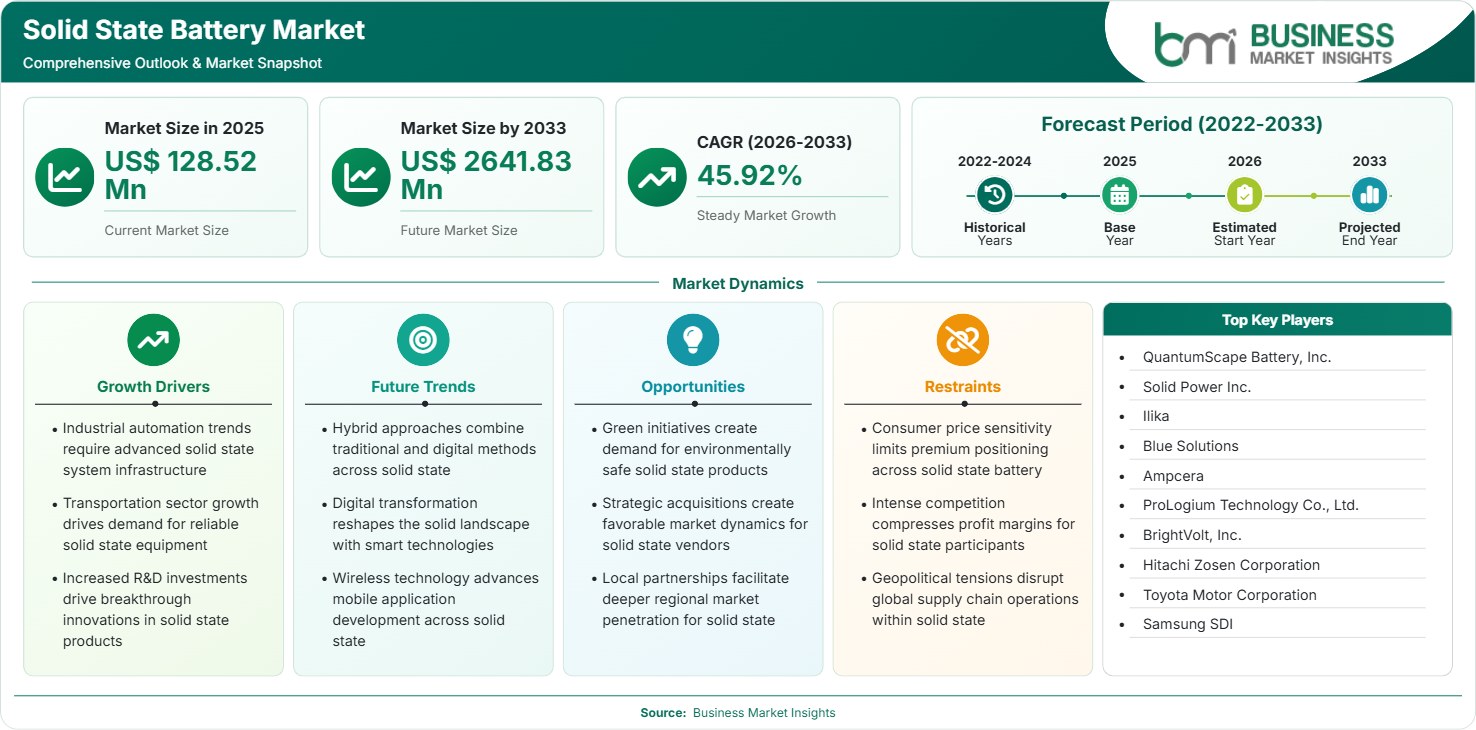
The Solid-State Battery Market size was valued at US$ 128.52 Million in 2025 and is projected to reach US$ 2641.83 Million by 2033, growing at a CAGR of 45.92% during 2026–2033. Rising electric vehicle production, increasing investments in next-generation battery technologies, and expanding demand for safer, high-energy-density storage systems are accelerating commercialization opportunities across automotive, consumer electronics, healthcare, and industrial applications.

Report Coverage
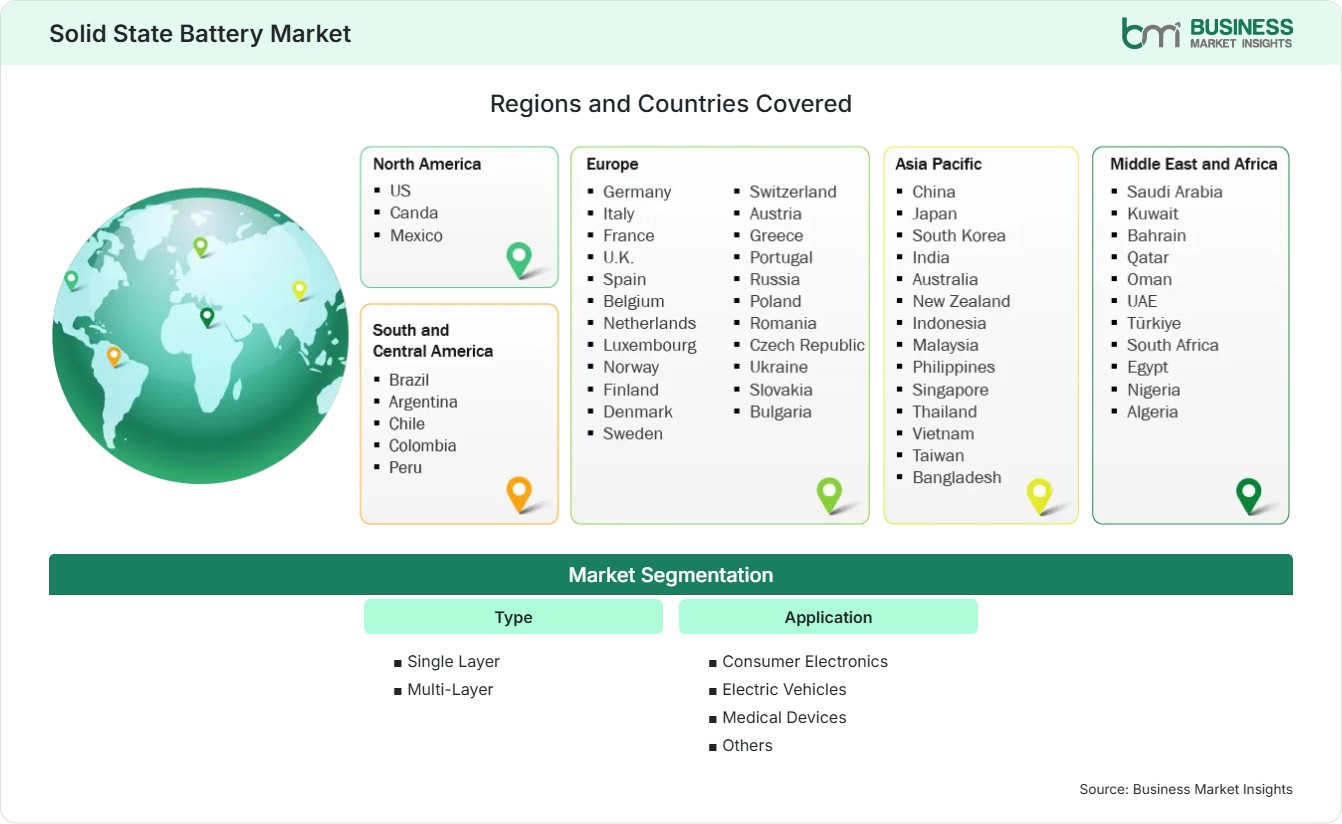
  • Type: Single Layer, Multi-Layer
  • Application: Consumer Electronics, Electric Vehicles, Medical Devices, Others
US$ 128.52 Mn Market size in 2025
US$ 2641.83 Mn Market Size by 2033
45.92% CAGR, 2026 - 2033
2026-2033 Forecast Period

01 AI Overview

Solid State Battery Market Summary

  • North America Region: North America holds a 36%–39% market share in 2025, growing with a 44%–47% CAGR during 2026–2033. Strong government funding, advanced battery research ecosystems, automotive electrification, domestic manufacturing incentives, and strategic partnerships continue accelerating commercialization and large-scale production investments across the regional value chain. The U.S. dominates regional commercialization through extensive battery innovation, federal manufacturing incentives, and expanding electric vehicle investments, registering an estimated 44%–47% CAGR through 2033.
  • Fastest Growing Region: Asia Pacific accounts for 28%–31% market share in 2025 and is projected to expand at a 47%–50% CAGR during 2026–2033. Accelerating EV production, expanding battery manufacturing capacity, supportive industrial policies, increasing semiconductor demand, and growing private investments strengthen long-term technology commercialization throughout regional economies.
  • Leading Segment: Consumer Electronics holds approximately 42%–45% market share in 2025 and advances with a 43%–46% CAGR through 2026–2033. Rising demand for compact batteries, longer device runtime, enhanced operational safety, rapid charging capability, and premium portable electronics continuously supports widespread commercial adoption.
  • High Growth Segment: Electric Vehicles represents 31%–34% market share in 2025 while recording the fastest 48%–51% CAGR during 2026–2033. Stringent emission regulations, higher driving-range expectations, battery safety improvements, charging efficiency advancements, and automotive investments continue creating exceptional long-term expansion opportunities worldwide.
  • Key Market Opportunity: Commercial-scale manufacturing innovations, advanced solid electrolytes, strategic automotive partnerships, and localized battery supply chains are creating significant opportunities for higher production efficiency, improved energy density, reduced charging time, and broader industrial deployment.
  • Major Market Players: QuantumScape Battery, Inc., Solid Power, Inc., Ilika plc, Blue Solutions SA, Ampcera Inc., ProLogium Technology Co., Ltd., BrightVolt Inc., Hitachi Zosen Corporation, Samsung SDI Co., Ltd., Toyota Motor Corporation.
02 Strategic Insights

Solid State Battery Market: Strategic Insights

Solid State Battery Market Strategic Framework
FREE PDF
Request your free sample
Request free sample
03 Stakeholder View

Key Takeaways

  • The industry's value chain is rapidly evolving through stronger collaboration among electrolyte developers, cell manufacturers, automotive OEMs, semiconductor suppliers, and advanced materials companies, creating a more integrated commercialization ecosystem.
  • Electric mobility, premium consumer electronics, and specialized medical devices present the strongest long-term revenue opportunities as manufacturers prioritize higher energy density, improved operational safety, and faster charging capabilities.
  • Innovation is increasingly focused on scalable solid electrolyte materials, multilayer cell architecture, advanced manufacturing automation, and production processes that improve yield while reducing overall battery costs.
  • Asia Pacific offers the most attractive long-term manufacturing investment opportunity, while North America continues leading technology development through government incentives, research institutions, and strategic industrial partnerships.
  • Strategic investments, licensing agreements, and joint development partnerships between battery developers and automotive manufacturers are accelerating commercialization timelines and strengthening intellectual property portfolios across the industry.
  • Companies capable of achieving cost-efficient mass production while maintaining consistent battery performance are expected to establish competitive advantages as commercialization progresses from pilot-scale production toward broader industrial deployment.
04 Geographic Outlook

Solid State Battery Market Regional Highlights

North America Solid-State Battery Market

North America accounts for approximately 36%–39% of the global market share in 2025 and is projected to expand at a 44%–47% CAGR during 2026–2033. The region benefits from strong federal funding, advanced battery research, and expanding domestic manufacturing initiatives. Automotive manufacturers and technology companies are strengthening strategic partnerships to commercialize solid-state batteries. The Solid-State Battery Market share remains the largest globally owing to an established innovation ecosystem, while sustained investment in gigafactory projects continues supporting long-term industrial expansion and commercialization.

  • Government incentives under advanced manufacturing and clean energy programs are encouraging domestic battery production, reducing import dependence, strengthening supply chains, and accelerating commercialization of next-generation energy storage technologies across the United States and Canada.
  • Automotive manufacturers are expanding strategic collaborations with battery developers to improve energy density, charging speed, and safety, enabling wider adoption of electric vehicles and supporting industrial-scale production facilities throughout the region.
  • Universities, national laboratories, and private technology firms continue increasing investments in advanced electrolyte materials, manufacturing automation, and pilot-scale validation programs that shorten commercialization timelines for innovative battery technologies.
  • Rising defense, aerospace, and medical technology applications are generating additional demand for compact, lightweight, and highly reliable batteries capable of delivering improved operational performance under demanding environmental conditions.
  • Growing localization initiatives for critical battery materials and semiconductor manufacturing are strengthening the regional value chain while improving long-term competitiveness and production resilience.

US Solid-State Battery Market

The United States represents approximately 82%–85% of North American Solid-State Battery Market revenue in 2025 and is anticipated to register a 44%–47% CAGR through 2033. Strong venture capital funding, government-backed research initiatives, and automotive electrification strategies continue positioning the country as the global center for battery innovation. Expanding pilot manufacturing facilities and collaborations between automotive OEMs and battery developers are accelerating commercialization while strengthening domestic technology leadership and industrial competitiveness across multiple application sectors.

  • Federal funding programs continue supporting research into sulfide, oxide, and polymer electrolyte technologies, enabling faster commercialization and reducing technological barriers for large-scale manufacturing.
  • Major automotive manufacturers are partnering with domestic battery innovators to validate next-generation cells that offer higher energy density, improved safety, and reduced charging time for future electric vehicle platforms.
  • Venture capital investment remains strong across battery startups developing scalable manufacturing technologies, advanced materials, and solid electrolyte innovations capable of improving production efficiency and reducing costs.
  • Increasing consumer demand for premium electronic devices and advanced medical technologies continues supporting commercialization opportunities beyond automotive applications while expanding domestic manufacturing capacity.

Europe Solid-State Battery Market

Europe captures approximately 24%–27% market Solid-State Battery Market share in 2025 and is forecast to grow at a 43%–46% CAGR during 2026–2033. Strong sustainability regulations, ambitious electric mobility targets, and regional battery manufacturing initiatives continue strengthening industrial competitiveness. Germany leads regional adoption through advanced automotive manufacturing, while France records one of the fastest expansion rates with an estimated 45%–48% CAGR, supported by battery innovation programs and industrial investments.

  • European Union battery regulations and sustainability policies continue encouraging domestic manufacturing, recycling infrastructure, and research investments that strengthen regional battery supply chains and technological competitiveness.
  • Germany remains the largest contributor through automotive innovation, industrial automation, and expanding partnerships between vehicle manufacturers and advanced battery technology companies.
  • France is emerging as one of the fastest-growing national markets with increasing investments in battery manufacturing facilities, advanced materials research, and commercialization partnerships across transportation industries.
  • Growing renewable energy integration is increasing demand for safer, longer-lasting energy storage systems capable of supporting distributed power networks and industrial energy management applications.
  • Collaborative research projects between universities, technology institutes, and industrial manufacturers continue improving manufacturing scalability and accelerating commercialization of advanced battery chemistries.

Asia Pacific Solid-State Battery Market

Asia Pacific accounts for approximately 28%–31% of global Solid-State Battery Market revenue in 2025 and is expected to expand at the fastest 47%–50% CAGR during 2026–2033. Rapid electric vehicle manufacturing, strong electronics production, and government-backed industrial policies continue strengthening regional competitiveness. China remains the largest market through extensive battery manufacturing capacity, while South Korea demonstrates one of the fastest growth trajectories with an estimated 48%–51% CAGR supported by technological innovation and advanced manufacturing investments.

  • China continues leading battery production through integrated supply chains, extensive manufacturing infrastructure, and sustained investments in advanced energy storage technologies for automotive and industrial applications.
  • Japan strengthens technological leadership through intensive research into solid electrolytes, precision manufacturing, and strategic collaborations between electronics manufacturers and automotive companies.
  • South Korea continues recording rapid expansion driven by semiconductor expertise, advanced battery innovation, and strong investments from globally recognized battery manufacturers.
  • Taiwan contributes significantly through specialized battery technology development, research collaborations, and commercialization initiatives supporting consumer electronics and industrial energy storage applications.
  • Regional governments continue expanding financial incentives, manufacturing subsidies, and innovation programs that accelerate commercialization while strengthening international competitiveness.

Rest of World Solid-State Battery Market

The Rest of World region represents approximately 8%–10% Solid-State Battery Market share in 2025 and is projected to grow at a 42%–45% CAGR during 2026–2033. South & Central America are gradually expanding battery research and electric mobility initiatives, while the Middle East and Africa are increasing investments in renewable energy storage and industrial diversification. Brazil leads adoption across South & Central America, whereas the United Arab Emirates records one of the fastest regional growth rates through strategic investments in advanced clean-energy technologies.

  • Brazil continues strengthening electric mobility policies and industrial partnerships supporting battery technology adoption within automotive manufacturing and renewable energy integration projects.
  • The United Arab Emirates is investing in advanced energy storage infrastructure to diversify national energy portfolios while supporting clean transportation and industrial modernization initiatives.
  • Mining activities across several African economies provide opportunities for critical battery material supply chains supporting future regional participation within the global battery ecosystem.
  • Renewable energy deployment across the Middle East and Africa is increasing demand for safer, high-performance battery technologies capable of supporting grid stability and industrial energy resilience.
  • Cross-border investments, technology partnerships, and manufacturing collaborations continue improving regional commercialization prospects while creating opportunities for localized battery assembly and supply chain development.
Global Market Geography
FREE PDF
Request your free sample
Request free sample
05 Segment Analysis

Solid State Battery Market Segmentation

Type

The Type segment represents the technological foundation of next-generation battery development, with Multi-Layer configurations driving commercialization due to superior energy density and scalability. This segment accounted for approximately 54%–57% market share in 2025 and is projected to grow at a 46%–49% CAGR during 2026–2033. The Solid-State Battery Market scope continues expanding as manufacturers optimize cell architecture, improve manufacturing efficiency, and enhance electrochemical performance for automotive and high-performance electronic applications.

  • Single Layer: Primarily adopted in prototype development, research laboratories, and specialized low-capacity applications where simplified cell architecture supports material validation, performance optimization, and rapid technology development for future commercial deployment.
  • Multi-Layer: Widely preferred for electric vehicles and premium electronics because stacked cell structures improve energy density, power output, charging efficiency, and operational reliability while supporting scalable commercial manufacturing.

Application

The application landscape is expanding rapidly as industries prioritize safer, lighter, and higher-capacity batteries across multiple end-use sectors. Consumer Electronics accounted for approximately 42%–45% market share in 2025, while the segment is anticipated to grow at a 43%–46% CAGR through 2033. The Solid-State Battery Market trends indicate accelerating adoption across mobility, healthcare, and industrial electronics as manufacturing technologies mature and production capacity increases globally.

  • Consumer Electronics: Growing demand for smartphones, laptops, wearables, and premium portable devices continues accelerating adoption of high-energy-density batteries offering longer operating life, compact form factors, and improved user safety.
  • Electric Vehicles: Automotive manufacturers increasingly prioritize solid-state battery technology to enhance driving range, minimize charging duration, improve battery safety, and support next-generation electric mobility platforms worldwide.
  • Medical Devices: Advanced implantable devices, portable diagnostic equipment, and wearable healthcare technologies increasingly require compact, highly reliable batteries capable of delivering stable long-term performance with enhanced operational safety.
06 Market Forces

Solid State Battery Market Dynamics

Key Market Drivers

Rapid Electrification of Global Transportation

Increased electric vehicle usage will continue to drive growth in the industry. As per reports from the International Energy Agency (IEA), sales of electric vehicles worldwide have crossed 17 million units by 2024, leading to a need for safer and more efficient battery technology. Traditional lithium-ion batteries have certain constraints in terms of heat efficiency and charging time. Automotive OEMs are strengthening strategic partnerships with battery developers to commercialize next-generation cells capable of extending driving range while reducing charging time. Continuous investment in battery manufacturing plants, government incentives, and strict emission regulations altogether bolster the chances of future commercialization and sustained adoption of the technology in global transportation markets.

Growing Investment in Advanced Battery Research

Governments, automobile producers, research organizations, and private capital continue to invest in advanced battery technology to enhance energy security and competitiveness. A lot of money is being invested in the development of sulfide, oxide, and polymer solid electrolytes to enhance the scalability of production and performance. Funds from the United States, Europe, Japan, and South Korea have been utilized to create pilot production facilities and cooperate with industries. The building up of intellectual property portfolios and licensing programs has been another driving force behind faster innovation and commercialization. Such efforts reduce technological risks, increase efficiency in manufacturing, and create the necessary groundwork for industrial use on a large scale.

Increasing Demand for Safer High-Energy Storage Systems

Safety has become a defining purchasing criterion across electric vehicles, aerospace systems, medical technologies, and premium consumer electronics. Solid-state batteries significantly reduce the risk of thermal runaway associated with liquid electrolytes while delivering higher energy density and longer operational life. Safety regulations continue to tighten on battery-operated equipment all over the world, pushing companies to employ battery technology that can comply with such tough performance specifications. The same time, customers want more rapid charging, longer battery life, and reliability from their battery-operated items. All this creates new performance requirements, making companies invest in the development of commercial solid-state batteries.

Key Market Opportunities

Commercial-Scale Manufacturing and Gigafactory Expansion

The transition from pilot production to commercial-scale manufacturing presents one of the strongest long-term investment opportunities for industry participants. Automobile manufacturers around the world, along with battery producers, are investing huge amounts of money into their local manufacturing plants, manufacturing technology, and logistics networks in order to increase production efficiency and cut down on unit cost. Various government incentives in North America, Europe, and Asia Pacific region are still helping their domestic battery production. The Solid-State Battery Market Forecasts indicate that companies which can make use of the high manufacturing efficiency without compromising on the quality of the products would get strong competitive edge over their competitors. The manufacturers of equipment, advanced materials, and automation technology are also forecasted to gain from this process.

Expansion into Medical, Aerospace, and Defense Applications

Apart from the applications in automobiles, there are several other areas including medical devices, aircraft, and defense equipment where safety, efficiency, and energy storage capacity of batteries are very important from operational point of view. Among these are implantable medical devices, portable diagnostic devices, UAVs, satellites, and communication systems used in military activities. The solid-state batteries offer improved thermal stability, lower maintenance needs, and increased durability than the traditional lithium-ion batteries. Increased funding by the government on healthcare advancement, aerospace development, and defense technology will facilitate the qualification process, which will generate lucrative business prospects for the specialist battery makers.

Advanced Solid Electrolyte Materials and Strategic Partnerships

Innovation in ceramic, sulfide, oxide, and polymer solid electrolyte materials is opening substantial commercial opportunities throughout the battery value chain. Firms that are working on the development of scalable electrolyte manufacturing techniques can forge strategic alliances with auto-makers, electronic manufacturers, and makers of industrial equipment that seek unique battery performance. Through collaborative research and joint development projects, commercialization risks are being mitigated through the process of rapid product validation. However, rising demands for local supply chains are leading to greater investment in raw material processing, electrolyte manufacture, and battery components. Organizations capable of combining proprietary material technologies with scalable manufacturing expertise are well positioned to capture premium Solid-State Battery Market opportunities as global commercialization expands.

Market Restraints and Challenges

High Manufacturing Costs and Limited Production Scalability

Factor: The manufacture of solid-state batteries involves sophisticated manufacturing procedures and electrolyte materials of very high purity, which are much more expensive to manufacture compared to the regular lithium-ion batteries.

Impact: High capital investment costs coupled with low production yields have continually hindered commercialization on a massive scale in price-sensitive industries. The production plants have remained limited to being either at the pilot or demonstration phase levels. Manufacturing challenges such as interface stability, defect control, multilayer cell assembly, and material compatibility increase production complexity while extending commercialization timelines. Funding issues also arise for smaller technology companies when it comes to increasing their production capabilities, which hinders their ability to compete with existing battery companies that have more finances and supply chain systems in place. It is only when efficiency is improved in production and cost reduced that adoption becomes easier.

Material Availability and Long-Term Performance Validation

Factor: Several of these advanced solid electrolyte materials need special raw materials, intricate manufacturing processes, and comprehensive performance tests before receiving regulatory clearance and market acceptance on a large scale.

Impact: Prolonged qualification times and concerns about the ability to maintain performance throughout its life cycle are currently hindering the acceptance by automotive manufacturers and industry clients. Researchers will have to prove that batteries can deliver electrochemical consistency over thousands of cycles and remain safe. Differences in electrolytes' chemical properties, electrode material compatibilities, and manufacturing procedures pose further technical difficulties that need to be tested extensively before going into full-scale production. In addition, assuring consistent supply of important materials and developing standard test methods continue to be important industry challenges. Technical and logistics difficulties prolong the time needed to develop the batteries, delay their launch, and make them riskier to commercialize.

07 Company Analysis

Competitive Landscape

The Solid-State Battery Market analysis indicates an increasingly competitive environment characterized by strategic collaborations, pilot-scale manufacturing expansion, intellectual property development, and investments in advanced solid electrolyte technologies. Companies are focusing on commercialization readiness, production scalability, and application-specific innovations for electric vehicles, consumer electronics, medical devices, and industrial energy storage.

Company Name

Overview

Products and Services Relevant to this Market

QuantumScape Battery, Inc.

U.S.-based battery technology company focused on developing lithium-metal solid-state batteries for next-generation electric vehicles through strategic automotive partnerships.

Solid-state lithium-metal battery cells, battery technology development, prototype validation, automotive battery platforms, research collaborations, and commercialization services.

Solid Power, Inc.

Advanced battery developer specializing in sulfide-based all-solid-state battery technology for automotive and industrial applications with pilot manufacturing capabilities.

Sulfide solid electrolyte materials, solid-state battery cells, battery validation services, automotive partnerships, and pilot-scale manufacturing technologies.

Ilika plc

U.K.-based innovator developing miniature solid-state batteries for medical, industrial, and consumer electronic applications using proprietary ceramic electrolyte technologies.

Stereax miniature solid-state batteries, battery materials research, medical device power solutions, IoT batteries, and licensing services.

Blue Solutions SA

French battery manufacturer recognized for solid-state lithium-metal polymer battery technology supporting transportation and stationary energy storage applications.

Lithium-metal polymer batteries, electric mobility battery systems, energy storage solutions, battery integration, and engineering services.

Ampcera Inc.

U.S.-based materials company developing advanced solid electrolyte materials and battery components supporting next-generation battery commercialization worldwide.

Solid electrolyte powders, battery materials, lithium-ion components, research materials, and advanced battery development solutions.

ProLogium Technology Co., Ltd.

Taiwan-based battery technology company advancing commercial solid-state battery manufacturing through innovative ceramic separator technologies and automotive partnerships.

Solid-state battery cells, ceramic separator technology, EV battery solutions, battery modules, and commercial manufacturing services.

BrightVolt Inc.

U.S.-based developer of thin, flexible solid-state batteries designed primarily for wearable electronics, medical devices, and smart connected products.

Thin-film solid-state batteries, flexible battery solutions, wearable electronics batteries, medical batteries, and custom energy storage solutions.

Hitachi Zosen Corporation

Japanese industrial company developing all-solid-state lithium-ion batteries for industrial, aerospace, and specialized energy storage applications.

All-solid-state lithium-ion batteries, industrial battery systems, aerospace batteries, research services, and advanced manufacturing technologies.

10 Trust & Transparency

Research Methodology

The market analysis combines proprietary research with secondary data from government agencies, company disclosures, regulatory filings, industry databases and expert interviews. Market estimates are validated through data triangulation, cross-market benchmarking and analyst review.

View Full Research Methodology

11 Questions Answered

Frequently Asked Questions

What does the Solid-State Battery Market Report provide for stakeholders?

The report provides detailed analysis of market size, regional outlook, segmentation, competitive landscape, growth drivers, investment opportunities, recent developments, technology trends, and strategic insights supporting informed business decisions.

What are the major challenges facing market participants?

High manufacturing costs, limited commercial-scale production, complex solid electrolyte manufacturing, long validation cycles, and critical material supply constraints remain the major barriers delaying widespread commercialization.

Which region is expected to grow the fastest?

Asia Pacific is projected to register the highest growth due to rapid electric vehicle production, expanding battery manufacturing capacity, supportive industrial policies, and increasing investments from leading automotive and battery manufacturers.

Which application dominates the market?

Consumer electronics currently account for the largest market share because manufacturers require compact batteries offering longer operational life, improved safety, faster charging, and higher energy density for premium electronic devices.

What is driving the growth of the Solid-State Battery Market?

Growing electric vehicle production, demand for safer batteries, improvements in energy density, government funding for battery manufacturing, and increasing investments in advanced electrolyte technologies are the primary growth drivers supporting market expansion.

Access the Full Solid State Battery Market Report

Get segment-level forecasts, regional estimates, competitive benchmarking, company profiles and downloadable Excel datasets.

Access the full Solid State Battery Market Report
350 pages PDF & Excel | 2026-08-17