
Gas Analyzers Market Outlook: Size, Share, Trends, Growth Analysis, Competitive Landscape & Forecast, 2026-2033

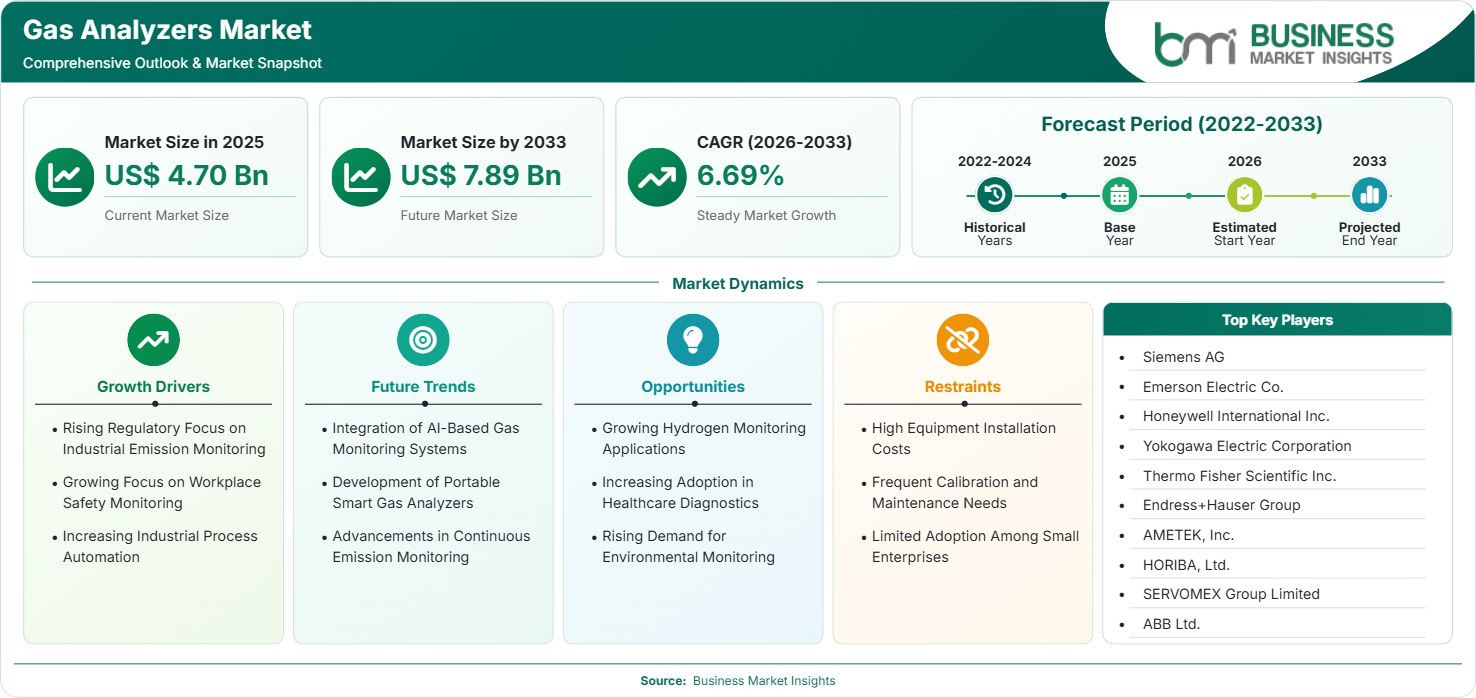
The Gas Analyzers Market size was valued at US$ 4.70 Billion in 2025 and is projected to reach US$ 7.89 Billion by 2033, growing at a CAGR of US$ 6.69% during 2026–2033, driven by emission regulations, industrial automation, process optimization, hydrogen monitoring applications, and increasing demand for real-time environmental compliance solutions.

Report Coverage
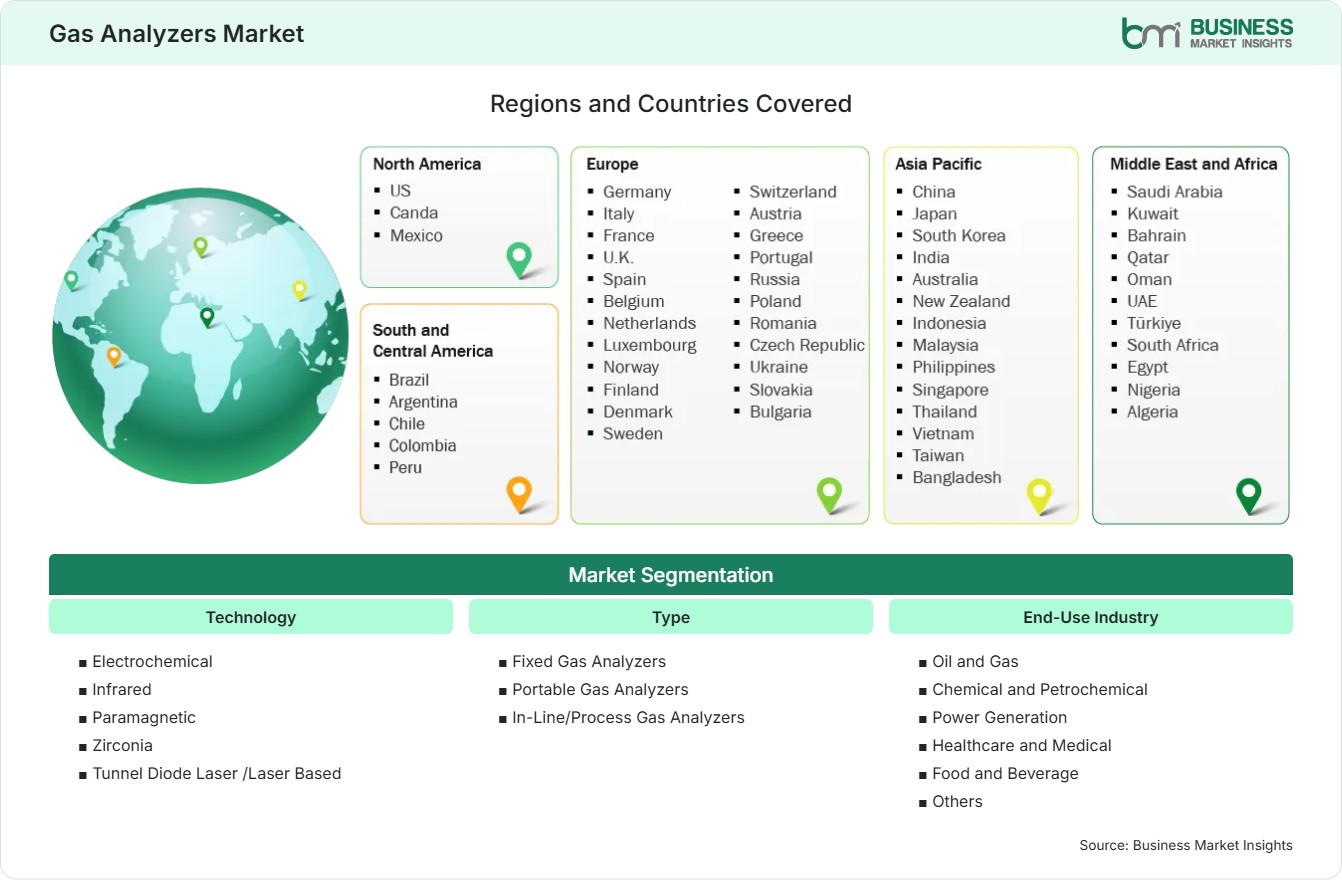
  • Technology: Electrochemical, Infrared, Paramagnetic, Zirconia, Tunnel Diode Laser /Laser Based
  • Type: Fixed Gas Analyzers, Portable Gas Analyzers, In-Line/Process Gas Analyzers
  • End-Use Industry: Oil and Gas, Chemical and Petrochemical, Power Generation, Healthcare and Medical, Food and Beverage, Others
US$ 4.70 Bn Market size in 2025
US$ 7.89 Bn Market Size by 2033
6.69% CAGR, 2026 - 2033
2026-2033 Forecast Period

AI Overview

Gas Analyzers Market Summary

  • North America Region: North America holds a market share of 34%–37% in 2025, growing with a CAGR of 6.1%–6.5%, influenced by strict emission standards, refinery modernization, and automation investments. The US market analysis shows steady adoption with a CAGR of 6.2%–6.6% from 2026–2033 due to industrial safety regulations.
  • Fastest Growing Region: Asia Pacific accounts for a share of 27%–30% in 2025, expanding at a CAGR of 7.3%–7.8%, supported by industrial expansion, power capacity additions, environmental monitoring programs, and increasing adoption of advanced analytical instruments across manufacturing sectors.
  • Leading Segment: Process gas analyzers represent a share of 38%–41% in 2025, advancing at a CAGR of 6.7%–7.1%, driven by continuous monitoring requirements, operational efficiency improvements, and demand for accurate measurement solutions in industrial production environments.
  • High Growth Segment: Laser-based technologies capture a share of 18%–21% in 2025, growing at a CAGR of 8.0%–8.5%, supported by high precision detection, lower maintenance requirements, and expanding applications in demanding industrial processes.
  • Key Market Opportunity: Expansion of hydrogen infrastructure, carbon management initiatives, and smart industrial systems creates opportunities for advanced gas measurement platforms with improved connectivity, accuracy, and predictive monitoring capabilities.
  • Major Market Players: Siemens AG, Emerson Electric Co., Honeywell International Inc., Yokogawa Electric Corporation, Thermo Fisher Scientific Inc., Endress+Hauser Group, AMETEK, Inc., HORIBA, Ltd., SERVOMEX Group Limited, and ABB Ltd.
Strategic Insights

Gas Analyzers Market: Strategic Insights

Gas Analyzers Market Strategic Framework
FREE PDF
Request your free sample
Request free sample
Stakeholder View

Key Takeaways

  • The market ecosystem is becoming more integrated, with manufacturers combining sensing technologies, software analytics, calibration services, and automation platforms to provide complete industrial monitoring solutions.
  • Process industries represent the strongest opportunity area as operators prioritize continuous measurement systems that improve efficiency, reduce downtime, and maintain compliance with increasingly strict operating standards.
  • Laser-based sensing technologies are reshaping product development by offering faster response times, improved selectivity, and reduced maintenance requirements compared with conventional measurement approaches.
  • Asia Pacific presents a compelling investment opportunity due to expanding manufacturing capacity, rising energy demand, and government initiatives focused on industrial emission control.
  • Industry consolidation is progressing through strategic collaborations, technology acquisitions, and portfolio expansion as companies seek stronger positions in digital industrial instrumentation.
  • Healthcare, hydrogen infrastructure, and environmental monitoring applications are creating diversified revenue opportunities beyond traditional process industries.
Geographic Outlook

Gas Analyzers Market Regional Highlights

North America Gas Analyzers Market

North America maintains a dominant position with a share of 34%–37% in 2025 and is projected to grow at a CAGR of 6.1%–6.5% between 2026–2033. The Gas Analyzers Market share in the region is supported by advanced industrial infrastructure, regulatory compliance requirements, and high adoption of automated monitoring systems across energy and manufacturing sectors.

  • Increasing environmental regulations are encouraging refineries and chemical plants to deploy continuous emission monitoring solutions with improved accuracy and digital integration capabilities.
  • Industrial automation investments across the US and Canada are strengthening demand for connected analytical instruments that provide real-time process visibility and operational control.
  • Growth in LNG infrastructure and energy transition projects is increasing adoption of advanced gas measurement technologies for safety and efficiency management.
  • The region benefits from strong presence of global instrument manufacturers, supporting innovation, service availability, and technology upgrades across industrial facilities.

US Gas Analyzers Market

The US represents a significant regional contributor, accounting for a share of 28%–31% in 2025 with a CAGR of 6.2%–6.6% during 2026–2033. The Gas Analyzers Market in the country benefits from industrial modernization, emission monitoring mandates, and increasing deployment of smart analytical systems across energy, healthcare, and manufacturing applications.

  • Federal and state environmental programs continue driving demand for reliable monitoring systems across power plants, refineries, and chemical processing facilities.
  • Expansion of hydrogen production projects is creating new requirements for precise gas composition measurement and safety monitoring solutions.
  • Industrial digitalization initiatives are increasing adoption of connected analyzers integrated with automation and control platforms.

Europe Gas Analyzers Market

Europe holds a share of 25%–28% in 2025 and is estimated to expand at a CAGR of 5.8%–6.3% through 2033. The Gas Analyzers Market growth in Europe is influenced by strict environmental policies, industrial decarbonization programs, and demand for efficient process management. Germany, the UK, and France remain important markets, while Germany demonstrates growth potential with a CAGR of 6.0%–6.4%.

  • European emission reduction targets are accelerating adoption of advanced monitoring technologies across industrial and energy sectors.
  • Germany’s manufacturing base supports demand for precision analytical equipment in automotive, chemical, and process industries.
  • The UK is increasing deployment of monitoring systems through energy transition and environmental compliance initiatives.
  • France is expanding industrial measurement applications through investments in clean energy and infrastructure modernization.
  • Regulatory emphasis on carbon accounting is encouraging adoption of connected analytical solutions.

Asia Pacific Gas Analyzers Market

Asia Pacific represents a rapidly expanding region with a share of 27%–30% in 2025 and a projected CAGR of 7.3%–7.8% during 2026–2033. The Gas Analyzers Market share across Asia Pacific is supported by industrial growth, power generation expansion, environmental regulations, and increasing automation adoption. China, Japan, India, and South Korea remain major contributors, with India showing strong potential through a CAGR of 7.5%–8.0%.

  • China’s industrial modernization programs are increasing demand for advanced monitoring systems across chemical, manufacturing, and energy facilities requiring continuous analysis.
  • India’s expanding power generation and manufacturing sectors are supporting adoption of analytical instruments for operational efficiency and emission management.
  • Japan continues investing in precision measurement technologies through advanced industrial automation and environmental control initiatives.
  • South Korea’s semiconductor, chemical, and energy industries are driving demand for high-performance gas monitoring solutions.
  • Growing environmental compliance requirements across emerging Asian economies are creating opportunities for connected analytical platforms.

Rest of World Gas Analyzers Market

Rest of World accounts for a share of 10%–13% in 2025 and is projected to grow at a CAGR of 5.5%–6.0% between 2026–2033. South and Central America are witnessing increased adoption through mining, energy, and industrial development projects, while Middle East and Africa markets are supported by oil and gas investments. Brazil demonstrates growth potential with a CAGR of 5.7%–6.2%, while Saudi Arabia expands at 5.8%–6.3%.

  • Brazil’s industrial and energy sectors are adopting analytical technologies to improve process efficiency and meet environmental requirements.
  • Middle Eastern countries are deploying advanced analyzers across refineries, petrochemical facilities, and hydrogen-related infrastructure projects.
  • African industrial development programs are gradually increasing demand for reliable process monitoring and emission control equipment.
  • Oil-producing economies are investing in digital refinery technologies requiring accurate gas measurement capabilities.
  • Infrastructure expansion across emerging markets is supporting wider adoption of automated analytical solutions.
Global Market Geography
FREE PDF
Request your free sample
Request free sample
Segment Analysis

Gas Analyzers Market Segmentation

Technology

Technology segmentation defines product adoption based on measurement accuracy, application requirements, and operating environments. The Gas Analyzers Market scope within this category is shaped by increasing preference for precise, automated, and connected analytical systems. The segment accounted for 2025 shares ranging across technologies, with laser-based solutions demonstrating faster adoption. Technology demand is supported by industrial automation, emission control, and process optimization requirements.

  • Electrochemical: Electrochemical analyzers remain widely used for oxygen, toxic gas, and safety monitoring applications due to affordability, portability, and suitability across industrial environments.
  • Infrared (NDIR/IR): Infrared analyzers support accurate measurement of gases such as carbon dioxide and hydrocarbons, benefiting from strong demand in environmental and industrial monitoring.
  • Paramagnetic: Paramagnetic technology provides reliable oxygen measurement for demanding applications, particularly healthcare, combustion control, and specialized industrial processes requiring precision.
  • Zirconia (ZrO2): Zirconia-based analyzers are preferred for high-temperature oxygen monitoring in combustion systems, improving efficiency across power generation and industrial heating operations.
  • Tunnel Diode Laser (TDL)/Laser Based: Laser-based analyzers are gaining adoption through high sensitivity, rapid response, and reduced maintenance requirements in complex industrial measurement applications.

Type

Type segmentation reflects deployment preferences across fixed, portable, and process-integrated systems. The Gas Analyzers Market trends indicate increasing demand for continuous monitoring solutions as industries prioritize operational safety and efficiency. Fixed and in-line systems maintain strong adoption due to industrial requirements, while portable systems support inspection, maintenance, and field measurement activities across diverse applications.

  • Fixed Gas Analyzers: Fixed analyzers support continuous monitoring in industrial facilities, enabling regulatory compliance, process control, and automated operational management.
  • Portable Gas Analyzers: Portable systems provide flexibility for field inspections, safety assessments, and temporary monitoring requirements across industrial and environmental applications.
  • In-Line/Process Gas Analyzers: In-line analyzers enable real-time process optimization through direct integration into production systems, improving efficiency and reducing operational risks.

End-Use Industry

End-use industries determine demand patterns based on safety standards, operational requirements, and environmental obligations. The market share across applications is influenced by energy, chemical processing, healthcare, and food industries requiring reliable measurement technologies. Industrial facilities increasingly use advanced analyzers for compliance, productivity improvement, and resource optimization.

  • Oil and Gas: Oil and gas companies use analyzers for combustion optimization, emission monitoring, pipeline management, and refinery process control applications.
  • Chemical and Petrochemical: Chemical facilities deploy analytical systems to improve production accuracy, maintain safety standards, and monitor complex process conditions.
  • Power Generation: Power plants utilize analyzers for combustion efficiency, emissions control, and equipment performance monitoring across thermal and renewable energy facilities.
  • Healthcare and Medical: Healthcare applications include respiratory analysis, medical gas verification, and diagnostic monitoring requiring accurate measurement capabilities.
  • Food and Beverage: Food industries apply gas analysis technologies for packaging control, quality management, and storage environment monitoring.
Market Forces

Gas Analyzers Market Dynamics

Key Market Drivers

Rising Regulatory Focus on Industrial Emission Monitoring

Emissions standards in industry are boosting the demand for continuous gas measuring devices in various industries, including manufacturing, energy production, and energy industries. Regulatory bodies around the world are tightening their air quality standards, thereby compelling firms to use high-tech monitoring systems. The market development will be driven by regulatory demands related to pollutants, greenhouse gas emissions, and process emissions. The latest Gas Analyzers Market trends indicate the rising popularity of digital monitors that give reliable reporting and remote access capability.

Growing Focus on Workplace Safety Monitoring

The rising need for safety at the workplace is driving the use of gas detection and analysis systems in industries where gases are hazardous in nature. Gas detection and analysis systems are being used in manufacturing units, chemical plants, and energy installations for protecting employees and preventing accidents. This need is being backed by the framework of occupational safety and risk management practices in the industry. Modern analyzers have faster detection, improved precision, and connectivity with emergency systems.

Increasing Industrial Process Automation

Industrial automation is driving increased need for smart analytical devices, which would enable the generation of process information instantly. Industrial enterprises are integrating analyzers into distributed control systems in order to enhance production efficiencies and save on resources. Automated measurements increase accuracy while reducing manual interference. The growth of smart factories and digital manufacturing will drive the adoption of smart gas monitoring systems. It is becoming increasingly important for organizations to opt for devices that can measure, analyze and diagnose processes remotely.

Key Market Opportunities

Growing Hydrogen Monitoring Applications

The development of the hydrogen network is opening up new prospects for modern analytical instruments, which can analyze hydrogen purity, hydrogen leaks, and process parameters. Rising investments in the installation of electrolyzers, fuel cells, and hydrogen storage systems make it necessary to develop monitoring systems to ensure safety and efficiency. As per the the Gas Analyzers Market Forecasts, hydrogen application is expected to open up a new source of demand due to the development of the low-carbon energy sector.

Increasing Adoption in Healthcare Diagnostics

The applications of gas measurement in the healthcare industry have become more diverse as medical facilities are implementing new gas measuring devices for purposes such as breathing analysis, anesthetic systems, and diagnostics. The growth in healthcare infrastructure investment and increasing need for reliable patient monitoring systems have facilitated the development and use of these technologies. Instruments that feature high accuracy, small sizes, and digital compatibility have become popular among manufacturers of medical equipment. This opens up avenues for diversification and development of products based on specific needs of the healthcare sector.

Rising Demand for Environmental Monitoring

Environmental monitoring programs provide more opportunities to the vendors of analytical instruments because of the increasing attention of governments and industries towards the management of air quality and climate change. In smart environmental monitoring systems, there is a need for reliable measurement devices that can monitor emissions and atmospheric conditions. More applications are being created through investments in urban monitoring solutions, sustainable industrial programs, and carbon management solutions. Companies providing connected analyzers with remote access to data and advanced analytics tools can capitalize on these trends.

Market Restraints and Challenges

High Equipment Installation Costs

Factor: High initial installation costs associated with advanced gas analyzers can limit adoption among small and medium-sized industrial users. Impact: Higher capital requirements may delay technology upgrades and restrict deployment in cost-sensitive applications. Sophisticated analyzers often require specialized installation, integration with control systems, and professional calibration services, increasing total ownership expenses. Although large industrial operators continue investing in advanced systems, smaller facilities may prefer lower-cost alternatives. This cost barrier can slow penetration across emerging markets where budget limitations influence purchasing decisions and technology adoption cycles.

Frequent Calibration and Maintenance Needs

Factor: Frequent calibration requirements and maintenance procedures increase operational complexity for gas analyzer users. Impact: Regular servicing can raise lifecycle costs and create temporary disruptions in monitoring activities. Analytical instruments require consistent calibration to maintain measurement accuracy, especially in harsh industrial environments involving temperature variations, contaminants, and continuous operation. Companies must allocate resources for skilled technicians, replacement components, and scheduled maintenance programs. These requirements can influence purchasing decisions, particularly among industries seeking simplified monitoring solutions with lower service dependency and reduced operational interruptions.

Company Analysis

Competitive Landscape

The Gas Analyzers Market analysis highlights a competitive environment shaped by established automation companies, analytical technology specialists, and industrial solution providers. Leading participants are focusing on product innovation, digital integration, application-specific solutions, and service expansion to strengthen their positions across industrial, environmental, and healthcare applications.

Company Name

Overview

Products and Services relevant to this market

Siemens AG

Global technology company providing industrial automation and measurement solutions across multiple sectors.

Process gas analyzers, emission monitoring systems, digital industrial measurement solutions.

Emerson Electric Co.

Industrial automation leader offering advanced process management technologies globally.

Gas analysis systems, process instrumentation, monitoring and control solutions.

Honeywell International Inc.

Diversified technology provider serving industrial safety and automation markets.

Gas analyzers, emission monitoring products, connected industrial safety systems.

Yokogawa Electric Corporation

Japanese measurement technology company specializing in industrial automation solutions.

Process analyzers, laser gas measurement systems, analytical instrumentation.

Thermo Fisher Scientific Inc.

Scientific technology company supporting laboratory and industrial analysis applications.

Gas analysis instruments, analytical technologies, monitoring solutions.

Endress+Hauser Group

Measurement instrumentation specialist serving process industries worldwide.

Gas analyzers, process measurement systems, industrial monitoring technologies.

AMETEK, Inc.

Global manufacturer of electronic instruments and electromechanical devices.

Process gas analyzers, spectroscopy solutions, industrial measurement products.

HORIBA, Ltd.

Japanese analytical equipment company serving automotive and industrial applications.

Gas analyzers, emission measurement systems, analytical instruments.

SERVOMEX Group Limited

Specialist provider of industrial gas analysis technologies.

Paramagnetic, zirconia, infrared gas analyzers and process solutions.

ABB Ltd.

Automation and electrification company offering industrial digital solutions.

Continuous gas analyzers, emission monitoring systems, process optimization technologies.

Trust & Transparency

Research Methodology

The market analysis combines proprietary research with secondary data from government agencies, company disclosures, regulatory filings, industry databases and expert interviews. Market estimates are validated through data triangulation, cross-market benchmarking and analyst review.

View Full Research Methodology

Questions Answered

Frequently Asked Questions

Why are hydrogen applications becoming important for analyzers?

Hydrogen projects require precise monitoring of purity, leakage, and production processes, creating new opportunities for specialized analytical instruments.

What information does the Gas Analyzers Market Report provide?

The market report provides insights into market size, segmentation, competitive dynamics, regional performance, trends, opportunities, and growth factors influencing future demand.

How is technology innovation affecting product development?

Innovation is focused on laser-based sensing, digital connectivity, remote diagnostics, and integration with industrial automation platforms to improve reliability and operational visibility.

Which industries represent major application areas for gas analyzers?

Oil and gas, chemical processing, power generation, healthcare, and food industries are major users because they require accurate measurement for safety, efficiency, and compliance.

What factors are influencing the adoption of advanced gas analyzers?

Industries are adopting advanced analyzers due to stricter emission regulations, automation requirements, workplace safety standards, and demand for real-time process optimization.

Access the Full Gas Analyzers Market Report

Get segment-level forecasts, regional estimates, competitive benchmarking, company profiles and downloadable Excel datasets.

Access the full Gas Analyzers Market Report
350 pages PDF & Excel | 2026-08-05