
Gas Sensors Market Outlook: Size, Share, Trends, Growth Analysis, Competitive Landscape & Forecast, 2026–2033

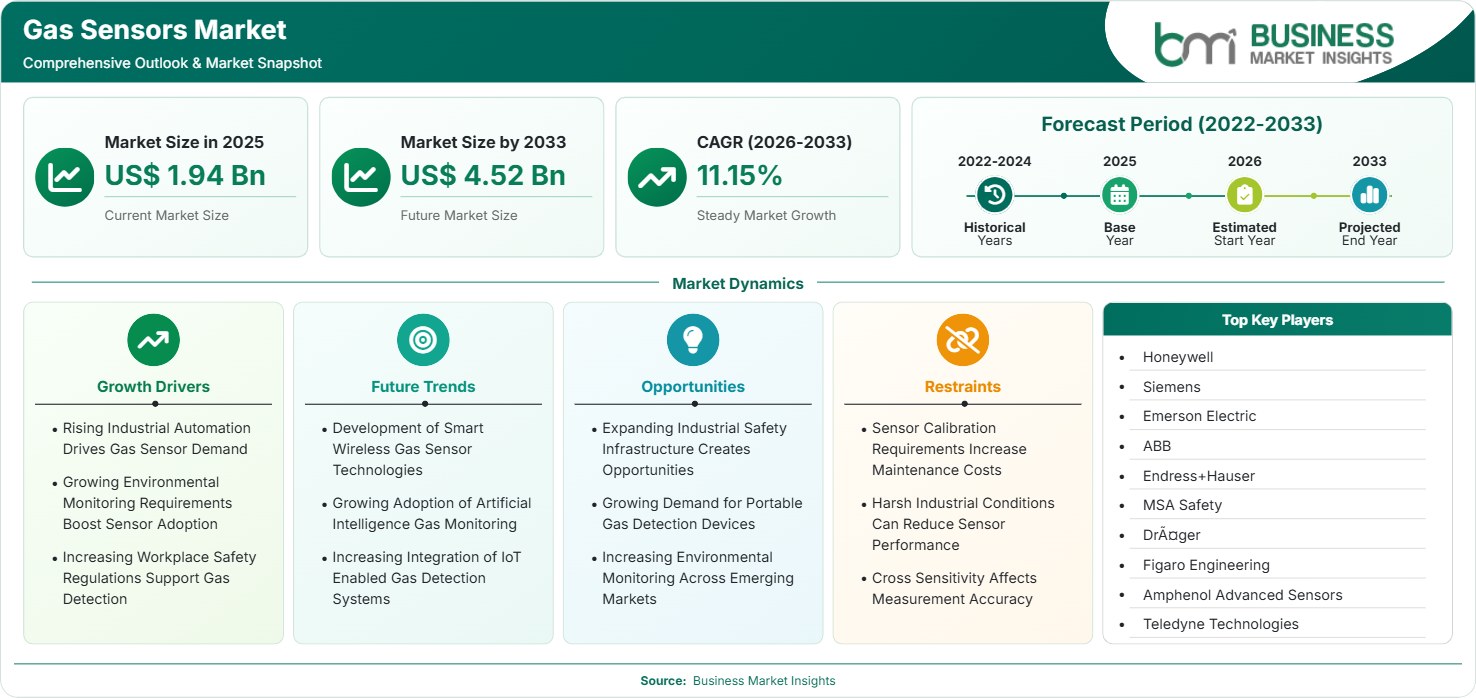
The Gas Sensors Market size was valued at US$ 1.94 billion in 2025 and is projected to reach US$ 4.52 billion by 2033, growing at a CAGR of 11.15% during 2026–2033, driven by industrial automation, environmental monitoring, workplace safety requirements, portable detection, and connected sensing systems.

Report Coverage
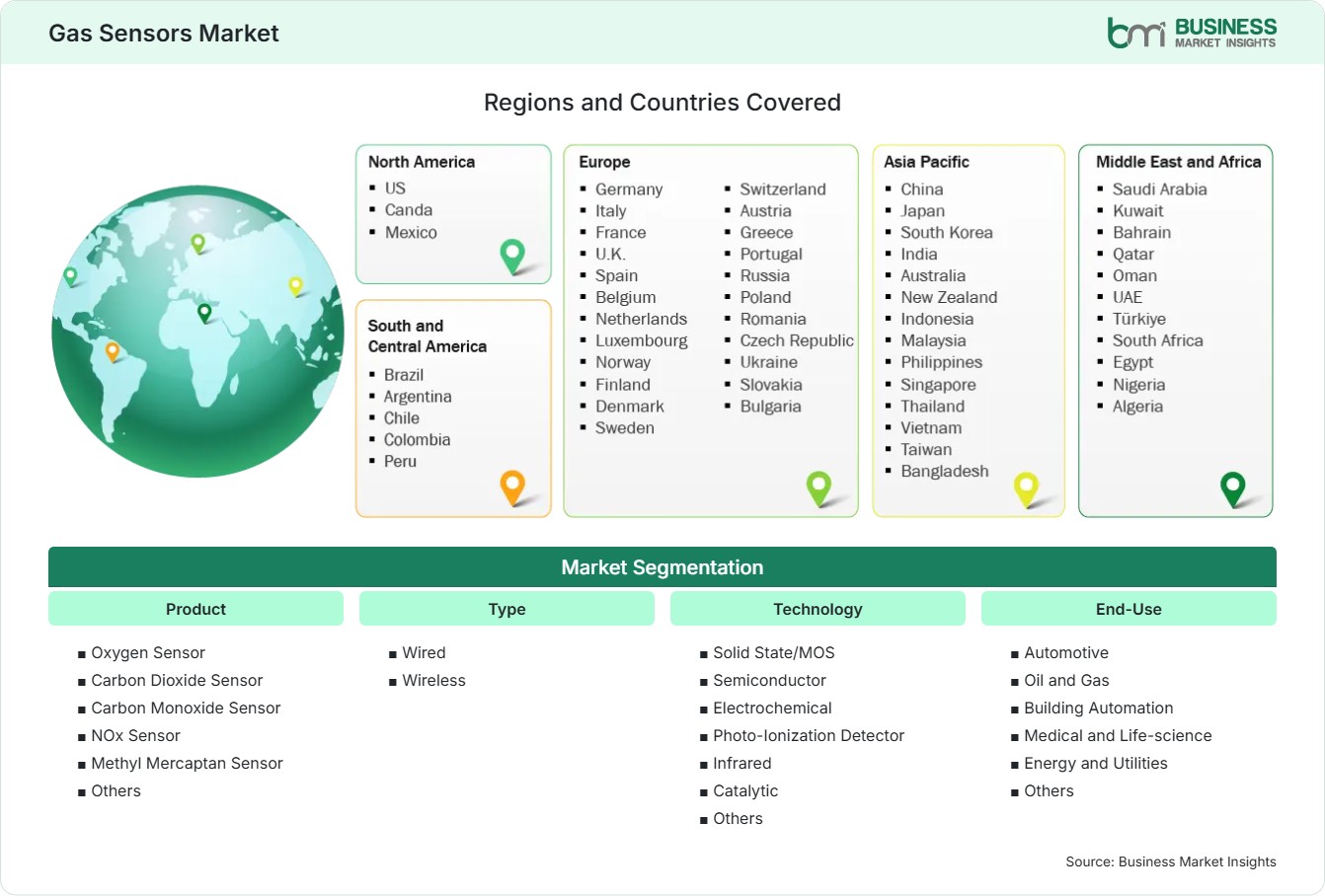
  • Product: Oxygen Sensor, Carbon Dioxide Sensor, Carbon Monoxide Sensor, NOx Sensor, Methyl Mercaptan Sensor, Others
  • Type: Wired, Wireless
  • Technology: Solid State/MOS, Semiconductor, Electrochemical, Photo-Ionization Detector , Infrared , Catalytic, Others
  • End-Use: Automotive, Oil and Gas, Building Automation, Medical and Life-science, Energy and Utilities, Others
US$ 1.94 Bn Market size in 2025
US$ 4.52 Bn Market Size by 2033
11.15% CAGR, 2026 - 2033
2026-2033 Forecast Period

AI Overview

Gas Sensors Market Summary

  • North America: North America holds 30%-34% share in 2025 and grows at a CAGR of 9.8%-10.7%, supported by industrial safety programs, process automation, environmental monitoring, building controls, and demand for connected detection. The U.S. accounts for 78%-83% of regional demand, supported by industrial automation, workplace monitoring, building safety, and established gas-detection infrastructure.
  • Fastest Growing Region: Asia Pacific holds 27%-31% share in 2025 and expands at a CAGR of 12.2%-13.4%, supported by manufacturing automation, industrial expansion, environmental monitoring, energy infrastructure, smart buildings, and increasing workplace safety requirements.
  • Leading Segment: Oxygen Sensor holds 25%-29% share in 2025 and grows at a CAGR of 10.3%-11.2%, supported by confined-space monitoring, combustion control, industrial processes, medical applications, and safety systems requiring oxygen-deficiency detection.
  • High Growth Segment: Wireless technology holds 28%-32% share in 2025 and grows at a CAGR of 13.2%-14.4%, driven by remote monitoring, industrial IoT, flexible installation, distributed sensing, predictive maintenance, and reduced wiring requirements.
  • Key Market Opportunity: Connected safety systems, portable detection, industrial IoT, environmental monitoring, and emerging-market industrialization create opportunities for intelligent, low-maintenance, network-enabled sensing platforms.
  • Major Market Players: Honeywell, Siemens, Emerson Electric, ABB, Endress+Hauser, MSA Safety, Dräger, Figaro Engineering, Amphenol Advanced Sensors, Teledyne Technologies.
Strategic Insights

Gas Sensors Market: Strategic Insights

Gas Sensors Market Strategic Framework
FREE PDF
Request your free sample
Request free sample
Stakeholder View

Key Takeaways

  • Value creation is moving from standalone sensing components toward integrated detection ecosystems connecting sensors, transmitters, control platforms, alarms, analytics, and maintenance workflows.
  • Portable and wireless detection offers strong upside because operators can deploy monitoring across temporary work zones, confined spaces, remote assets, and facilities where permanent wiring is impractical.
  • Sensor innovation is increasingly focused on miniaturization, lower power consumption, faster response, interference reduction, digital diagnostics, and multi-gas capabilities.
  • Asia Pacific presents a compelling expansion opportunity as industrial automation, manufacturing capacity, energy infrastructure, and environmental monitoring requirements broaden the installed base.
  • Procurement is increasingly influenced by lifecycle cost, calibration requirements, interoperability, cybersecurity considerations, service support, and compatibility with industrial control environments.
  • Competitive differentiation is shifting toward sensing accuracy, durability, connectivity, diagnostics, application-specific engineering, and the ability to combine detection with broader safety and automation workflows.
Geographic Outlook

Gas Sensors Market Regional Highlights

North America Gas Sensors Market

North America represents 30%-34% share in 2025 and grows at a CAGR of 9.8%-10.7% through 2033. Industrial automation, environmental compliance, workplace safety, building controls, and energy infrastructure sustain demand across established applications.

  • Industrial facilities increasingly integrate gas detection with automation platforms, enabling continuous monitoring, alarm management, remote diagnostics, and faster response to abnormal operating conditions.
  • Oil and gas operations require dependable detection across processing areas, storage facilities, pipelines, and confined spaces, supporting demand for fixed and portable sensing systems.
  • Building automation is creating opportunities for carbon dioxide and indoor-air monitoring as facility operators prioritize ventilation management, occupant comfort, and energy efficiency.
  • Portable multi-gas instruments remain important for maintenance, emergency response, confined-space entry, and industrial inspection activities where flexible deployment is required.

US Gas Sensors Market

The U.S. represents 78%-83% of North American demand in 2025 and grows at a CAGR of 9.6%-10.5%. Industrial safety, process automation, environmental monitoring, and building applications support continued adoption.

  • Industrial operators increasingly connect gas detection with centralized control and safety systems to improve visibility across production areas and remote assets.
  • Portable detection remains important across confined-space operations, emergency response, maintenance, and hazardous industrial environments requiring immediate atmospheric assessment.
  • Building operators are expanding indoor environmental monitoring capabilities, creating demand for compact carbon dioxide and multi-parameter sensing solutions.

Europe Gas Sensors Market

Europe represents 24%-28% Gas Sensors Market share in 2025 and grows at a CAGR of 9.4%-10.5%. Germany leads regional demand, while the United Kingdom, France, Italy, and Spain provide additional opportunities.

  • Germany benefits from advanced manufacturing, process automation, industrial safety infrastructure, and demand for reliable monitoring across complex production environments.
  • The United Kingdom provides opportunities through energy infrastructure, environmental monitoring, industrial facilities, and building-management applications requiring continuous gas measurement.
  • France and Italy support adoption through manufacturing, utilities, transportation, healthcare, and commercial-building applications where environmental and safety monitoring are increasingly integrated.
  • Spain offers opportunities through industrial modernization, renewable-energy infrastructure, hospitality facilities, and building automation requiring connected environmental monitoring.

Asia Pacific Gas Sensors Market

Asia Pacific represents 27%-31% share in 2025 and expands at a CAGR of 12.2%-13.4%. China leads regional demand, while India, Japan, and South Korea provide high-growth opportunities.

  • China benefits from manufacturing expansion, industrial automation, environmental monitoring, energy development, and increasing deployment of connected industrial safety systems.
  • India is expanding industrial capacity and infrastructure, creating demand for gas detection across manufacturing, energy, utilities, buildings, and workplace safety applications.
  • Japan provides mature demand across automotive, electronics, industrial automation, healthcare, and building applications requiring precise and reliable sensing.
  • South Korea offers opportunities through semiconductor, electronics, chemical, energy, and advanced manufacturing facilities requiring sophisticated monitoring capabilities.

Rest of World Gas Sensors Market

Rest of World represents 11%-15% share in 2025 and grows at a CAGR of 9.1%-10.3%. Latin America provides leading opportunities, while Middle Eastern markets benefit from energy and industrial investments.

Middle Eastern Gas Sensors Markets are supported by oil and gas, petrochemicals, utilities, construction, and smart-building investments. Saudi Arabia and the United Arab Emirates lead regional adoption, while selected African markets provide longer-term opportunities.

  • Brazil provides demand across energy, mining, manufacturing, utilities, and workplace safety applications, supporting deployment of fixed and portable detection equipment.
  • Mexico benefits from manufacturing expansion, automotive production, energy infrastructure, and industrial modernization requiring dependable gas-monitoring capabilities.
  • Saudi Arabia provides opportunities through energy, petrochemical, industrial, and infrastructure projects requiring continuous atmospheric monitoring and safety systems.
  • The United Arab Emirates supports adoption through energy facilities, commercial buildings, smart infrastructure, and advanced industrial safety programs.
Global Market Geography
FREE PDF
Request your free sample
Request free sample
Segment Analysis

Gas Sensors Market Segmentation

Product

Oxygen Sensor represents 25%-29% share in 2025 and grows at a CAGR of 10.3%-11.2% through 2033, supported by industrial safety, combustion processes, medical systems, and confined-space monitoring. The Gas Sensors Market scope therefore spans safety, environmental, process, automotive, and healthcare monitoring applications.

  • Oxygen Sensor: Oxygen sensing supports confined-space safety, combustion optimization, medical equipment, and industrial processes where oxygen deficiency or enrichment requires dependable monitoring.
  • Carbon Dioxide Sensor: Carbon dioxide sensors support ventilation control, indoor-air monitoring, food applications, healthcare environments, and building automation requiring continuous concentration measurement.
  • Carbon Monoxide Sensor: Carbon monoxide sensors provide critical detection across buildings, industrial workplaces, combustion systems, and automotive environments where exposure monitoring is required.
  • NOx Sensor: NOx sensors support emissions monitoring, automotive control systems, combustion management, and environmental applications requiring measurement of nitrogen oxide concentrations.
  • Methyl Mercaptan Sensor: Methyl mercaptan sensing supports odorant detection in gas distribution and industrial applications where leak identification and safety monitoring are important.
  • Others: Other gas sensors address application-specific gases across industrial processing, healthcare, environmental monitoring, energy, utilities, and specialized safety requirements.

Type

Wired systems represent 68%-72% share in 2025 and grow at a CAGR of 10.2%-11.0% through 2033, supported by established industrial infrastructure and continuous fixed monitoring. Wireless systems are expanding faster as facilities seek flexible installation and remote connectivity. Adoption depends on power management, network reliability, cybersecurity, environmental durability, and integration with existing control systems.

  • Wired: Wired systems provide dependable continuous connectivity for fixed installations across industrial facilities, utilities, buildings, and process environments requiring centralized monitoring.
  • Wireless: Wireless systems simplify deployment across distributed assets and remote locations while reducing cabling requirements and enabling flexible monitoring architectures.

Technology

Electrochemical technology represents 30%-34% share in 2025 and grows at a CAGR of 10.5%-11.4% through 2033, supported by toxic-gas and oxygen detection applications. Infrared and semiconductor technologies are gaining importance in selective and continuous monitoring.

  • Solid State/MOS: Solid-state and MOS sensors provide compact gas detection for consumer, building, automotive, and industrial applications requiring economical sensing architectures.
  • Semiconductor: Semiconductor technologies support compact detection systems and application-specific monitoring where integration, sensitivity, and manufacturing scalability are important.
  • Electrochemical: Electrochemical sensors provide selective measurement for oxygen and toxic gases and remain widely used in portable and fixed safety instruments.
  • Photo-Ionization Detector (PID): PID technology supports volatile organic compound detection and industrial monitoring applications requiring sensitive measurement of ionizable compounds.
  • Infrared (IR): Infrared sensors support continuous and selective gas measurement, particularly where long-term stability, non-contact detection principles, and reduced sensor poisoning are advantageous.
  • Catalytic: Catalytic sensors support combustible-gas detection and are widely relevant to industrial safety applications requiring monitoring of flammable atmospheres.
  • Others: Other technologies address specialized gases, environmental conditions, detection ranges, and application requirements not served efficiently by mainstream sensing methods.

End-Use

Oil and Gas represents 27%-31% share in 2025 and grows at a CAGR of 10.7%-11.6% through 2033, supported by hazardous-area monitoring, process safety, leak detection, and maintenance activities. Automotive, building automation, medical and life-science, and energy and utilities applications broaden demand.

  • Automotive: Automotive applications use gas sensing for emissions management, cabin monitoring, powertrain systems, and increasingly sophisticated vehicle environmental-control functions.
  • Oil and Gas: Oil and gas facilities require fixed and portable detection across production, processing, storage, transportation, and maintenance environments with hazardous-atmosphere risks.
  • Building Automation: Building automation applications use gas sensing for ventilation management, indoor-air quality, safety monitoring, and connected facility-control systems.
  • Medical and Life-science: Medical and life-science applications require reliable gas measurement across equipment, laboratories, controlled environments, and specialized healthcare processes.
  • Energy and Utilities: Energy and utilities applications use gas sensors across generation, distribution, storage, maintenance, and safety operations requiring continuous atmospheric monitoring.
  • Others: Other end uses include manufacturing, mining, transportation, food processing, environmental monitoring, and specialized industrial applications with gas-detection requirements.
Market Forces

Gas Sensors Market Dynamics

Key Market Drivers

Rising Industrial Automation Drives Gas Sensor Demand

There is an increase in the demand for continuous sensing as industries embrace automation in manufacturing processes, process equipment, storage locations, and safety systems. There are various factors driving the Gas Sensors Market growth, and one such factor is the increased use of integrated control systems that need accurate field measurements. Gas sensors are now supplying inputs for alarm systems, process management, ventilation control, and predictive maintenance operations. With their integration into industrial networks, users have the ability to manage different assets without having to rely entirely on manual monitoring techniques. With increased network integration, there is a transition from safety equipment to an embedded sensing layer.

Growing Environmental Monitoring Requirements Boost Sensor Adoption

The increasing requirement for environmental monitoring in industries, commercial establishments, energy systems, and environments is widening the scope of applications for gas sensors. Users need such devices to measure emissions, improve ventilation, monitor combustion, and implement their environmental management strategies. The Gas Sensors Market trend is motivating the development of portable solutions able to transfer measurements to centralized platforms. Different types of gas sensors for CO2, CO, NOx, and other specific applications can meet diverse needs for environmental and process monitoring. Selection of sensors now depends not only on selectivity but also on stability, response time, interference resistance, and operating conditions.

Increasing Workplace Safety Regulations Support Gas Detection

Workplace safety guidelines are still fueling the demand for direct-reading gas monitors as well as fixed gas detectors in dangerous settings. The Gas Sensors Market forecast is likely to remain tied to the continued need for reliable gas sensing equipment in situations involving oxygen deprivation, toxicity, or flammability in the atmosphere. Portable multi-gas sensors will serve as monitoring tools in restricted areas, whereas fixed gas detectors will continuously monitor permanent areas for any dangers. Furthermore, the regulatory focus on reliability will work in favor of providers who can offer proper documentation, calibration, replacement, and training services based on the applications.

Key Market Opportunities

Expanding Industrial Safety Infrastructure Creates Opportunities

Modernization of industries offers possibilities to suppliers to offer the replacement of individual detectors with safety architecture integration solutions. Construction of new factories, plants, warehouses, energy sites, and infrastructure projects can have integrated gas detection systems from the very beginning of system integration. Integration solutions can combine sensor capabilities with alarm capabilities, control systems, maintenance systems, and remote monitoring capabilities. The suppliers will be able to stand out with their modular architecture, allowing the use of various sensor and communication technology standards. It is especially relevant when it comes to facilities that are increasing automation and safety infrastructure at the same time.

Growing Demand for Portable Gas Detection Devices

The portability of gas detection is becoming significant as workers shift from one restricted space to another in maintenance areas, inspection areas, and temporary worksites. Multi-gas detectors may allow workers not to have to use multiple instruments at once and monitor the levels of oxygen, combustibles, and chosen toxic gases at once. There are possibilities for designing small detectors with higher runtime capabilities, durable build, wireless communication, data logging, and easier calibration processes. Another option for manufacturers is the creation of cloud-connected monitoring systems that will enable supervisors to see worker exposure and the status of the instrument.

Increasing Environmental Monitoring Across Emerging Markets

Emerging markets offer prospects due to increased need for environmental and workplace monitoring as a result of industrialization, urbanization, energy exploitation, and infrastructure construction. New industrial establishments could implement modern sensors without the limitations imposed by their old systems. Market demand could arise from the manufacturing sector, utility industry, transportation, building, energy, and environmental sectors. Suppliers could serve these markets through localized distribution, application engineering, low-cost sensor systems, and maintenance. Wireless sensors could be especially useful if the existing facilities do not have established wiring. Technical support in the local area is crucial since the accuracy of sensors relies on maintenance.

Market Restraints and Challenges

Sensor Calibration Requirements Increase Maintenance Costs

Factor: There is a possibility of calibration drift in the case of gas sensors due to reasons such as chemical breakdown, environmental factors, presence of interfering gases, and exposure to challenging operational conditions. Impact: Regular calibration, testing, and replacing the gas sensors and maintenance can lead to increased lifecycle cost. Calibration is especially essential for portable safety devices, as any incorrect reading may jeopardize the safety of the workers. This requires that the operators have suitable reference gases, calibration processes, skilled personnel, and proper maintenance schedules. The suppliers can reduce the burden by providing diagnostics, durable sensing components, and automated calibration support.

Harsh Industrial Conditions Can Reduce Sensor Performance

Factor: Temperature extremes, humidity, particulates, corrosive gases, vibration, pressure change, and exposure to high concentrations of gases may negatively impact the operation of a sensor or may lead to sensor drift. Impact: Extreme conditions may result in a drop in the accuracy of a sensor, a shorter lifespan of a sensor, more servicing needs, and unexpected expenses for replacing sensors. Thus, industrial companies need sensors that are designed to work in certain environmental conditions as opposed to general detection sensors. However, extreme environmental conditions are still difficult due to the various responses of sensors. Protective housings, filters, algorithms for compensation, tough material, and calibration specific to applications can enhance reliability. However, harsh environments are still difficult because various sensors react differently to contaminants and other conditions.

Company Analysis

Competitive Landscape

The Gas Sensors Market analysis reflects competition among industrial automation providers, safety specialists, instrumentation manufacturers, sensor developers, and diversified technology companies. Competitive positioning depends on sensing accuracy, technology breadth, application engineering, connectivity, ruggedness, calibration support, and global service capabilities.

Company Name

Overview

Products and Services relevant to this market

Honeywell

Diversified technology company serving industrial automation, safety, buildings, aerospace, and connected industrial applications.

Gas detectors, fixed and portable monitoring systems, sensors, transmitters, controllers, alarms, and connected safety solutions.

Siemens

Industrial technology provider with broad automation, building, infrastructure, and process-control capabilities.

Gas detection components, sensing technologies, automation integration, building controls, process instrumentation, and monitoring systems.

Emerson Electric

Industrial technology company focused on automation, process management, measurement, and operational safety.

Gas detection, process instrumentation, analytical systems, transmitters, monitoring platforms, and industrial automation integration.

ABB

Electrification and automation company serving industrial, energy, and infrastructure applications.

Gas analyzers, process measurement systems, safety instrumentation, monitoring solutions, and automation integration.

Endress+Hauser

Measurement and instrumentation specialist focused on process industries and industrial monitoring.

Gas analyzers, process sensors, measurement systems, analytical instrumentation, and monitoring technologies.

MSA Safety

Safety technology company specializing in worker protection and hazardous-environment monitoring.

Portable gas detectors, fixed gas monitoring, multi-gas instruments, sensors, alarms, and safety accessories.

Dräger

Safety and medical technology company with extensive gas detection and respiratory protection expertise.

Portable and fixed gas detectors, multi-gas monitors, sensors, calibration systems, and hazardous-area monitoring solutions.

Figaro Engineering

Sensor specialist developing gas sensing technologies for industrial, automotive, and consumer applications.

Semiconductor gas sensors, air-quality sensors, detection modules, and application-specific sensing components.

Amphenol Advanced Sensors

Sensor technology provider serving industrial, automotive, environmental, and medical applications.

Gas sensors, environmental sensors, sensing modules, transmitters, and application-specific monitoring components.

Teledyne Technologies

Technology company providing instrumentation, digital imaging, sensing, and industrial measurement solutions.

Gas detection and analytical instrumentation, sensing components, monitoring technologies, and specialized measurement systems.

Trust & Transparency

Research Methodology

The market analysis combines proprietary research with secondary data from government agencies, company disclosures, regulatory filings, industry databases and expert interviews. Market estimates are validated through data triangulation, cross-market benchmarking and analyst review.

View Full Research Methodology

Questions Answered

Frequently Asked Questions

What does the Gas Sensors Market report indicate about future competition?

The report indicates that competition will increasingly focus on sensing accuracy, durability, connectivity, calibration efficiency, miniaturization, multi-gas capability, and integration with automation platforms. Suppliers with strong application engineering and lifecycle service capabilities can strengthen customer relationships and expand recurring revenue opportunities.

Why are wireless gas detection systems creating new opportunities?

Wireless systems reduce cabling requirements and can simplify monitoring across distributed assets, remote locations, temporary work areas, and facilities undergoing modernization. Connectivity also enables remote diagnostics, centralized alarms, data logging, and integration with broader industrial monitoring platforms.

How are advanced sensing technologies influencing adoption?

Electrochemical, infrared, semiconductor, catalytic, MOS, and PID technologies enable detection of different gases under varied operating conditions. Technology selection is increasingly driven by selectivity, response speed, environmental durability, power consumption, interference resistance, and application-specific measurement requirements.

Which applications present the strongest opportunity in the market?

Oil and gas, industrial automation, building automation, energy and utilities, automotive, and portable workplace monitoring offer strong opportunities. Demand is particularly attractive where continuous detection, remote monitoring, environmental compliance, or hazardous-atmosphere protection is essential.

What factors are improving Gas Sensors Market return on investment?

Industrial automation, workplace safety requirements, environmental monitoring, connected facilities, and expanding portable detection are improving return on investment. Sensors can support both safety and operational objectives by providing continuous measurements for alarms, ventilation, process management, maintenance, and environmental monitoring.

Access the Full Gas Sensors Market Report

Get segment-level forecasts, regional estimates, competitive benchmarking, company profiles and downloadable Excel datasets.

Access the full Gas Sensors Market Report
350 pages PDF & Excel | 2026-08-19