
Intelligent Flow Meter Market Outlook: Size, Share, Trends, Growth Analysis, Competitive Landscape & Forecast, 2026-2033

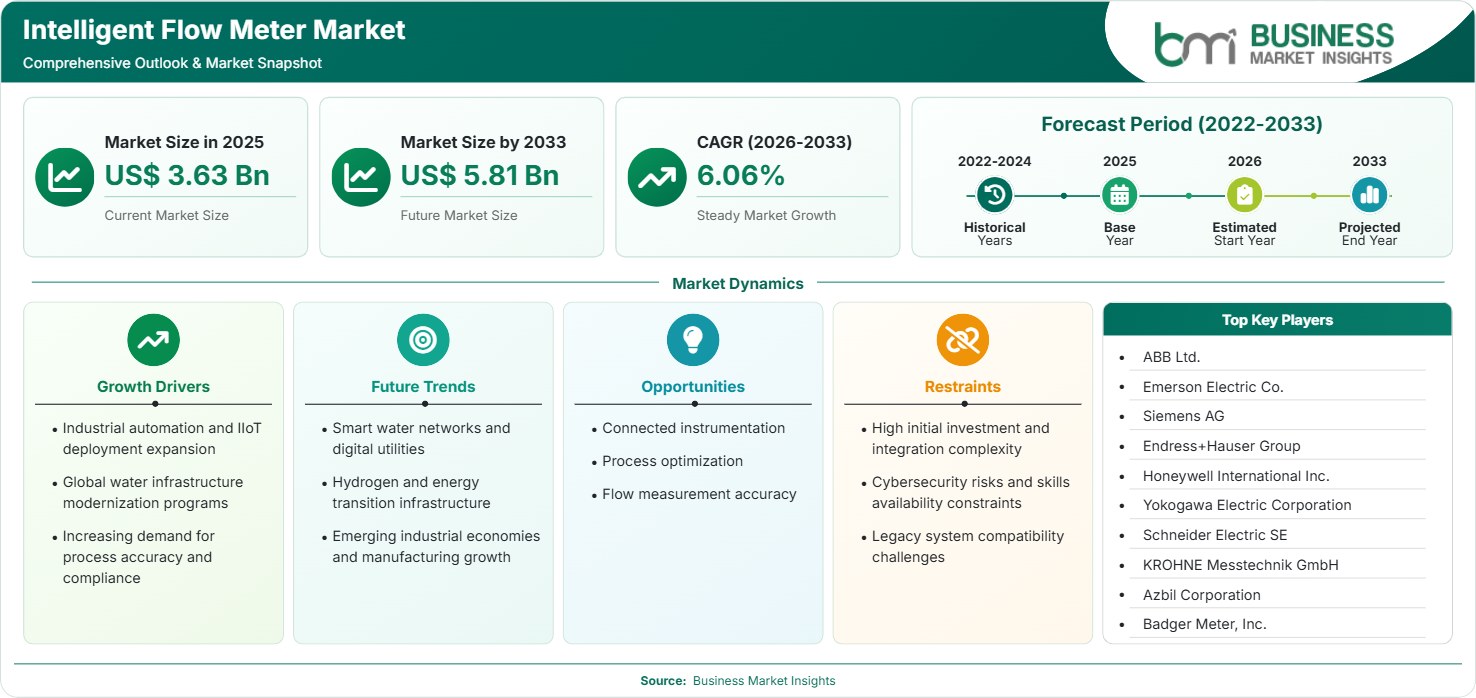
The Intelligent Flow Meter Market size was valued at US$ 3.63 Billion in 2025 and is projected to reach US$ 5.81 Billion by 2033, growing at a CAGR of 6.06% during 2026–2033, driven by industrial automation, IIoT integration, smart water management investments, process efficiency requirements, and expanding deployment opportunities across energy, chemicals, and advanced manufacturing facilities.

Report Coverage
  • Product Type: Coriolis Flow Meter, Electromagnetic Flow Meter, Ultrasonic Flow Meter, Vortex Flow Meter, Thermal Mass Flow Meter, Differential Pressure Flow Meter, Turbine Flow Meter, Positive Displacement Flow Meter
  • Application: Industrial, Oil and Gas, Chemicals and Petrochemicals, Power Generation, Food and Beverages, Water and Wastewater, Pharmaceuticals and Biotechnology, Pulp, Paper, Textile, Commercial, Residential
US$ 3.63 Bn Market size in 2025
US$ 5.81 Bn Market Size by 2033
6.06% CAGR, 2026 - 2033
2026-2033 Forecast Period

AI Overview

Intelligent Flow Meter Market Summary

  • North America Region: North America holds market share of 32%–35% in 2025, growing with a CAGR of 5.4%–5.8% during 2026–2033. Growth is supported by refinery modernization, smart utility programs, digital instrumentation upgrades, cybersecurity-focused automation architectures, predictive maintenance adoption, asset optimization initiatives, regulatory compliance requirements, and industrial efficiency investments across sectors. U.S. demand remains strong due to oilfield digitization, water infrastructure upgrades, and industrial automation adoption, recording 5.5%–5.9% CAGR.
  • Fastest Growing Region: Asia Pacific accounts for 28%–31% share in 2025 and advances at 7.2%–7.8% CAGR. Rapid industrialization, expanding manufacturing capacity, smart water projects, chemical sector investments, energy infrastructure deployment, process automation adoption, digital monitoring requirements, and regional sustainability initiatives accelerate equipment demand substantially.
  • Leading Segment: Electromagnetic (Mag) Flow Meter represents 24%–27% share in 2025 and grows at 6.0%–6.5% CAGR. Strong suitability for water applications, low maintenance requirements, measurement accuracy, wastewater infrastructure spending, smart utility adoption, process reliability needs, and regulatory monitoring requirements sustain growth.
  • High Growth Segment: Ultrasonic Flow Meter captures 14%–17% share in 2025 while expanding at 7.5%–8.1% CAGR. Non-invasive measurement capability, digital connectivity, predictive diagnostics, infrastructure monitoring applications, leakage management requirements, installation flexibility, and lower lifecycle costs support rapid adoption.
  • Key Market Opportunity: Digital water networks increasingly require connected measurement infrastructure that enables continuous analytics, leakage reduction, resource optimization, remote monitoring, predictive maintenance, regulatory reporting, and operational efficiency across utility environments.
  • Major Market Players: ABB Ltd., Emerson Electric Co., Siemens AG, Endress+Hauser Group, Honeywell International Inc., Yokogawa Electric Corporation, Schneider Electric SE, KROHNE Messtechnik GmbH, Azbil Corporation, and Badger Meter, Inc.
Strategic Insights

Intelligent Flow Meter Market: Strategic Insights

Intelligent Flow Meter Market Strategic Framework
FREE PDF
Request your free sample
Request free sample
Stakeholder View

Key Takeaways

  • Digital measurement ecosystems are becoming central to industrial operations, creating recurring revenue opportunities through software, diagnostics, calibration services, and asset-performance monitoring.
  • Water and wastewater infrastructure modernization presents one of the strongest long-term demand avenues due to leakage reduction objectives and regulatory performance requirements.
  • Product innovation increasingly focuses on embedded intelligence, cybersecurity, wireless communication, and predictive maintenance functionality rather than measurement capability alone.
  • Asia Pacific offers the most compelling investment case, supported by manufacturing expansion, utility modernization, and large-scale process industry investments.
  • Strategic acquisitions increasingly target analytics software, sensor technology, and industrial connectivity platforms, enabling suppliers to deliver integrated automation solutions.
  • Sustainability objectives are encouraging broader deployment of advanced instrumentation to optimize energy consumption, resource use, and regulatory reporting accuracy.
Geographic Outlook

Intelligent Flow Meter Market Regional Highlights

North America Intelligent Flow Meter Market

North America accounted for 32%–35% Intelligent Flow Meter Market share in 2025 and is projected to expand at 5.4%–5.8% CAGR through 2033. Demand stems from refinery upgrades, industrial automation investments, smart water infrastructure initiatives, and advanced process manufacturing requirements. Energy producers increasingly deploy connected instrumentation to improve operational efficiency and asset reliability. Stringent environmental compliance standards and growing digitalization across utility networks continue supporting adoption, particularly within oil and gas, chemicals, power generation, and municipal water management environments.

  • Refinery modernization projects are increasing deployment of intelligent instrumentation for process optimization, emissions monitoring, and predictive maintenance requirements.
  • Municipal water utilities continue expanding smart metering programs to improve leakage detection, operational visibility, and resource management.
  • Industrial automation investments support the replacement of legacy analog equipment with digitally integrated measurement systems.
  • Growing cybersecurity requirements encourage the adoption of next-generation devices incorporating secure communication protocols and advanced diagnostics.

US Intelligent Flow Meter Market

The United States represented approximately 74%–78% of the North American Intelligent Flow Meter Market share in 2025 while advancing at 5.5%–5.9% CAGR. Investments across shale operations, LNG infrastructure, pharmaceutical manufacturing, and smart utility modernization strengthen demand. Process industries prioritize digital measurement technologies that improve reliability, safety, and operational performance. Federal infrastructure programs supporting water system upgrades and industrial competitiveness continue encouraging deployment of connected monitoring equipment throughout critical sectors.

  • Water infrastructure funding supports replacement of aging measurement assets and deployment of remote monitoring technologies.
  • LNG export expansion creates new opportunities for high-performance metering solutions across energy value chains.
  • Pharmaceutical manufacturing facilities increasingly require precise measurement and validation capabilities.
  • Industrial digitalization strategies continue accelerating demand for integrated instrumentation platforms.

Europe Intelligent Flow Meter Market

Europe captured 25%–28% Intelligent Flow Meter Market share in 2025 and is anticipated to grow at 5.6%–6.1% CAGR. Sustainability policies, energy efficiency objectives, and industrial modernization programs stimulate adoption. Germany leads regional demand, while Eastern European industrial investment supports incremental opportunities. The United Kingdom and France remain significant markets for water and process industry applications. Regulatory emphasis on emissions monitoring, resource efficiency, and digital operations reinforces long-term equipment deployment prospects.

  • Germany remains the leading regional market, supported by advanced manufacturing and industrial automation initiatives.
  • Poland is among the fastest-growing opportunities, benefiting from industrial infrastructure expansion and modernization projects.
  • Energy transition investments generate demand for measurement technologies used in hydrogen and renewable applications.
  • Water efficiency regulations encourage utilities to deploy advanced monitoring and control systems.

Asia Pacific Intelligent Flow Meter Market

Asia Pacific held 28%–31% Intelligent Flow Meter Market share in 2025 and is forecast to register the strongest expansion at 7.2%–7.8% CAGR. The region benefits from manufacturing growth, urban infrastructure investment, industrial automation adoption, and rapid utility modernization. China remains the largest revenue contributor, while India records the highest growth trajectory. Expanding chemical production, semiconductor manufacturing, power infrastructure, and water treatment capacity continue to generate substantial demand across numerous industrial sectors.

  • China leads regional consumption through large-scale manufacturing, chemicals, and municipal utility investments.
  • India is among the fastest-growing national markets due to industrialization and infrastructure development programs.
  • Southeast Asian economies continue investing in wastewater treatment and industrial processing facilities.
  • Smart factory strategies accelerate adoption of digitally connected measurement technologies.
  • Growing environmental regulations strengthen demand for monitoring and reporting capabilities.

Rest of World Intelligent Flow Meter Market

Rest of World represented 12%–15% share in 2025 and is anticipated to expand at 6.1%–6.7% CAGR. South and Central America benefit from mining, water infrastructure, and energy sector investments. Meanwhile, Middle East and Africa demand is supported by desalination, petrochemicals, and large-scale industrial diversification projects. Countries including Saudi Arabia, the UAE, Brazil, and Chile remain important growth contributors as operators increasingly prioritize automation and operational efficiency.

  • Saudi Arabia benefits from industrial diversification programs and major petrochemical investments.
  • UAE desalination and utility modernization projects support increasing instrumentation deployment.
  • Brazil remains the leading Latin American market due to industrial processing and infrastructure investment.
  • Chile's mining sector continues adopting advanced monitoring technologies to improve productivity.
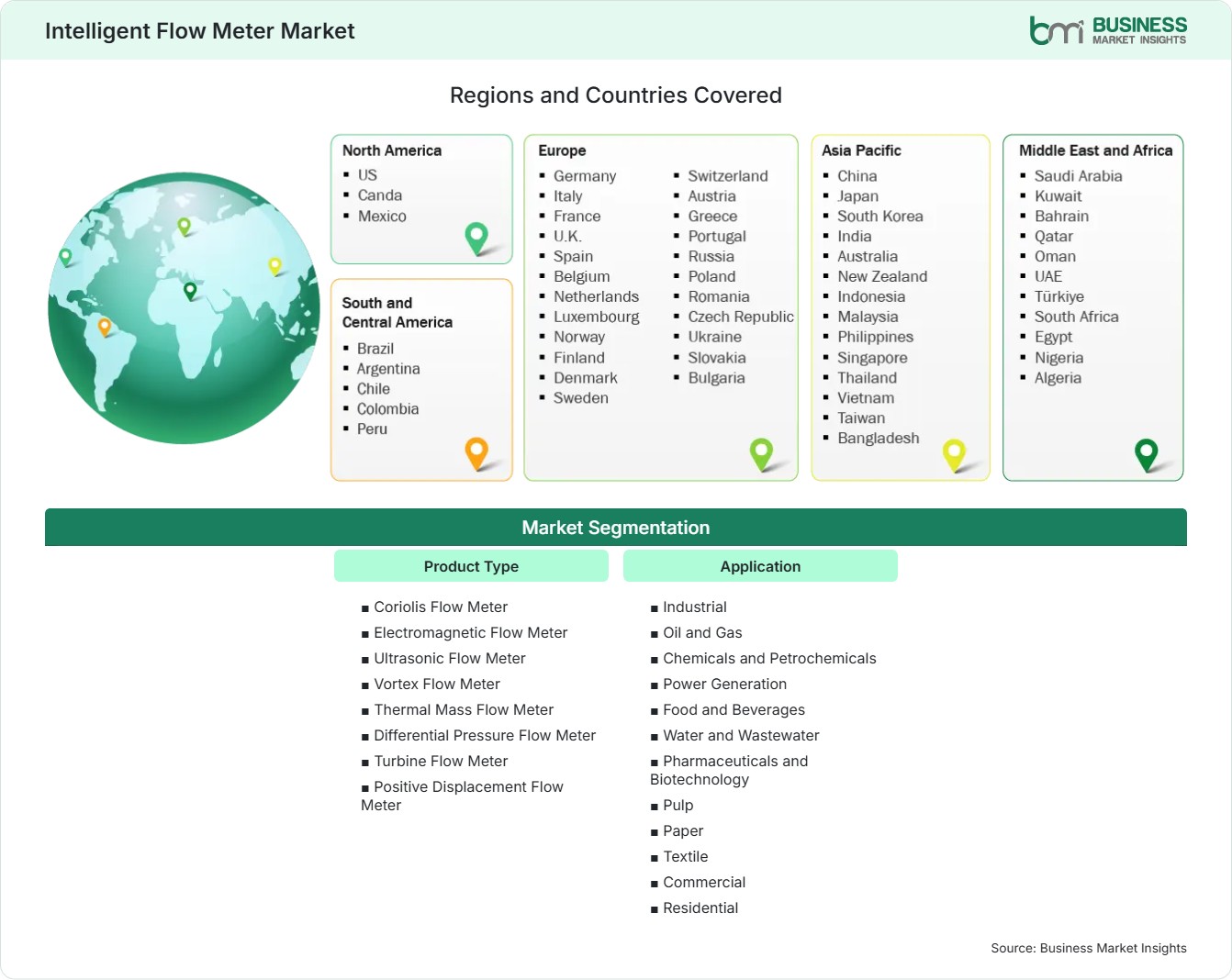
Global Market Geography
FREE PDF
Request your free sample
Request free sample
Segment Analysis

Intelligent Flow Meter Market Segmentation

Product Type

Product Type accounted for roughly 100% market distribution, with Electromagnetic Flow Meters leading at 24%–27% share in 2025 and the category advancing at 6.0%–6.8% CAGR. The Intelligent Flow Meter Market scope continues expanding as industries prioritize measurement accuracy, digital connectivity, process reliability, and compliance-driven monitoring requirements across diverse liquid, gas, and steam applications.

  • Coriolis Flow Meter: Preferred where high accuracy and direct mass measurement are critical, particularly across chemical processing, custody transfer operations, and pharmaceutical production environments.
  • Electromagnetic (Mag) Flow Meter: Strong adoption across water and wastewater sectors due to reliability, low maintenance requirements, and suitability for conductive fluid measurement applications.
  • Ultrasonic Flow Meter: Benefiting from non-invasive deployment capabilities, remote monitoring integration, and expanding use across infrastructure monitoring and utility management systems.
  • Vortex Flow Meter: Widely utilized in steam, liquid, and gas measurement environments requiring dependable performance and operational efficiency.
  • Thermal Mass Flow Meter: Increasingly deployed for gas flow applications where energy efficiency, emissions monitoring, and process optimization are priorities.
  • Differential Pressure (DP) Flow Meter: Continues maintaining relevance within industrial facilities due to established installations and broad application versatility.
  • Turbine Flow Meter: Utilized in clean liquid applications requiring cost-effective performance and dependable volumetric measurement capability.
  • Positive Displacement (PD) Flow Meter: Applied in precision measurement environments involving viscous fluids, custody transfer tasks, and specialized process operations.

Application

Application demand remains dominated by Industrial use with 66%–70% share in 2025 and 6.2%–6.7% CAGR. The phrase Intelligent Flow Meter Market trends is visible through widespread automation adoption, increasing operational transparency requirements, digital transformation initiatives, and growing utilization across processing industries requiring accurate fluid management and real-time performance insights.

  • Industrial: Largest deployment category, supported by automation initiatives, regulatory compliance requirements, predictive maintenance adoption, and process optimization objectives.
  • Oil and Gas: Requires precise measurement technologies for upstream, midstream, and downstream operational efficiency and custody transfer applications.
  • Chemicals and Petrochemicals: Demand remains driven by safety, process consistency, and advanced monitoring requirements across complex production systems.
  • Power Generation: Increasing digitalization of generation assets supports demand for accurate measurement and operational control capabilities.
  • Food and Beverages: Strict quality assurance requirements encourage deployment of hygienic and highly reliable measurement technologies.
  • Water and Wastewater: Utilities continue investing in smart monitoring systems that support leakage management and regulatory compliance objectives.
  • Pharmaceuticals and Biotechnology: Precision process control and validation requirements sustain demand for advanced instrumentation solutions.
  • Pulp, Paper, and Textile: Process optimization initiatives and resource efficiency targets support ongoing technology adoption.
  • Commercial: Adoption expands in building management systems, utility networks, and facility efficiency monitoring environments.
  • Residential: Smart metering initiatives create selective opportunities within advanced utility infrastructure programs.
Market Forces

Intelligent Flow Meter Market Dynamics

Key Market Drivers

Industrial Automation and IIoT Deployment Expansion

Industry 4.0 implementation remains a primary catalyst as manufacturers increasingly connect field devices with enterprise-level monitoring and analytics platforms. The performance of digital technologies continues to be emphasized in International Energy Agency reports as being an important enabler in industry. The convergence of intelligent instrumentation with cloud computing platforms, edge analytics, and predictive maintenance technology enhances the visibility of process performance while minimizing unexpected downtime. The connection of measurement systems is used to optimize the use of assets, ensure operational consistency, and support compliance reporting. This makes these considerations continue playing an increasingly important role in purchasing decisions in energy, chemicals, pharmaceuticals, and utilities.

Global Water Infrastructure Modernization Programs

Utilities worldwide are investing heavily in infrastructure upgrades to reduce non-revenue water, improve resource efficiency, and support sustainability objectives. There are many organizations, such as the World Bank and regional development authorities, that keep coming up with huge capital requirements for updating the water infrastructure. Modern systems of measurement help greatly in identifying leaks in the system, making it efficient and helping with accurate regulation reporting. Intelligent measurement equipment helps greatly in remote control, reduces the need for maintenance, and ensures efficient operation. Urbanization and climate effects on water resources also drive the use of connected measurement equipment.

Increasing Demand for Process Accuracy and Compliance

Industries handling critical fluids increasingly require highly accurate monitoring to satisfy quality control, environmental compliance, safety, and operational efficiency objectives. The process industry needs to satisfy increasingly demanding traceability, emissions control, and process uniformity requirements. New instruments that have the capacity to perform diagnostics, self-checking procedures, and have digital communication abilities can assist operators in maintaining tight process controls while reducing measurement errors. Regulation in the pharmaceutical, chemical, food, and energy industries has also served to reinforce equipment replacement schedules. Such demands have ensured steady demand for intelligent instrumentation systems.

Key Market Opportunities

Smart Water Networks and Digital Utilities

Water utilities are beginning to adopt connected water network architectures, which utilize sensor technologies and remote asset management systems. The development of smart utilities provides chances for vendors who can provide interoperable and cyber-secure measurement devices. Water conservation and leak detection have become important issues, leading to the purchase of smart monitoring technologies. Long-term Intelligent Flow Meter Market Forecasts remain favorable as governments are investing their money into building sustainable infrastructure and digital service delivery. Companies that offer hardware, software, and analytics together will be at an advantage in this scenario, especially in developing nations with urban infrastructure development programs and utility reforms.

Hydrogen and Energy Transition Infrastructure

The expansion of hydrogen production, carbon management projects, renewable fuels, and alternative energy systems generates demand for advanced measurement technologies. Accuracy in tracking, digitization, and reliability are vital for these types of applications. Operators of industrial installations have started building new plants where connected instruments are included from the outset instead of modifying old ones. In light of the increasing global investment in energy transition projects, manufacturers have an additional income source based on their special products suited for novel process conditions. This source includes not only hardware but also diagnostics and service solutions.

Emerging Industrial Economies and Manufacturing Growth

Industrial expansion across Asia, the Middle East, and selected Latin American countries continues to create significant demand potential. The government has been encouraging manufacturers to compete through automation, infrastructural development, and sustainability measures. The new factories that have been coming up use smart monitoring systems to help maximize efficiency while reducing risks in operations. The companies developing regional production centers have ensured that they use the best instruments that meet global standards. This has given both global market leaders and regional experts the opportunity to develop networks.

Market Restraints and Challenges

High Initial Investment and Integration Complexity

Factor: Highly advanced intelligent instruments usually involve high initial costs as compared to traditional measuring instruments in cases where software installation, networking, and employee training are considered. Impact: Operators with budget constraints sometimes delay such initiatives even after realizing their long-term advantages. Integration difficulty may also cause delays in the implementation of such projects and add risks, especially for those facilities that have automation systems of various generations. Smaller organizations may find it difficult to make investments for such projects. There can be huge discrepancies in the adoption of such technologies in different geographic locations and industries.

Cybersecurity Risks and Skills Availability Constraints

Factor: Increased connectivity exposes industrial environments to broader cybersecurity considerations while simultaneously raising demand for specialized technical skills. Impact: Companies need to be able to make investments in communication architectures that are secure, in monitoring and in training their employees in order to be able to benefit from the deployment process. In some places, there is a shortage of skilled automation and instrumentation engineers, which complicates the implementation process and makes it more expensive. Issues with data security, network reliability, and system compatibility can add time to the procurement process.

Company Analysis

Competitive Landscape

The Intelligent Flow Meter Market analysis indicates competition is centered on automation expertise, measurement accuracy, digital connectivity, and lifecycle service capabilities.

Company Name

Overview

Products and Services relevant to this market

ABB Ltd.

Global automation and electrification provider serving process industries and utilities worldwide.

Electromagnetic, Coriolis, vortex, and digital flow measurement systems with analytics capabilities.

Emerson Electric Co.

Major industrial technology company with extensive process automation portfolio.

Rosemount flow meters, diagnostics platforms, wireless monitoring, and asset management services.

Siemens AG

Industrial automation leader with broad instrumentation and digitalization offerings.

Process instrumentation, ultrasonic and electromagnetic meters, industrial software integration solutions.

Endress+Hauser Group

Specialized process measurement and automation technology provider.

Coriolis, electromagnetic, thermal, vortex, and ultrasonic measurement solutions.

Honeywell International Inc.

Diversified technology company serving industrial and infrastructure customers.

Flow monitoring instruments, industrial automation systems, and connected analytics platforms.

Yokogawa Electric Corporation

Industrial automation specialist focused on process industries globally.

Magnetic, vortex, Coriolis, and intelligent digital flow measurement technologies.

Schneider Electric SE

Global energy management and industrial automation provider.

Integrated automation platforms supporting flow measurement and operational intelligence.

KROHNE Messtechnik GmbH

Measurement technology specialist with strong process-industry presence.

Electromagnetic, ultrasonic, Coriolis, and specialized industrial metering systems.

Azbil Corporation

Automation-focused manufacturer serving industrial and commercial applications.

Smart flow meters, control systems, and process optimization solutions.

Badger Meter, Inc.

Recognized provider of water-focused measurement and monitoring technologies.

Ultrasonic meters, smart water solutions, analytics software, and monitoring platforms.

Trust & Transparency

Research Methodology

The market analysis combines proprietary research with secondary data from government agencies, company disclosures, regulatory filings, industry databases and expert interviews. Market estimates are validated through data triangulation, cross-market benchmarking and analyst review.

View Full Research Methodology

Questions Answered

Frequently Asked Questions

What information does an Intelligent Flow Meter Market Report generally provide?

An Intelligent Flow Meter Market Report typically evaluates technology trends, competitive positioning, regional demand patterns, end-user adoption dynamics, investment opportunities, and long-term market outlooks.

How do intelligent flow meters support sustainability objectives?

They improve resource utilization, reduce water losses, optimize energy consumption, and provide accurate performance data that supports environmental reporting and compliance programs.

What role does digitalization play in adoption decisions?

Digitalization enables remote monitoring, analytics integration, predictive maintenance, and real-time operational visibility, allowing users to improve efficiency while reducing downtime and maintenance costs.

Why are ultrasonic flow meters growing faster than several traditional technologies?

Their non-invasive installation, reduced maintenance requirements, enhanced connectivity features, and suitability for infrastructure monitoring applications support stronger adoption momentum across utilities and industrial facilities.

Which industry generates the highest demand for intelligent flow meters?

Industrial applications account for the largest demand base because process industries require accurate measurement, operational visibility, compliance monitoring, and predictive maintenance capabilities across complex production environments.

Access the Full Intelligent Flow Meter Market Report

Get segment-level forecasts, regional estimates, competitive benchmarking, company profiles and downloadable Excel datasets.

Access the full Intelligent Flow Meter Market Report
350 pages PDF & Excel | 2026-09-02