Market Summary
Executive Summary and Global Market Analysis
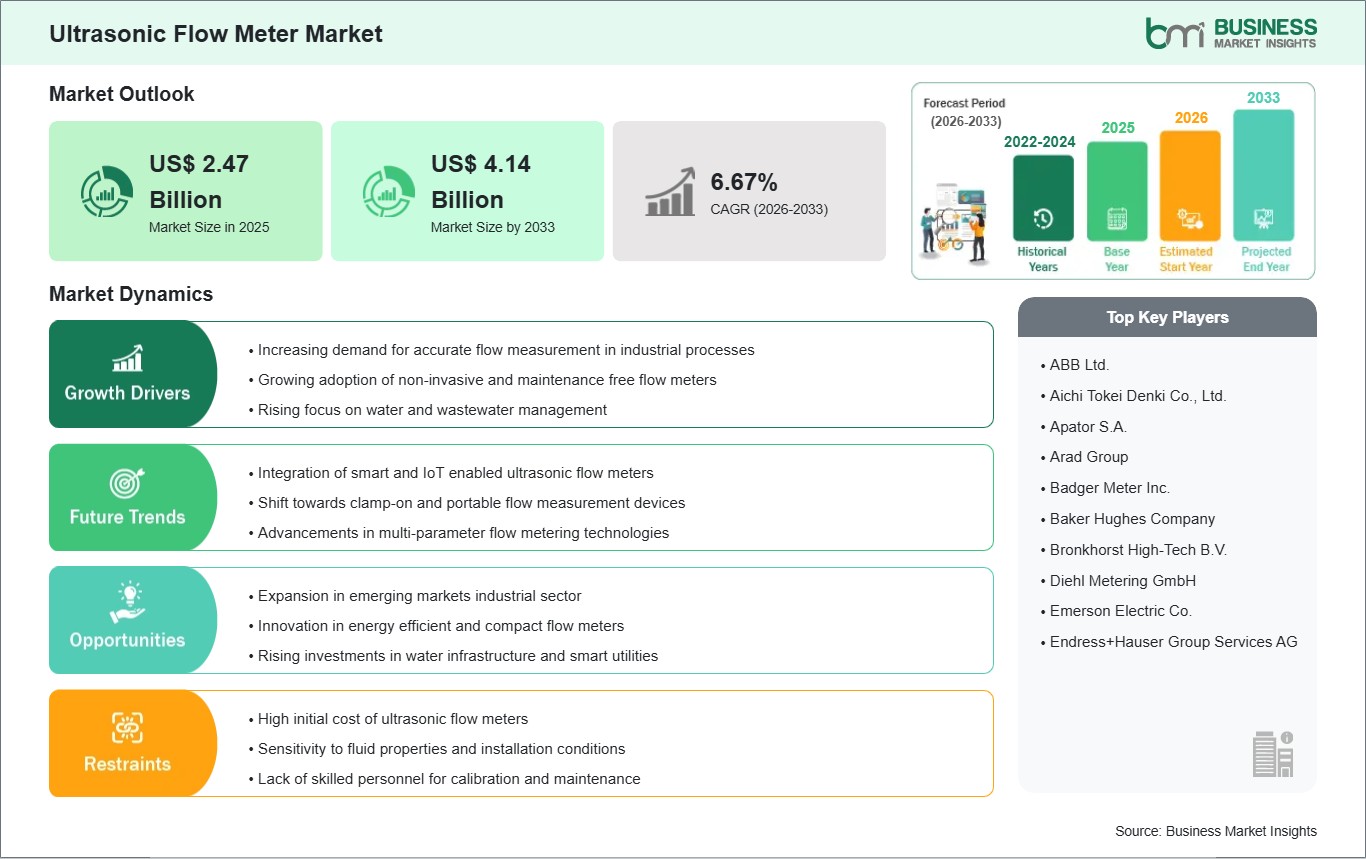
Ultrasonic flow meters represent a sophisticated category of inferential measurement devices that utilize high-frequency acoustic waves to determine the volumetric flow rate of liquids and gases. By measuring either the transit-time difference of signals traveling with and against the flow or the frequency shift caused by the Doppler effect, these sensors provide highly accurate, non-intrusive data essential for modern process control and custody transfer. Unlike traditional mechanical meters, ultrasonic variants feature no moving parts, which eliminates pressure drops, reduces long-term maintenance overhead, and ensures high reliability in corrosive or abrasive environments. These components are fundamental in the transition toward digitalized industrial ecosystems, underpinning the precision required in oil and gas pipelines, chemical processing, and smart water management systems.
However, the market faces notable challenges, including the high initial capital expenditure associated with multi-path high-precision systems and the technical complexity of processing signals in heterogeneous fluids with high aeration or suspended solids. Furthermore, the specialized expertise required for the installation and calibration of inline variants can act as a deterrent for smaller industrial operators facing budgetary constraints.
Despite these hurdles, the market holds significant opportunities driven by the global push for Industry 4.0 and the integration of the Industrial Internet of Things (IIoT). The move toward autonomous "smart factories" is creating a demand for intelligent meters equipped with AI-driven self-diagnostics and remote verification capabilities. Additionally, the expansion of hydrogen infrastructure and the demand for energy-efficient "green" manufacturing frameworks are expected to open lucrative new avenues for ultrasonic technology as industries seek auditable, high-fidelity data to meet stringent environmental and regulatory mandates.
Segment Analysis
Ultrasonic Flow Meter Market Segmentation
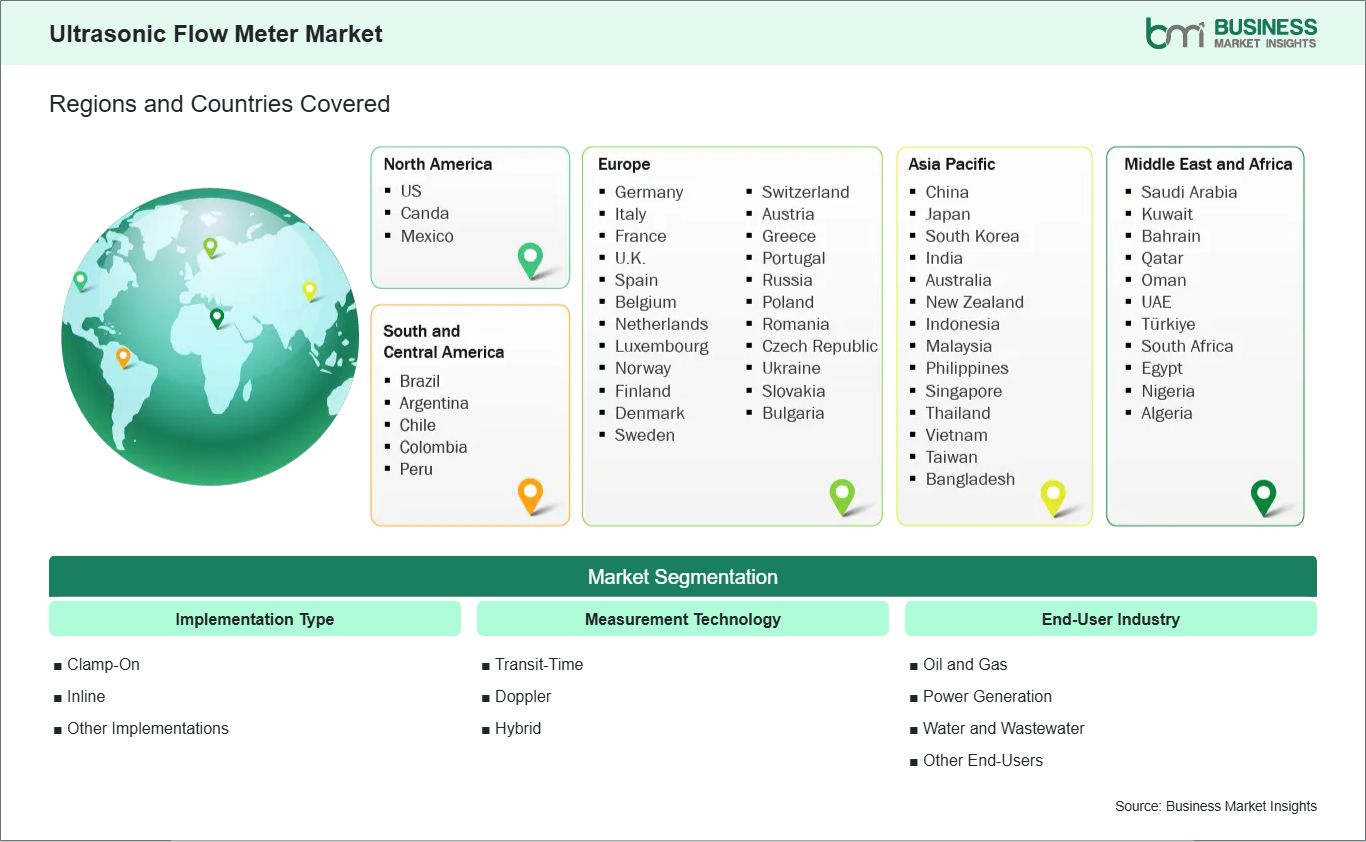
Key segments that contributed to the derivation of the Ultrasonic Flow Meter market analysis are implementation type, measurement technology, and end-user industry.
- By Implementation Type, the market is segmented into Clamp-On, Inline, and Others.
- By Measurement Technology, the market is divided into Transit-Time, Doppler, and Hybrid.
- By End-User Industry, the market is categorized into Oil and Gas, Power Generation, Water and Wastewater, and Others.
Market Forces
Ultrasonic Flow Meter Market Drivers and Opportunities
Accelerated Transition to Smart Industrial Automation and Industry 4.0
The global acceleration toward fully automated industrial ecosystems serves as a foundational driver for the ultrasonic flow meter market. As manufacturing facilities and utilities transition into "Smart Factories," there is an escalating requirement for high-fidelity, real-time data to feed into centralized control systems. Unlike traditional mechanical meters that provide static or delayed readings, ultrasonic flow meters offer instantaneous digital output and advanced signal processing capabilities. This transition is particularly evident in the water and wastewater sector, where municipalities are replacing aging infrastructure with intelligent ultrasonic networks to combat non-revenue water losses. These meters facilitate precise leak detection and consumption monitoring without the need for periodic manual intervention.
Furthermore, the non-intrusive nature of clamp-on ultrasonic technology allows industrial operators to modernize their facilities without the costly downtime associated with cutting pipes or halting production lines. This inherent flexibility, combined with the ability to maintain consistent accuracy over long operational lifespans due to the absence of moving parts, makes ultrasonic technology the preferred choice for sectors prioritizing operational continuity. As global industries increasingly rely on data-driven decision-making, the demand for these sophisticated, communication-ready measurement tools continues to intensify.
Emergence of the Hydrogen Economy and Decarbonization Infrastructure
The global shift toward sustainable energy sources, specifically the rapid development of hydrogen production and distribution infrastructure, presents a transformative growth opportunity for the ultrasonic flow meter market. Hydrogen, characterized by its low density and high flow velocities, poses significant measurement challenges for legacy differential-pressure or turbine meters. Ultrasonic meters are uniquely suited for this application because they offer a wide turndown ratio and a completely unobstructed flow path, which minimizes pressure drops and prevents potential energy loss within the supply chain.
As governments implement aggressive decarbonization targets, massive investments are being funneled into green hydrogen electrolyzers and carbon capture systems, all of which require precise flow control to safeguard equipment and ensure commercial viability. Beyond simple measurement, the integration of these meters into digital twin frameworks allows operators to simulate various flow scenarios and optimize the performance of hydrogen blending in existing natural gas grids. This creates a lucrative avenue for manufacturers to develop specialized, "hydrogen-ready" ultrasonic sensors that can withstand the unique chemical properties of the gas. This strategic alignment with the global energy transition ensures that ultrasonic technology will remain a critical component in the next generation of clean energy infrastructure.
Size and Share Analysis
Ultrasonic Flow Meter Market Size and Share Analysis
The Ultrasonic Flow Meter market demonstrates steady growth, with size and share analysis revealing evolving trends and competitive positioning among key players. The report further examines subsegments categorized within implementation type, measurement technology, and end-user industry, offering insights into their contribution to overall market performance.
In the implementation type, the Clamp-On sub-segment is gaining substantial share due to its non-intrusive nature, which allows for installation without interrupting process flow.
Regarding measurement technology, the Transit-Time sub-segment remains the most widely adopted for its superior accuracy in clean liquids and gases, which are prevalent in power and water management.
Among end-users, the Oil and Gas sub-segment continues to be the dominant contributor, utilizing high-path-count ultrasonic meters for precise custody transfer and pipeline leak detection.
Report Coverage
Ultrasonic Flow Meter Market Report Coverage and Deliverables
The "Ultrasonic Flow Meter Market Size and Forecast (2022–2033)" report provides a detailed analysis of the market covering below areas:
- Ultrasonic Flow Meter market size and forecast at global, regional, and country levels for all the key market segments covered under the scope
- Ultrasonic Flow Meter market trends, as well as market dynamics such as drivers, restraints, and key opportunities
- Ultrasonic Flow Meter market analysis covering key market trends, global and regional framework, major players, regulations, and recent market developments
- Industry landscape and competition analysis covering market concentration, heat map analysis, prominent players, and recent developments for the Ultrasonic Flow Meter market
- Detailed company profiles, including SWOT analysis
Geographic Insights
Ultrasonic Flow Meter Market Geographic Insights
The geographical scope of the Ultrasonic Flow Meter market report is divided into five regions: North America, Asia Pacific, Europe, the Middle East & Africa, and South & Central America.
In North America, the market is anchored by the extensive modernization of aging municipal water systems and the rapid expansion of shale gas exploration, where high-precision measurement is critical for both operational efficiency and environmental reporting. Europe maintains a leading position in the technological transition toward the hydrogen economy, with regional activities focused on the deployment of "hydrogen-ready" ultrasonic meters and the integration of advanced sensors into green energy distribution grids to support decarbonization targets. The Asia-Pacific region serves as a primary hub for both high-volume manufacturing and massive infrastructure projects, where rapid urbanization and government-led smart city initiatives in major emerging economies are fueling the large-scale adoption of digital metering solutions.
In the Middle East & Africa, market expansion is largely propelled by high-capital investment in desalination plants and the continued modernization of the oil and gas midstream sector, requiring ruggedized equipment for harsh desert environments. Meanwhile, South & Central America are witnessing a steady rise in demand through the digital transformation of the mining and food processing industries, as regional operators increasingly adopt non-intrusive clamp-on technology to improve resource management and reduce process downtime.
Industry Activity
Recent Developments
The Ultrasonic Flow Meter market is evaluated by gathering qualitative and quantitative data post primary and secondary research, which includes important corporate publications, association data, and databases. A few of the key developments in the Ultrasonic Flow Meter market are:
- In December 2025, KROHNE highlighted new advancements in Ultrasonic Flow Meter verification designed to improve accuracy and efficiency in custody transfer applications across the oil and gas sector. The company stated that integrating Ultrasonic Flow Meters with small volume provers remained a common yet technically demanding approach for optimizing custody transfer and lowering operational costs. Unlike mechanical meters, these ultrasonic systems featured no moving parts, which reduced maintenance needs and long-term wear while improving overall reliability.
- In April 2025, global automation leader Emerson introduced the Flexim FLUXUS / PIOX 731 series, a new range of non-intrusive, clamp-on Ultrasonic Flow Meters designed to offer greater flexibility, convenience, and availability. The nine models in the 731 series featured high-performance volumetric and mass flow sensing technologies and a robust, functional design, which provided accurate and reliable measurements for both liquids and gases with no process media pressure limitations.
Trust & Transparency
Research Methodology
The market analysis combines proprietary research with secondary data from government agencies, company disclosures, regulatory filings, industry databases and expert interviews. Market estimates are validated through data triangulation, cross-market benchmarking and analyst
review.
View Full Research Methodology
Key Sources Referred:
World Bank – Global Trade Indicators World Trade Organization (WTO) (International Monetary Fund )IMF International Trade Administration (ITA) Company website Company annual reports Company investor presentations