
Automotive Power Modules Market Outlook: Size, Share, Trends, Growth Analysis, Competitive Landscape & Forecast, 2026-2033

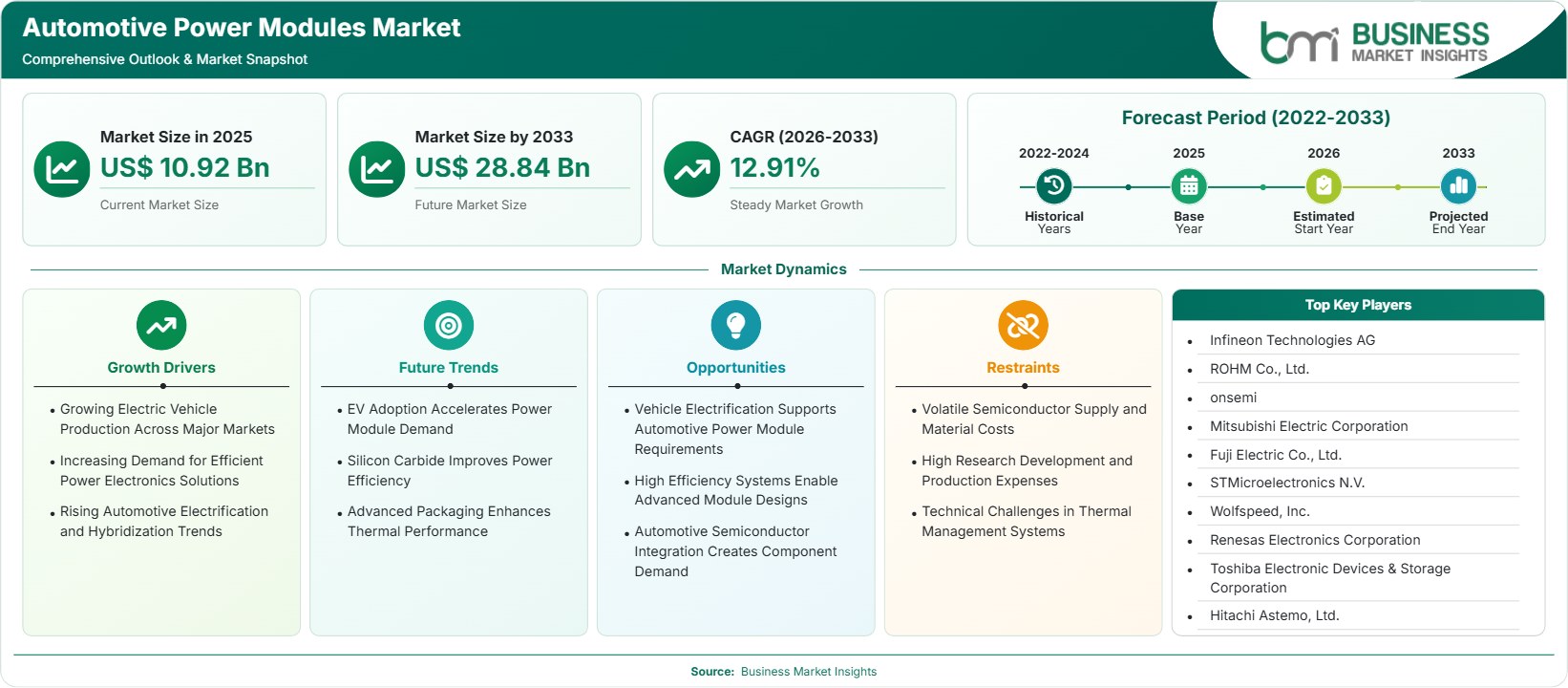
The Automotive Power Modules Market size was valued at US$ 10.92 Billion in 2025 and is projected to reach US$ 28.84 Billion by 2033, growing at a CAGR of 12.91% during 2026–2033. Growth is supported by accelerating EV production, rising silicon carbide adoption, inverter efficiency improvements, vehicle electrification programs, and expanding investment in high-voltage power electronics platforms across global automotive supply chains.

Report Coverage
  • Type: SiC MOSFETs, Si IGBTs
  • Vehicle Type: Passenger Cars, Commercial Vehicles
  • Propulsion Type: Battery Electric Vehicle, Hybrid Electric Vehicle
  • Application: Traction Inverter, DC-DC Converter, On-Board Charger
US$ 10.92 Bn Market size in 2025
US$ 28.84 Bn Market Size by 2033
12.91% CAGR, 2026 - 2033
2026-2033 Forecast Period

AI Overview

Automotive Power Modules Market Summary

  • North America Region: North America holds an Automotive Power Modules Market share of 24%–27% in 2025, growing at a CAGR of 11.5%–12.5% during 2026–2033. Growth is driven by EV manufacturing localization, semiconductor investments, SiC deployment, policy incentives, charging infrastructure expansion, OEM electrification strategies, domestic sourcing initiatives, advanced inverter demand, efficiency mandates, powertrain innovation, supplier partnerships, and vehicle platform modernization. US market benefits from EV production scaling and semiconductor reshoring initiatives, advancing at an estimated CAGR of 11.8%–12.8%.
  • Fastest Growing Region: Asia Pacific accounts for 42%–46% share in 2025 and expands at 13.8%–14.8% CAGR. Growth is propelled by Chinese EV output, Japanese semiconductor innovation, Indian electrification programs, localized power electronics production, battery investments, automotive exports, manufacturing scale advantages, rising charging infrastructure, and strong government support mechanisms.
  • Leading Segment: Passenger Cars command 68%–72% share in 2025 and grow at 12.4%–13.4% CAGR. Expansion reflects increasing EV penetration, consumer demand for efficiency, wider availability of high-voltage platforms, improved vehicle range, integrated power electronics architectures, stricter emissions regulations, automaker electrification strategies, cost optimization efforts, and growing adoption worldwide.
  • High Growth Segment: SiC MOSFETs represent a 38%–42% share of the Automotive Power Modules Market in 2025 and advance at 15.5%–16.5% CAGR. Adoption is fueled by switching efficiency gains, reduced thermal losses, higher power density, support for 800V architectures, extended driving range, faster charging capabilities, declining production costs, and increasing OEM qualification activity globally.
  • Key Market Opportunity: Expansion of 800V electric vehicle platforms creates new revenue streams for module suppliers through efficiency enhancements, thermal optimization, compact inverter architectures, faster charging capability, and differentiated premium vehicle performance.
  • Major Market Players: Infineon Technologies AG, ROHM Co., Ltd., onsemi, Mitsubishi Electric Corporation, Fuji Electric Co., Ltd., STMicroelectronics N.V., Wolfspeed, Inc., Renesas Electronics Corporation, Toshiba Electronic Devices & Storage Corporation, Hitachi Astemo, Ltd.
Strategic Insights

Automotive Power Modules Market: Strategic Insights

Automotive Power Modules Market Strategic Framework
FREE PDF
Request your free sample
Request free sample
Stakeholder View

Key Takeaways

  • The value chain is increasingly defined by semiconductor wafer suppliers, packaging specialists, automotive Tier-1 suppliers, and OEMs collaborating to secure materials and improve supply resilience.
  • Highest upside remains concentrated in traction inverter applications and BEV platforms where power-module content value per vehicle significantly exceeds conventional configurations.
  • Product development is shifting toward SiC-based integrated modules capable of supporting 800V architectures, higher switching frequencies, and reduced cooling requirements.
  • Asia Pacific offers the strongest investment proposition due to EV manufacturing scale, government incentives, semiconductor capacity expansion, and battery ecosystem maturity.
  • Strategic acquisitions and alliances continue as companies secure access to SiC substrates, packaging capabilities, and advanced manufacturing technologies.
  • Thermal performance, reliability certification, and automotive-grade qualification remain critical competitive differentiators influencing supplier selection processes.
Geographic Outlook

Automotive Power Modules Market Regional Highlights

North America Automotive Power Modules Market

North America accounts for 24%–27% of global revenue in 2025 and is expected to expand at a CAGR of 11.5%–12.5% through 2033. The region benefits from EV manufacturing expansion, semiconductor investment incentives, and growing local sourcing requirements. Automotive Power Modules Market share gains are supported by increasing deployment of high-voltage architectures and domestic power electronics production. Major automotive manufacturers continue strengthening partnerships with semiconductor suppliers to secure long-term access to advanced vehicle electrification technologies.

  • EV assembly expansion strengthens demand for traction inverter modules across passenger and commercial vehicle segments.
  • U.S. and Canadian semiconductor investments improve supply security and encourage localized manufacturing ecosystems.
  • Rising adoption of 800V vehicle platforms increases demand for premium SiC-based solutions.
  • Fleet electrification initiatives support sustained deployment of high-power conversion technologies.

US Automotive Power Modules Market

The U.S. represents approximately 78%–82% of North American demand and advances at a CAGR of 11.8%–12.8%. Federal manufacturing incentives, EV production investments, and domestic semiconductor programs support market expansion. Demand is concentrated in electric pickups, SUVs, and commercial vehicles. Innovation in powertrain efficiency and localized battery manufacturing enhances competitiveness while strengthening adoption of advanced power conversion systems throughout the transportation sector.

  • Major automakers continue investing in dedicated EV facilities and battery plants.
  • Increasing utility-scale charging infrastructure supports broader electric vehicle adoption.
  • Commercial fleet electrification creates demand for durable high-power module configurations.
  • Research programs accelerate commercialization of advanced wide-bandgap technologies.

Europe Automotive Power Modules Market

Europe holds a 22%–25% share in 2025 and records 12.2%–13.2% CAGR. Strong emissions regulations and electrification mandates support adoption of advanced power electronics. Germany remains the leading country, while Eastern European manufacturing hubs demonstrate faster expansion with CAGR ranges exceeding regional averages. Automakers are increasingly standardizing modular EV architectures, supporting larger deployment volumes and accelerating integration of SiC-based components across passenger vehicle platforms.

  • Germany leads regional consumption through premium EV production and semiconductor integration.
  • Poland and Hungary emerge as high-growth manufacturing locations supported by battery investments.
  • Stringent carbon reduction targets accelerate electrified powertrain deployment.
  • European supply-chain localization initiatives encourage investment across semiconductor production.

Asia Pacific Automotive Power Modules Market

Asia Pacific represents 42%–46% of global demand and remains the fastest-growing region with 13.8%–14.8% CAGR. China leads consumption and production, while India demonstrates high-growth potential. Automotive Power Modules Market growth is reinforced by large-scale EV manufacturing, battery investments, and supportive industrial policies. Japanese and South Korean suppliers continue advancing power semiconductor innovation, strengthening the region's dominance in materials, packaging, and automotive electronics manufacturing.

  • China maintains leadership in EV production volumes and power electronics adoption.
  • India records among the strongest regional growth trajectories due to electrification programs.
  • Japan drives innovation in SiC technologies and automotive reliability standards.
  • South Korean investments enhance advanced semiconductor and battery ecosystem capabilities.
  • Regional manufacturing scale supports cost competitiveness and export growth.

Rest of World Automotive Power Modules Market

Rest of World contributes 8%–10% share in 2025 and expands at 11.8%–12.8% CAGR. South and Central America benefit from increasing vehicle electrification initiatives led by Brazil and Mexico. Middle East and Africa adoption remains comparatively nascent, but gains support from sustainability programs and industrial diversification investments. Automotive Power Modules Market share is gradually increasing as countries pursue cleaner mobility strategies and attract automotive technology investment.

  • Brazil leads South American adoption supported by automotive manufacturing infrastructure.
  • Mexico benefits from proximity to North American vehicle production networks.
  • UAE invests in smart mobility and advanced transportation electrification programs.
  • Saudi Arabia pursues industrial diversification projects supporting EV ecosystem development.
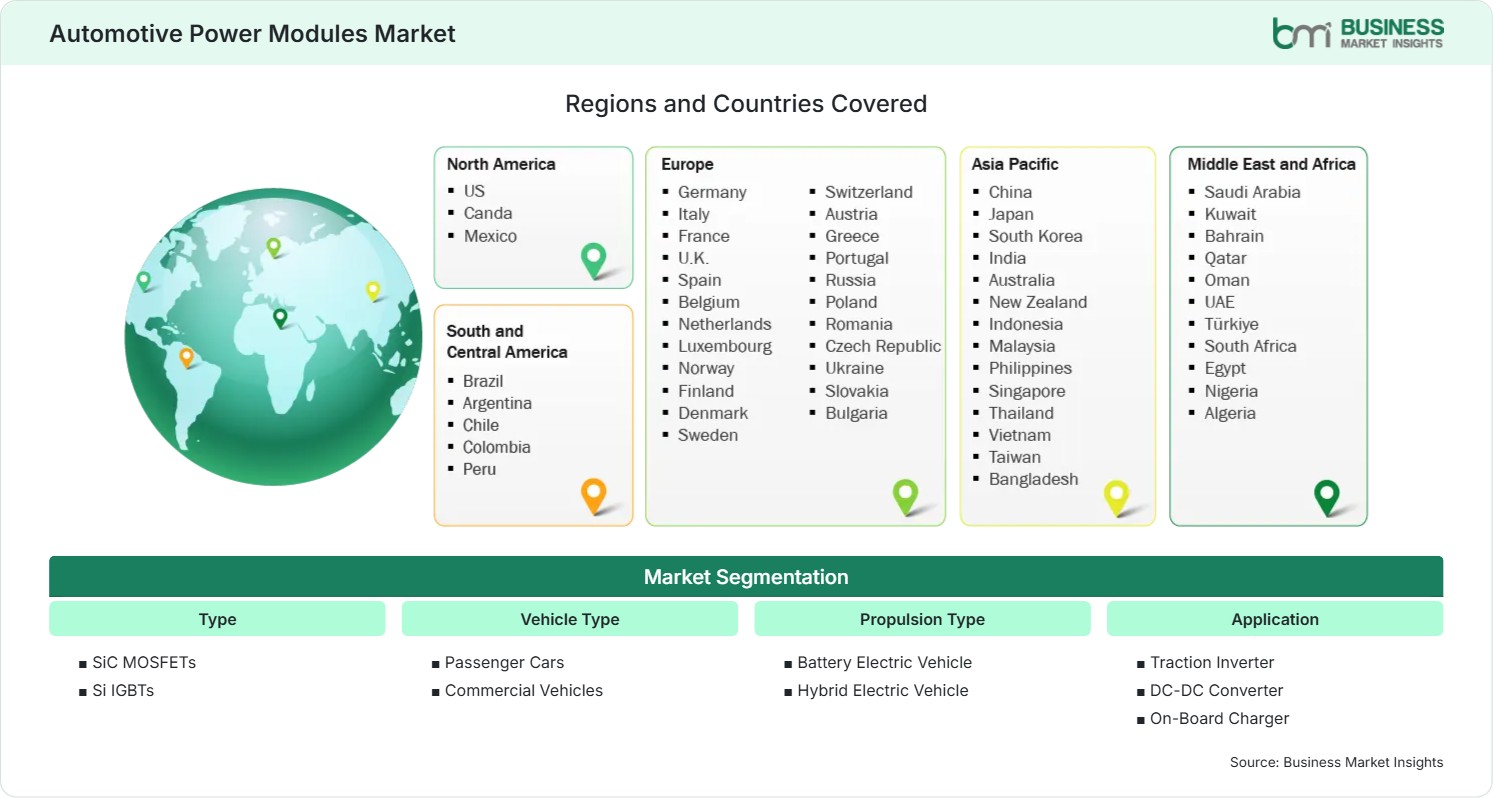
Global Market Geography
FREE PDF
Request your free sample
Request free sample
Segment Analysis

Automotive Power Modules Market Segmentation

Type

Type segmentation reflects growing preference for high-efficiency architectures. This segment held a substantial market presence in 2025, with Si-based and SiC-based technologies driving adoption across traction systems. The Automotive Power Modules Market scope continues expanding as OEMs transition toward higher-voltage systems. The segment is expected to advance at 13.0%–14.0% CAGR through the forecast period due to performance and efficiency requirements.

  • SiC MOSFETs: Enable lower switching losses, higher power density, and support 800V architectures, making them increasingly preferred across premium electric vehicle platforms and next-generation traction inverter systems.
  • Si IGBTs: Maintain strong deployment in cost-sensitive applications where established manufacturing ecosystems, reliability performance, and affordability continue supporting widespread adoption across diverse vehicle categories.

Vehicle Type

Vehicle type demand remains dominated by passenger transport applications. Passenger Cars account for 68%–72% share in 2025 and demonstrate 12.4%–13.4% CAGR. Increasing EV adoption, government incentives, and automaker investments sustain growth across both electrified and hybrid vehicle platforms.

  • Passenger Cars: Strong electrification momentum and consumer preference for longer-range vehicles support elevated adoption of advanced power module solutions.
  • Commercial Vehicles: Growing fleet electrification and operating cost reduction objectives encourage deployment of high-power, durable semiconductor modules.

Propulsion Type

Propulsion type segmentation reflects accelerating transition toward battery-powered mobility. BEVs represent the leading category with approximately 62%–66% share and projected CAGR of 13.5%–14.5%, supported by ongoing charging infrastructure expansion and advancements in energy-storage technologies.

  • Battery Electric Vehicle (BEV): Requires sophisticated power conversion systems across inverters, chargers, and battery management architectures, driving higher semiconductor content.
  • Hybrid Electric Vehicle (HEV): Continues growing through fuel-efficiency mandates and serves as a transition pathway in regions with evolving charging infrastructure.

Application

Application demand will be driven by powertrain architecture needs related to electrification. The Traction Inverter segment continues to be the market leader in 2025 with a share of 48%-52% and a CAGR of 13.2%-14.2%. Rising expectations for vehicle output and efficiency strengthen long-term demand.

  • Traction Inverter: Core component governing motor control, energy conversion efficiency, and vehicle driving performance in electric mobility systems.
  • DC-DC Converter: Supports voltage conversion between electrical subsystems and enables reliable power management for auxiliary vehicle functions.
  • On-Board Charger: Facilitates battery charging capabilities while benefiting from growing demand for faster charging and compact vehicle packaging designs.
Market Forces

Automotive Power Modules Market Dynamics

Key Market Drivers

Acceleration of Global Electric Vehicle Production

Global EV sales are projected to exceed 17 million units by 2024, according to reports published by the International Energy Agency; hence, there is a growing need for power conversion solutions. Electrified platforms require traction inverters, on-board chargers, and DC-DC converters, resulting in increased module content per car. Automotive companies are launching electric vehicles at different price points, resulting in increased use of power semiconductor chips. The Automotive Power Modules Market trends is witnessing increased integration of energy-efficient electronic architectures to maximize vehicle range and performance. Battery prices are falling as charging infrastructure improves, and power module suppliers benefit from higher production volumes, larger platform deployments, and increasing semiconductor content in both passenger and commercial electric vehicles.

Transition Toward Silicon Carbide Architectures

Silicon carbide components offer reduced conduction losses, enhanced heat dissipation, and greater efficiency than traditional silicon-based components. SiC is becoming increasingly popular among automakers designing their best electrified models, as efficiency improvements translate into longer driving distances and reduced cooling needs. The high-voltage architecture operating at 800 volts especially benefits from the use of SiC. The semiconductor suppliers increase manufacturing capacity and efficiency, slowly decreasing prices. The shift leads to increased popularity of solutions for a wider range of vehicle types and increases the need for more advanced modules in the traction and charging systems. Performance improvements achieved through wide-bandgap semiconductors continue influencing procurement strategies throughout the automotive electronics ecosystem.

Government Electrification and Emissions Policies

North American, European, and Asian efforts to decarbonize transportation continue to encourage electric vehicles through incentives, emissions targets, manufacturing funding, and battery investments, which in turn directly support the adoption of advanced power electronics. The regulatory framework provides demand predictability, allowing semiconductor makers to justify increases in capacity and technology investments. The Automotive Power Modules Market growth is increasingly seen as driven by government-sponsored industry initiatives for clean transportation and local production. Manufacturers need to increase efficiency and reduce emissions, thereby ensuring continued demand for state-of-the-art inverters and power converters. Government support remains a critical catalyst influencing both supply-side investment and end-user EV adoption.

Key Market Opportunities

Expansion of 800V Vehicle Platforms

Shifts towards 800V designs will provide advantages for companies capable of developing high-performance power modules with good thermal properties. High-voltage systems allow faster charging, better efficiency, and lighter cables. Premium and performance car brands are increasingly utilizing such systems, creating a need for silicon carbide components. Automotive Power Modules Market forecasts and reports suggest huge potential for high-voltage power conversion products. Organizations working towards innovative packaging technology, automotive qualification, and high-temperature operations are likely to reap rewards when more platforms are introduced in the future. Ecosystem development around 800V voltages creates potential in both charging infrastructure and associated power management applications.

Localization of Semiconductor Manufacturing

Governments of countries that are major players in automotive manufacturing are supporting their national semiconductor industries through subsidies and industrial strategies. Localizing manufacturing provides supply chain security and regional sourcing opportunities. More and more automotive OEMs are choosing suppliers with geographically distributed manufacturing capacity. The construction of new facilities makes the supply chain safer and improves cooperation with automakers. Expansion of the manufacturing presence provides access to long-term agreements and enables a better response to customers' needs. Localization also supports regulatory compliance objectives and enhances competitiveness within key automotive manufacturing hubs.

Electrification of Commercial Vehicle Fleets

Commercial vehicles have become an interesting opportunity for logistics firms seeking to reduce emissions and cut operational costs. Electric buses, vans, and trucks need efficient power converters that can handle tough operating conditions and high loads. In many cases, content per vehicle is higher in commercial applications than in passenger-car applications, resulting in higher revenue. The development of charging infrastructure and programs to support the fleet transition to electric vehicles will drive demand in this space. Suppliers that can offer reliability, thermal management skills, and a broad product are likely to capture growing commercial electrification spending.

Market Restraints and Challenges

High Cost of Advanced Wide-Bandgap Technologies

Factor: Silicon carbide components remain costlier than traditional silicon components due to substrate issues, process complexities, and production volumes. Impact: Costly parts may deter the uptake in cost-sensitive car categories and developing countries. Even though there are future energy-saving advantages, OEMs' purchasing decisions are guided by car affordability. Manufacturers have to weigh performance gains against cost implications. The cost reductions resulting from economies of scale and yield improvement efforts have had little impact on prices. It is especially true for affordable electric cars where cost competitiveness directly influences consumer adoption and profitability across the broader automotive ecosystem.

Supply Chain and Material Availability Risks

Factor: Automotive power modules require specific semiconductor materials, packaging techniques, and manufacturing processes. Impact: Disruptions to the manufacturing process for wafers and substrates may lead to production delays and higher costs. The semiconductor industry is still working to improve its resilience after the previous shortage. Qualification cycle times make substitution very hard and risky. This is why the automobile industry looks for diversification. While the development of regional manufacturing capacity will enhance resilience over time, procuring key materials remains a fundamental challenge for market players supporting electrified vehicle production.

Company Analysis

Competitive Landscape

Automotive Power Modules Market analysis reflects competition focused on SiC innovation, thermal performance, automotive qualification, manufacturing scale, and strategic partnerships with leading OEMs.

Company Name

Overview

Products and Services relevant to this market

Infineon Technologies AG

Global automotive semiconductor leader with extensive EV power electronics portfolio and strong OEM relationships.

HybridPACK modules, SiC MOSFET solutions, traction inverter modules, automotive power semiconductors.

ROHM Co., Ltd.

Leading Japanese semiconductor company focused on wide-bandgap technologies and automotive reliability.

SiC power modules, MOSFETs, automotive power devices, electrification solutions.

onsemi

Major supplier of intelligent power technologies serving vehicle electrification applications worldwide.

EliteSiC devices, inverter modules, power management components, EV semiconductor systems.

Mitsubishi Electric Corporation

Established power electronics provider with broad automotive and industrial expertise.

IGBT modules, SiC modules, traction power solutions, inverter technologies.

Fuji Electric Co., Ltd.

Power semiconductor specialist serving transportation and industrial markets globally.

Automotive IGBT modules, power conversion products, semiconductor systems.

STMicroelectronics N.V.

European semiconductor manufacturer with strong automotive electrification capabilities.

SiC devices, power modules, automotive microelectronics, inverter components.

Wolfspeed, Inc.

Dedicated silicon carbide technology company supporting next-generation EV architectures.

SiC wafers, MOSFETs, power modules, high-voltage semiconductor solutions.

Renesas Electronics Corporation

Automotive electronics provider emphasizing power management and control technologies.

Power devices, control semiconductors, automotive electronic systems.

Toshiba Electronic Devices & Storage Corporation

Semiconductor manufacturer offering advanced automotive power solutions.

IGBTs, MOSFETs, power management semiconductors, vehicle electronics components.

Hitachi Astemo, Ltd.

Integrated automotive technology supplier delivering electrified drivetrain systems.

Inverters, power modules, electric powertrain technologies, mobility solutions.

Trust & Transparency

Research Methodology

The market analysis combines proprietary research with secondary data from government agencies, company disclosures, regulatory filings, industry databases and expert interviews. Market estimates are validated through data triangulation, cross-market benchmarking and analyst review.

View Full Research Methodology

Questions Answered

Frequently Asked Questions

Which region offers the strongest long-term opportunity?

Asia Pacific offers the strongest opportunity due to EV manufacturing leadership, battery investments, supportive government policies, and a robust semiconductor ecosystem.

What does the Automotive Power Modules Market Report cover?

The report covers market sizing, competitive positioning, technology developments, regional demand patterns, segmentation analysis, growth drivers, opportunities, restraints, and future industry outlook.

Why are SiC MOSFETs gaining market attention?

SiC MOSFETs provide superior switching efficiency, lower thermal losses, faster charging support, and improved power density compared with conventional silicon technologies.

What application generates the highest revenue?

Traction inverter applications generate the highest revenue because they represent the primary power conversion function within battery electric and hybrid vehicle drivetrains.

What factors are increasing demand for automotive power modules?

Electrification of vehicles, expansion of EV production, adoption of 800V architectures, and growing use of high-efficiency traction inverters are driving demand across passenger and commercial transportation platforms.

Access the Full Automotive Power Modules Market Report

Get segment-level forecasts, regional estimates, competitive benchmarking, company profiles and downloadable Excel datasets.

Access the full Automotive Power Modules Market Report
350 pages PDF & Excel | 2026-09-22
Similar Research

Related Market Reports