
Combined Heat And Power (CHP) Market Outlook: Size, Share, Trends, Growth Analysis, Competitive Landscape & Forecast, 2026–2033

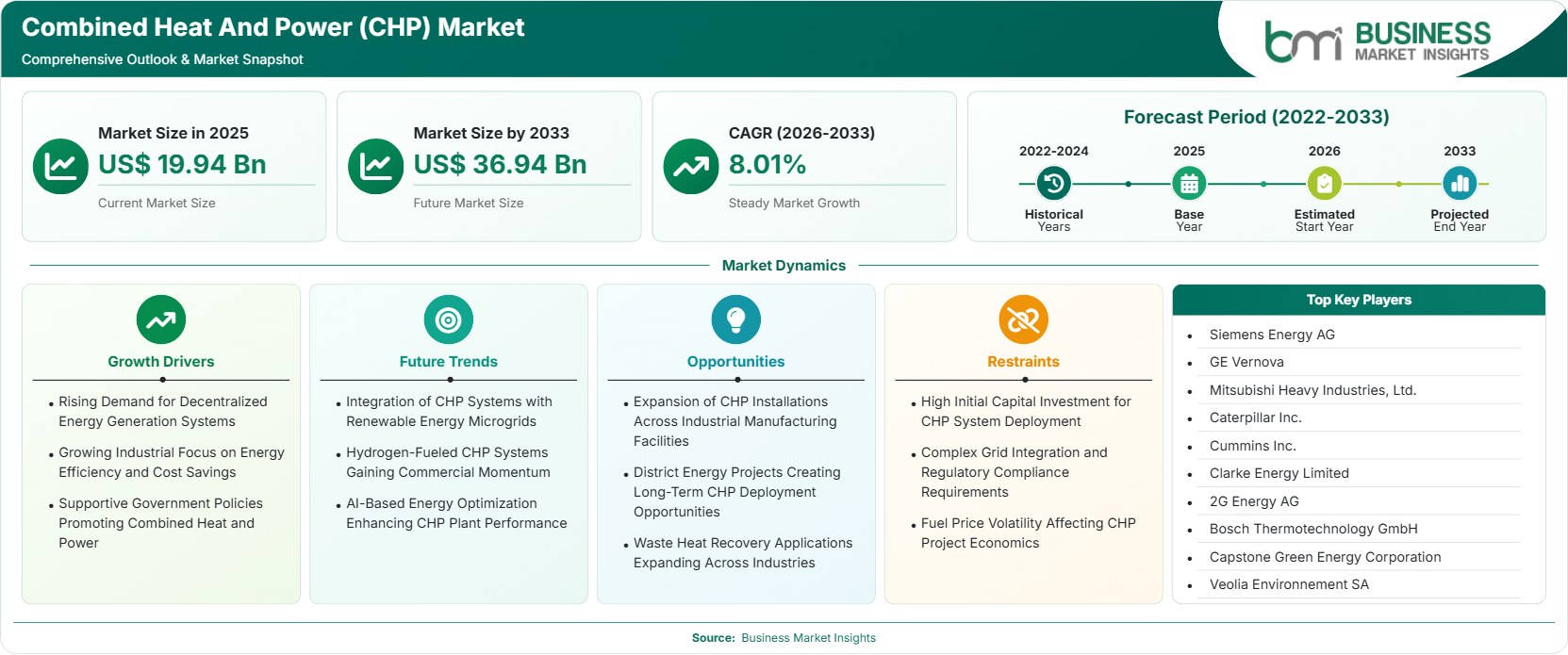
The Combined Heat and Power (CHP) Market size was valued at US$ 19.94 Billion in 2025 and is projected to reach US$ 36.94 Billion by 2033, growing at a CAGR of 8.01% during 2026–2033. Rising industrial demand for energy-efficient power generation, increasing decarbonization initiatives, and supportive clean energy policies are creating significant growth opportunities across commercial, utility, and manufacturing sectors.

Report Coverage
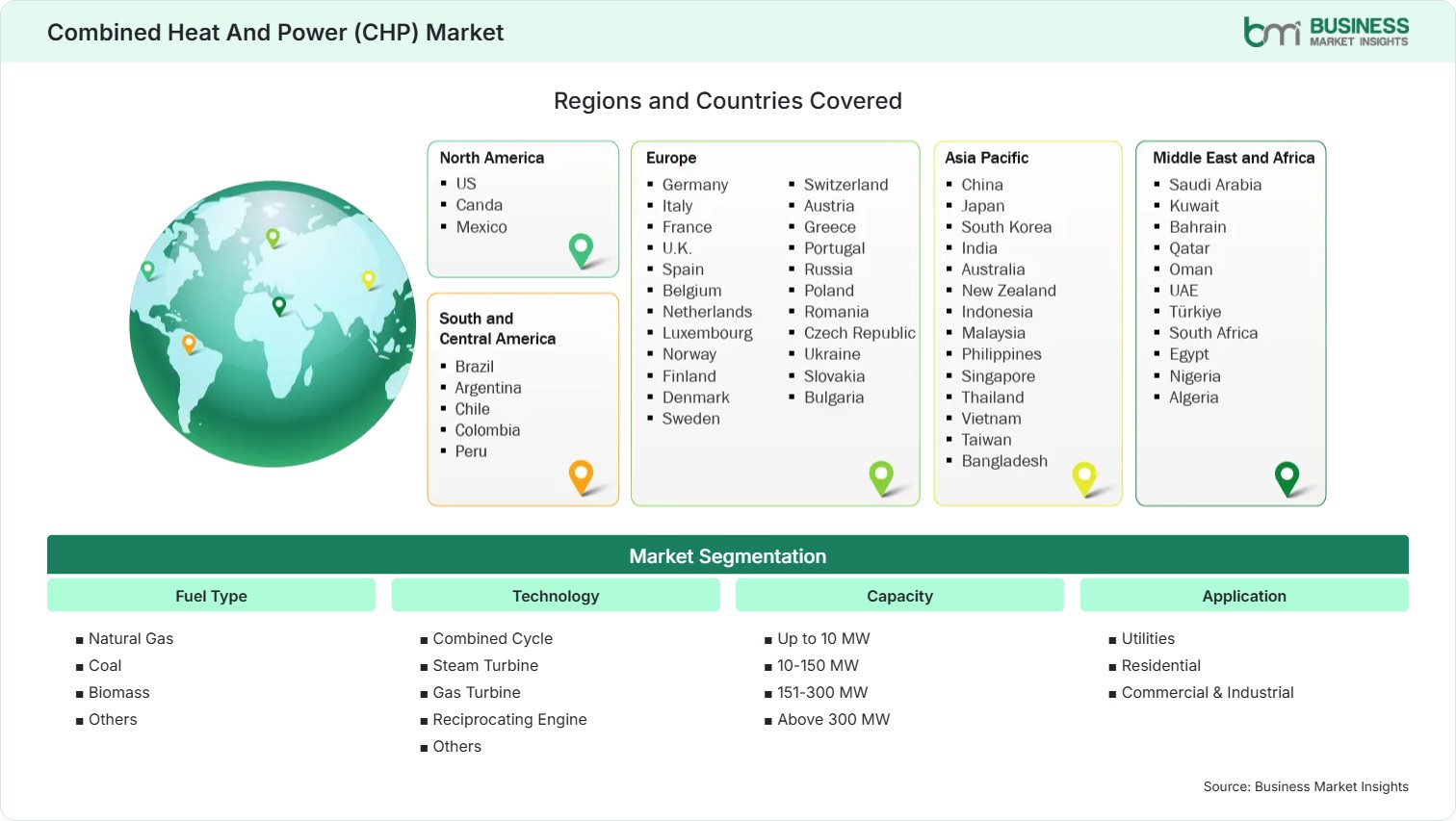
  • Fuel Type: Natural Gas, Coal, Biomass, Others
  • Technology: Combined Cycle, Steam Turbine, Gas Turbine, Reciprocating Engine, Others
  • Capacity: Up to 10 MW, 10-150 MW, 151-300 MW, Above 300 MW
  • Application: Utilities, Residential, Commercial & Industrial
US$ 19.94 Bn Market size in 2025
US$ 36.94 Bn Market Size by 2033
8.01% CAGR, 2026 - 2033
2026-2033 Forecast Period

01 AI Overview

Combined Heat And Power (CHP) Market Summary

  • North America Region: North America holds 34%–37% market share in 2025 and is projected to grow at a 7.4%–7.9% CAGR during 2026–2033. Industrial modernization, natural gas availability, grid resilience investments, and energy efficiency incentives continue supporting new CHP installation. The U.S. remains the regional leader with widespread industrial deployment and supportive state-level efficiency programs, advancing at approximately 7.5%–8.0% CAGR through 2033.
  • Fastest Growing Region: Asia Pacific accounts for 28%–31% market share in 2025 and is expected to register a 9.4%–9.9% CAGR during 2026–2033. Rapid industrialization, and government-backed distributed generation programs continue accelerating investments across manufacturing facilities, commercial complexes, and municipal energy projects.
  • Leading Segment: Natural Gas represents 48%–52% market share in 2025 while expanding at 8.0%–8.4% CAGR through 2033. High fuel efficiency, comparatively lower emissions, and operational flexibility continue supporting broad deployment across industrial, institutional, and commercial energy systems.
  • High Growth Segment: Commercial & Industrial applications account for 44%–48% market share in 2025 and are anticipated to record 8.8%–9.3% CAGR during 2026–2033. Rising electricity prices, and improved return on investment are encouraging organizations to adopt advanced CHP systems.
  • Key Market Opportunity: Growing integration of CHP systems with hydrogen-ready technologies, district heating infrastructure, and carbon reduction initiatives is creating long-term investment opportunities across industrial and urban energy networks.
  • Major Market Players: Siemens Energy AG, GE Vernova, Mitsubishi Heavy Industries, Ltd., Caterpillar Inc., Cummins Inc., Clarke Energy Limited, 2G Energy AG, Bosch Thermotechnology GmbH, Capstone Green Energy Corporation, and Veolia Environnement SA.
02 Strategic Insights

Combined Heat And Power (CHP) Market: Strategic Insights

Combined Heat And Power (CHP) Market Strategic Framework
FREE PDF
Request your free sample
Request free sample
03 Stakeholder View

Key Takeaways

  • The market ecosystem continues shifting toward integrated energy solutions where equipment manufacturers, and energy service companies collaborate to deliver higher efficiency, lower emissions, and long-term operational savings across industrial and commercial facilities.
  • Commercial & industrial facilities represent the strongest long-term opportunity as manufacturers increasingly prioritize onsite power generation, and operational resilience to reduce energy costs.
  • Digitalization is reshaping CHP operations through AI-enabled monitoring, and cloud-based energy management systems that maximize equipment availability while improving fuel utilization and lifecycle performance.
  • Asia Pacific presents the most attractive regional investment landscape owing to accelerating industrial expansion, and increasing deployment of distributed energy systems across China, India, Southeast Asia, and South Korea.
  • Strategic collaborations between technology developers, EPC contractors, utilities, and industrial operators are increasing as companies expand localized manufacturing capabilities.
  • Growing emphasis on hydrogen-ready turbines, renewable natural gas utilization, and carbon capture compatibility is expected to redefine future product development strategies.
04 Geographic Outlook

Combined Heat And Power (CHP) Market Regional Highlights

North America Combined Heat and Power (CHP) Market

North America accounted for approximately 34%–37% of the Combined Heat and Power (CHP) Market share in 2025 and is projected to expand at a CAGR of 7.4%–7.9% through 2033. Strong industrial infrastructure, abundant natural gas availability, supportive energy-efficiency regulations, and increasing grid resilience investments continue supporting regional demand.

  • Industrial manufacturers continue replacing aging boiler systems with high-efficiency CHP installations to improve energy productivity, lower operating costs, and achieve corporate decarbonization objectives while maintaining uninterrupted production across energy-intensive operations.
  • Utilities increasingly integrate distributed CHP assets into regional power systems to improve grid flexibility, reduce transmission losses, and strengthen resilience against severe weather events and growing electricity demand.
  • Federal and state incentive programs continue encouraging deployment of advanced gas turbine, reciprocating engine, and combined-cycle CHP technologies across institutional facilities seeking long-term operational savings and emission reductions.
  • Digital asset management platforms, predictive maintenance software, and intelligent energy optimization solutions are improving equipment performance while reducing maintenance costs and extending operational lifecycles across installed CHP fleets.

US Combined Heat and Power (CHP) Market

The United States represents the largest contributor within North America, accounting for approximately 74%–77% of regional revenue while expanding at a CAGR of 7.5%–8.0% during the forecast period. Industrial modernization, expanding district energy projects, increasing investment in resilient power infrastructure, and widespread natural gas availability continue supporting new CHP deployment.

  • Federal energy-efficiency initiatives and state-level clean energy programs continue supporting industrial investments in CHP systems designed to improve reliability while reducing greenhouse gas emissions.
  • Food processing, pharmaceutical manufacturing, and chemical production facilities increasingly deploy CHP solutions to improve process efficiency, maximize waste heat utilization, and minimize operational disruptions.
  • Modern gas-fired CHP installations continue replacing aging standalone generation assets as organizations prioritize higher efficiency, reduced maintenance requirements, and improved lifecycle economics.
  • Growing integration of digital monitoring platforms enables operators to optimize fuel consumption, reduce unplanned downtime, and improve long-term equipment reliability across diverse industrial applications.

Europe Combined Heat and Power (CHP) Market

Europe Combined Heat and Power CHP Market represented 26%–29% market share in 2025 and is anticipated to grow at a CAGR of 7.8%–8.3% through 2033. Stringent decarbonization policies, district heating expansion, industrial efficiency initiatives, and renewable gas adoption continue driving regional investment. Germany remains the leading country owing to strong industrial deployment, while Poland records one of the fastest growth rates as governments prioritize cleaner distributed energy infrastructure and modernization of conventional power generation assets.

  • Germany continues leading regional deployment through extensive industrial manufacturing, district heating investments, and favorable energy-efficiency regulations supporting long-term CHP adoption.
  • Poland records among the fastest regional expansion owing to modernization of industrial infrastructure, increasing natural gas utilization, and government initiatives promoting efficient distributed power generation.
  • Hydrogen-ready CHP technologies are attracting increasing investments as European industries prepare for long-term decarbonization and diversification of fuel sources.
  • Commercial facilities increasingly integrate CHP systems with renewable energy assets and advanced energy management platforms to maximize operational efficiency and reduce carbon emissions.
  • Expansion of district heating infrastructure across Northern and Central Europe continues supporting demand for large-capacity CHP installations with improved thermal efficiency.

Asia Pacific Combined Heat and Power (CHP) Market

Asia Pacific accounted for 28%–31% of global revenue in 2025 and is projected to register the highest CAGR of 9.4%–9.9% during 2026–2033. Rapid industrialization, expanding manufacturing activities, urban infrastructure development, and growing electricity demand continue strengthening regional adoption. China dominates regional installations through large-scale industrial deployment, while India demonstrates the fastest growth supported by expanding industrial corridors, commercial infrastructure investments, and distributed energy initiatives.

  • China continues leading regional demand through extensive manufacturing capacity, chemical production, district energy development, and ongoing industrial modernization initiatives.
  • India records the strongest regional growth as industrial expansion, energy security priorities, and supportive government programs accelerate CHP deployment across commercial and manufacturing facilities.
  • Japan and South Korea continue investing in highly efficient gas-fired CHP systems to improve energy resilience while supporting national decarbonization objectives.
  • Rapid urbanization and commercial construction across Southeast Asia continue expanding opportunities for distributed energy systems in hospitals, hotels, airports, and mixed-use developments.

Rest of World Combined Heat and Power (CHP) Market

The Rest of the World contributed 8%–11% of global revenue in 2025 and is expected to expand at a CAGR of 8.3%–8.8% through 2033. South & Central America is witnessing increasing CHP adoption across food processing, mining, and manufacturing industries as governments encourage energy efficiency and distributed generation investments. The Middle East & Africa continue benefiting from industrial diversification strategies, expanding natural gas infrastructure, and investments in reliable onsite power generation supporting commercial, petrochemical, and utility applications.

  • Brazil leads South & Central America through expanding industrial modernization projects, while Chile demonstrates faster adoption supported by mining sector energy optimization initiatives.
  • Saudi Arabia continues leading Middle Eastern deployment through industrial diversification strategies, while the United Arab Emirates accelerates adoption across commercial infrastructure and district cooling applications.
  • Mining, petrochemical, and oil & gas facilities increasingly deploy CHP systems to improve operational reliability while maximizing fuel utilization and lowering emissions.
Global Market Geography
FREE PDF
Request your free sample
Request free sample
05 Segment Analysis

Combined Heat And Power (CHP) Market Segmentation

Fuel Type

The fuel type segment plays a decisive role in determining efficiency, emissions, operating costs, and installation economics. It accounted for nearly 48%–52% market share in 2025 and is projected to expand at a CAGR of 8.0%–8.4% during 2026–2033. The Combined Heat and Power (CHP) Market scope continues widening as industries increasingly adopt cleaner fuels and flexible generation technologies.

  • Natural Gas: Continues dominating installations because of higher efficiency, comparatively lower emissions, mature pipeline infrastructure, operational flexibility, and suitability across commercial buildings, hospitals, universities, utilities, and large industrial manufacturing facilities.
  • Coal: Demand remains concentrated in legacy industrial operations and selected utility applications undergoing phased modernization, with investments increasingly focused on improving combustion efficiency and reducing environmental emissions through technology upgrades.
  • Biomass: Gains momentum as organizations pursue renewable energy objectives through agricultural residues, forestry waste, municipal biomass resources, and circular economy initiatives supporting sustainable distributed heat and power generation.

Technology

Technology selection directly influences fuel utilization, efficiency, reliability, maintenance requirements, and capital investment. This segment represented approximately 31%–35% market share in 2025 while advancing at a CAGR of 8.3%–8.8% during the forecast period. Continuous innovation in turbine efficiency, engine optimization, digital controls, and waste heat recovery continues strengthening the Combined Heat and Power (CHP) Market trends across industrial and commercial energy applications.

  • Combined Cycle: Delivers exceptional thermal efficiency through integrated gas and steam generation, making it highly suitable for utility-scale facilities and large industrial operations requiring continuous high-capacity energy production.
  • Steam Turbine: Remains widely deployed across refineries, chemical plants, pulp and paper facilities, and district heating networks utilizing high-temperature steam generated from industrial processes.
  • Gas Turbine: Preferred for medium and large-scale installations requiring operational reliability, rapid response capability, lower emissions, and compatibility with future hydrogen blending initiatives.
  • Reciprocating Engine: Experiences strong adoption among commercial facilities, hospitals, educational campuses, manufacturing plants, and distributed generation projects because of modularity, operational flexibility, and efficient part-load performance.

Capacity

Capacity requirements vary according to facility size, electricity demand, thermal load, and industrial operating conditions. The segment held nearly 36%–40% market share in 2025 and is expected to record a CAGR of 8.2%–8.6% through 2033. Growing investments in scalable distributed energy infrastructure continue encouraging deployment across small commercial buildings as well as large utility and industrial facilities.

  • Up to 10 MW: Supports hospitals, hotels, educational institutions, office complexes, and small industrial facilities seeking dependable onsite electricity generation alongside efficient thermal energy utilization.
  • 10–150 MW: Serves medium-sized industrial facilities, commercial campuses, district energy projects, and municipal infrastructure requiring balanced electrical and thermal output with improved operational economics.
  • 151–300 MW: Primarily deployed across energy-intensive manufacturing plants, petrochemical facilities, utility networks, and integrated industrial complexes demanding high-capacity continuous power generation.
  • Above 300 MW: Adopted by large utilities and major industrial operators operating extensive combined-cycle facilities designed to maximize fuel efficiency while supporting large-scale electricity and steam production.

Application

Application diversity continues expanding as organizations prioritize operational resilience, lower electricity costs, emission reduction, and energy efficiency. This segment accounted for approximately 44%–48% market share in 2025 and is anticipated to register the highest CAGR of 8.8%–9.3% during 2026–2033.

  • Utilities: Utilities increasingly integrate CHP systems into regional energy infrastructure to strengthen grid stability, improve fuel efficiency, support district heating networks, and complement renewable electricity generation resources.
  • Residential: Residential adoption remains concentrated within district heating projects, multi-family housing developments, and community energy systems designed to improve energy efficiency while reducing household operating expenses.
  • Commercial & Industrial: Continues representing the fastest expanding application owing to continuous manufacturing operations, rising electricity prices, corporate sustainability initiatives, process heat requirements, and increasing investment in resilient onsite power generation.
06 Market Forces

Combined Heat And Power (CHP) Market Dynamics

Key Market Drivers

Rising Demand for Decentralized Energy Generation Systems

Decentralized energy infrastructure is becoming an essential component of industrial and commercial power strategies as organizations seek greater resilience against grid disruptions and rising electricity costs. Combined heat and power systems provide simultaneous electricity and thermal energy with overall efficiencies frequently exceeding 70%, substantially outperforming conventional separate heat and power generation. Increasing investments in distributed generation continue supporting Combined Heat and Power CHP Market growth while improving operational reliability, lowering transmission losses, and enhancing long-term energy security.

Growing Industrial Focus on Energy Efficiency and Cost Savings

The energy-consuming industries are becoming more inclined towards the use of CHP units in order to enhance the use of fuels along with the reduction in the cost of operations. Industries such as chemicals, food processing, pulp and paper, pharmaceuticals, and refining are in constant need of energy. Such factors are contributing to the Combined Heat and Power CHP Market trends, leading to the adoption of new CHP units instead of conventional boiler and generator units.

Supportive Government Policies Promoting Combined Heat and Power

North American, European, and Asian governments are continually developing new policies aimed at increasing efficiency, decarbonizing industries, and modernizing electricity systems. Financial incentives, carbon targets, district heating, and other clean energy policies are making it easier for companies to invest in cutting-edge CHP technology. The utilities have also realized that CHP technology is a significant distributed generation technology and it can increase the grid reliability and decrease network congestion. With such support and investments in renewable natural gas and hydrogen blends, the adoption of this technology will be sustained in the future.

Key Market Opportunities

Expansion of CHP Installations Across Industrial Manufacturing Facilities

Industrial facilities continue presenting the largest investment opportunity because production processes simultaneously require electricity and process heat. Manufacturers increasingly prioritize resilient onsite energy infrastructure to improve productivity while reducing dependence on centralized grids. Long-term Combined Heat and Power CHP Market Forecasts indicate increasing investments in modular systems capable of supporting flexible industrial expansion, lower emissions, and improved operating economics across diverse manufacturing environments.

District Energy Projects Creating Long-Term CHP Deployment Opportunities

Rapid urbanization and expansion of district heating and cooling infrastructure continue creating favorable conditions for CHP deployment. Municipal authorities increasingly integrate centralized CHP plants into mixed-use developments, hospitals, universities, airports, and smart cities to maximize overall energy efficiency. Engineering firms and technology providers are expected to benefit from increasing public-private partnerships focused on resilient urban energy systems and sustainable infrastructure modernization.

Waste Heat Recovery Applications Expanding Across Industries

Waste heat recovery continues emerging as one of the strongest long-term opportunities for CHP providers. Industrial sectors generate substantial recoverable thermal energy that can be converted into useful electricity and process heat, improving resource utilization while lowering emissions. Expanding sustainability commitments among industrial operators continue accelerating investment in CHP solutions capable of maximizing energy recovery while supporting corporate environmental objectives and regulatory compliance.

Market Restraints and Challenges

High Initial Capital Investment for CHP System Deployment

Factor: CHP systems demand substantial capital expenditure for the acquisition of the systems, engineering, construction, connection, and maintenance services. Impact: High capital costs could cause delay in the decision to invest in the technology, especially among small and medium-scale businesses that have fewer financial resources. The economic advantages, despite being attractive, tend not to be taken advantage of in cases where energy prices are stable.

Complex Grid Integration and Regulatory Compliance Requirements

Factor: The CHP projects often involve the need for compliance with various environmental laws, electrical requirements, fuel supply rules, emissions regulations, and utility interconnections that vary from one country to another. Impact: Such complexities may make the process of obtaining permits lengthy and costly, and also cause delays in commencing operations. The organizations implementing CHP have to work together with the utilities and environmental agencies as well as comply with the emissions regulations.

07 Company Analysis

Competitive Landscape

The competitive environment is characterized by continuous investments in high-efficiency turbines, digital energy management, hydrogen-ready technologies, and distributed generation solutions. The Combined Heat and Power CHP Market analysis indicates that established equipment manufacturers are expanding service portfolios, strengthening aftermarket capabilities, and developing integrated energy solutions to support industrial decarbonization and resilient power infrastructure.

Company Name

Overview

Products and Services relevant to this market

Siemens Energy AG

Global energy technology company specializing in power generation, transmission, and industrial energy infrastructure with strong CHP capabilities.

Gas turbines, steam turbines, combined-cycle systems, digital monitoring, maintenance services, and integrated CHP solutions.

GE Vernova

Diversified industrial technology provider offering advanced power generation equipment and energy optimization solutions worldwide.

Gas turbines, generators, CHP engineering, grid integration, digital asset management, and lifecycle services.

Mitsubishi Heavy Industries, Ltd.

Leading supplier of advanced thermal power generation technologies serving utilities and industrial customers globally.

Gas turbines, steam turbines, combined-cycle systems, CHP engineering, and plant modernization services.

Caterpillar Inc.

Major manufacturer of distributed power generation equipment supporting commercial and industrial applications.

Gas engine CHP systems, generators, energy management, maintenance, and remote monitoring services.

Cummins Inc.

Global power solutions company focused on reliable distributed energy technologies and low-emission systems.

Natural gas generators, CHP packages, microgrid integration, controls, and aftermarket services.

Clarke Energy Limited

International engineering company specializing in distributed energy and efficient power generation projects.

CHP design, engineering, installation, maintenance, and gas engine technologies.

2G Energy AG

Specialist manufacturer focused on decentralized CHP solutions for industrial, municipal, and commercial customers.

Gas-powered CHP systems, hydrogen-ready engines, service support, and digital monitoring platforms.

Bosch Thermotechnology GmbH

Provider of efficient heating and industrial thermal technologies supporting decentralized energy systems.

CHP units, heating technologies, energy efficiency solutions, and integrated thermal management systems.

Capstone Green Energy Corporation

Developer of microturbine-based distributed energy solutions emphasizing clean and flexible power generation.

Microturbines, CHP systems, energy storage integration, and remote monitoring software.

Veolia Environnement SA

Global environmental services company delivering integrated energy and resource efficiency solutions.

District energy, CHP project development, energy services, operations, and facility optimization.

10 Trust & Transparency

Research Methodology

The market analysis combines proprietary research with secondary data from government agencies, company disclosures, regulatory filings, industry databases and expert interviews. Market estimates are validated through data triangulation, cross-market benchmarking and analyst review.

View Full Research Methodology

11 Questions Answered

Frequently Asked Questions

How are digital technologies influencing CHP systems?

Artificial intelligence, predictive maintenance, IoT connectivity, and advanced energy management platforms improve equipment reliability, and enhance long-term operating efficiency.

Which application segment offers the highest growth potential?

Commercial & Industrial applications are expected to deliver the strongest growth as manufacturers prioritize operational resilience, and corporate sustainability objectives.

Which region is expected to witness the fastest market expansion?

Asia Pacific is projected to record the fastest growth through 2033 owing to rapid industrialization, and supportive distributed energy initiatives across major economies.

Which fuel type dominates the Combined Heat and Power (CHP) Market Report?

Natural gas remains the leading fuel because of its high efficiency, and compatibility with advanced turbine and reciprocating engine technologies.

What is driving demand for Combined Heat and Power (CHP) market?

Growing emphasis on energy efficiency, industrial decarbonization, and commercial facilities to deploy CHP systems that simultaneously generate electricity and useful thermal energy.

Access the Full Combined Heat And Power (CHP) Market Report

Get segment-level forecasts, regional estimates, competitive benchmarking, company profiles and downloadable Excel datasets.

Access the full Combined Heat And Power (CHP) Market Report
350 pages PDF & Excel | 2026-08-20