Market Summary
Executive Summary and Global Market Analysis
Brazed plate heat exchangers are sophisticated thermally conducting units created to facilitate heat transfer between fluids by means of brazed plates made of metal. The compactness of their design ensures high thermal conductivity, allowing for effective use in various refrigeration, industrial manufacturing, and energy control environments characterized by reliable thermal performance requirements.
Current energy-saving trends influencing machinery purchasing decisions among businesses and industries lead to preferences in favor of compact exchangers that allow achieving thermal efficiency and reduce consumption. The development of the refrigerating sector, heating system improvement, and higher thermal management expectations result in a greater demand for heat exchangers that ensure consistent thermal performance and minimize maintenance efforts.
Technical evolution has led to a greater focus on higher pressure tolerance, resistance to corrosion, and effective thermal surface designs. There have been continuous efforts by manufacturers in perfecting plate designs and brazing techniques for improving efficiency in operation under extreme conditions. Incorporation of products with automatic control systems and advanced refrigeration systems has also made products more relevant in contemporary industrial settings.
The current competitive environment within the market suggests that companies are paying attention to product durability, performance in terms of energy consumption, and product design based on application. Companies are striving to bring about technical modifications in keeping with the efficiency objectives of industry and environment standards. Expansion in process industries, district cooling, and thermal management has greatly influenced business decisions.
Segment Analysis
Brazed Plate Heat Exchanger Market Segmentation
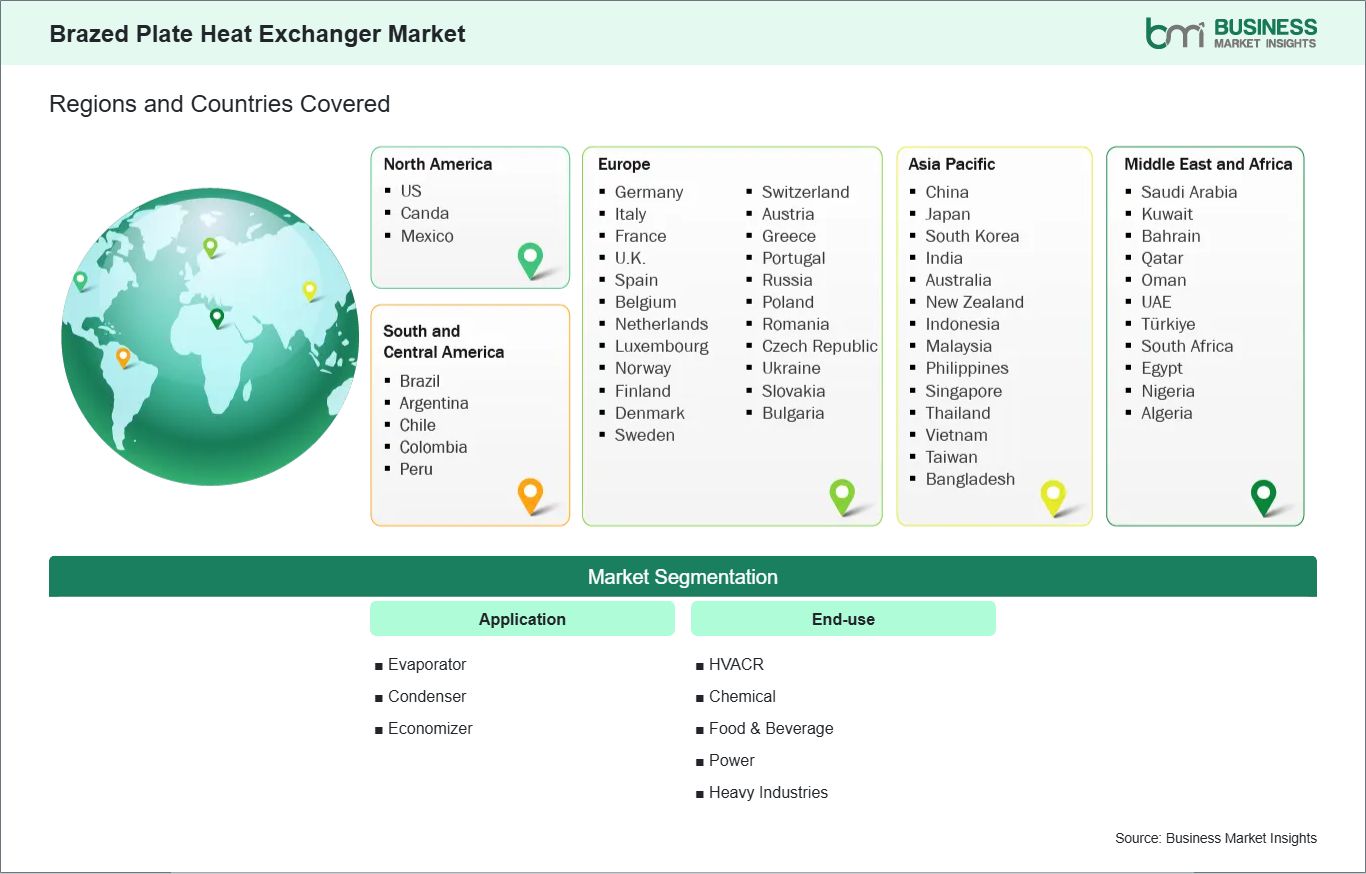
The brazed plate heat exchanger market is segmented based on application and end-use, reflecting the expanding deployment of compact thermal transfer systems across refrigeration, industrial processing, and energy-efficient heating and cooling operations.
By Application
- Evaporator - Preferred for efficient cooling cycles within refrigeration and HVAC systems.
- Condenser - Supports controlled heat rejection in industrial thermal transfer operations.
- Economizer - Enhances waste heat recovery across energy-conscious industrial facilities.
By End-use
- HVACR - Compact exchanger integration strengthens modern climate control infrastructure.
- Chemical - Corrosion-resistant exchanger designs improve process temperature regulation.
- Food and Beverage - Hygienic thermal transfer supports controlled production environments.
- Power - Heat recovery applications improve operational thermal efficiency.
- Heavy Industries - Durable exchanger systems withstand demanding process conditions.
Market Forces
Brazed Plate Heat Exchanger Market Drivers and Opportunities
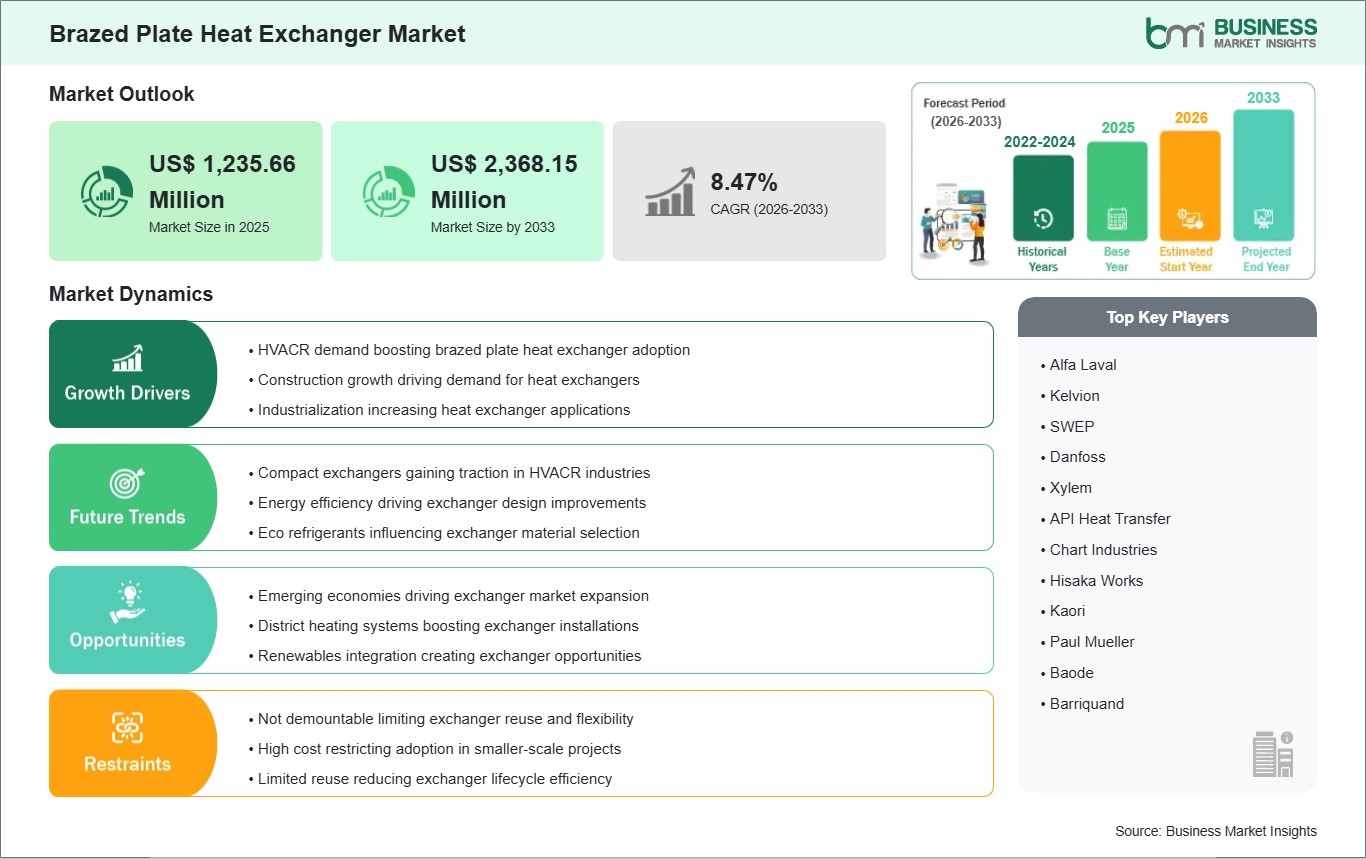
HVACR demand boosting brazed plate heat exchanger adoption
Increased demands from expanded commercial infrastructure and improved refrigeration equipment continue to grow thermal management needs in the HVACR industry. Compact heat exchanger designs help increase heat exchange efficiency and reduce the constraints of installation space in domestic and industrial applications. Brazing technology is increasingly used in the design of equipment by manufacturers with the aim of increasing efficiency in energy usage and optimal cooling.
The move towards energy-efficient building systems has made the heat exchanger an important part of thermal regulation systems. The growing demand for efficient refrigeration and optimal thermal management continues to influence the need for replacements in various systems. This scenario enhances the implementation of brazed plate heat exchangers in district cooling systems, industrial refrigeration systems, and other heating infrastructures.
Emerging economies driving exchanger market expansion
The ongoing industrialization efforts in emerging countries have increased investments in processors, refrigeration units, and power plants. Application-oriented heat exchangers that can accommodate different levels of temperature and pressure are also being developed by manufacturers. The increased production in food processing, chemical industries, and manufacturing industries keeps providing more application areas for miniaturized heat exchangers.
Further expansion in the future will be associated with the need for infrastructure development as well as operational efficiencies in industrial operations. The automation of thermal processes and process optimization methods will encourage extended use of heat exchange equipment over time. The development of manufacturing sites and utilities is expected to boost heat exchanger usage in industrial cooling, energy recovery, and process heating applications through the forecast period.
Size and Share Analysis
Brazed Plate Heat Exchanger Market Size and Share Analysis
The Brazed Plate Heat Exchanger Market is projected to grow from US$ 1,235.66 Million in 2025 to US$ 2,368.15 Million by 2033 , registering a CAGR of 8.47% from 2026 to 2033.
The brazed plate heat exchanger market is projected to grow from USD 1.20 billion in 2025 to USD 2.05 billion by 2033, registering a CAGR of 7.0% from 2026 to 2033
By application, evaporators account for a significant share due to their widespread utilization in refrigeration and cooling systems requiring efficient thermal transfer. Condensers maintain strong deployment across industrial heat rejection processes, while economizers are gaining traction as industries prioritize waste heat recovery and operational energy optimization.
By end-use, HVACR represents the leading segment, supported by expanding deployment of compact thermal management systems across residential, commercial, and industrial infrastructure. The chemical industry continues adopting brazed plate heat exchangers for controlled process temperature management and corrosion-resistant performance. Food and beverage applications are expanding steadily due to hygienic processing requirements and precise thermal regulation. Power and heavy industries are also strengthening market penetration through rising utilization of heat recovery and process efficiency solutions.
Report Coverage
Brazed Plate Heat Exchanger Market Report Coverage and Deliverables
The "Brazed Plate Heat Exchanger Market Size and Forecast (2022 - 2033)" report provides a detailed analysis of the market covering below areas:
- The market size and forecast at global, regional, and country levels for all the key market segments covered under the scope
- The market trends, as well as drivers, restraints, and opportunities
- The market analysis covering key trends, global and regional framework, major players, regulations, and recent developments
- Industry landscape and competition analysis covering market concentration, heat map analysis, prominent players, and recent developments for the market
- Detailed company profiles, including SWOT analysis
Geographic Insights
Brazed Plate Heat Exchanger Market Geographic Insights
The brazed plate heat exchanger market shows diverse regional adoption patterns influenced by industrial energy efficiency initiatives, expanding HVACR infrastructure, rising refrigeration demand, and increasing integration of compact thermal management systems across manufacturing, power, and process industries.
Brazed plate heat exchanger exhibits varied market dynamics based on regional differences arising from industrial development, need for refrigeration, energy efficiency considerations, and capacity expansion. The need for upgrading thermal solutions in various industrial and commercial applications has remained central to procurement trends around the world. Focus on optimizing energy use and integrated systems has boosted industry acceptance in advanced as well as emerging markets.
Market performance in North America is consistent owing to demand for upgrades within existing HVACR infrastructure as well as industrial refrigeration systems. Commercial facilities have become more inclined towards adopting small-scale thermal solutions that could enhance efficiency in limited space settings. Process industries are incorporating state-of-the-art heat exchanger solutions for facilitating process optimization and energy recovery.
Asia Pacific demonstrates strong deployment momentum supported by manufacturing growth, urban infrastructure development, and expanding cold chain networks. Industrial facilities across the region continue modernizing thermal management systems to improve process efficiency and operational reliability. Rising construction activity and wider utilization of commercial climate control systems have strengthened exchanger integration within refrigeration, district cooling, and industrial processing environments.
Europe continues emphasizing sustainable thermal technologies aligned with environmental efficiency objectives and industrial modernization initiatives. Process industries within the region increasingly adopt compact exchanger systems designed for enhanced thermal control and optimized operational performance. Meanwhile, emerging markets across the Middle East, Africa, and South and Central America are witnessing broader exchanger utilization linked to industrial expansion, infrastructure investment, and evolving refrigeration requirements across commercial sectors.
Industry Activity
Recent Developments
The brazed plate heat exchanger market is evaluated by gathering qualitative and quantitative data post primary and secondary research, which includes important corporate publications, association data, and databases. A few of the key developments in the brazed plate heat exchanger market are:
- In September 2024, Alfa Laval, announced that it had introduced an enhanced range of brazed plate heat exchangers at Chillventa 2024, aimed at improving energy efficiency and performance in district heating, cooling, and heat pump systems.
- In June 2023, Alfa Laval, announced that it had launched the AC900 brazed plate heat exchanger, designed for low-GWP refrigerants and next-generation heat pump and industrial chiller applications, strengthening its high-efficiency heat transfer portfolio.
Trust & Transparency
Research Methodology
The market analysis combines proprietary research with secondary data from government agencies, company disclosures, regulatory filings, industry databases and expert interviews. Market estimates are validated through data triangulation, cross-market benchmarking and analyst
review.
View Full Research Methodology
Key Sources Referred:
Industry white papers on thermal management systems
Government energy efficiency publications
Engineering and heat transfer journals
Industrial refrigeration market studies
Company annual reports and financial filings
Academic research papers on compact heat exchangers
Trade association publications related to HVACR systems
Manufacturing and process industry technical documents