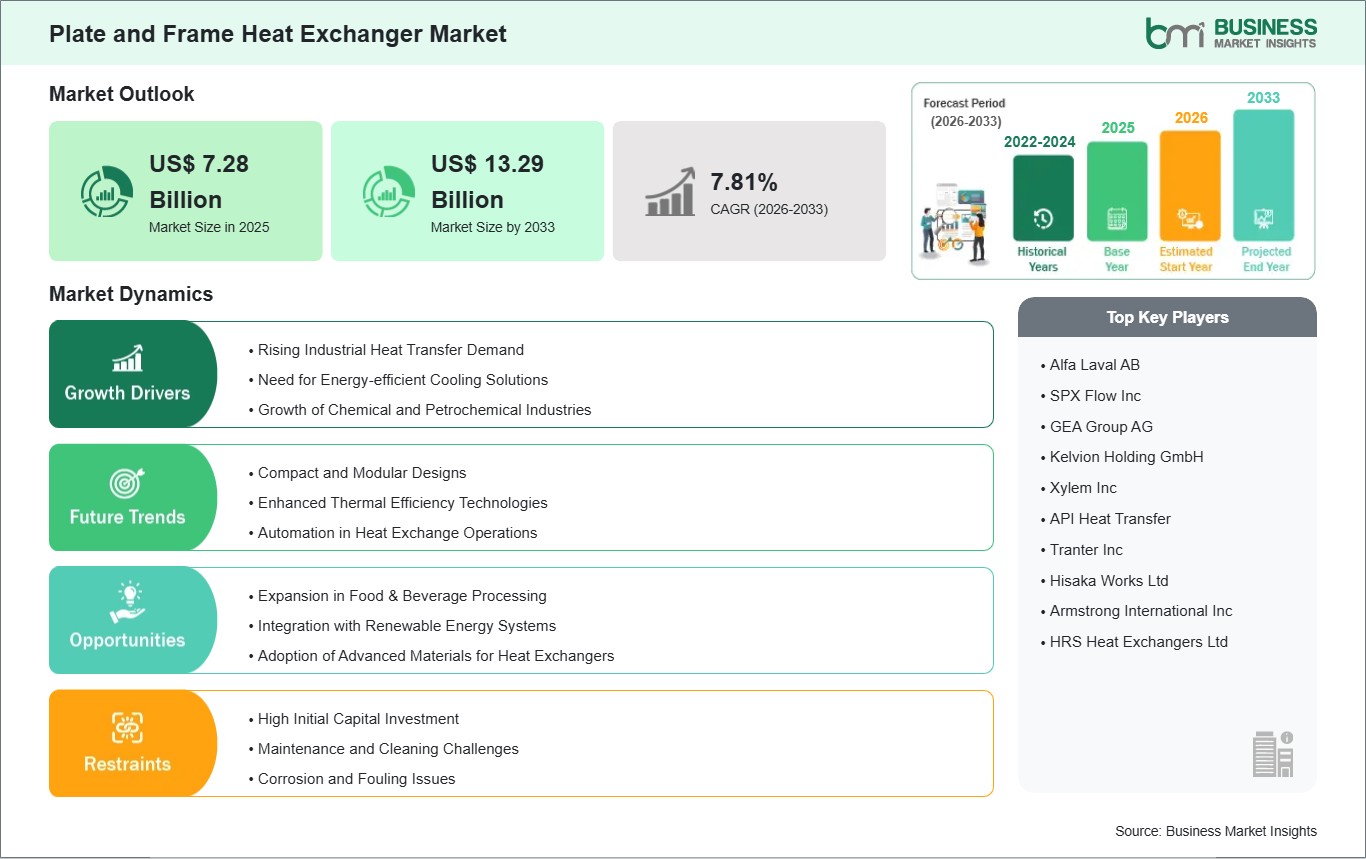
The Plate and Frame Heat Exchanger Market size is expected to reach US$ 13.29 billion by 2033 from US$ 7.28 billion in 2025. The market is estimated to record a CAGR of 7.81% from 2026 to 2033.
The Plate and Frame Heat Exchanger Market is expanding rapidly due to increasing industrial demand for efficient and reliable heat transfer solutions. Brazed, gasketed, and welded product types are widely used across chemical, oil & gas, and food & beverage industries. Technological advancements in compact, modular, and high-efficiency designs, along with the integration of energy-saving solutions, are driving adoption. Industries are focusing on reducing operational costs, improving thermal performance, and complying with regulatory standards. Growing investments in chemical processing, food & beverage production, and petrochemical operations further support market growth, positioning the market for strong expansion in the coming years.

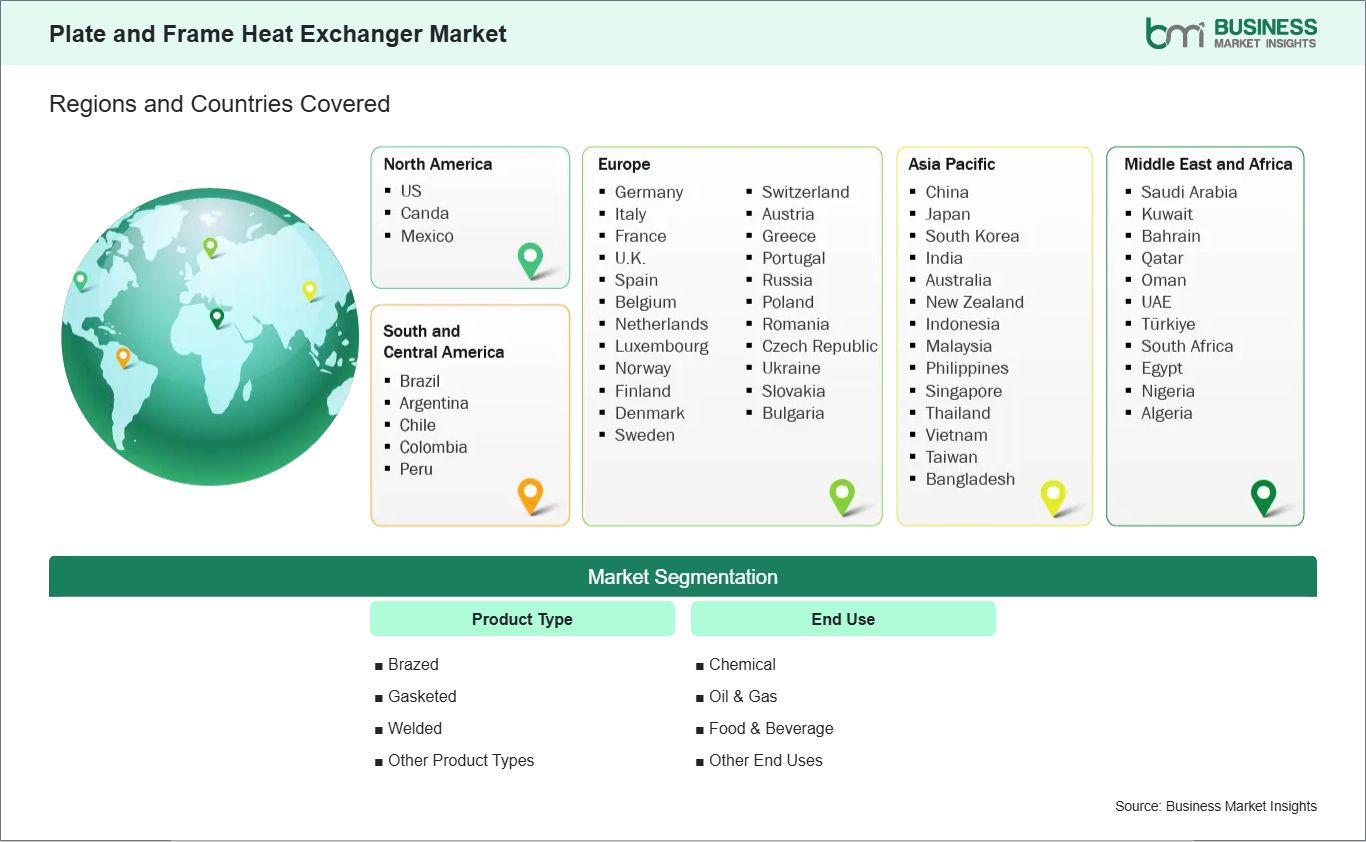
Key segments that contributed to the derivation of the Plate and Frame Heat Exchanger market analysis are product type and end use.
As the use of heat exchangers becomes more widespread in a variety of industries such as chemical, oil and gas, and food manufacturing, the Plate and Frame Heat Exchanger Market will grow rapidly as a result of this increased demand for energy and resource efficiency. Plate and frame heat exchangers have become increasingly popular due to their ability to maintain optimum temperature control throughout the manufacturing process, thereby improving process capability, providing for reliable energy use, and maintaining quality standards for the product produced in these industries.
Temperature management is essential for chemical and petrochemical process applications such as reaction, separation and distillation processes. They are capable of providing high thermal performance, compact designs, and flexibility in the control of heat loads in large and complex industrial processes. Because they are capable of operating under a diverse range of operating conditions; plate and frame heat exchangers provide a high degree of reliability and low operating costs through reduced maintenance downtime and are capable of sustaining continuous production requirements for the industry.
Additionally, as companies strive for a more sustainable and energy-efficient approach to the use of energy in the manufacturing sector, plate and frame heat exchangers will continue to be used as solutions for reducing energy consumption through improved heat recovery and reduced thermal losses. The combination of energy efficiency, compact designs, and versatility to be applied to many industrial applications will ultimately continue to contribute significantly to the strong growth trends of industrial heat transfer activity across many sectors.
The food & beverage industry presents a major opportunity for the Plate and Frame Heat Exchanger Market due to increasing demand for processed, packaged, and refrigerated food products. Temperature-controlled processes, including pasteurization, sterilization, and cooling, require precise and efficient heat exchange to maintain product quality and safety.
Plate and frame heat exchangers offer compact designs, high heat transfer efficiency, and easy cleaning, making them ideal for sanitary applications in food and beverage processing plants. Their ability to handle varying viscosities, flow rates, and temperatures enables manufacturers to improve operational efficiency while maintaining hygiene standards and complying with regulatory requirements.
Furthermore, the growing global population, urbanization, and rising consumption of packaged and ready-to-eat foods are driving increased investments in advanced heat exchange solutions. Companies adopting innovative materials, modular designs, and energy-efficient systems can capitalize on this expanding market, enhancing production capabilities, reducing operational costs, and meeting the evolving needs of food and beverage processing.

The global Plate and Frame Heat Exchanger market is experiencing steady growth, with market size and share analysis reflecting evolving treatment preferences and competitive dynamics among key players. The report evaluates important subsegments categorized within product type and end use, highlighting their respective contributions to overall market performance.
By product type, the brazed subsegment dominated in 2025 due to compact design, high heat transfer efficiency, durability, and corrosion resistance, making it suitable for small- to medium-scale chemical and industrial applications.
By end use, the chemical subsegment dominated in 2025 because chemical processing requires efficient temperature regulation in reactions, distillation, and other critical operations, driving high adoption of plate and frame heat exchangers.
| Report Attribute | Details |
|---|---|
| Market size in 2025 | US$ 7.28 Billion |
| Market Size by 2033 | US$ 13.29 Billion |
| Global CAGR (2026 - 2033) | 7.81% |
| Historical Data | 2022-2024 |
| Forecast period | 2026-2033 |
| Segments Covered | By Product Type
|
|
Regions and Countries Covered
| |
| North America | US, Canada, Mexico |
| Europe | Belgium, Austria, Finland, Denmark, Greece, Poland, Romania, Russia, Ukraine, Czech Republic, Slovakia, Bulgaria, Italy, Luxembourg, Germany, Switzerland, France, Netherlands, Norway, Portugal, Spain, Sweden, United Kingdom |
| Asia-Pacific | Australia, China, India, Japan, South Korea, Indonesia, Malaysia, Philippines, Singapore, Thailand, Vietnam, Bangladesh, New Zealand, Taiwan |
| South and Central America | Brazil, Argentina, Peru, Chile, Colombia |
| Middle East and Africa | Bahrain, Kuwait, Oman, Qatar, Saudi Arabia, United Arab Emirates, Turkiye, South Africa, Egypt, Algeria, Nigeria |
| Market leaders and key company profiles |
|
The "Plate and Frame Heat Exchanger Market Size and Forecast (2022 - 2033)" report provides a detailed analysis of the market covering below areas:
The geographical scope of the Plate and Frame Heat Exchanger market report is divided into: North America, Asia Pacific, Europe, Middle East & Africa, and South & Central America. North America held the largest share in 2025.
North America dominates the Plate and Frame Heat Exchanger Market due to well-established industrial infrastructure, advanced manufacturing capabilities, and high adoption of energy-efficient heat transfer technologies. The U.S. leads regional growth with investments in chemical, petrochemical, and food & beverage plants requiring reliable and efficient heat exchangers. Additionally, North American industries emphasize sustainability, energy optimization, and operational efficiency, encouraging adoption of high-performance brazed, gasketed, and welded plate and frame heat exchangers. Integration with renewable energy systems and advanced materials further supports market expansion, positioning the region as a key driver of global market growth.

The Plate and Frame Heat Exchanger market is evaluated by gathering qualitative and quantitative data post primary and secondary research, which includes important corporate publications, association data, and databases. A few of the key developments in the Plate and Frame Heat Exchanger market are:
The Plate and Frame Heat Exchanger Market is valued at US$ 7.28 Billion in 2025, it is projected to reach US$ 13.29 Billion by 2033.
As per our report Plate and Frame Heat Exchanger Market, the market size is valued at US$ 7.28 Billion in 2025, projecting it to reach US$ 13.29 Billion by 2033. This translates to a CAGR of approximately 7.81% during the forecast period.
The Plate and Frame Heat Exchanger Market report typically cover these key segments-
The historic period, base year, and forecast period can vary slightly depending on the specific market research report. However, for the Plate and Frame Heat Exchanger Market report:
The Plate and Frame Heat Exchanger Market is populated by several key players, each contributing to its growth and innovation. Some of the major players include:
The Plate and Frame Heat Exchanger Market report is valuable for diverse stakeholders, including:
Essentially, anyone involved in or considering involvement in the Plate and Frame Heat Exchanger Market value chain can benefit from the information contained in a comprehensive market report.
Please tell us your area of interest
(Market Segments/ Regions and Countries/ Companies)