Market Summary
Executive Summary and Global Market Analysis
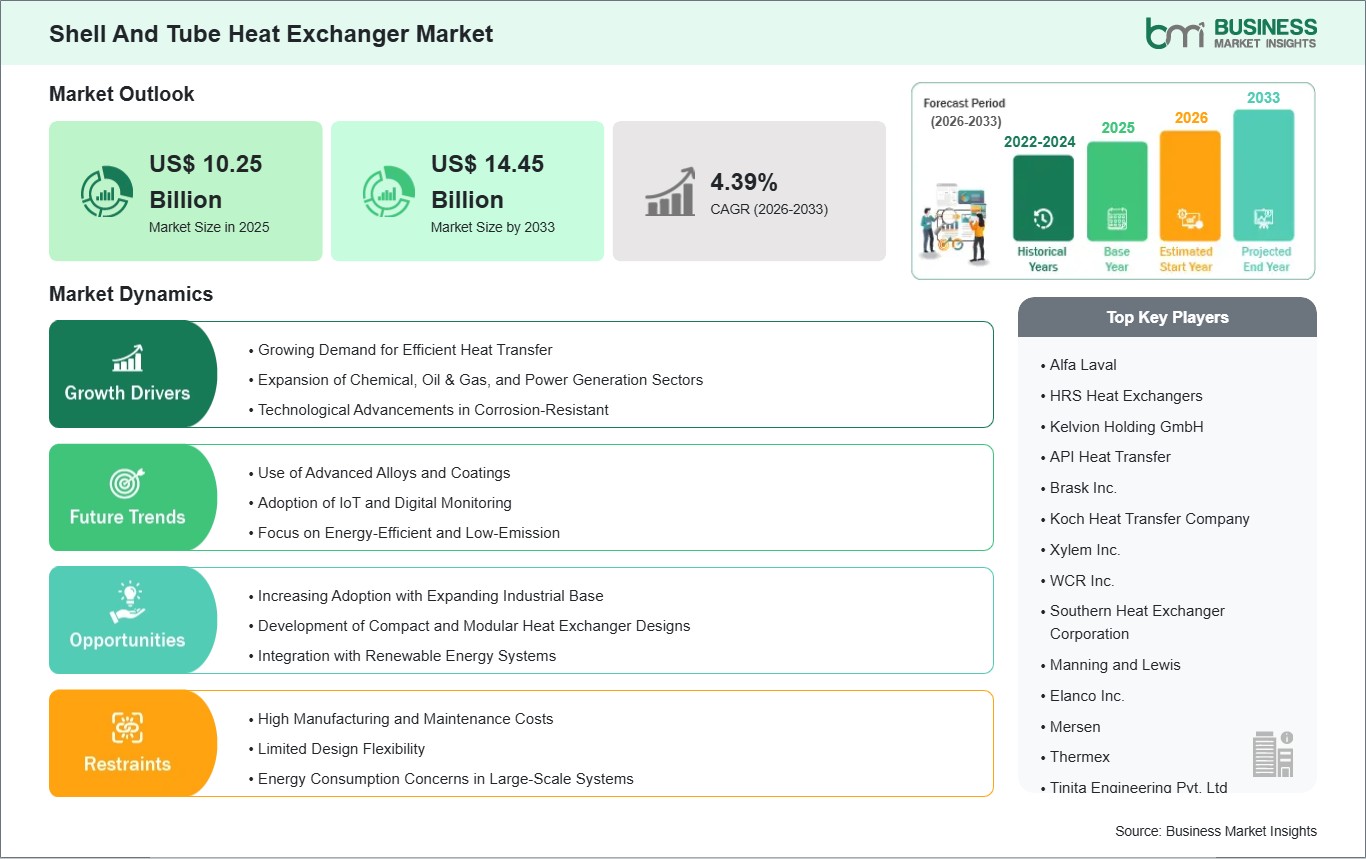
The global market for shell and tube heat exchangers is increasing as different industries are focusing more on efficient thermal management and optimization of heat transfer. Shell and tube heat exchangers have been used to transfer heat from one fluid to another. They have been used in different industries like the oil and gas industry, chemical industry, power industry, HVAC industry, and many more. They have been used due to their high durability, as they can operate at high pressure and high temperature. They can also transfer a high volume of fluids. Different industries have been using heat exchangers that can reduce their operational costs, decrease their energy consumption, and provide sustainability. Different innovations have been made in heat exchangers, like corrosion-resistant alloys, modular designs, and tube arrangements.
In addition, different emerging economies have been expanding their process industries, which have been increasing the demand for heat exchangers. Shell and tube heat exchangers have been used in different industries, but their high capital costs, installation complexities, and maintenance issues have posed challenges to these industries. In addition, different heat transfer technologies have been emerging, which can provide competition to traditional heat exchangers.
Segment Analysis
Shell And Tube Heat Exchanger Market Segmentation
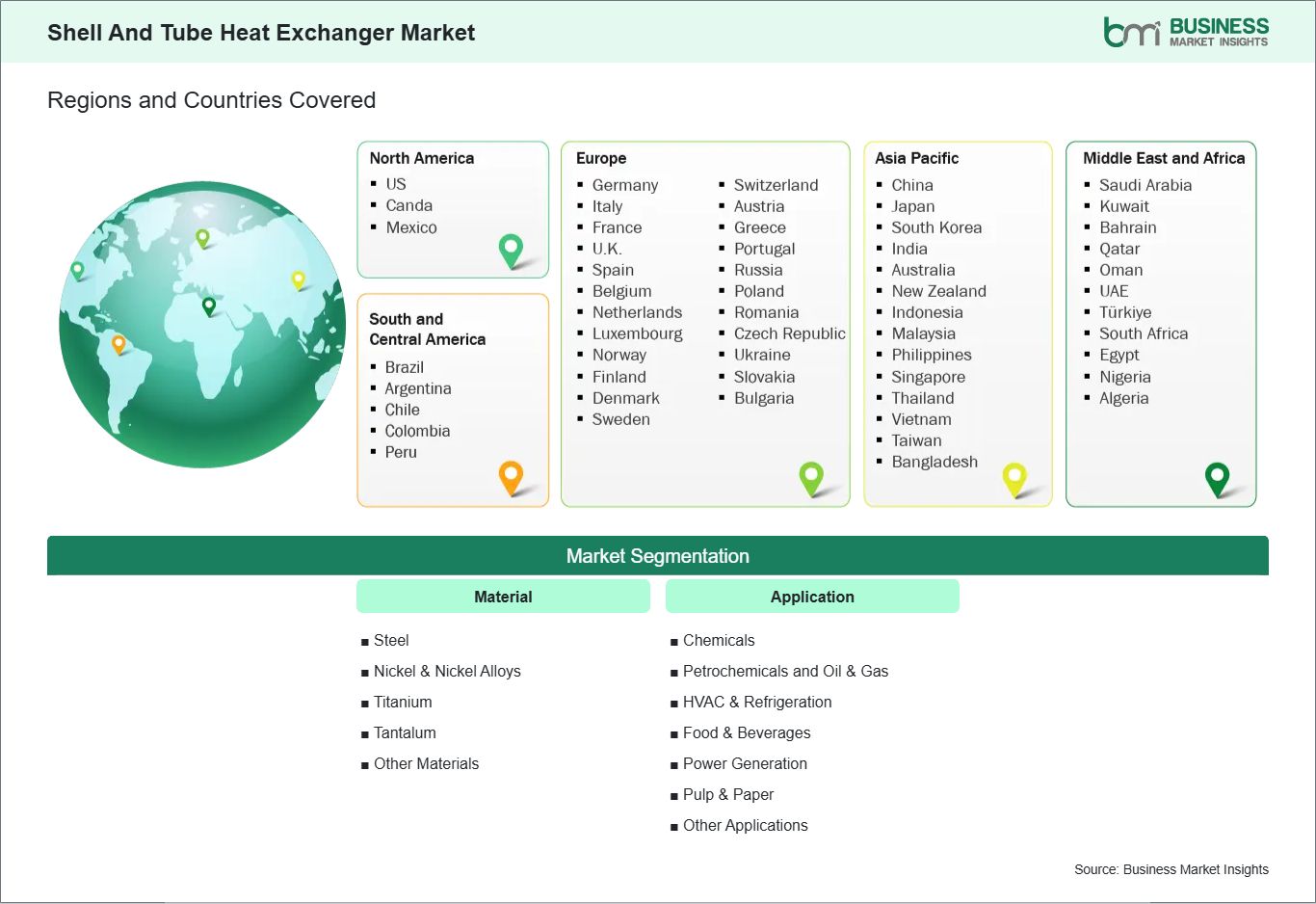
Key segments that contributed to the derivation of the shell and tube heat exchanger market analysis are material and application.
- By material, the Shell & Tube Heat Exchanger market is segmented into steel, nickel & nickel alloys, titanium, tantalum, and others. The steel subsegment dominated the market in 2025.
- Based on application, the Shell & Tube Heat Exchanger market is classified into chemicals, petrochemicals and oil & gas, HVAC & refrigeration, food & beverages, power generation, pulp & paper, and others. The petrochemicals and oil & gas subsegment dominated the market in 2025.
Market Forces
Shell And Tube Heat Exchanger Market Drivers and Opportunities
Growing Demand for Efficient Heat Transfer
The global shell and tube heat exchanger market is being driven by the increasing need for efficient and reliable heat transfer solutions across industrial processes. Industries across the board require equipment capable of maintaining consistent thermal management under demanding operational conditions. Shell and tube heat exchangers are widely favored for their ability to handle high pressures and temperatures, making them essential for critical processes where performance and reliability cannot be compromised.
Organizations are seeking solutions that can maximize heat transfer while minimizing energy consumption and operational costs. Advanced designs, including optimized tube arrangements and enhanced surface geometries, are enabling better thermal performance, helping companies improve process efficiency and reduce waste.
Ongoing innovations in materials and construction methods are also contributing to market growth. The development of corrosion-resistant alloys, modular configurations, and improved fabrication techniques allows these heat exchangers to operate safely and consistently under harsh conditions. These technological improvements ensure longer equipment life, reduced maintenance, and reliable operation, reinforcing the position of shell and tube heat exchangers as a key component of industrial thermal management strategies.
Increasing Adoption with Expanding Industrial Base
The expansion of industrial operations worldwide is creating significant opportunities for the shell and tube heat exchanger market. As industries scale up production and invest in new facilities, the demand for effective thermal management solutions grows. Heat exchangers play a critical role in processes such as chemical reactions, power generation, and refining, providing opportunities for manufacturers to supply equipment that meets diverse operational requirements.
The integration of these automation technologies and digital monitoring tools is increasing the attractiveness of these systems. The real-time monitoring of performance, as well as other features such as predictive maintenance and improved control, are giving the operators the opportunity to maximize the efficiency of these systems. This makes the shell and tube heat exchangers an investment opportunity that will continue to be valuable to the industrial sector as they seek to maintain performance and reliability.
The increased focus on sustainability will also provide another opportunity for growth. Companies are focusing on solutions that are environmentally friendly and ensure sustainability. As the industrial sector continues to grow and develop, the shell and tube heat exchangers will provide the opportunity to ensure sustainability and performance, thus being at the core of the infrastructure of the industry.
Size and Share Analysis
Shell And Tube Heat Exchanger Market Size and Share Analysis
The shell and tube heat exchanger market is experiencing steady growth, with market size and share analysis reflecting evolving treatment preferences and competitive dynamics among key players. The report evaluates important subsegments categorized within are material and application, highlighting their respective contributions to overall market performance.
By material, the steel subsegment dominated the Shell & Tube Heat Exchanger market in 2025. This is driven by steel’s widespread availability, cost-effectiveness, and strong mechanical properties, making it suitable for a wide range of industrial applications. Its resistance to corrosion and high-temperature performance ensures durability and reliability in chemical, petrochemical, and power generation processes, positioning steel as the preferred choice for manufacturers and end-users.
Based on application, the petrochemicals and oil & gas subsegment dominated the Shell & Tube Heat Exchanger market in 2025. The leadership of this application is attributed to the high demand for efficient heat transfer systems in refining, processing, and petrochemical operations. Shell & tube heat exchangers are essential for handling large volumes of fluids under high pressures and temperatures, making them critical for operational efficiency and process safety in the oil & gas sector.
Report Coverage
Shell And Tube Heat Exchanger Market Report Coverage and Deliverables
The "Shell and Tube Heat Exchanger Market Size and Forecast (2022 - 2033)" report provides a detailed analysis of the market covering below areas:
- Shell and Tube Heat Exchanger market size and forecast at global, regional, and country levels for all the key market segments covered under the scope
- Shell and Tube Heat Exchanger market trends, as well as drivers, restraints, and opportunities
- Shell and Tube Heat Exchanger market analysis covering key trends, regional framework, major players, regulations, and recent developments
- Industry landscape and competition analysis covering market concentration, heat map analysis, prominent players, and recent developments for the Shell and Tube Heat Exchanger market
- Detailed company profiles, including SWOT analysis
Geographic Insights
Shell And Tube Heat Exchanger Market Geographic Insights
The geographical scope of the Shell and Tube Heat Exchanger market report is divided into five regions: North America, Asia Pacific, Europe, Middle East & Africa, and South & Central America. The Shell and Tube Heat Exchanger market in North America is expected to grow during the forecast period.
The regional market for shell and tube heat exchangers in North America holds the highest market share, owing to the well-developed industrial sector in the region. In addition, the energy sector and petrochemical industry in North America have been thriving, which has contributed to the development of the regional market. In particular, the heat exchanger market in the United States has been thriving, owing to the well-established oil and gas industry, as well as the chemical industry. In addition, the country has been witnessing constant development in the power generation sector, which has been fueling the market for shell and tube heat exchangers. This is due to the need for heat exchangers that can perform well in extreme conditions.
In addition, the heat exchanger market in the country has been witnessing constant development, with companies increasingly opting for modular designs that can be easily installed and maintained. In addition, companies have been opting for advanced materials, as well as digital technologies, to enhance the efficiency of heat exchangers. Companies in the industry have been focusing on heat exchangers that can reduce energy consumption, as well as emissions, to enhance sustainability.
Industry Activity
Recent Developments
The shell and tube heat exchanger market is evaluated by gathering qualitative and quantitative data post primary and secondary research, which includes important corporate publications, association data, and databases. A few of the key developments in the shell and tube heat exchanger market are:
- In November 2025, Shenzhen Hylita Heat Exchanger Co., Ltd. announced that it had developed and introduced the HLD‑25 safety shell and tube heat exchanger, an advanced design featuring double‑walled tubes with an integrated safety chamber and real‑time leak monitoring to enhance operational safety and efficiency in industrial environments.
- In May 2025, Standard Glass Lining Technology Limited announced that it had launched glass‑lined shell and tube heat exchangers in partnership with Japan’s AGI Group and its affiliate GL HAKKO, securing an exclusive 20‑year license to assemble and market these advanced corrosion‑resistant units in India for both domestic and international markets.
Trust & Transparency
Research Methodology
The market analysis combines proprietary research with secondary data from government agencies, company disclosures, regulatory filings, industry databases and expert interviews. Market estimates are validated through data triangulation, cross-market benchmarking and analyst
review.
View Full Research Methodology
Key Sources Referred:
American Chemistry Council (ACC) European Chemicals Agency (ECHA) Organisation for Economic Co-operation and Development (OECD) World Bank United Nations Environment Programme (UNEP) S. Environmental Protection Agency (EPA) International Council of Chemical Associations (ICCA) International Energy Agency (IEA) - for petrochemical and feedstock insights ICIS (Independent Commodity Intelligence Services) Company Websites Company Annual Reports Company Investor Presentations