Market Summary
Executive Summary and Global Market Analysis
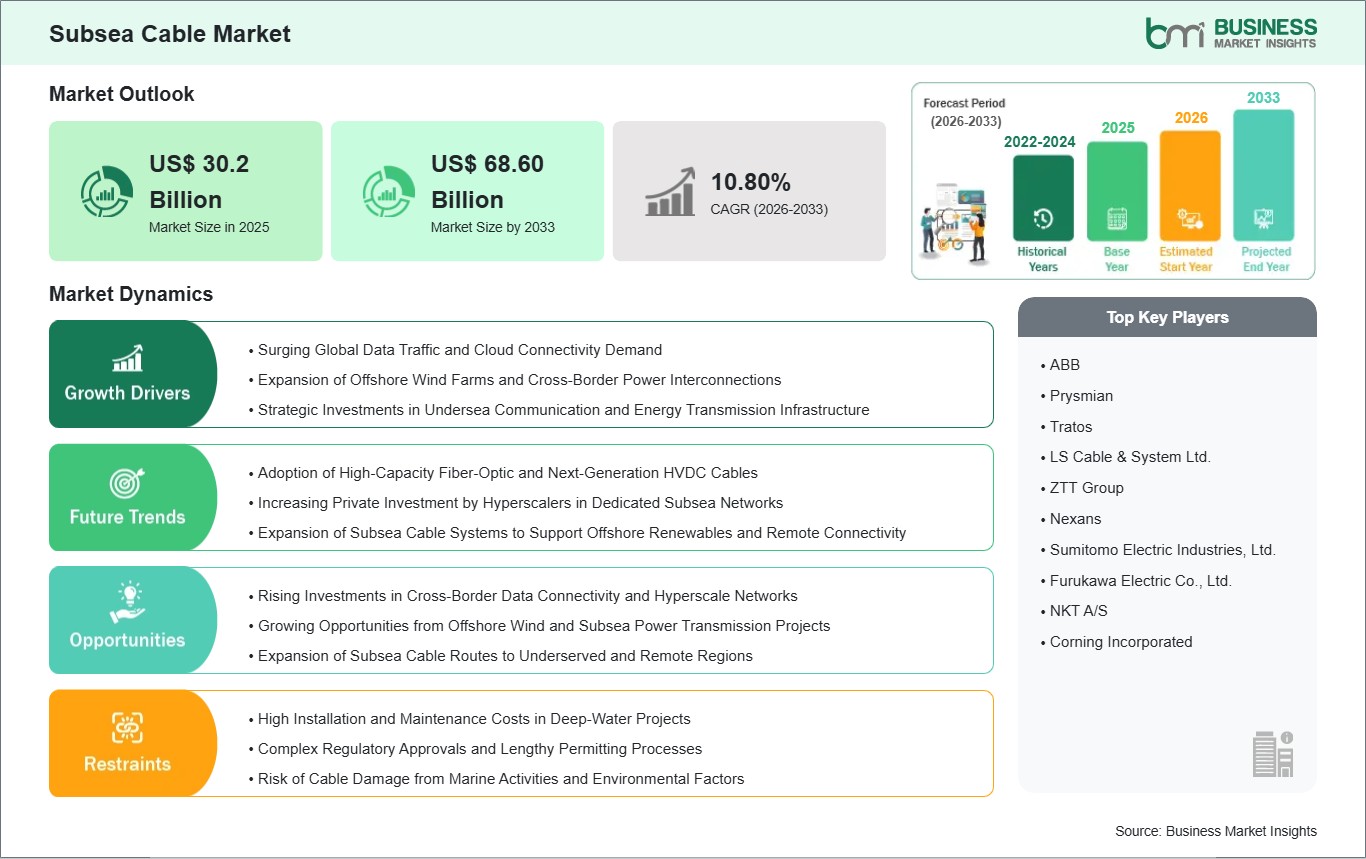
Subsea cables are vital for moving data and power quickly and reliably between continents. They support important industries such as telecommunications, offshore wind energy, oil and gas, and finance. Compared to satellite communication, subsea cables offer much higher bandwidth, lower latency, and better reliability. Demand for high-speed internet, more cloud computing, new data centers, and the growth of offshore wind power are driving the market. New technologies such as Space-Division Multiplexing (SDM) and High-Voltage Direct Current (HVDC) transmission are further making these cables more efficient and able to carry more data.
However, several challenges can restrain market growth, such as the extremely high upfront costs for installation, the logistical complexities of deep-sea laying and maintenance, and the vulnerability of cables to environmental factors such as earthquakes, as well as human activities like fishing and anchoring. The industry is also sensitive to geopolitical tensions and security concerns due to the strategic nature of this critical infrastructure. Despite these hurdles, the market holds significant opportunities driven by the global push for decarbonization and renewable energy integration, the need to connect developing economies to the digital grid, and the continued investment by hyperscale content providers (like Google and Meta) in private cable systems. The growing focus on developing diverse, resilient cable routes is also expected to open new avenues for market expansion.
Segment Analysis
Subsea Cable Market Segmentation
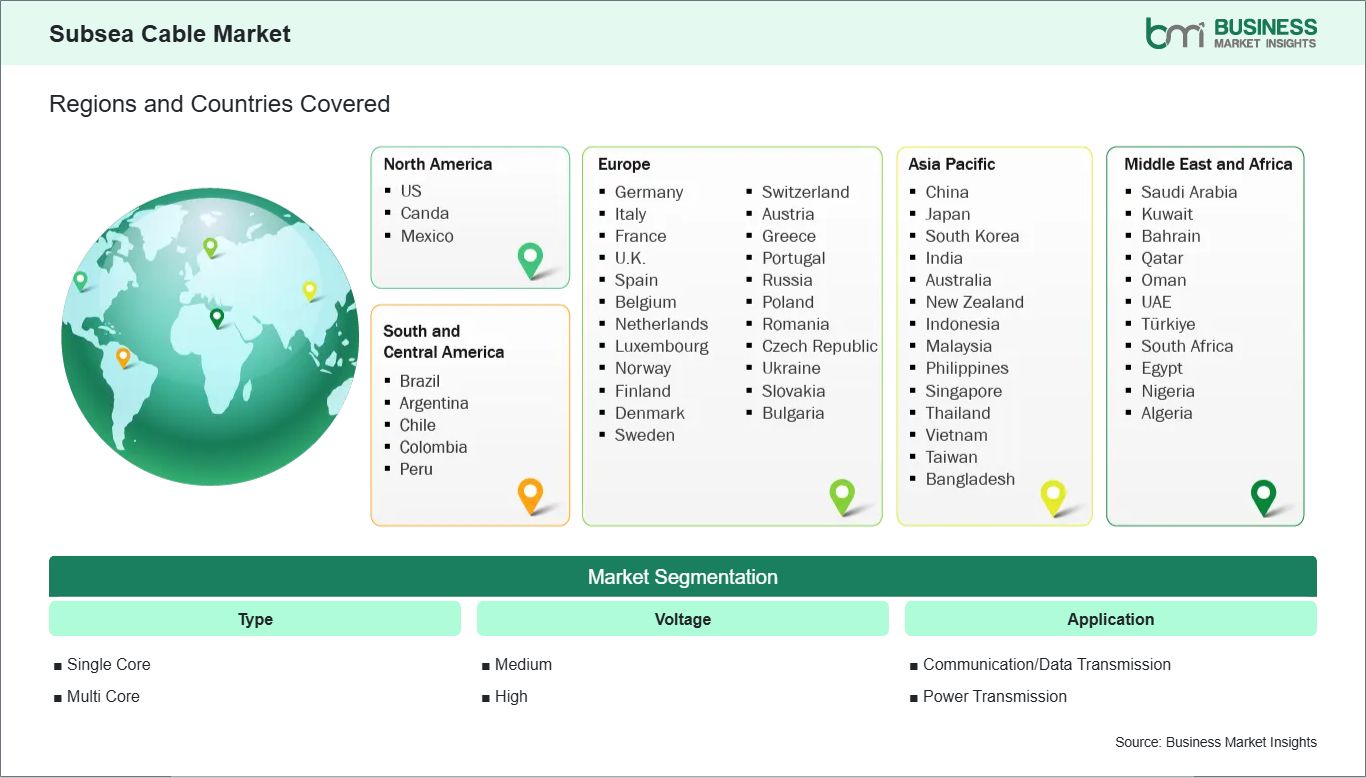
Key segments that contributed to the derivation of the Subsea Cable Market analysis are type, voltage, and application.
- By Type, the market is bifurcated into Single Core and Multi Core.
- By Voltage, the market is segmented into Medium and High.
- By Application, the market is categorized into Communication/Data Transmission and Power Transmission.
Market Forces
Subsea Cable Market Drivers and Opportunities
Global Data Demand and Bandwidth Growth
The rapid increase in global data traffic and the growing need for high-speed internet are the main factors driving the subsea cable market. Subsea fiber optic cables form the backbone of the global digital economy, carrying most international internet traffic. This growth comes from several trends coming together. More people are using smartphones and digital services, leading to a sharp rise in internet users who stream high-definition videos, play online games, and use social media. This heavy use puts pressure on the infrastructure to handle more data, and the rising demand for capacity signals the need for more subsea cables. Large technology and cloud companies are investing in new submarine cables to connect their data centers around the world. These investments help ensure fast, reliable data transfer for cloud services, which are essential for businesses and consumers everywhere. The ongoing need for better, faster, and higher-capacity data transmission keeps driving investment in new, advanced subsea cable systems.
Offshore Renewable Energy Expansion
The global shift to renewable energy, especially the rapid growth of offshore wind farms, is creating major opportunities for the subsea power cable industry. As countries set ambitious carbon reduction goals, more wind and tidal energy are being produced offshore. These distant energy sources need specialized subsea cables to bring electricity back to land. The scale of planned renewable projects worldwide is driving this demand. Offshore wind farms are now being built farther from shore and in deeper waters, which means longer and stronger High-Voltage Direct Current (HVDC) subsea cables are needed. HVDC technology helps reduce power loss over long distances, making it ideal for these projects. Subsea cables also play a key role in connecting power grids between countries, improving energy security and supporting energy trading. This move toward clean energy is expected to keep demand for high-capacity subsea power cables strong for years to come.
Size and Share Analysis
Subsea Cable Market Size and Share Analysis
The Subsea Cable Market demonstrates steady growth, with size and share analysis revealing evolving trends and competitive positioning among key players. The report further examines subsegments categorized within type, voltage, and application, offering insights into their contribution to overall market performance.
For instance, high voltage cables are primarily utilized for power transmission applications, specifically in long-distance inter-country interconnectors and offshore wind export systems. This high-value segment is experiencing significant growth as nations invest in cross-border grid integration and large-scale renewable energy projects to enhance energy security.
Communication/data transmission predominantly employs multi-core fiber-optic cables to manage the explosive growth in global internet traffic. This segment is heavily driven by hyperscale cloud providers and the increasing demand for high-speed, low-latency connectivity across continents and remote island regions.
Report Coverage
Subsea Cable Market Report Coverage and Deliverables
The "Subsea Cable Market Size and Forecast (2022–2033)" report provides a detailed analysis of the market covering below areas:
- Subsea Cable Market size and forecast at global, regional, and country levels for all the key market segments covered under the scope
- Subsea Cable Market trends, as well as market dynamics such as drivers, restraints, and key opportunities
- Subsea Cable Market analysis covering key market trends, global and regional framework, major players, regulations, and recent market developments
- Industry landscape and competition analysis covering market concentration, heat map analysis, prominent players, and recent developments for the Subsea Cable Market
- Detailed company profiles, including SWOT analysis
Geographic Insights
Subsea Cable Market Geographic Insights
The geographical scope of the Subsea Cable Market report is divided into five regions: North America, Asia Pacific, Europe, the Middle East & Africa, and South & Central America.
The Asia-Pacific Subsea Cable Market is segmented into China, Japan, South Korea, India, Australia, New Zealand, Indonesia, Malaysia, the Philippines, Singapore, Thailand, Vietnam, Taiwan, Bangladesh, and the Rest of Asia. The market is primarily driven by the region's massive digital transformation and the rapid expansion of 5G networks and cloud computing. China and India lead the growth, fueled by surging data traffic and heavy investments from global hyperscalers like Google and Meta in private cable systems.
Growth is further bolstered by the rising demand for renewable energy, particularly offshore wind farms in China and Taiwan, which require extensive subsea power cable networks. Rising cross-border connectivity initiatives and proactive government programs aimed at narrowing the digital divide across Southeast Asia are reinforcing Asia Pacific as the critical global hub for subsea cable infrastructure and technological deployment.
Industry Activity
Recent Developments
The Subsea Cable Market is evaluated by gathering qualitative and quantitative data post primary and secondary research, which includes important corporate publications, association data, and databases. A few of the key developments in the Subsea Cable Market are:
- In October 2025, Meta Platforms, the parent company of Facebook, Instagram, and WhatsApp, selected Mumbai and Visakhapatnam as the landing sites for its multibillion-dollar subsea cable project, Waterworth. The company has appointed Sify Technologies as its landing partner in India under a US$ 5 million contract.
- In August 2025, the Federal Communications Commission updated its rules on subsea communications cables, aiming to streamline regulations and add more protections to the increasingly important underwater infrastructure that connects the world.
- In May 2025, Prysmian invested over €200 million in the Pikkala plant expansion, which includes a new high-voltage line inside a 185-meter-tall tower, the highest building in Finland. The facility uses vertical continuous vulcanization to produce approximately 1 kilometre of HVDC 525 kV submarine cable per day.
Trust & Transparency
Research Methodology
The market analysis combines proprietary research with secondary data from government agencies, company disclosures, regulatory filings, industry databases and expert interviews. Market estimates are validated through data triangulation, cross-market benchmarking and analyst
review.
View Full Research Methodology
Key Sources Referred:
World Bank – Global Trade Indicators World Trade Organization (WTO) International Monetary Fund (IMF) International Trade Administration (ITA) Company Websites Company Annual Reports Company Investor Presentations