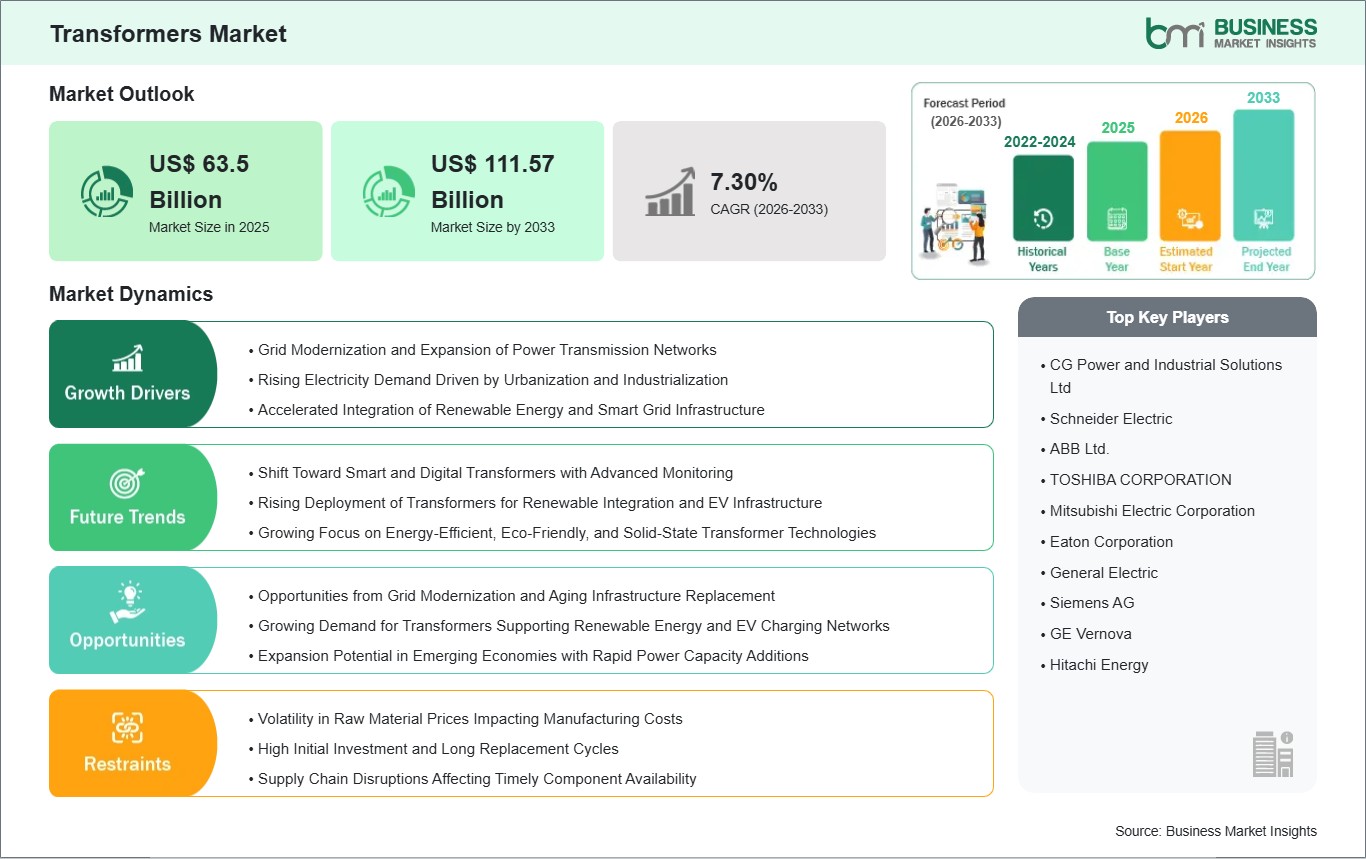
The Transformers Market size is expected to reach US$ 111.58 billion by 2033 from US$ 63.5 billion in 2025. The market is estimated to record a CAGR of 7.30% from 2026 to 2033.
Power and distribution Transformers play a critical role in the transmission and distribution of electricity globally, reliably stepping voltage up or down across power grids. They are essential for core infrastructure sectors such as power utilities, manufacturing, commercial real estate, and the rapidly expanding data center market. Transformers offer several advantages, including high efficiency in energy transfer, decades-long operational lifespans, and the crucial function of enabling seamless power delivery from generation sources to end users. The market is being fueled by aggressive global grid modernization programs, the massive integration of intermittent renewable energy sources (solar and wind), and the surge in global electricity demand driven by industrialization and the electrification of transport (EVs). Additionally, the development of smart transformers with digital monitoring and predictive maintenance capabilities is enhancing grid reliability and operational efficiency.
However, several challenges can restrain market growth, such as the acute volatility and shortage of key raw materials like grain-oriented electrical steel (GOES) and copper, which lead to long manufacturing lead times and significantly higher prices. The industry is also challenged by the high initial capital investment required for large power transformers and the aging installed base in developed economies, which requires massive, capital-intensive replacement cycles. Despite these hurdles, the market holds significant opportunities driven by massive government investments in infrastructure (like the U.S. grid programs), the growing need for high-capacity transformers to support hyperscale data centers, and the expansion of rural electrification in developing countries, particularly across the Asia-Pacific region. The shift towards eco-friendly and biodegradable transformer oils and modular designs is also expected to open new avenues for market expansion.

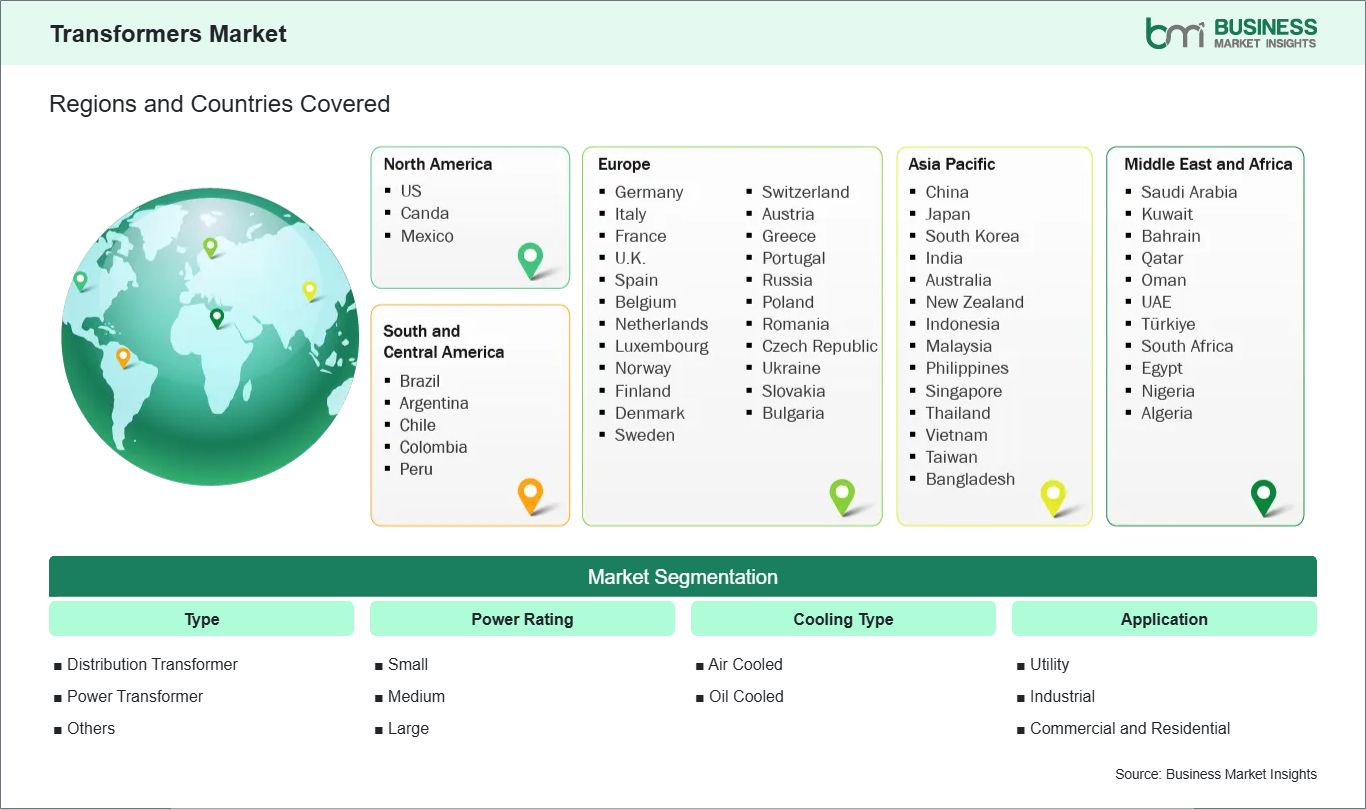
Key segments that contributed to the derivation of the Transformers Market analysis are type, power rating, cooling type, and application.
The pressing need to upgrade and modernize aging power infrastructure due to escalating global energy demand is the central factor driving the growth of the transformers market. In many developed and developing economies, power grids rely on transformers installed decades ago that have reached or exceeded their operational lifespan.
These older assets are inherently less efficient and are not designed to handle the complex, dynamic power flows of a modern electrical system. The aging infrastructure leads to higher energy losses, increased maintenance costs, and frequent service disruptions, ultimately compromising grid stability and reliability. This critical situation compels governments and utility companies globally to initiate major grid modernization and replacement programs.
This overhaul involves systematically replacing old power and distribution units with new, higher-capacity, and more energy-efficient transformers. The replacement cycle is accelerated by the continuous increase in electricity consumption, driven by factors like urbanization, industrialization, and population growth. Utilities must invest in robust, modern transformer technology to prevent widespread outages and support the rising demand for reliable power supply across residential, commercial, and industrial sectors.
The global shift toward clean energy and the adoption of smart grid technologies present a significant and transformative market opportunity for advanced transformer solutions. Renewable energy sources like solar and wind power are inherently intermittent and decentralized, which poses stability challenges to the traditional one-way power grid.
Transformers are essential for connecting these variable renewable generation sources to the main transmission and distribution network. This necessity is driving the demand for specialized units, such as High-Voltage Direct Current (HVDC) transformers, which are highly efficient for long-distance power transmission and crucial for integrating large, remote offshore wind farms or major solar projects. Additionally, the proliferation of distributed energy resources, like rooftop solar, requires distribution transformers that can handle bidirectional power flow.
Furthermore, the evolution toward Smart Grids demands the integration of advanced, digital, or "Smart Transformers." These units incorporate sensors, communication technology, and digital monitoring capabilities (IoT) for real-time data analysis, fault detection, and automated voltage regulation. This digitalization enables utilities to balance supply and demand dynamically, enhance grid resilience, and significantly improve overall operational efficiency.

The Transformers Market demonstrates steady growth, with size and share analysis revealing evolving trends and competitive positioning among key players. The report further examines subsegments categorized within type, power rating, cooling type, and application, offering insights into their contribution to overall market performance.
For instance, large transformers are crucial for utility application, typically featuring high power rating. Large transformers hold a dominant market share, often exceeding 60% of total revenue, due to the critical need for high-voltage transmission and the global push to modernize aging grid infrastructure and integrate large-scale renewable energy.
Medium transformers are widely adopted in industrial applications, often utilizing oil-cooled technology to handle the heavy-duty loads of manufacturing plants and data centers. This segment is currently the fastest-growing by power rating, as industries expand their electrification efforts and seek standardized, reliable units with shorter procurement lead times.
| Report Attribute | Details |
|---|---|
| Market size in 2025 | US$ 63.5 Billion |
| Market Size by 2033 | US$ 111.57 Billion |
| Global CAGR (2026 - 2033) | 7.30% |
| Historical Data | 2022-2024 |
| Forecast period | 2026-2033 |
| Segments Covered | By Type
|
|
Regions and Countries Covered
| |
| North America | US, Canada, Mexico |
| Europe | Belgium, Austria, Finland, Denmark, Greece, Poland, Romania, Russia, Ukraine, Czech Republic, Slovakia, Bulgaria, Italy, Luxembourg, Germany, Switzerland, France, Netherlands, Norway, Portugal, Spain, Sweden, United Kingdom |
| Asia-Pacific | Australia, China, India, Japan, South Korea, Indonesia, Malaysia, Philippines, Singapore, Thailand, Vietnam, Bangladesh, New Zealand, Taiwan |
| South and Central America | Brazil, Argentina, Peru, Chile, Colombia |
| Middle East and Africa | Bahrain, Kuwait, Oman, Qatar, Saudi Arabia, United Arab Emirates, Turkiye, South Africa, Egypt, Algeria, Nigeria |
| Market leaders and key company profiles |
|
The "Transformers Market Size and Forecast (2022–2033)" report provides a detailed analysis of the market covering below areas:
The geographical scope of the Transformers Market report is divided into five regions: North America, Asia Pacific, Europe, Middle East & Africa, and South & Central America.
The Asia-Pacific Transformers Market is segmented into China, Japan, South Korea, India, Australia, New Zealand, Indonesia, Malaysia, the Philippines, Singapore, Thailand, Vietnam, Taiwan, Bangladesh, and the Rest of Asia. The market is primarily driven by the region's massive grid modernization efforts and the rapid integration of renewable energy sources like solar and wind. China and India lead the growth, fueled by record government investments in Ultra-High Voltage (UHV) transmission corridors and smart-grid upgrades.
Growth is further bolstered by the booming demand from data centers and the expansion of Electric Vehicle (EV) charging infrastructure, which requires advanced distribution and power transformers. The push for energy efficiency standards (such as China's mandatory phase-out of legacy S7/S8 units) and the presence of major manufacturing hubs solidify Asia-Pacific as the critical global driver for transformer demand and technological innovation.

The Transformers Market is evaluated by gathering qualitative and quantitative data post primary and secondary research, which includes important corporate publications, association data, and databases. A few of the key developments in the Transformers Market are:
The Transformers Market is valued at US$ 63.5 Billion in 2025, it is projected to reach US$ 111.57 Billion by 2033.
As per our report Transformers Market, the market size is valued at US$ 63.5 Billion in 2025, projecting it to reach US$ 111.57 Billion by 2033. This translates to a CAGR of approximately 7.30% during the forecast period.
The Transformers Market report typically cover these key segments-
The historic period, base year, and forecast period can vary slightly depending on the specific market research report. However, for the Transformers Market report:
The Transformers Market is populated by several key players, each contributing to its growth and innovation. Some of the major players include:
The Transformers Market report is valuable for diverse stakeholders, including:
Essentially, anyone involved in or considering involvement in the Transformers Market value chain can benefit from the information contained in a comprehensive market report.
Please tell us your area of interest
(Market Segments/ Regions and Countries/ Companies)