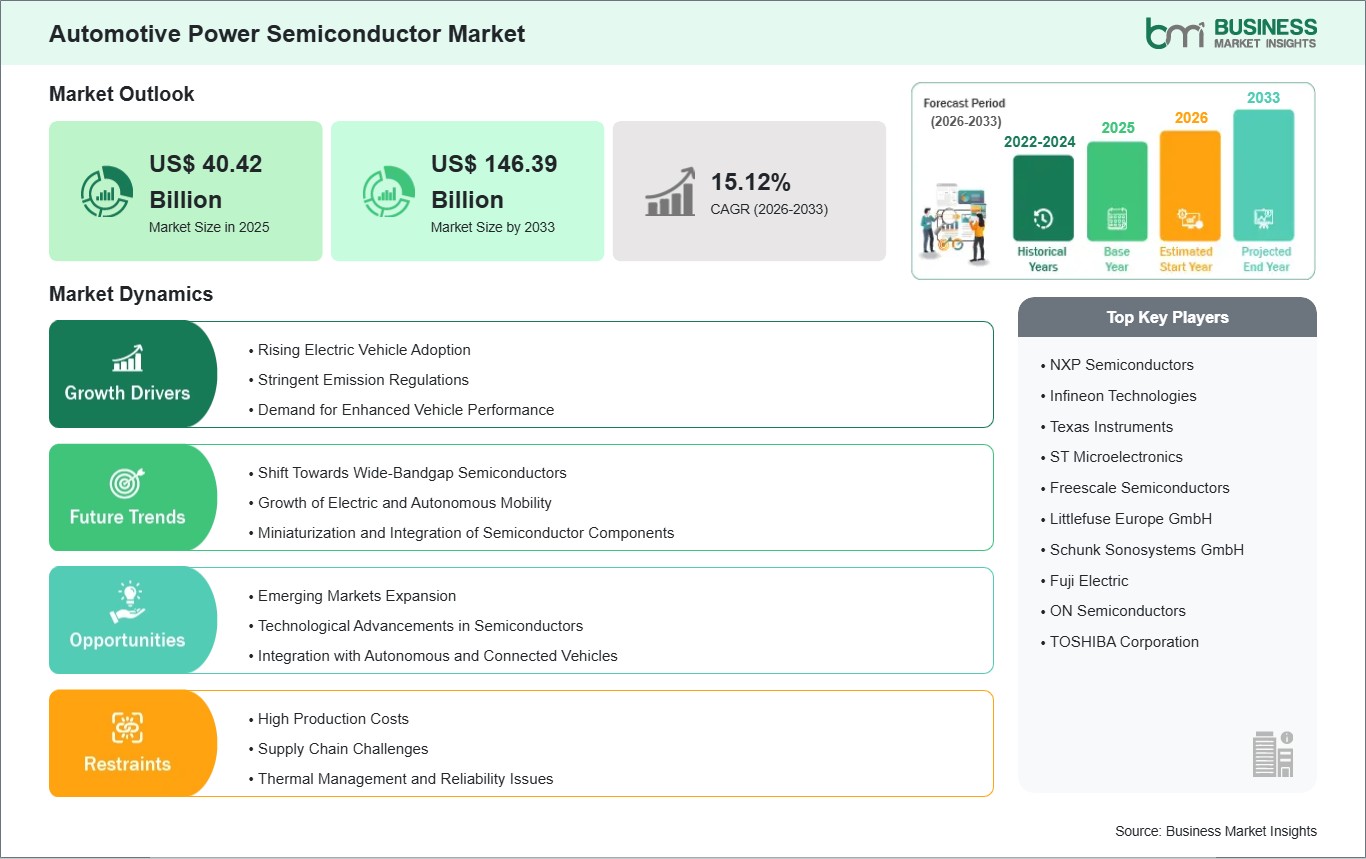
The Automotive power semiconductor market size is expected to reach US$146.39 billion by 2033 from US$40.42 billion in 2025. The market is estimated to record a CAGR of 15.12% from 2026 to 2033.
Automotive power semiconductors are electronic components designed to control and manage the flow of electrical power in vehicles. They are critical for converting, switching, and regulating electrical energy efficiently within automotive systems. These devices help improve the performance, energy efficiency, and reliability of electrical and electronic functions in modern vehicles, especially in electrified powertrains and advanced electronics systems. Power semiconductors are widely used in electric and hybrid vehicle (EV/HEV) powertrain components such as inverters, DC‑DC converters, onboard chargers (OBC), battery management systems (BMS), and motor drives.
The automotive power semiconductor market is experiencing robust growth driven by several key factors. A major driver is the accelerating electrification of vehicles, as EVs and HEVs require sophisticated power electronics for efficient energy conversion and battery utilization; power semiconductors are essential in main inverters, DC‑DC converters, and chargers. Government mandates on emissions reduction and fuel efficiency further propel the adoption of energy‑efficient semiconductor technologies. Additionally, the increasing integration of advanced systems such as ADAS and autonomous features requires reliable and high‑performance power components, expanding demand beyond traditional powertrain applications.
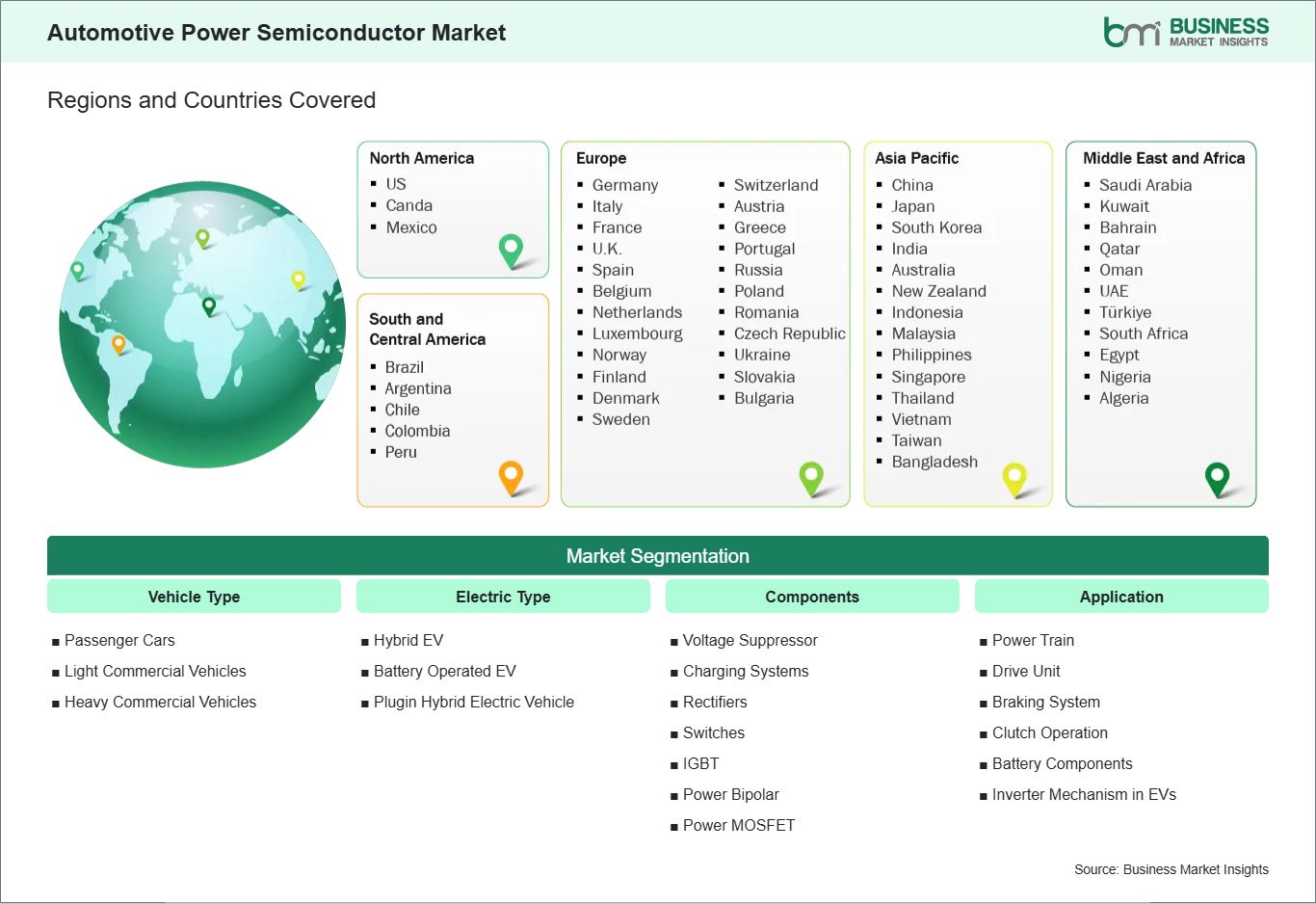
Key segments that contributed to the derivation of the Automotive Power Semiconductor Market Analysis are Vehicle Type, Electric Type, Components and Application.
The growing adoption of electric vehicles (EVs) worldwide is a major driver for the automotive power semiconductor market. EVs rely heavily on power semiconductors for efficient energy conversion, motor control, and battery management. Government incentives, environmental regulations, and consumer preference for sustainable mobility are accelerating EV production. Additionally, advancements in battery technologies and charging infrastructure are supporting the shift from internal combustion engine vehicles to electric alternatives. As EV penetration increases in key markets such as Europe, North America, and China, the demand for high-performance semiconductors like IGBTs, MOSFETs, and SiC devices is expected to grow exponentially.
The development of advanced semiconductor materials such as silicon carbide (SiC) and gallium nitride (GaN) offers substantial growth opportunities. These materials enable higher efficiency, lower energy losses, and better thermal performance compared to traditional silicon devices. Innovations in compact packaging, high-voltage operation, and integrated circuit design further enhance their applicability in EVs, hybrid vehicles, and autonomous systems. As automotive manufacturers strive for improved performance, extended range, and reduced energy consumption, advanced power semiconductors present a lucrative opportunity for companies to deliver cutting-edge solutions. Continuous R&D investment will drive market expansion and create competitive advantages for early adopters.
By Vehicle Type, the market is segmented into Passenger Cars, Light Commercial Vehicles, and Heavy Commercial Vehicles. The Passenger Cars segment dominated the market in 2024. The Indoor vehicle type segment in the Automotive Power Semiconductor Market focuses on electric and hybrid vehicles primarily used in controlled environments, such as warehouses, factories, or urban facilities. These vehicles rely on compact, efficient power semiconductors for enhanced energy management and operational efficiency.
By Electric Type, the market is segmented into Hybrid EV, Battery Operated EV, and Plug-in Hybrid Electric Vehicle (PHEV). The Hybrid EV segment held the largest share of the market in 2024. The Hybrid EV segment in the Automotive Power Semiconductor Market includes vehicles combining internal combustion engines with electric motors. Power semiconductors in these vehicles optimize energy conversion, improve fuel efficiency, and enable regenerative braking, supporting reduced emissions and enhanced overall vehicle performance.
By Components, the market is segmented into Voltage Suppressor, Charging Systems, Rectifiers, Switches, IGBT, Power Bipolar, and Power MOSFET. The IGBT segment held the largest share of the market in 2024. The IGBT (Insulated Gate Bipolar Transistor) component segment in the Automotive Power Semiconductor Market is crucial for electric and hybrid vehicles. IGBTs efficiently manage high-voltage power conversion, enhance motor control, reduce energy losses, and improve overall vehicle performance and reliability.
By Application, the market is segmented into Power Train, Drive Unit, Braking System, Clutch Operation, Battery Components, and Inverter Mechanism in EVs. The Powertrain segment held the largest share of the market in 2024. The Powertrain application segment in the Automotive Power Semiconductor Market focuses on electric, hybrid, and conventional vehicles. Power semiconductors enable efficient energy conversion, precise motor control, and thermal management, enhancing the performance, fuel efficiency, and reliability of engines, electric motors, and overall drivetrain systems.
| Report Attribute | Details |
|---|---|
| Market size in 2025 | US$ 40.42 Billion |
| Market Size by 2033 | US$ 146.39 Billion |
| Global CAGR (2026 - 2033) | 15.12% |
| Historical Data | 2022-2024 |
| Forecast period | 2026-2033 |
| Segments Covered | By Vehicle Type
|
| Regions and Countries Covered | North America
|
| Market leaders and key company profiles |
|
The Automotive Power Semiconductor Market Size and Forecast (2022–2033) report provides a detailed analysis of the market covering below areas:
The geographical scope of the Automotive Power Semiconductor market report is divided into five regions: North America, Asia Pacific, Europe, Middle East & Africa, and South & Central America. The Automotive Power Semiconductor market in Asia Pacific is expected to grow significantly during the forecast period.
The Asia-Pacific Automotive power semiconductor market is segmented into China, Japan, South Korea, India, Australia, New Zealand, Indonesia, Malaysia, the Philippines, Singapore, Thailand, Vietnam, Taiwan, Bangladesh, and the Rest of Asia. The Asia-Pacific Automotive power semiconductor market is experiencing robust growth, driven by the rapid adoption of electric and hybrid vehicles, supportive government policies, expanding automotive manufacturing, and increasing consumer demand for energy-efficient, high-performance vehicles. Technological advancements in semiconductors further fuel market expansion across the region.
Additionally, rising urbanization, growing disposable incomes, and investments in EV infrastructure, such as charging networks, are accelerating market demand. Manufacturers are increasingly adopting advanced power semiconductors, boosting efficiency, reliability, and overall vehicle performance across the Asia-Pacific.
The Automotive power semiconductor market is evaluated by gathering qualitative and quantitative data post primary and secondary research, which includes important corporate publications, association data, and databases. A few of the key developments in the Automotive power semiconductor market are:
The Automotive Power Semiconductor Market is valued at US$ 40.42 Billion in 2025, it is projected to reach US$ 146.39 Billion by 2033.
As per our report Automotive Power Semiconductor Market, the market size is valued at US$ 40.42 Billion in 2025, projecting it to reach US$ 146.39 Billion by 2033. This translates to a CAGR of approximately 15.12% during the forecast period.
The Automotive Power Semiconductor Market report typically cover these key segments-
The historic period, base year, and forecast period can vary slightly depending on the specific market research report. However, for the Automotive Power Semiconductor Market report:
The Automotive Power Semiconductor Market is populated by several key players, each contributing to its growth and innovation. Some of the major players include:
The Automotive Power Semiconductor Market report is valuable for diverse stakeholders, including:
Essentially, anyone involved in or considering involvement in the Automotive Power Semiconductor Market value chain can benefit from the information contained in a comprehensive market report.
Please tell us your area of interest
(Market Segments/ Regions and Countries/ Companies)