Market Summary
Executive Summary and Global Market Analysis
A semiconductor foundry, or fab, is a dedicated facility that manufactures integrated circuits (ICs) for other companies, primarily fabless semiconductor firms. This market is the backbone of the global electronics industry, enabling companies to focus on chip design while outsourcing the capital-intensive and technologically complex manufacturing process.
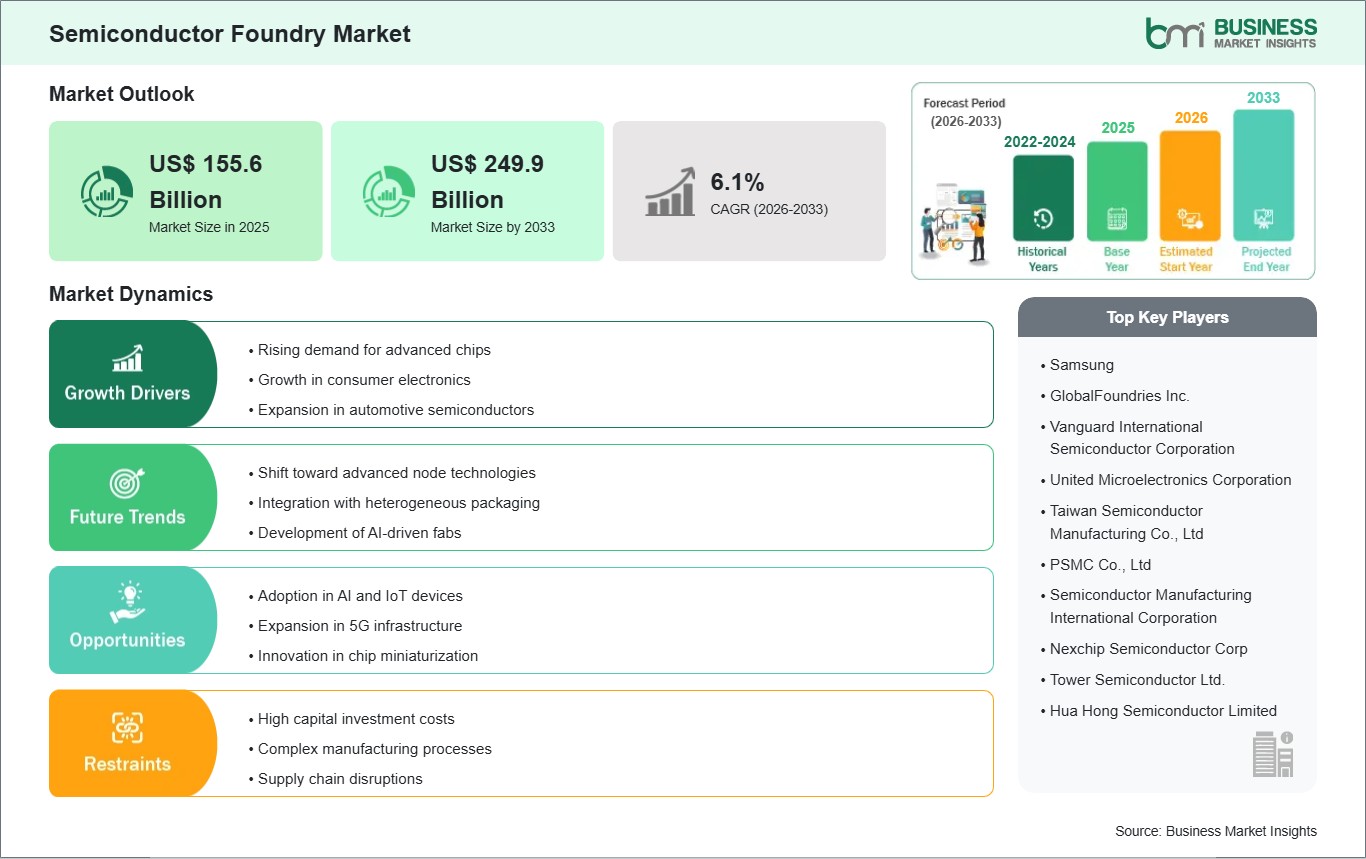
The Semiconductor Foundry Market is experiencing explosive growth, largely driven by the pervasive integration of advanced chips into everyday life, the proliferation of data-intensive technologies like Artificial Intelligence (AI) and High-Performance Computing (HPC), and the global deployment of 5G networks. Foundries are engaged in a race to develop and perfect cutting-edge process nodes (3nm, 2nm, and beyond) and advanced packaging solutions to meet the escalating performance and energy efficiency demands of next-generation applications. Geopolitical dynamics are also spurring massive government investments across regions to localize and secure semiconductor supply chains.
Segment Analysis
Semiconductor Foundry Market Segmentation
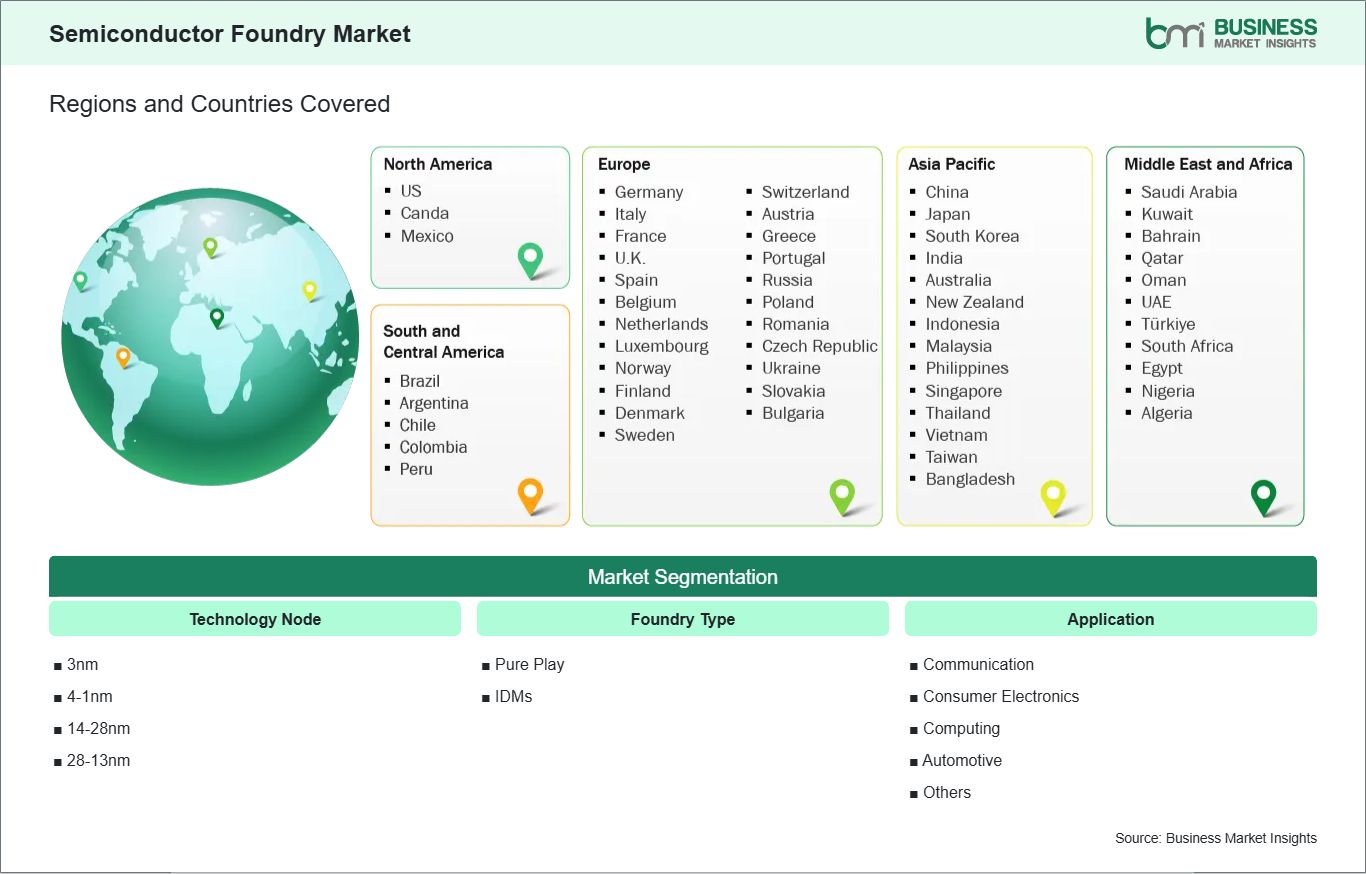
Key segments that contributed to the derivation of the Semiconductor Foundry Market analysis are technology node, foundry type, and application.
- By Technology Node, the market is segmented into 3nm, 4–10nm, 14–28nm, and 28–130nm.
- By Foundry Type, the market is segmented into Pure Play and IDMs.
- By Application, the market is segmented into Communication, Consumer Electronics, Computing, Automotive, and Others.
Market Forces
Semiconductor Foundry Market Drivers and Opportunities
Demand for AI and High-Performance Computing (HPC) Chips
The proliferation of Artificial Intelligence (AI) and Machine Learning (ML) across virtually all industries (cloud, automotive, healthcare, finance) predominantly drives the demand for advanced foundry services. AI/HPC processors, such as high-end GPUs and custom ASICs, require the absolute bleeding edge of semiconductor technology, specifically, the smallest process nodes. These chips demand maximum transistor density, unparalleled computational speed, and superior power efficiency to handle massive parallel processing tasks like training large language models (LLMs) and running hyperscale data centers.
Foundries like TSMC and Samsung are the sole entities capable of manufacturing these advanced chips, locking in high-volume, high-margin business from key customers like NVIDIA, AMD, and hyperscalers (Google, Microsoft, Amazon). This driver forces foundries into a continuous, multi-billion-dollar R&D cycle, which is both a market driver and a barrier to entry.
Global Push for Supply Chain Regionalization and Resilience
Following the supply chain disruptions of the past few years, there is a strong and coordinated geopolitical drive to reduce reliance on concentrated manufacturing in a single geographic area. Governments in North America and Europe are allocating hundreds of billions of dollars in subsidies, tax incentives, and grants to encourage major foundries and IDMs to establish new, high-volume fabrication plants within their borders.
This represents a massive, government-backed opportunity for semiconductor foundries. It guarantees substantial long-term capital expenditure and provides a localized, secure, and resilient supply chain for domestic industries like defense, automotive, and IT infrastructure. This not only expands the total manufacturing capacity globally but also opens new regional markets for foundries that successfully establish operations in these new hubs.
Size and Share Analysis
Semiconductor Foundry Market Size and Share Analysis
The Semiconductor Foundry Market demonstrates consistent growth, with size and share analysis revealing strong positioning for material and product leaders amid customization trends. The report examines subsegments within technology node, foundry type, and application, offering insights into their contribution to overall market performance.
For instance, the 4–10nm subsegment holds a significant share by technology node, as it remains the "sweet spot" for premium mobile and server chips. The Communications subsegment remains the top application-based revenue contributor, supported by the global rollout of 5G. The Automotive subsegment is identified as a high-growth area, driven by the increasing semiconductor content in electric and autonomous vehicles.
Report Coverage
Semiconductor Foundry Market Report Coverage and Deliverables
The "Semiconductor Foundry Market Size and Forecast (2022 - 2033)" report provides a detailed analysis of the market covering below areas:
- Semiconductor Foundry Market size and forecast at global, regional, and country levels for all the key market segments covered under the scope
- Semiconductor Foundry Market trends, as well as market dynamics such as drivers, restraints, and key opportunities
- Semiconductor Foundry Market analysis covering key market trends, global and regional framework, major players, regulations, and recent market developments
- Industry landscape and competition analysis covering market concentration, heat map analysis, prominent players, and recent developments for the Semiconductor Foundry Market
- Detailed company profiles, including SWOT analysis
Geographic Insights
Semiconductor Foundry Market Geographic Insights
The geographical scope of the Semiconductor Foundry Market report is divided into five regions: North America, Asia Pacific, Europe, Middle East & Africa, and South & Central America.
Asia Pacific holds a significant share of the market, driven by the presence of manufacturing giants in Taiwan, South Korea, and China. The region benefits from a highly integrated supply chain and massive established capacity.
North America is projected as the fastest-growing region, propelled by unprecedented public and private investments in new fabrication plants and a strong presence of the world's leading chip design firms (fabless companies). Europe is expected to exhibit the fastest growth due to government-led incentive programs aimed at building new fabrication plants.
Industry Activity
Recent Developments
The Semiconductor Foundry Market is evaluated by gathering qualitative and quantitative data post-primary and secondary research, which includes important corporate publications, association data, and databases. A few of the key developments in the Semiconductor Foundry Market are:
- In October 2025, NVIDIA announced plans with Samsung Electronics to build a new AI factory, representing a new era where intelligent computing and chip manufacturing converge. The state-of-the-art AI factory will combine Samsung’s semiconductor technologies with NVIDIA platforms to establish the foundation of next-generation, AI-driven production.
- In November 2025, GlobalFoundries and Navitas Semiconductor announced a long-term strategic partnership to strengthen and accelerate U.S.-based gallium nitride (GaN) technology, design, and manufacturing. Together, the companies will collaborate, develop, and deliver advanced solutions for critical applications in high-power markets that demand the highest efficiency and power density, including AI datacenters, performance computing, energy and grid infrastructure, and industrial electrification.
- In August 2025, GlobalFoundries announced it had entered into an agreement with Apple for a deeper collaboration that will advance semiconductor technologies and strengthen U.S. manufacturing.
Trust & Transparency
Research Methodology
The market analysis combines proprietary research with secondary data from government agencies, company disclosures, regulatory filings, industry databases and expert interviews. Market estimates are validated through data triangulation, cross-market benchmarking and analyst
review.
View Full Research Methodology
Key Sources Referred:
World Bank - Global Trade IndicatorsWorld Trade Organization (WTO)International Monetary Fund (IMF)International Trade Administration (ITA)Company WebsitesCompany Annual ReportsCompany Investor Presentations