Market Summary
Executive Summary and Global Market Analysis
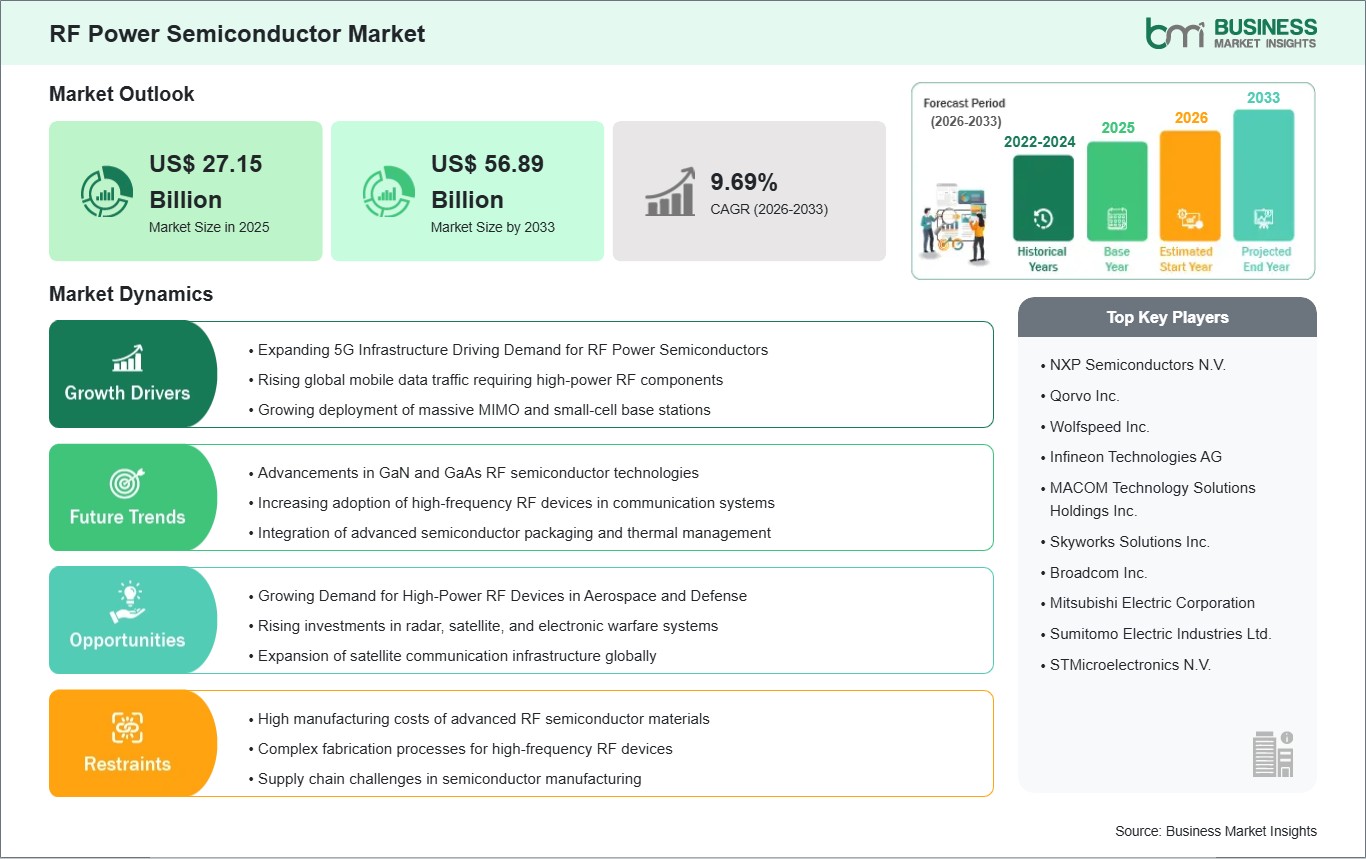
The global RF power semiconductor market is growing due to rising demand for high-frequency communication, wireless network expansion, and adoption of advanced semiconductor materials like GaN and GaAs. RF power semiconductors amplify and transmit RF signals in telecom, radar, satellite networks, and industrial RF energy applications.
Telecom infrastructure represents the largest segment, driven by 5G rollout and early 6G development. LDMOS is widely used in sub-6 GHz applications, while GaN is adopted for higher frequencies due to superior power density and thermal performance. Aerospace, defense, and satellite systems also drive demand for high-power RF components. Competitive dynamics focus on material innovation, device packaging, and strategic partnerships to enhance performance and supply chain efficiency.
Segment Analysis
RF Power Semiconductor Market Segmentation
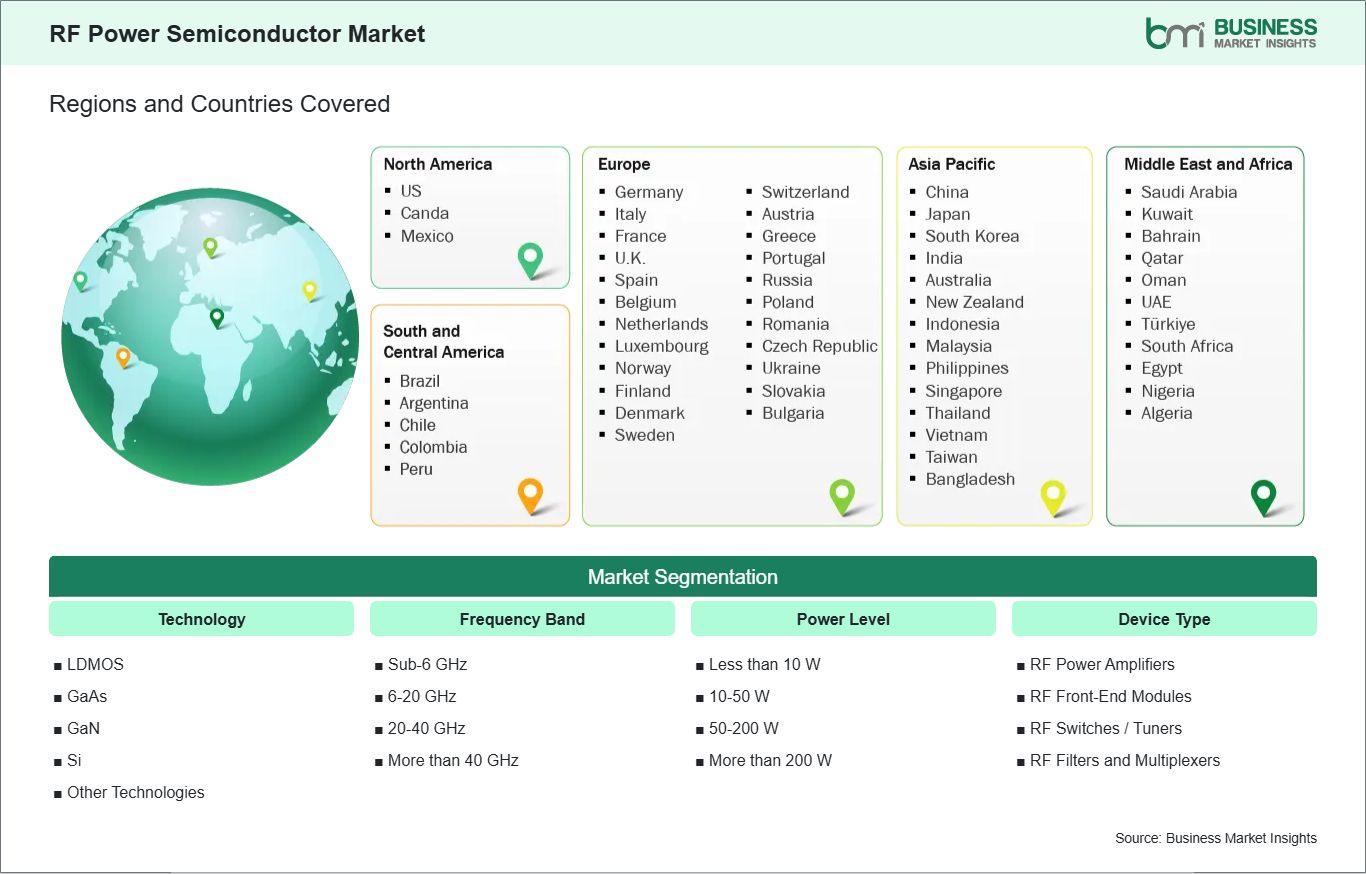
Key segments that contributed to the derivation of the RF power semiconductor market analysis are technology, frequency band, power level, device type, and application.
- By technology, the RF power semiconductor market is segmented into LDMOS, GaAs, GaN, and Si (other). The LDMOS segment dominated the market in 2025.
- Based on frequency band, the RF power semiconductor market is segmented into Sub-6 GHz, 6 - 20 GHz, 20 - 40 GHz, and more than 40 GHz (mmWave). The Sub-6 GHz segment dominated the market in 2025.
Market Forces
RF Power Semiconductor Market Drivers and Opportunities
Expanding 5G Infrastructure
5G network deployment is increasing demand for RF power semiconductors. RF power amplifiers and front-end modules are critical for high-frequency signal transmission. GaN and GaAs provide higher power density, frequency operation, and better thermal performance, enabling compact and energy-efficient base stations.
High-Power RF Devices in Aerospace and Defense
Defense and aerospace sectors drive growth. Radar, satellite, and electronic warfare systems require high-performance RF semiconductors. GaN offers high breakdown voltage, thermal conductivity, and high-frequency operation. Government defense modernization programs increase adoption of high-power RF devices for mission-critical applications.
Size and Share Analysis
RF Power Semiconductor Market Size and Share Analysis
The RF Power Semiconductor Market demonstrates steady growth, with size and share analysis highlighting evolving trends and competitive dynamics among key players. The report examines subsegments categorized within technology, frequency band, power level, device type, and application, offering insights into their contribution to overall market performance.
By technology, the LDMOS subsegment dominated the market in 2025, driven by its cost efficiency and widespread deployment in sub-6 GHz telecom base stations.
Based on frequency band, the Sub-6 GHz subsegment dominated the market in 2025, driven by extensive global 5G network deployment in mid-band spectrum.
In terms of power level, the 10 - 50 W subsegment dominated the market in 2025, driven by its suitability for telecom infrastructure and wireless communication systems.
By device type, the RF power amplifiers subsegment dominated the market in 2025, driven by their critical role in amplifying RF signals across communication and radar systems.
In Terms of application, the telecom infrastructure subsegment dominated the market in 2025, driven by increasing global investment in 5G network infrastructure.
Report Coverage
RF Power Semiconductor Market Report Coverage and Deliverables
The "RF Power Semiconductor Market Size and Forecast (2022 - 2033)" report provides a detailed analysis of the market covering below areas:
- RF Power Semiconductor Market size and forecast at global, regional, and country levels for all the key market segments covered under the scope
- RF Power Semiconductor Market trends, as well as drivers, restraints, and opportunities
- RF Power Semiconductor Market analysis covering key trends, global and regional framework, major players, regulations, and recent developments
- Industry landscape and competition analysis covering market concentration, heat map analysis, prominent players, and recent developments for the RF Power Semiconductor Market
- Detailed company profiles, including SWOT analysis
Geographic Insights
RF Power Semiconductor Market Geographic Insights
The geographical scope of the RF Power Semiconductor Market report is divided into North America, Asia Pacific, Europe, Middle East & Africa, and South & Central America. North America held the largest share in 2025.
The adoption of RF power semiconductor devices varies across global regions depending on telecommunications infrastructure development, semiconductor manufacturing capacity, and defense technology investments. North America represents important market for RF power semiconductors due to significant investments in telecommunications infrastructure, defense electronics, and semiconductor innovation. The United States plays a leading role in RF semiconductor research and development, supported by strong collaborations between semiconductor manufacturers, telecommunications companies, and defense organizations.
Asia Pacific has emerged as a major production and consumption hub due to strong semiconductor manufacturing ecosystems in countries such as China, Taiwan, South Korea, and Japan. Governments in the region are investing heavily in semiconductor supply chain development and digital connectivity initiatives to strengthen technological competitiveness.
In Europe, increasing investments in telecommunications networks, aerospace systems, and industrial automation are supporting the adoption of RF semiconductor technologies. Countries such as Germany, France, and the United Kingdom are focusing on strengthening semiconductor manufacturing capabilities and supporting advanced research in high-frequency electronics.
Emerging markets in the Middle East, Africa, and South & Central America are gradually adopting RF semiconductor technologies as governments expand telecommunications infrastructure and satellite connectivity programs. Across regions, regulatory policies, semiconductor supply chain strategies, and technological innovation are expected to play key roles in shaping the long-term growth of the RF power semiconductor market.
Industry Activity
Recent Developments
The RF Power Semiconductor Market is evaluated by gathering qualitative and quantitative data post primary and secondary research, which includes important corporate publications, association data, and databases. A few of the key developments in the RF power semiconductor market are:
- In February 2025, NXP Semiconductors introduced a new generation of RF power amplifiers designed for massive MIMO base stations, enabling improved efficiency and signal performance in 5G telecom infrastructure.
- In September 2024, Qorvo announced expansion of its GaN-based RF power semiconductor portfolio aimed at satellite communication and defense radar applications to support high-frequency communication systems.
Trust & Transparency
Research Methodology
The market analysis combines proprietary research with secondary data from government agencies, company disclosures, regulatory filings, industry databases and expert interviews. Market estimates are validated through data triangulation, cross-market benchmarking and analyst
review.
View Full Research Methodology
Key Sources Referred:
Semiconductor Industry Association (SIA)International Telecommunication Union (ITU)IEEE (Institute of Electrical and Electronics Engineers)Organisation for Economic Cooperation and Development (OECD)World Bank Group