Market Summary
Executive Summary and Global Market Analysis
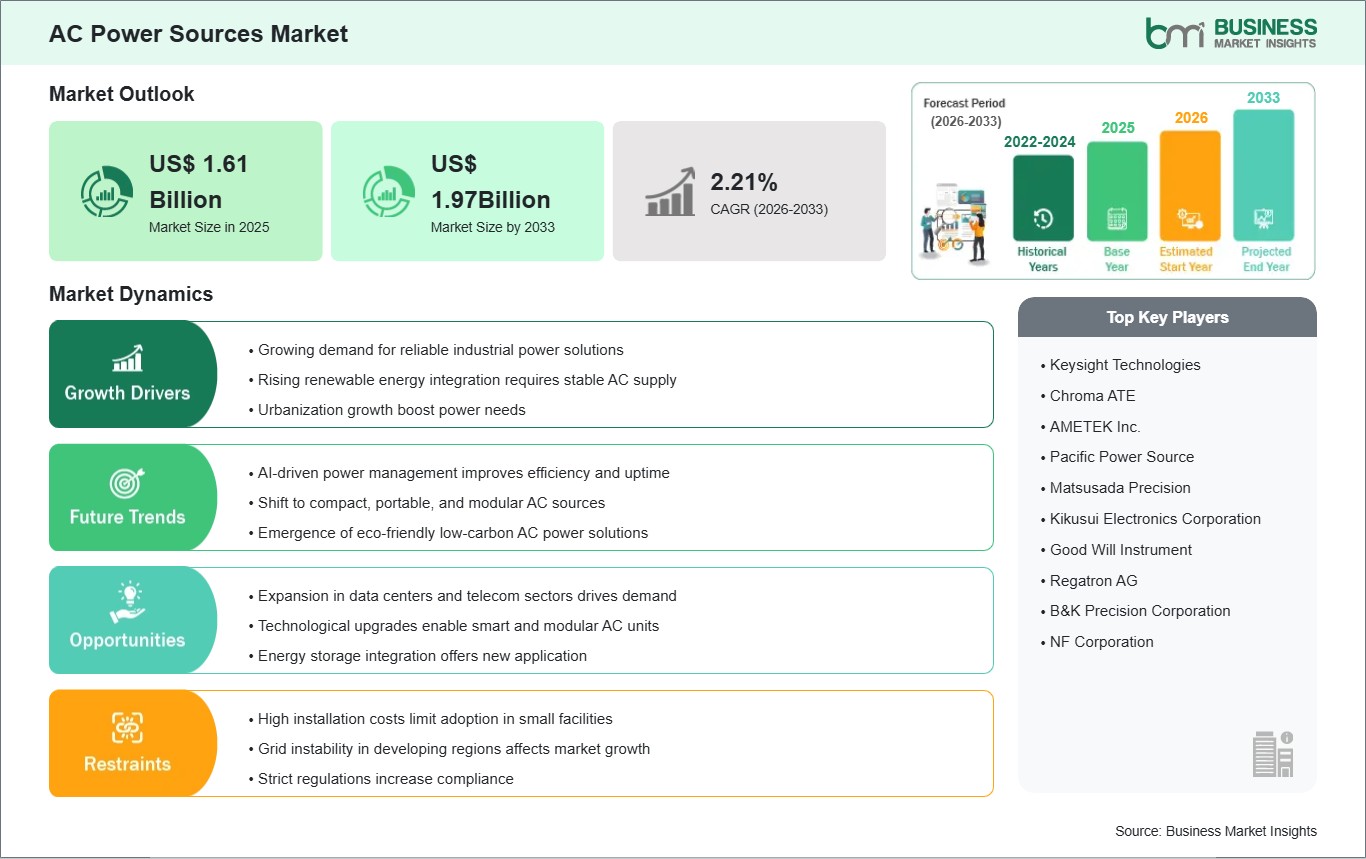
AC (Alternating Current) power sources are electronic devices that convert and regulate electrical energy from a primary source into a specific voltage, current, and frequency required by a load. These technologies deliver significant clinical and economic value by enabling surgical-grade reliability in medical equipment testing, offering efficient solutions for qualifying avionics and defense systems that operate on non-standard frequencies (e.g., 400Hz or 800Hz), and ensuring the seamless integration of renewable energy systems into the public grid. Market expansion is primarily attributed to the explosive growth of Electric Vehicle (EV) powertrain testing, the massive infrastructure investment in 5G and telecommunications, and the rising global demand for energy-efficient industrial automation. Furthermore, the integration of wide-bandgap semiconductors (GaN and SiC), which allow for higher power densities and thermal efficiency in more compact footprints, is substantially improving the practical utility of these sources.
However, several challenges can restrain market growth: high initial procurement and maintenance costs, particularly for high-power, multi-phase programmable units, can limit adoption among smaller R&D laboratories and startups. Stringent regulatory hurdles and evolving international safety standards lengthen the time-to-market for new hardware designs and increase compliance overhead. Additionally, the industry faces constraints due to global supply chain volatility and fluctuating raw material costs for specialized magnets and high-grade copper, which can delay production and compress profit margins for manufacturers.
Despite these hurdles, the market holds immense opportunities in the universal mandate for decarbonization and the accelerating deployment of smart grid and microgrid simulators. The expansion of AI-driven power management systems, which can autonomously optimize load balancing, and the development of regenerative AC sources that feed excess test energy back into the local grid are expected to create significant opportunities for market growth.
Segment Analysis
AC Power Sources Market Segmentation
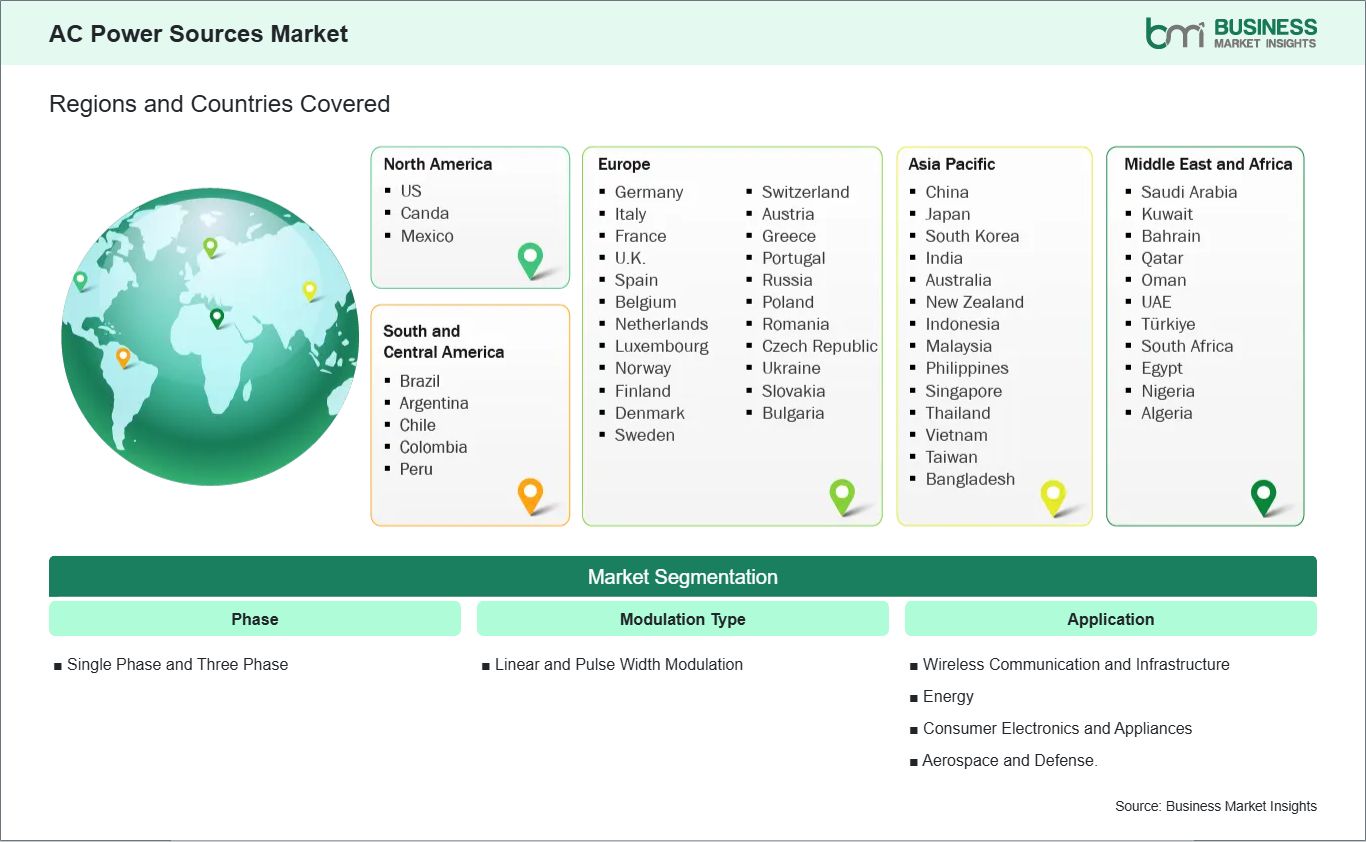
Key segments that contributed to the derivation of the AC Power Sources market analysis are Phase, Modulation Type, and Application.
- By Phase, the market is segmented into Single Phase and Three Phase.
- By Modulation Type, the market is divided into Linear and Pulse Width Modulation.
- By Application, the market is categorized into Wireless Communication and Infrastructure, Energy, Consumer Electronics and Appliances, and Aerospace and Defense.
Market Forces
AC Power Sources Market Drivers and Opportunities
Advancing Global Electrification and Precision Testing Mandates
The primary driver for the AC Power Sources Market is the accelerating global requirement for precise and programmable voltage control across mission-critical industries. As high-tech sectors such as aerospace, defense, and telecommunications transition toward more sophisticated electronic architectures, the demand for stable AC sources that can simulate diverse grid conditions, such as frequency fluctuations and voltage sags, has become non-discretionary. This need is further amplified by the rapid expansion of the Electric Vehicle (EV) and Renewable Energy sectors. Manufacturers require high-power AC sources to validate the performance of EV charging stations and ensure that solar inverters meet stringent grid-tied certification standards.
Additionally, the proliferation of "Industry 4.0" automation and the surge in consumer electronics manufacturing necessitate reliable, low-harmonic power for the rigorous quality verification of motors, appliances, and high-density semiconductors. Together, these cross-industry mandates for energy efficiency and compliance ensure a sustained and robust growth path for the market through 2026.
Grid Simulation and Smart Regenerative Solutions
A significant high-value opportunity lies in the integration of Regenerative AC Power Sources and Smart Grid simulation. Unlike traditional systems that dissipate excess energy as heat, regenerative sources can feed power back into the local grid during testing, drastically reducing operational costs and supporting corporate sustainability targets. There is also a major growth frontier in the adoption of Wide Bandgap (WBG) semiconductors, such as Silicon Carbide (SiC) and Gallium Nitride (GaN), within power source designs. These materials enable higher power densities, faster switching speeds, and ultra-compact footprints, which are essential for the next generation of portable and rack-mounted laboratory equipment.
Furthermore, the rise of Digital Power Management and IoT connectivity presents an opportunity for "connected" AC sources that offer remote diagnostics, automated test sequencing, and cloud-based data analytics. Manufacturers who focus on modular, three-phase systems tailored for high-load industrial applications and those pioneering software-defined power platforms are positioned to capture the highest-margin segments of the global energy landscape.
Size and Share Analysis
AC Power Sources Market Size and Share Analysis
The AC Power Sources market demonstrates steady growth, with size and share analysis revealing evolving trends and competitive positioning among key players. The report further examines subsegments categorized within Phase, Modulation Type, and Application, offering insights into their contribution to overall market performance.
Based on phase, the Three Phase subsegment holds a significant market share. Three-phase AC sources are indispensable for the Energy and Aerospace and Defense sectors, as they provide the high-capacity, stable power required for testing heavy industrial machinery and sophisticated avionics. A notable trend in 2026 is the deployment of these sources in data centers to handle the rising power densities of AI-driven server racks. These innovations are particularly vital in high-load industrial installations, where they allow for more efficient power delivery with smaller wiring, reducing both material costs and heat dissipation issues in mission-critical environments.
Report Coverage
AC Power Sources Market Report Coverage and Deliverables
The "AC Power Sources Market Size and Forecast (2022 - 2033)" report provides a detailed analysis of the market covering below areas:
- AC Power Sources market size and forecast at global, regional, and country levels for all the key market segments covered under the scope
- AC Power Sources market trends, as well as market dynamics such as drivers, restraints, and key opportunities
- AC Power Sources market analysis covering key market trends, global and regional framework, major players, regulations, and recent market developments
- Industry landscape and competition analysis covering market concentration, heat map analysis, prominent players, and recent developments for the AC Power Sources market
- Detailed company profiles, including SWOT analysis
Geographic Insights
AC Power Sources Market Geographic Insights
The geographical scope of the AC Power Sources market report is divided into five regions: North America, Asia Pacific, Europe, Middle East &Africa, and South &Central America.
The Asia-Pacific AC Power Sources Market is segmented into China, Japan, South Korea, India, Australia, New Zealand, Indonesia, Malaysia, the Philippines, Singapore, Thailand, Vietnam, Taiwan, Bangladesh, and the Rest of Asia. The market is primarily propelled by aggressive industrial automation and smart grid initiatives.
Growth is further bolstered by the global integration of renewable energy sources, which requires specialized AC sources to simulate varying grid conditions for inverter and solar-component testing. The rising adoption of Intelligent AC Power Sources, featuring IoT connectivity for remote monitoring, and the shift toward regenerative power solutions that feed energy back into the grid solidify Asia-Pacific as a critical hub for innovation and sustainable power management in the enterprise landscape.
Industry Activity
Recent Developments
The AC Power Sources market is evaluated by gathering qualitative and quantitative data post primary and secondary research, which includes important corporate publications, association data, and databases. A few of the key developments in the AC Power Sources market are:
- In December 2025, ABB completed the acquisition of Gamesa Electric's power electronics business from Siemens Gamesa, expanding its portfolio in wind converters, industrial battery energy storage systems, and utility-scale solar inverters. The acquisition strengthens ABB's renewable power conversion capabilities, increases its installed base capacity by approximately 46 GW, and positions the company to capitalize on growing global demand for sustainable energy solutions. This strategic move represents a positive development for the AC power sources market, supporting the adoption of advanced power electronics in renewable energy applications.
- In December 2025, Advanced Energy Industries, Inc. introduced a new dual-output 400 W module for its NeoPower™ configurable power supply family. The module delivers up to 150 W per output in a compact form factor, enabling up to 16 isolated outputs per supply. This launch provides flexible, high-density AC/DC power conversion solutions for industrial, medical, semiconductor, and test applications, reducing system size, cost, and complexity. The development represents a positive advancement for the AC Power Sources Market, supporting more efficient and adaptable power delivery in complex engineering environments.
Trust & Transparency
Research Methodology
The market analysis combines proprietary research with secondary data from government agencies, company disclosures, regulatory filings, industry databases and expert interviews. Market estimates are validated through data triangulation, cross-market benchmarking and analyst
review.
View Full Research Methodology
Key Sources Referred:
World Bank - Global Trade IndicatorsWorld Trade Organization (WTO)International Monetary Fund (IMF)International Trade Administration (ITA)Company websiteCompany annual reportsCompany investor presentations