
Automotive Semiconductor Market Outlook: Size, Share, Trends, Growth Analysis, Competitive Landscape & Forecast, 2026-2033

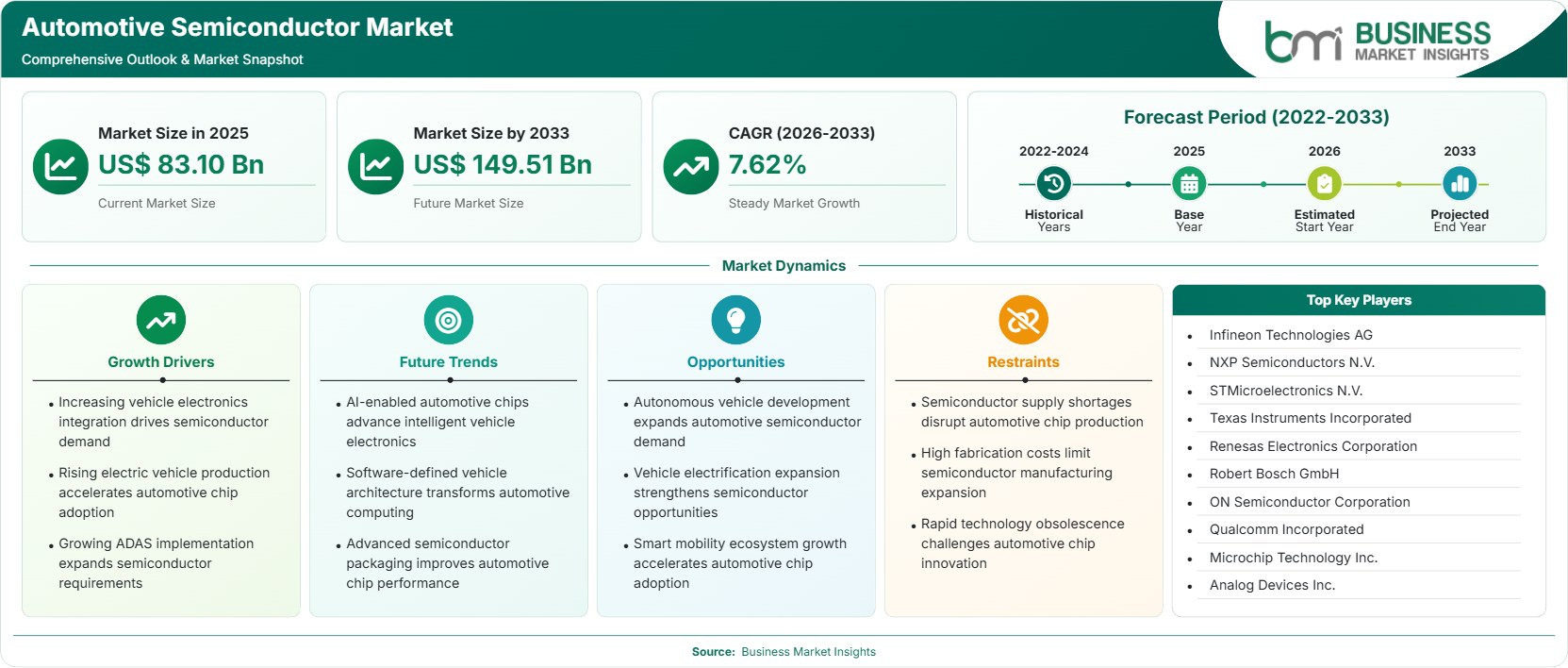
The Automotive Semiconductor Market size was valued at US$ 83.1 billion in 2025 and is projected to reach US$ 149.51 billion by 2033, registering a CAGR of 7.62% during 2026–2033. The market is experiencing robust growth driven by increasing vehicle electronics integration, rising electric vehicle production, and growing ADAS implementation. Automotive semiconductors have become fundamental components of modern vehicles by enabling advanced powertrain control, vehicle safety, infotainment, connectivity, electrification, and autonomous driving capabilities. The transition toward software-defined vehicles and intelligent mobility continues accelerating semiconductor demand across the global automotive industry.

Report Coverage
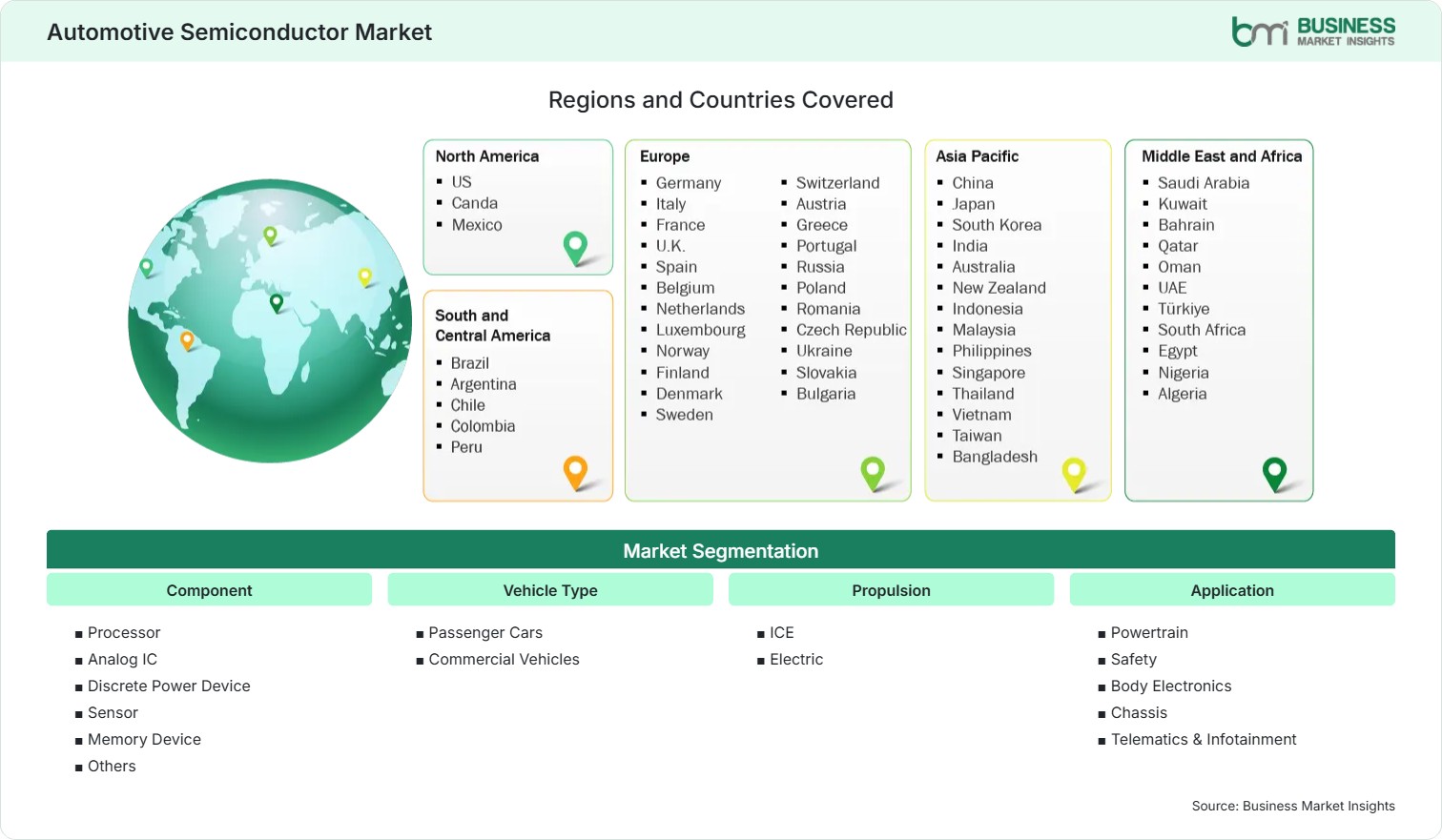
  • Component: Processor, Analog IC, Discrete Power Device, Sensor, Memory Device, Others
  • Vehicle Type: Passenger Cars, Commercial Vehicles
  • Propulsion: ICE, Electric
  • Application: Powertrain, Safety, Body Electronics, Chassis, Telematics & Infotainment
US$ 83.10 Bn Market size in 2025
US$ 149.51 Bn Market Size by 2033
7.62% CAGR, 2026 - 2033
2026-2033 Forecast Period

AI Overview

Automotive Semiconductor Market Summary

  • North America Region: North America accounted for 23%–26% of global revenue in 2025 and is projected to register a CAGR of 7.3%–7.8% during 2026–2033. Strong automotive innovation, increasing electric vehicle adoption, growing investments in autonomous driving technologies, and expanding semiconductor manufacturing initiatives continue supporting regional market growth. The United States contributes approximately 86%–89% of regional revenue and is expected to register a CAGR of 7.4%–7.9% owing to rising EV production, automotive R&D investments, and expanding semiconductor fabrication capacity.
  • Fastest Growing Region: Asia Pacific represented 47%–50% of global revenue in 2025 and is projected to register the highest CAGR of 8.2%–8.7% during the forecast period. Expanding automotive manufacturing, increasing electric vehicle production, strong semiconductor ecosystems, and rising government support for intelligent mobility continue driving regional market expansion.
  • Leading Segment: Processor accounted for 27%–30% of market revenue in 2025 and is projected to register a CAGR of 7.9%–8.4% during the assessment period owing to growing deployment in vehicle control units, ADAS platforms, infotainment systems, and centralized computing architectures.
  • High Growth Segment: Passenger Cars represented 69%–72% of total market revenue in 2025 and is projected to expand at a CAGR of 7.8%–8.3% driven by increasing semiconductor integration, connected vehicle adoption, and rising global passenger vehicle production.
  • Key Market Opportunity: Autonomous vehicle development, vehicle electrification expansion, and smart mobility ecosystem growth continue creating significant opportunities for automotive semiconductor manufacturers.
  • Major Market Players: Infineon Technologies AG, NXP Semiconductors N.V., STMicroelectronics N.V., Texas Instruments Incorporated, Renesas Electronics Corporation, Robert Bosch GmbH, ON Semiconductor Corporation, Qualcomm Incorporated, Microchip Technology Inc., Analog Devices Inc.
Strategic Insights

Automotive Semiconductor Market: Strategic Insights

Automotive Semiconductor Market Strategic Framework
FREE PDF
Request your free sample
Request free sample
Stakeholder View

Key Takeaways

  • The market continues benefiting from increasing vehicle electronics integration, rising electric vehicle production, growing ADAS implementation, and expanding connected vehicle technologies.
  • The strongest Automotive Semiconductor Market Growth opportunities continue emerging from autonomous vehicle development, vehicle electrification expansion, smart mobility ecosystems, and next-generation automotive computing platforms.
  • Processor remains the dominant component segment owing to its critical role in vehicle control systems, infotainment platforms, ADAS, connectivity, and centralized vehicle computing.
  • Asia Pacific is projected to witness the fastest growth owing to expanding automotive manufacturing, rising EV production, strong semiconductor manufacturing capabilities, and supportive government initiatives.
  • Manufacturers are increasingly investing in silicon carbide power devices, AI-enabled automotive processors, advanced sensors, V2X communication technologies, and high-performance semiconductor platforms to strengthen market competitiveness.
  • Companies focusing on intelligent mobility, automotive safety, electrification technologies, software-defined vehicles, and advanced semiconductor manufacturing are expected to strengthen their competitive positioning.
Geographic Outlook

Automotive Semiconductor Market Regional Highlights

North America Automotive Semiconductor Market

North America accounted for 23%–26% of global revenue in 2025 and is projected to register a CAGR of 7.3%–7.8% during 2026–2033. The region continues maintaining a strong market position owing to increasing investments in electric vehicles, autonomous driving technologies, advanced automotive electronics, and semiconductor manufacturing. The Automotive Semiconductor Market Share remains significant as automakers continue integrating advanced electronic systems to improve vehicle safety, connectivity, energy efficiency, and driving performance.

  • The United States remains the largest regional market owing to strong electric vehicle production, automotive innovation, and expanding semiconductor fabrication investments.
  • Canada continues supporting regional growth through increasing automotive manufacturing activities, EV adoption, and government initiatives promoting semiconductor supply chain resilience.
  • Rising implementation of advanced driver assistance systems (ADAS), connected vehicle technologies, and vehicle electrification continues accelerating semiconductor demand.
  • Growing investments in domestic semiconductor manufacturing and automotive R&D continue strengthening long-term regional competitiveness.

US Automotive Semiconductor Market

The United States accounted for approximately 86%–89% of North American revenue in 2025 and is projected to register a CAGR of 7.4%–7.9% during the forecast period. Increasing production of electric vehicles, growing investments in autonomous driving technologies, and expanding adoption of connected vehicles continue driving domestic market growth.

  • Automotive manufacturers continue increasing semiconductor content across powertrain, safety, infotainment, and connectivity applications.
  • Expansion of semiconductor fabrication facilities continues improving domestic automotive chip production capabilities in automotive semiconductor market.
  • Growing collaboration between automotive OEMs and semiconductor manufacturers continues accelerating product innovation.
  • Increasing implementation of software-defined vehicle architectures continues driving demand for high-performance automotive processors and memory devices.

Europe Automotive Semiconductor Market

Europe represented 24%–27% of global revenue in 2025 and is expected to expand at a CAGR of 7.1%–7.6% during 2026–2033. The region continues benefiting from strong automotive manufacturing, growing electric vehicle adoption, and advanced automotive electronics development. Germany remains the largest regional market, while France is projected to register the fastest growth with a CAGR of 7.8%–8.3% owing to increasing EV production, automotive digitalization, and investments in intelligent mobility technologies.

  • Germany continues leading regional demand through its well-established automotive manufacturing ecosystem and leadership in vehicle innovation.
  • France continues witnessing strong market growth through expanding electric vehicle production and investments in semiconductor-enabled automotive technologies.
  • Italy continues supporting regional expansion through increasing automotive component manufacturing and industrial modernization in automotive semiconductor market.
  • Growing adoption of ADAS, connected vehicle technologies, and electric mobility continues strengthening semiconductor demand.
  • Government initiatives supporting semiconductor manufacturing and sustainable transportation continue contributing to long-term market growth.

Asia Pacific Automotive Semiconductor Market

Asia Pacific accounted for 47%–50% of global revenue in 2025 and is projected to register the highest CAGR of 8.2%–8.7% during the forecast period. Rapid automotive production, expanding semiconductor manufacturing capacity, rising electric vehicle sales, and strong government support for advanced mobility continue driving regional market expansion. China remains the leading regional market, while India is projected to register the fastest growth with a CAGR of 8.8%–9.3% owing to expanding vehicle manufacturing, increasing EV adoption, and rising investments in automotive electronics.

  • China continues dominating regional demand through large-scale automotive production, advanced semiconductor manufacturing, and strong EV market growth.
  • India continues witnessing rapid expansion through increasing vehicle production, government incentives for EVs, and growing localization of automotive electronics.
  • Japan continues supporting technological innovation through advanced semiconductor design, automotive R&D, and high-value automotive manufacturing in automotive semiconductor market.
  • South Korea continues contributing through leading semiconductor manufacturing capabilities and growing connected vehicle technologies.
  • Increasing deployment of intelligent transportation systems, autonomous driving technologies, and smart mobility solutions continues supporting regional demand.

Rest of World Automotive Semiconductor Market

The Rest of World accounted for 5%–7% of global revenue in 2025 and is projected to register a CAGR of 7.4%–7.9% during 2026–2033. Latin America, the Middle East, and Africa continue strengthening market growth through increasing automotive production, expanding vehicle electrification initiatives, and modernization of transportation infrastructure.

Growing investments in connected mobility, electric vehicle ecosystems, and automotive manufacturing continue creating new opportunities for automotive semiconductor suppliers across emerging markets.

  • Brazil continues supporting regional demand through expanding automotive production and increasing adoption of vehicle electronics.
  • Mexico continues strengthening market growth through export-oriented automotive manufacturing and integration with global automotive supply chains.
  • Saudi Arabia continues investing in advanced mobility initiatives and industrial diversification, supporting demand for automotive semiconductor technologies.
  • The United Arab Emirates continues promoting smart mobility, connected transportation, and electric vehicle adoption across the region.
  • Government investments in automotive manufacturing, intelligent transportation infrastructure, and digital mobility continue supporting long-term market expansion across emerging economies.
Global Market Geography
FREE PDF
Request your free sample
Request free sample
Segment Analysis

Automotive Semiconductor Market Segmentation

Component

The Component segment accounted for 27%–30% of market revenue in 2025 and is projected to register a CAGR of 7.9%–8.4% during the forecast period. Increasing semiconductor integration across modern vehicles, growing electrification, connected mobility, and advanced safety systems continue supporting market expansion. The Automotive Semiconductor Market Trends indicate rising adoption of high-performance processors, advanced sensors, power semiconductors, memory devices, and analog integrated circuits that enable intelligent vehicle functionality.

  • Processor: Processor remains the dominant segment owing to its critical role in vehicle control units, advanced driver assistance systems (ADAS), infotainment platforms, digital cockpits, autonomous driving systems, and centralized vehicle computing architectures.
  • Analog IC: Analog ICs continue witnessing strong demand for power management, signal processing, battery monitoring, sensor interfacing, and vehicle control applications.
  • Discrete Power Device: Discrete Power Devices continue gaining importance with increasing deployment in electric powertrains, battery management systems, motor control units, and power conversion applications.
  • Sensor: Sensors continue experiencing robust growth owing to rising implementation of radar, lidar, cameras, ultrasonic sensing, pressure monitoring, temperature detection, and vehicle safety technologies.
  • Memory Device: Memory Devices continue supporting advanced automotive computing by enabling data storage, infotainment processing, navigation systems, autonomous driving platforms, and software-defined vehicle architectures.
  • Others: Other semiconductor components including microcontrollers, communication ICs, interface devices, and mixed-signal solutions continue contributing significantly to market expansion.

Vehicle Type

The Vehicle Type segment represented 69%–72% of total market revenue in 2025 and is expected to expand at a CAGR of 7.8%–8.3% throughout the assessment period. Increasing vehicle production, rising consumer demand for connected mobility, and growing adoption of electronic safety and infotainment systems continue strengthening semiconductor demand. The Automotive Semiconductor Market Scope continues expanding across both passenger and commercial vehicle categories.

  • Passenger Cars: Passenger Cars remain the dominant segment owing to increasing production volumes, widespread adoption of advanced electronics, electric vehicle growth, connected vehicle technologies, and consumer demand for enhanced safety and comfort features.
  • Commercial Vehicles: Commercial Vehicles continue witnessing increasing semiconductor deployment through fleet electrification, telematics integration, advanced safety systems, predictive maintenance technologies, and intelligent transportation solutions.

Propulsion

The Propulsion segment accounted for 61%–64% of market revenue in 2025 and is projected to register a CAGR of 8.1%–8.6% during the forecast period. Rising global electrification initiatives and growing investments in energy-efficient transportation continue supporting semiconductor deployment across multiple propulsion technologies.

  • ICE: Internal Combustion Engine (ICE) vehicles continue generating significant semiconductor demand through powertrain management, safety systems, infotainment, engine control units, and emission control technologies.
  • Electric: Electric vehicles are projected to register the fastest growth owing to increasing adoption of battery management systems, power electronics, traction inverters, charging systems, and advanced semiconductor-intensive vehicle architectures.

Application

The Application segment represented 31%–34% of total market revenue in 2025 and is expected to expand at a CAGR of 8.0%–8.5% during the forecast period as semiconductor integration continues increasing across critical vehicle systems.

  • Powertrain: Powertrain remains the leading application owing to extensive semiconductor deployment in engine management, electric propulsion systems, battery management, power conversion, and motor control applications.
  • Safety: Safety applications continue witnessing strong growth through increasing implementation of ADAS, airbags, braking systems, collision avoidance technologies, and vehicle monitoring systems.
  • Body Electronics: Body Electronics continue supporting vehicle comfort, lighting systems, climate control, access control, and interior electronic functions.
  • Chassis: Chassis applications continue utilizing semiconductors for suspension control, steering systems, braking technologies, and vehicle stability management.
  • Telematics & Infotainment: Telematics & Infotainment continue expanding through connected vehicle services, navigation systems, digital cockpits, wireless connectivity, and multimedia platforms.
Market Forces

Automotive Semiconductor Market Dynamics

Key Market Drivers

Increasing vehicle electronics integration drives semiconductor demand

Automobile manufacturers are continuously increasing the integration of electronic systems to enhance vehicle safety, efficiency, connectivity, comfort, and driving performance. Growing deployment of digital cockpits, electronic control units, connected vehicle technologies, intelligent sensors, and software-defined vehicle architectures continues driving demand for high-performance automotive semiconductors across both passenger and commercial vehicles. Modern vehicles increasingly rely on advanced processors, microcontrollers, power management integrated circuits, memory devices, and communication chips to support infotainment systems, navigation, telematics, and vehicle-to-everything (V2X) connectivity. The transition toward software-centric vehicle platforms is further increasing semiconductor content per vehicle, enabling over-the-air software updates, predictive diagnostics, and enhanced user experiences.

Rising electric vehicle production accelerates automotive chip adoption

Rapid expansion of global electric vehicle production is significantly increasing semiconductor demand across battery management systems, traction inverters, onboard chargers, power control modules, motor drives, and thermal management systems. Automotive manufacturers are investing heavily in semiconductor-intensive electric vehicle platforms to improve vehicle efficiency, driving range, charging performance, and overall system reliability. Wide-bandgap semiconductor technologies, including silicon carbide (SiC) and gallium nitride (GaN), are gaining wider adoption due to their superior power efficiency, faster switching capabilities, and reduced energy losses. Increasing investments in EV charging infrastructure and next-generation battery technologies are further supporting demand for advanced automotive semiconductors.

Growing ADAS implementation expands semiconductor requirements

Growing implementation of Advanced Driver Assistance Systems (ADAS) continues accelerating semiconductor adoption through increasing deployment of radar sensors, cameras, lidar interfaces, processors, memory devices, and artificial intelligence computing platforms. Automakers are integrating advanced safety technologies to improve collision avoidance, driver assistance, vehicle monitoring, and autonomous driving capabilities. Features such as adaptive cruise control, automatic emergency braking, lane-keeping assistance, blind-spot detection, driver monitoring, and automated parking systems require high-performance semiconductor components capable of processing large volumes of real-time data with minimal latency. Increasing regulatory emphasis on vehicle safety and rising consumer demand for intelligent driving features are further encouraging adoption of semiconductor-intensive ADAS solutions.

Key Market Opportunities

Autonomous vehicle development expands automotive semiconductor demand

Rapid development of autonomous vehicle technologies is creating significant opportunities for automotive semiconductor manufacturers. Self-driving vehicles require high-performance processors, AI accelerators, advanced sensing technologies, high-speed memory, and vehicle-to-everything (V2X) communication solutions, driving long-term semiconductor demand across next-generation mobility platforms.

Vehicle electrification expansion strengthens semiconductor opportunities

Global expansion of vehicle electrification continues creating substantial growth opportunities for semiconductor suppliers. Increasing adoption of battery electric vehicles, hybrid electric vehicles, and commercial electric transportation is accelerating demand for power semiconductors, battery management systems, charging technologies, and energy-efficient electronic components.

Smart mobility ecosystem growth accelerates automotive chip adoption

Growing investments in connected vehicles, intelligent transportation systems, vehicle-to-infrastructure communication, cloud-connected mobility platforms, and software-defined transportation continue strengthening semiconductor demand. The evolution of smart mobility ecosystems is encouraging manufacturers to develop advanced semiconductor solutions supporting safer, more efficient, and connected transportation networks.

Market Restraints and Challenges

Semiconductor supply shortages disrupt automotive chip production

Factor: The automotive industry is still struggling to deal with semiconductor-related supply issues resulting from capacity limitations, geopolitical risks, raw materials shortages, and increased demand for semiconductors on a global level. In order to be considered automotive grade, the semiconductors need to meet certain quality requirements and have a longer production cycle than most electronics sectors.

Impact: This may result in delays in production of cars and higher manufacturing costs. The companies within the automotive industry are becoming more resilient through forming partnerships and making long-term supply agreements and investing into semiconductor production facilities in various parts of the world.

High fabrication costs limit semiconductor manufacturing expansion

Factor: Establishing and expanding semiconductor fabrication facilities requires substantial investments in advanced manufacturing equipment, cleanroom infrastructure, research and development, process technologies, and skilled technical personnel. The transition toward smaller process nodes and advanced automotive-grade semiconductors further increases production complexity and capital expenditure.

Impact: High fabrication costs can slow capacity expansion, increase semiconductor pricing, and create barriers for new market entrants. Semiconductor companies are investing in manufacturing automation, process optimization, advanced packaging technologies, and collaborative ecosystem partnerships to improve production efficiency while supporting long-term industry growth.

Company Analysis

Competitive Landscape

Competition within the automotive semiconductor industry is driven by technological innovation, product reliability, power efficiency, automotive-grade certification, and long-term partnerships with vehicle manufacturers. The Automotive Semiconductor Market Analysis indicates that leading companies continue investing in silicon carbide (SiC) technologies, advanced automotive processors, AI-enabled computing platforms, power management solutions, and intelligent sensing technologies to strengthen their competitive positions.

Company Name

Overview

Products and Services relevant to this market

Infineon Technologies AG

Global leader in automotive power semiconductors and electronic systems.

Power semiconductors, automotive microcontrollers, sensors, power management ICs, and silicon carbide solutions.

NXP Semiconductors N.V.

Leading supplier of automotive semiconductor solutions for connected and intelligent vehicles.

Automotive processors, radar chipsets, microcontrollers, networking solutions, and vehicle security technologies.

STMicroelectronics N.V.

Global semiconductor manufacturer serving automotive and industrial markets.

MEMS sensors, power devices, automotive microcontrollers, analog ICs, and silicon carbide semiconductor solutions.

Texas Instruments Incorporated

Semiconductor company specializing in analog and embedded processing technologies.

Analog ICs, automotive processors, power management devices, interface ICs, and embedded semiconductor solutions.

Renesas Electronics Corporation

Automotive semiconductor supplier focused on intelligent vehicle electronics.

Automotive microcontrollers, system-on-chip processors, analog ICs, power management solutions, and connectivity devices.

Robert Bosch GmbH

Global automotive technology company with advanced semiconductor capabilities.

Automotive sensors, MEMS devices, control units, power electronics, and semiconductor technologies for vehicle systems.

ON Semiconductor Corporation

Supplier of intelligent power and sensing semiconductor technologies.

Power devices, image sensors, battery management solutions, automotive ICs, and silicon carbide technologies.

Qualcomm Incorporated

Technology company specializing in connected and intelligent automotive platforms.

Automotive processors, connectivity chipsets, digital cockpit platforms, telematics, and autonomous driving solutions.

Microchip Technology Inc.

Semiconductor manufacturer serving automotive embedded system applications.

Microcontrollers, analog ICs, memory devices, connectivity solutions, and automotive embedded semiconductor products.

Analog Devices Inc.

Global supplier of high-performance analog and mixed-signal semiconductor technologies.

Battery management ICs, signal processing solutions, sensors, power management devices, and automotive connectivity technologies.

Trust & Transparency

Research Methodology

The market analysis combines proprietary research with secondary data from government agencies, company disclosures, regulatory filings, industry databases and expert interviews. Market estimates are validated through data triangulation, cross-market benchmarking and analyst review.

View Full Research Methodology

Questions Answered

Frequently Asked Questions

How do market forecasts support strategic planning?

Automotive Semiconductor Market Forecasts help semiconductor manufacturers, automotive OEMs, Tier-1 suppliers, investors, and technology companies evaluate future demand, identify growth opportunities, optimize product development strategies, and support long-term investment planning.

What does the market Report include?

The Automotive Semiconductor Market Report provides comprehensive insights covering market size, competitive landscape, segmentation analysis, regional outlook, technology trends, investment opportunities, competitive benchmarking, and future growth prospects.

What factors are driving market expansion?

Increasing vehicle electronics integration, rising electric vehicle production, growing ADAS implementation, connected mobility, autonomous driving development, and vehicle electrification continue driving market growth.

Which vehicle type is expected to witness significant growth?

Passenger Cars are expected to remain the largest vehicle type segment due to increasing global production, rising electric vehicle adoption, expanding connected vehicle technologies, and growing integration of advanced automotive electronics.

Which component dominates the market?

Processor represents the leading component segment owing to its critical role in vehicle control systems, advanced driver assistance systems (ADAS), infotainment platforms, digital cockpits, and software-defined vehicle architectures.

Access the Full Automotive Semiconductor Market Report

Get segment-level forecasts, regional estimates, competitive benchmarking, company profiles and downloadable Excel datasets.

Access the full Automotive Semiconductor Market Report
350 pages PDF & Excel | 2026-08-21
Similar Research

Related Market Reports