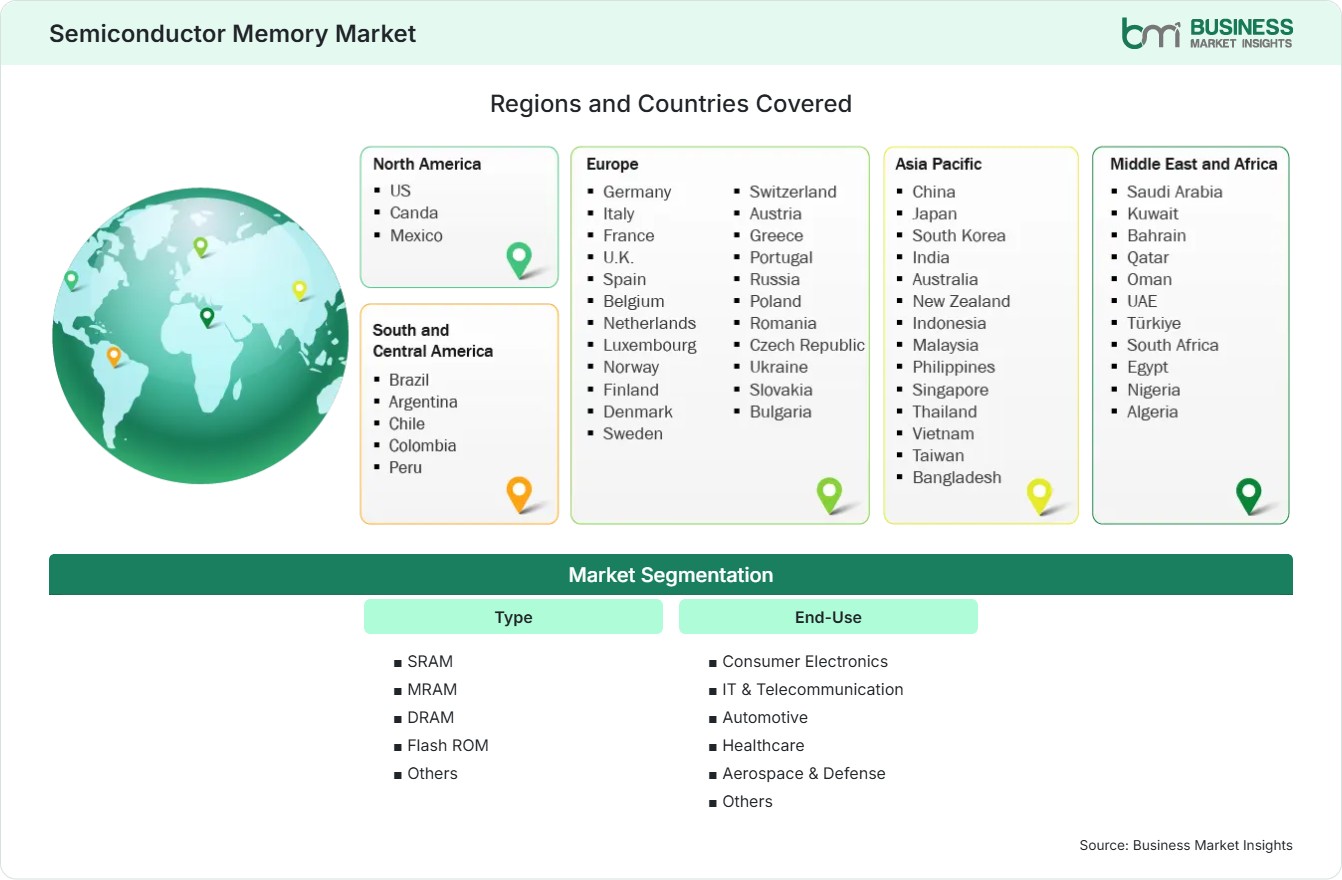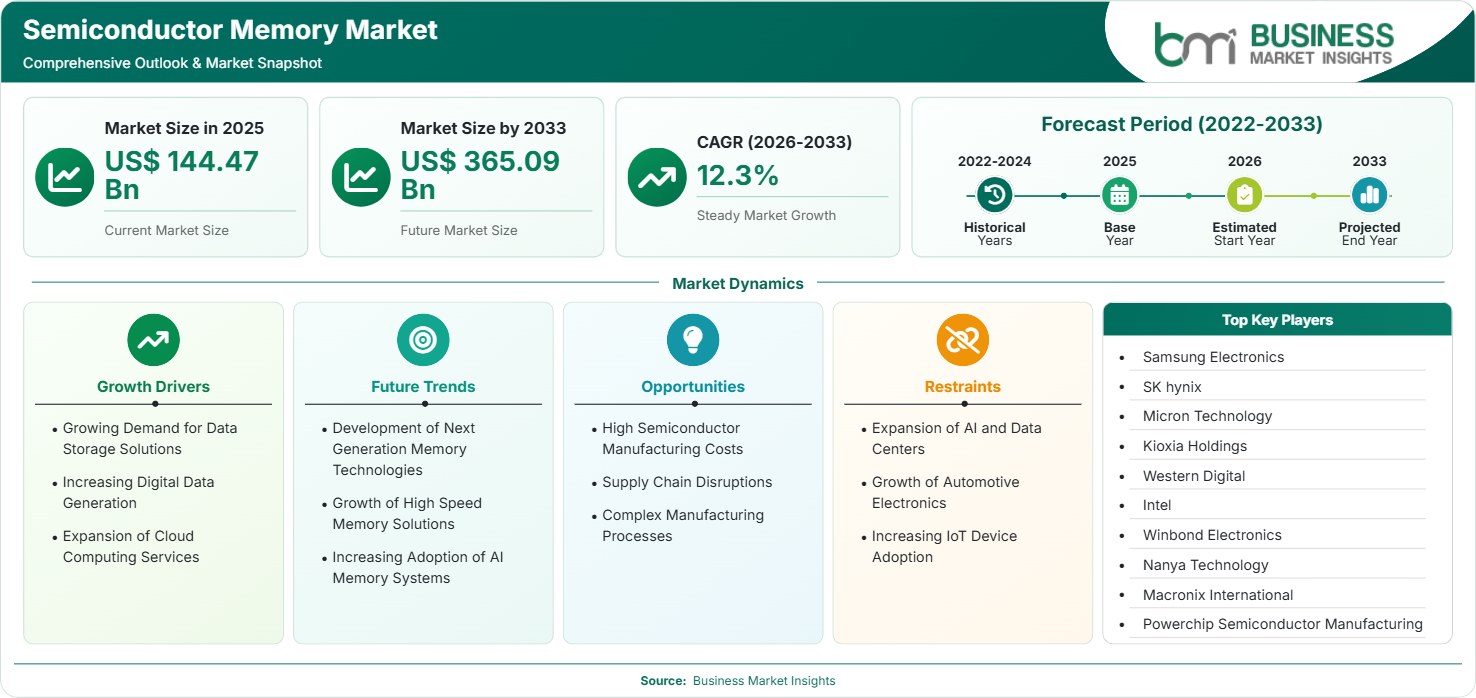
Semiconductor Memory Market Regional Highlights
North America Semiconductor Memory Market
North America accounted for a market share of 28%–31% in 2025 and is projected to expand at a CAGR of 11%–13% from 2026–2033. The region benefits from strong technology infrastructure, AI investments, cloud computing expansion, and semiconductor innovation. The Semiconductor Memory Market share is supported by major data center operators, technology companies, and research initiatives.
- The United States drives regional demand through AI infrastructure and advanced computing investments.
- Semiconductor companies are expanding domestic manufacturing capabilities through strategic capacity investments.
- Cloud service providers are increasing demand for advanced memory solutions and storage technologies.
- Automotive and industrial sectors are adopting high-performance memory components for connected applications.
US Semiconductor Memory Market
The US represented a market share of 24%–27% in 2025 and is expected to grow at a CAGR of 11%–12% during 2026–2033. The country maintains a strong position through advanced technology development, AI adoption, and expanding data center infrastructure. The Semiconductor Memory Market growth is supported by increasing demand from enterprise computing and semiconductor innovation.
- AI data centers are increasing demand for high-performance memory solutions and advanced architectures.
- Government semiconductor initiatives are supporting domestic manufacturing and supply chain resilience.
- Technology companies are investing in next-generation computing infrastructure and memory optimization.
- Automotive manufacturers are integrating advanced electronics requiring increased memory capacity.
Europe Semiconductor Memory Market
Europe held a market share of 8%–11% in 2025 and is forecast to achieve a CAGR of 10%–12% between 2026–2033. The region benefits from automotive electronics demand, industrial automation, semiconductor initiatives, and digital transformation programs. Germany, France, and the Netherlands are key contributors, with increasing focus on semiconductor supply security.
- Germany supports memory demand through automotive electronics and industrial technology applications.
- France invests in semiconductor innovation and advanced electronic manufacturing capabilities.
- The Netherlands contributes through semiconductor equipment and technology development ecosystems.
- European automotive manufacturers are increasing adoption of advanced memory components.
- Regional initiatives focus on strengthening semiconductor supply chain independence.
Asia Pacific Semiconductor Memory Market
Asia Pacific accounted for 58%–61% of the market in 2025 and is expected to register a CAGR of 13%–15% during the Semiconductor Memory Market Forecast. The region represents the largest market due to semiconductor manufacturing leadership, electronics production, and memory technology development. China, South Korea, Japan, and Taiwan remain major contributors.
- South Korea leads memory innovation through advanced DRAM and NAND manufacturing capabilities.
- China is expanding semiconductor capacity through domestic technology development initiatives.
- Japan contributes through semiconductor materials, technology expertise, and memory innovation.
- Taiwan supports semiconductor manufacturing ecosystems and advanced chip production.
- Regional electronics manufacturing drives continuous demand for memory components.
Rest of World Semiconductor Memory Market
South America, the Middle East, and Africa accounted for a combined market share of 3%–5% in 2025. Growth is supported by increasing digitalization, telecom expansion, industrial automation, and technology infrastructure development. Brazil, Israel, and Gulf countries represent developing markets adopting advanced computing, connected systems, and digital services requiring memory solutions.
- Brazil experiences increasing demand through telecom expansion and digital transformation initiatives.
- Middle Eastern countries invest in data centers and technology infrastructure development.
- Israel supports semiconductor innovation through technology research and advanced applications.
- African markets are adopting digital services requiring improved computing infrastructure.
- Emerging regions provide opportunities through increasing connectivity and technology adoption.