
Opto Semiconductors Market Outlook: Size, Share, Trends, Growth Analysis, Competitive Landscape & Forecast, 2026-2033

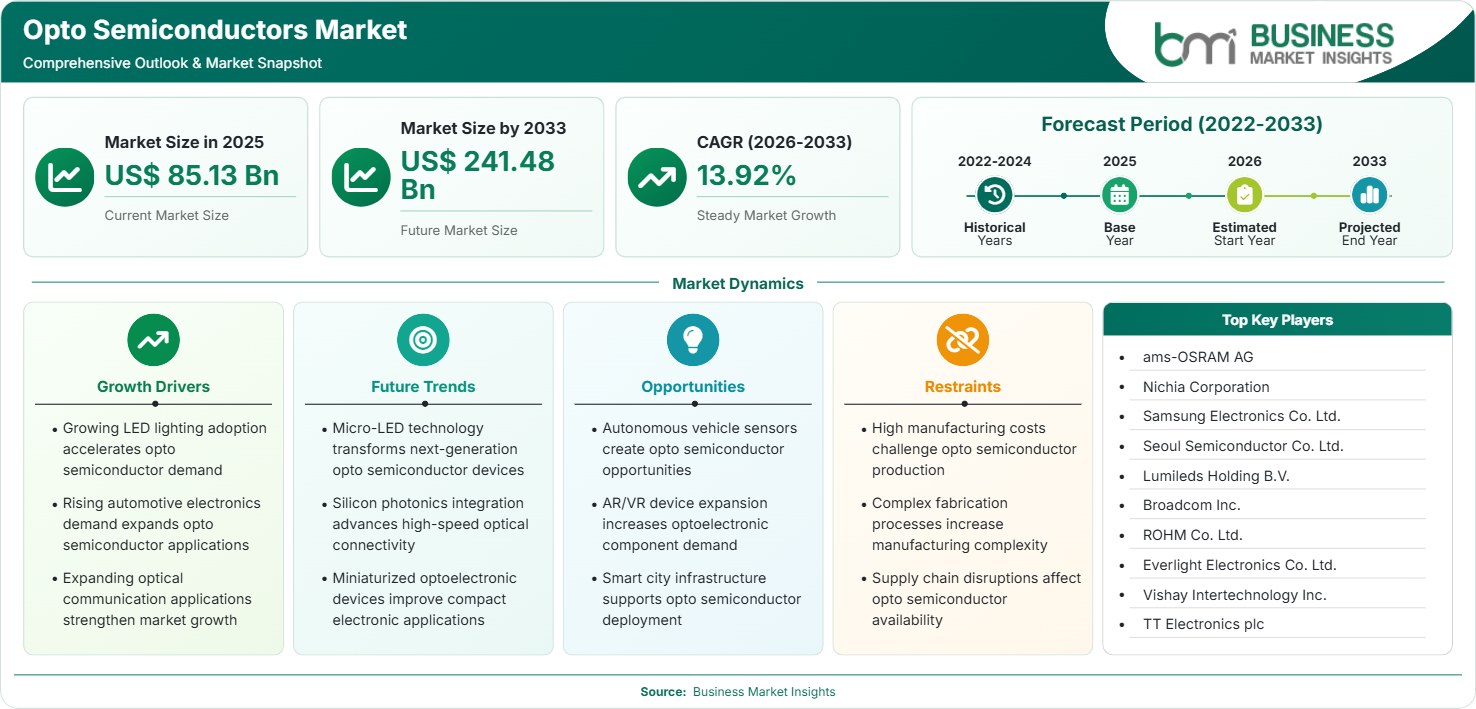
The Opto Semiconductors Market size was valued at US$ 85.13 billion in 2025 and is projected to reach US$ 241.48 billion by 2033, registering a CAGR of 13.92% during 2026–2033. The market is witnessing substantial expansion owing to increasing deployment of LED lighting, rapid advancements in automotive electronics, and rising adoption of optical communication technologies across industries. Continuous innovation in image sensors, laser diodes, and infrared components is enabling higher efficiency, improved sensing capabilities, and enhanced connectivity across consumer electronics, automotive, industrial automation, and communication applications. Growing investments in smart infrastructure, autonomous technologies, and next-generation consumer devices continue creating favorable conditions for sustained market expansion.

Report Coverage
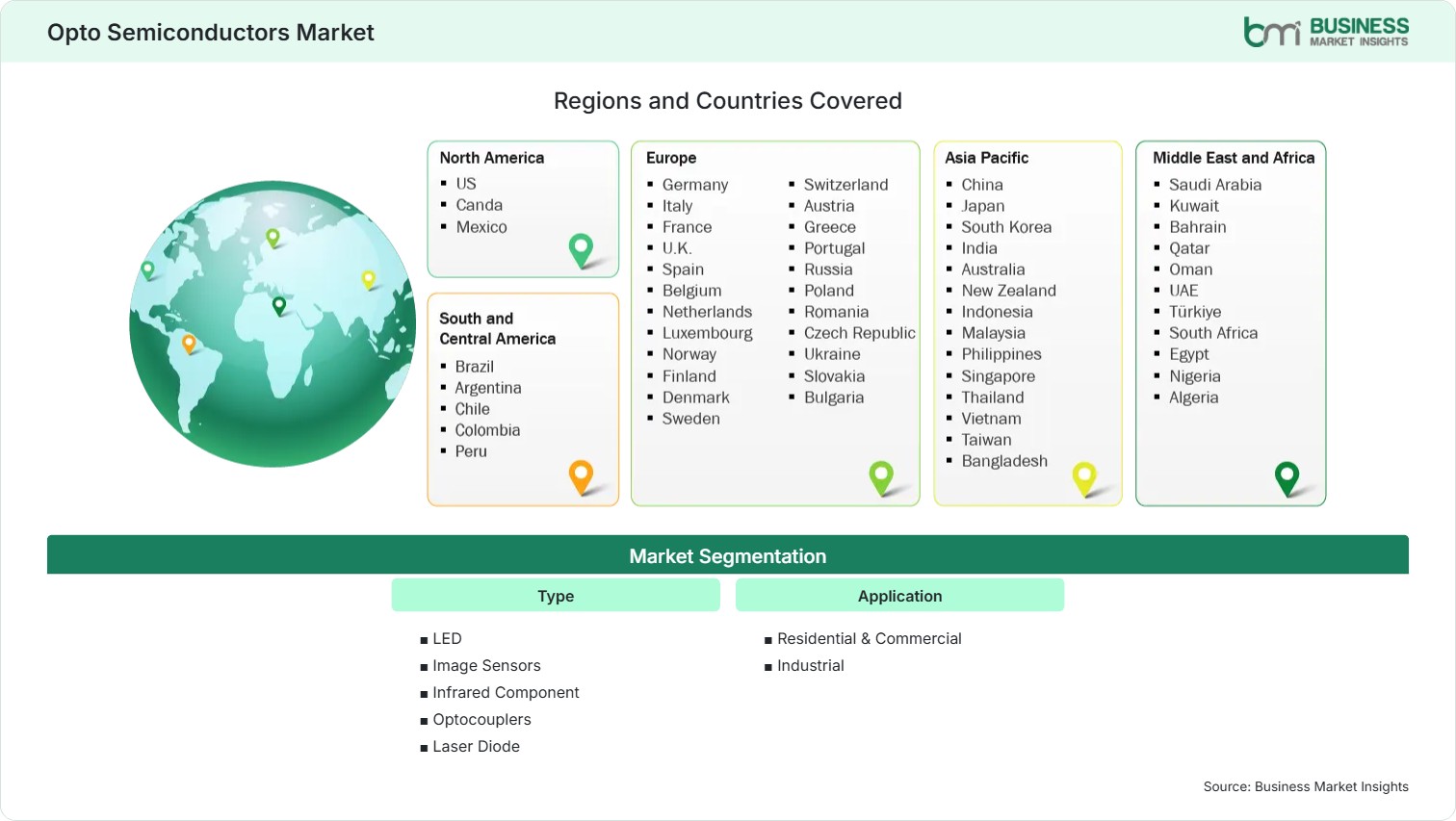
  • Type: LED, Image Sensors, Infrared Component, Optocouplers, Laser Diode
  • Application: Residential & Commercial, Industrial
US$ 85.13 Bn Market size in 2025
US$ 241.48 Bn Market Size by 2033
13.92% CAGR, 2026 - 2033
2026-2033 Forecast Period

01 AI Overview

Opto Semiconductors Market Summary

  • North America Region: North America accounted for 24%–27% of global revenue in 2025 and is projected to register a CAGR of 13.3%–13.8% during 2026–2033. Increasing investments in automotive electronics, optical networking infrastructure, advanced manufacturing, and high-performance computing continue supporting regional demand. The United States contributes approximately 84%–87% of regional revenue and is expected to register a CAGR of 13.4%–13.9% owing to expanding semiconductor innovation and increasing deployment of optoelectronic technologies.
  • Fastest Growing Region: Asia Pacific represented 45%–48% of global revenue in 2025 and is projected to register the highest CAGR of 14.5%–15.0% during the forecast period. Strong semiconductor manufacturing capacity, expanding electronics production, rapid industrial automation, and increasing adoption of smart devices continue accelerating regional growth.
  • Leading Segment: LED accounted for 39%–42% of market revenue in 2025 and is projected to register a CAGR of 14.1%–14.6% during the assessment period owing to increasing adoption of energy-efficient lighting, automotive illumination, display technologies, and smart lighting applications.
  • High Growth Segment: Industrial represented 55%–58% of total market revenue in 2025 and is projected to expand at a CAGR of 14.4%–14.9% driven by automation, optical sensing technologies, machine vision systems, industrial robotics, and advanced communication infrastructure.
  • Key Market Opportunity: Expansion of autonomous mobility technologies, augmented reality devices, smart city infrastructure, and next-generation optical communication networks continues creating significant long-term opportunities for optoelectronic component manufacturers.
  • Major Market Players: ams-OSRAM AG, Nichia Corporation, Samsung Electronics Co. Ltd., Seoul Semiconductor Co. Ltd., Lumileds Holding B.V., Broadcom Inc., ROHM Co. Ltd., Everlight Electronics Co. Ltd., Vishay Intertechnology Inc., TT Electronics plc
02 Strategic Insights

Opto Semiconductors Market: Strategic Insights

opto-semiconductors-market-market-strategic-framework
FREE PDF
Request your free sample
Request free sample
03 Stakeholder View

Key Takeaways

  • The market continues benefiting from increasing adoption of energy-efficient lighting, intelligent sensing technologies, advanced automotive electronics, and optical communication infrastructure.
  • The strongest Opto Semiconductors Market Growth opportunities continue emerging from autonomous vehicles, industrial automation, augmented reality devices, smart cities, and next-generation communication networks.
  • Continuous advancements in LED efficiency, image sensing technologies, infrared components, and laser diode performance continue strengthening product innovation across multiple end-use industries.
  • Asia Pacific remains the leading manufacturing and consumption hub owing to extensive semiconductor fabrication capacity, electronics production, and expanding industrial investments.
  • Strategic collaborations among semiconductor manufacturers, automotive companies, communication equipment providers, and consumer electronics manufacturers continue accelerating commercialization of advanced optoelectronic technologies.
  • Companies investing in next-generation semiconductor manufacturing, intelligent sensing platforms, and integrated photonic technologies are expected to strengthen their long-term competitive positioning.
04 Geographic Outlook

Opto Semiconductors Market Regional Highlights

North America Opto Semiconductors Market

North America accounted for 24%–27% of global revenue in 2025 and is projected to register a CAGR of 13.3%–13.8% during 2026–2033. Strong investments in semiconductor manufacturing, automotive electronics, industrial automation, aerospace technologies, and high-speed communication infrastructure continue supporting regional demand. The Opto Semiconductors Market Share remains significant due to increasing adoption of LED technologies, advanced image sensors, optical networking equipment, and intelligent sensing platforms across multiple industries.

  • The United States remains the largest regional market owing to strong semiconductor innovation, increasing defense electronics investments, and rapid deployment of optical communication technologies.
  • Canada continues strengthening regional growth through expanding industrial automation, smart infrastructure development, and advanced manufacturing investments.
  • Rising adoption of machine vision systems and intelligent sensing technologies supports increasing deployment of optoelectronic components across manufacturing industries.
  • Semiconductor manufacturers continue investing in advanced fabrication technologies to improve component efficiency and production capacity.

US Opto Semiconductors Market

The United States accounted for approximately 84%–87% of North American revenue in 2025 and is projected to register a CAGR of 13.4%–13.9% during the forecast period. Increasing investment in semiconductor fabrication, autonomous vehicle technologies, aerospace electronics, and AI-enabled sensing platforms continues supporting sustained market expansion. Growing deployment of optical networking infrastructure and high-performance computing further strengthens demand for advanced optoelectronic devices.

  • Expansion of semiconductor manufacturing initiatives continues increasing domestic production capacity for advanced optoelectronic components.
  • Growing investments in autonomous driving technologies accelerate adoption of image sensors, infrared components, and laser-based sensing systems.
  • Continuous innovation in consumer electronics and industrial automation strengthens long-term demand for high-performance optoelectronic devices.

Europe Opto Semiconductors Market

Europe represented 23%–26% of global revenue in 2025 and is expected to expand at a CAGR of 13.0%–13.5% during 2026–2033. Strong automotive manufacturing, industrial automation, smart lighting adoption, and increasing investment in optical communication infrastructure continue supporting regional market growth. Germany remains the largest regional market, while the United Kingdom is expected to register the fastest growth with a CAGR of 13.8%–14.3% owing to increasing semiconductor research and advanced electronics development.

  • Germany continues leading regional demand through automotive electronics manufacturing, industrial automation, and precision engineering.
  • The United Kingdom strengthens market expansion through increasing investment in photonics research, semiconductor innovation, and intelligent sensing technologies.
  • France supports growth through expanding smart lighting infrastructure, communication technologies, and industrial modernization.
  • European manufacturers continue investing in energy-efficient LED technologies and advanced optical sensing solutions.
  • Collaboration between semiconductor companies and automotive manufacturers continues accelerating product innovation across mobility applications.

Asia Pacific Opto Semiconductors Market

Asia Pacific accounted for 45%–48% of global revenue in 2025 and is projected to register the highest CAGR of 14.5%–15.0% during the assessment period. Strong semiconductor manufacturing capacity, rapid electronics production, expanding automotive manufacturing, and increasing industrial automation continue supporting regional leadership. China remains the largest regional market, while India is expected to register the fastest growth with a CAGR of 15.2%–15.7% owing to expanding electronics manufacturing and government-supported semiconductor initiatives.

  • China continues leading regional production through extensive semiconductor fabrication, consumer electronics manufacturing, and LED production capacity.
  • India continues witnessing rapid expansion through semiconductor investment programs, electronics manufacturing growth, and industrial digitalization.
  • Japan strengthens regional demand through advanced automotive electronics, robotics, and high-performance optical technologies.
  • South Korea remains a leading innovation hub for semiconductor manufacturing, image sensors, and display technologies.
  • Increasing investments in optical communication networks and smart infrastructure continue supporting long-term market expansion.

Rest of World Opto Semiconductors Market

The Rest of World accounted for 6%–8% of global revenue in 2025 and is projected to expand at a CAGR of 13.2%–13.7% throughout the forecast period. South & Central America together with the Middle East & Africa continue benefiting from increasing industrial automation, expanding communication infrastructure, and growing adoption of energy-efficient lighting technologies.

Rising investments in digital infrastructure, manufacturing modernization, and intelligent transportation systems continue creating favorable opportunities for optoelectronic component suppliers across emerging economies.

  • Brazil remains the leading South & Central American market through expanding industrial electronics and automotive manufacturing activities.
  • The United Arab Emirates continues strengthening demand through smart city projects, intelligent infrastructure, and advanced communication networks.
  • Saudi Arabia supports market expansion through industrial diversification, renewable energy investments, and digital transformation initiatives.
  • South Africa continues recording gradual growth through increasing industrial automation and infrastructure modernization.
  • International semiconductor manufacturers continue expanding regional partnerships and technology investments to improve supply chain resilience.
global-market-geography
FREE PDF
Request your free sample
Request free sample
05 Segment Analysis

Opto Semiconductors Market Segmentation

Type

The Type segment accounted for 39%–42% of market revenue in 2025 and is projected to register a CAGR of 14.1%–14.6% during the forecast period. Increasing deployment of energy-efficient lighting, intelligent sensing technologies, advanced imaging systems, and optical communication infrastructure continues supporting demand across diverse applications. The Opto Semiconductors Market Trends indicate sustained innovation in semiconductor materials, miniaturized packaging, and high-performance optoelectronic devices to meet evolving industrial and consumer requirements.

  • LED: LED remains the dominant segment owing to widespread adoption across residential lighting, commercial buildings, automotive illumination, display technologies, and smart lighting infrastructure. Increasing energy efficiency standards continue supporting long-term demand.
  • Image Sensors: Image sensors continue witnessing strong adoption across automotive safety systems, smartphones, surveillance equipment, industrial automation, medical imaging, and machine vision applications.
  • Infrared Component: Infrared components continue expanding across biometric authentication, night vision systems, remote sensing, industrial monitoring, and healthcare devices.
  • Optocouplers: Optocouplers remain essential for electrical isolation, signal transmission, industrial automation equipment, renewable energy systems, and power electronics.
  • Laser Diode: Laser diodes continue strengthening applications across optical communication, consumer electronics, healthcare equipment, industrial processing, and LiDAR technologies.

Application

The Application segment represented 55%–58% of total market revenue in 2025 and is expected to register a CAGR of 14.4%–14.9% throughout the forecast period. Increasing deployment of intelligent sensing, industrial automation, optical networking, and advanced manufacturing technologies continues driving adoption across end-use industries. The Opto Semiconductors Market Scope continues expanding through wider integration of optoelectronic technologies into connected devices and smart infrastructure.

  • Residential & Commercial: Residential and commercial applications continue benefiting from increasing LED lighting installations, smart building technologies, security systems, display solutions, and energy-efficient lighting initiatives.
  • Industrial: Industrial applications continue leading demand through factory automation, robotics, optical communication equipment, machine vision, quality inspection systems, and advanced manufacturing technologies.
06 Market Forces

Opto Semiconductors Market Dynamics

Key Market Drivers

Growing LED lighting adoption accelerates opto semiconductor demand

The growing use of energy-efficient LED lighting in residential, commercial, industrial, and infrastructure uses is also driving demand for optoelectronic semiconductor components. Energy efficiency policies by governments, decreasing cost of LED manufacturing, and ongoing developments in lighting technology continue to drive the adoption of LED lights at the expense of older lighting technologies, driving increased demand for high-quality LED semiconductor components. The emergence of smart cities and greater implementation of connected lighting systems continues to drive demand for more efficient LEDs that incorporate intelligent control systems. Ongoing consumer preference for sustainable lighting products that offer long lifespans continues to drive manufacturers towards more innovative semiconductor components that increase efficiency and life span of the lighting products. The growing use of LED-based horticultural lighting, architectural lighting, automotive lighting, and display backlighting also offers more commercial avenues for the optoelectronic semiconductor components.

Rising automotive electronics demand expands opto semiconductor applications

Automotive manufacturers continue integrating advanced electronic systems including adaptive lighting, driver monitoring, image sensing, LiDAR technologies, and intelligent safety systems into modern vehicles. Increasing production of electric vehicles and autonomous driving technologies further accelerates demand for high-performance optoelectronic semiconductor components capable of supporting advanced automotive functions. Growing adoption of advanced driver assistance systems, in-vehicle sensing technologies, and intelligent cabin monitoring solutions is further increasing demand for high-performance image sensors, infrared emitters, and optical communication devices across next-generation vehicles.

Expanding optical communication applications strengthen market growth

Rapid expansion of high-speed communication networks, cloud computing infrastructure, hyperscale data centers, and broadband connectivity continues driving demand for laser diodes, optical transmitters, receivers, and photonic semiconductor technologies. Growing global data traffic and increasing fiber-optic deployment continue strengthening long-term industry expansion. Continuous investments in 5G infrastructure, edge computing facilities, and artificial intelligence data centers are further increasing demand for high-speed optical interconnects and advanced photonic semiconductor solutions that enable reliable, low-latency, and energy-efficient data transmission.

Key Market Opportunities

Autonomous vehicle sensors create opto semiconductor opportunities

Continuous advancements in autonomous driving technologies are creating substantial opportunities for image sensors, infrared devices, LiDAR systems, and laser diode manufacturers. Increasing investments in intelligent transportation systems and advanced driver assistance technologies continue supporting long-term market expansion.

AR/VR device expansion increases optoelectronic component demand

Growing adoption of augmented reality and virtual reality technologies across consumer electronics, industrial training, healthcare, education, and entertainment continues expanding demand for advanced image sensors, display technologies, infrared components, and precision optical semiconductor devices.

Smart city infrastructure supports opto semiconductor deployment

Global investments in smart city development continue increasing deployment of intelligent lighting, traffic monitoring systems, surveillance infrastructure, environmental sensing, and connected public services. These initiatives continue creating favorable opportunities for manufacturers supplying advanced optoelectronic semiconductor technologies.

Market Restraints and Challenges

High manufacturing costs challenge opto semiconductor production

Factor: Manufacturing opto semiconductor devices requires advanced fabrication facilities, precision wafer processing, specialized materials, and significant capital investment. Maintaining high production yields while meeting stringent quality and performance standards further increases manufacturing expenditure.

Impact: High manufacturing costs can reduce profit margins, increase product prices, and limit adoption in cost-sensitive applications. Manufacturers continue investing in process optimization, production automation, and economies of scale to improve manufacturing efficiency while maintaining product quality.

Complex fabrication processes increase manufacturing complexity

Factor: Optoelectronic semiconductor production involves highly sophisticated fabrication techniques, precision material engineering, advanced packaging technologies, and strict quality control procedures. Continuous miniaturization and increasing performance requirements further add to manufacturing complexity.

Impact: Complex production processes may extend manufacturing cycles, increase operational costs, and require continuous investment in advanced fabrication technologies and skilled engineering expertise. Companies continue strengthening research and development capabilities while modernizing manufacturing infrastructure to improve production efficiency and maintain competitive advantage.

07 Company Analysis

Competitive Landscape

Competition within the optoelectronic semiconductor industry is driven by technological innovation, product performance, manufacturing capability, and continuous investment in advanced semiconductor fabrication. The Opto Semiconductors Market Analysis indicates that leading manufacturers continue focusing on high-efficiency LEDs, advanced image sensors, laser technologies, infrared components, and intelligent sensing solutions to strengthen their competitive positions across automotive, industrial, communication, and consumer electronics applications.

Company Name

Overview

Products and Services relevant to this market

ams-OSRAM AG

Global provider of optical technologies and advanced semiconductor solutions.

LEDs, laser diodes, optical sensors, infrared components, automotive lighting, and intelligent sensing solutions.

Nichia Corporation

Leading manufacturer specializing in LED and laser technologies.

LEDs, laser diodes, ultraviolet LEDs, automotive lighting components, and display technologies.

Samsung Electronics Co. Ltd.

Global electronics manufacturer with advanced semiconductor capabilities.

Image sensors, LEDs, display components, semiconductor devices, and optoelectronic solutions.

Seoul Semiconductor Co. Ltd.

Manufacturer focused on innovative LED technologies and lighting solutions.

LED products, automotive lighting, display LEDs, UV LEDs, and smart lighting technologies.

Lumileds Holding B.V.

Global supplier of advanced lighting and illumination technologies.

High-performance LEDs, automotive lighting components, specialty lighting, and optical semiconductor products.

Broadcom Inc.

Semiconductor company serving networking, industrial, and communication markets.

Optical communication components, optocouplers, fiber-optic devices, and industrial optoelectronic solutions.

ROHM Co. Ltd.

Semiconductor manufacturer serving automotive and industrial sectors.

LEDs, laser diodes, infrared devices, optocouplers, sensors, and power semiconductor solutions.

Everlight Electronics Co. Ltd.

Leading manufacturer of optoelectronic semiconductor devices.

LEDs, infrared components, image sensing devices, display products, and optical communication components.

Vishay Intertechnology Inc.

Global supplier of discrete semiconductors and electronic components.

Infrared components, optocouplers, optical sensors, LEDs, and industrial semiconductor products.

TT Electronics plc

Electronics manufacturer serving industrial and aerospace applications.

Optoelectronic components, sensors, industrial electronics, optical assemblies, and semiconductor technologies.


10 Trust & Transparency

Research Methodology

The market analysis combines proprietary research with secondary data from government agencies, company disclosures, regulatory filings, industry databases and expert interviews. Market estimates are validated through data triangulation, cross-market benchmarking and analyst review.

View Full Research Methodology

11 Questions Answered

Frequently Asked Questions

How do market forecasts support strategic planning?

Opto Semiconductors Market Forecasts help manufacturers, investors, semiconductor companies, and technology providers evaluate future demand, optimize production strategies, identify emerging opportunities, and support long-term investment decisions.

What does market report include?

The Opto Semiconductors Market Report provides comprehensive insights covering market size, competitive landscape, regional outlook, segmentation analysis, technological developments, investment opportunities, and future business prospects.

What factors are accelerating opto semiconductor adoption?

Increasing deployment of energy-efficient lighting, automotive electronics, optical communication networks, intelligent sensing technologies, industrial automation, and smart infrastructure continue supporting industry expansion.

Which application is expected to witness the fastest growth?

Industrial applications are projected to register the highest growth because of increasing automation, machine vision deployment, optical communication infrastructure, robotics, and intelligent manufacturing technologies.

Which type dominates the Opto Semiconductors Market?

LED remains the leading type owing to its widespread adoption across general lighting, automotive illumination, display technologies, smart lighting systems, and energy-efficient infrastructure.

Access the Full Opto Semiconductors Market Report

Get segment-level forecasts, regional estimates, competitive benchmarking, company profiles and downloadable Excel datasets.

Access the full Opto Semiconductors Market Report
350 pages PDF & Excel | 2026-08-04