Semiconductor IP Market Regional Highlights
North America Semiconductor IP Market
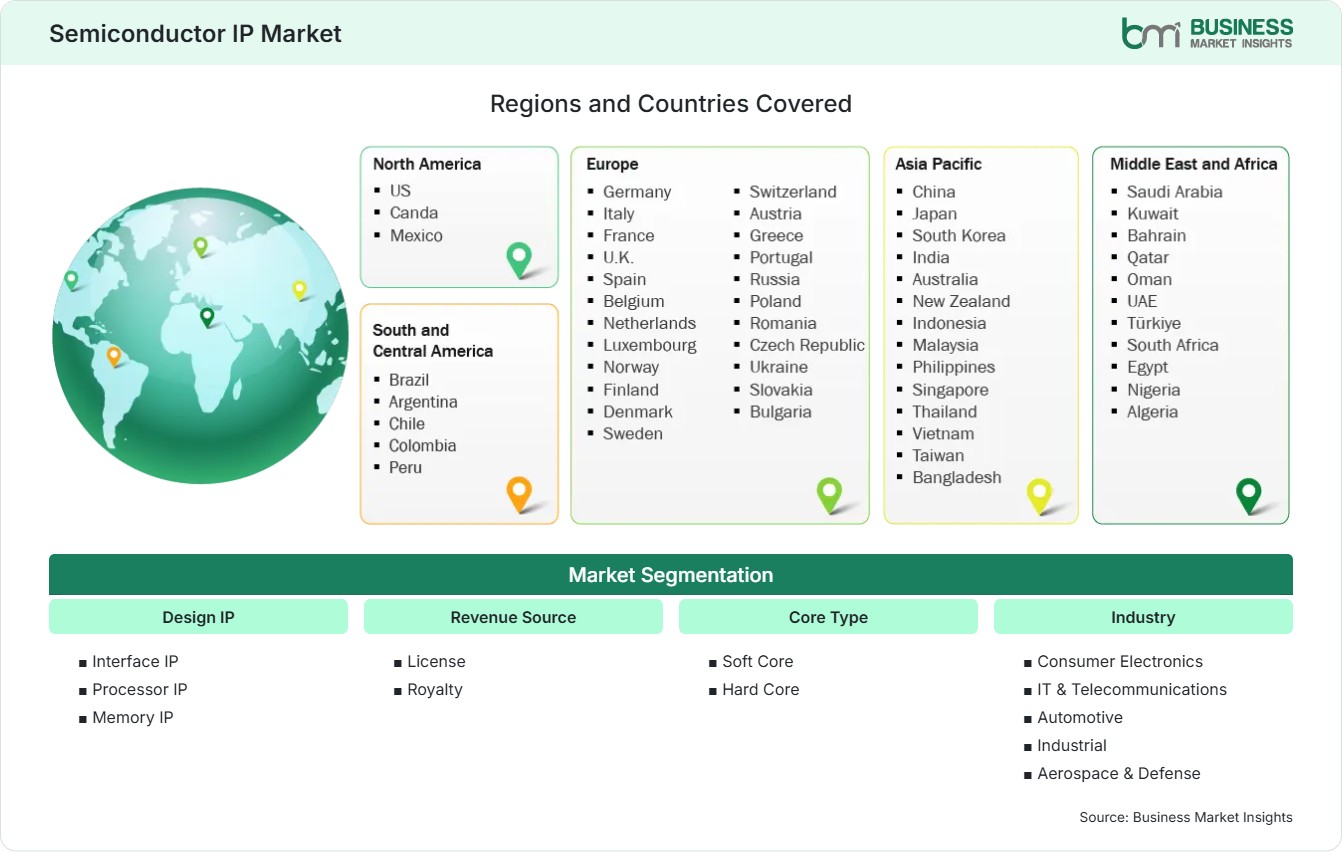
North America accounts for 30%–33% Semiconductor IP Market share in 2025 and is projected to register a CAGR of 8.0%–8.5% during 2026–2033. Regional demand benefits from established fabless companies, AI accelerator development, custom silicon programs, and advanced EDA capabilities. The region also maintains strong demand for processor, interface, security, and memory IP as designers pursue higher performance with shorter development cycles.
- AI accelerator programs are increasing demand for processor and interface blocks that can be integrated into differentiated silicon platforms while reducing architectural development and verification requirements.
- Custom silicon initiatives among technology companies are expanding the addressable customer base for licensable processor, connectivity, memory, and security architectures across data-center and edge applications.
- Established EDA and foundry relationships improve qualification pathways for semiconductor IP vendors, allowing validated IP blocks to move more efficiently across advanced design programs.
- Growing emphasis on chiplet-based architectures is strengthening demand for high-bandwidth interface IP capable of supporting communication between heterogeneous compute and memory components.
US Semiconductor IP Market
The United States represents 78%–82% of North American Semiconductor IP Market revenue and is projected to grow at a CAGR of 8.1%–8.6% during 2026–2033. Strong fabless design capabilities, AI computing investment, cloud infrastructure development, and custom accelerator programs support demand.
- AI and custom accelerator development is broadening demand for optimized processor, memory, interconnect, and neural-processing IP across cloud and edge computing applications.
- Advanced SoC programs increasingly require reusable IP with comprehensive verification collateral, reducing integration risk for design teams operating under demanding performance and development schedules.
- Automotive semiconductor development is increasing interest in safety-oriented processing and connectivity architectures that can support increasingly software-defined vehicle platforms and distributed electronic systems.
Europe Semiconductor IP Market
Europe represents 21%–24% Semiconductor IP Market share in 2025 and is projected to expand at a CAGR of 7.3%–7.8% during 2026–2033. Germany and France remain leading design centers, while the United Kingdom and Italy offer attractive specialist opportunities. Automotive electronics, industrial automation, telecommunications, aerospace systems, and energy-efficient computing support demand for reliable IP. Germany is modeled at 7.5%–8.0% CAGR, while the United Kingdom is modeled at 7.9%–8.4% CAGR.
- Automotive semiconductor development remains a core demand driver as European vehicle programs require increasingly sophisticated processing, connectivity, sensing, and safety architectures.
- Industrial automation supports demand for embedded processors and connectivity IP that can enable deterministic control, efficient edge processing, and interoperable electronic systems.
- Specialist semiconductor companies increasingly value reusable IP because it allows smaller design teams to access validated architectures without maintaining every development capability internally.
- Security and functional safety requirements are strengthening demand for IP with verification documentation, predictable behavior, and integration support across complex industrial and automotive designs.
Asia Pacific Semiconductor IP Market
Asia Pacific accounts for 37%–40% Semiconductor IP Market share in 2025 and is projected to register the fastest CAGR of 9.6%–10.1% during 2026–2033. China, Japan, South Korea, Taiwan, and India form major demand centers, supported by electronics manufacturing, semiconductor design, foundry activity, telecommunications, and automotive electronics. China is modeled at 9.7%–10.2% CAGR, while India records 10.2%–10.7% CAGR as domestic design capabilities broaden.
- Consumer electronics production creates recurring demand for processor, interface, memory, connectivity, and display-related IP across increasingly integrated semiconductor architectures.
- Expanding domestic semiconductor design capabilities are increasing the need for licensable IP that can shorten development cycles and support locally differentiated SoC platforms.
- Automotive electronics investment is broadening demand for processing and connectivity architectures as vehicle manufacturers integrate advanced driver assistance and software-defined functions.
- Growing foundry and packaging ecosystems improve commercialization opportunities for IP suppliers capable of supporting advanced process technologies and heterogeneous integration requirements.
Rest of World Semiconductor IP Market
The Rest of World region accounts for 7%–10% Semiconductor IP Market share in 2025 and is projected to expand at a CAGR of 7.4%–7.9% during 2026–2033. South and Central America benefit from growing electronics and telecommunications requirements, while the Middle East and Africa offer emerging opportunities in communications, industrial systems, and digital infrastructure. Brazil is modeled at 7.6%–8.1% CAGR, while the United Arab Emirates records 8.0%–8.5% CAGR.
Latin American opportunities are concentrated around telecommunications, industrial electronics, consumer devices, and expanding digital infrastructure.
Middle Eastern opportunities increasingly relate to digital infrastructure, communications, intelligent systems, and localized technology development.
- Telecommunications infrastructure supports demand for efficient connectivity and signal-processing IP as network equipment becomes more computationally sophisticated.
- Industrial modernization is creating opportunities for embedded processing and interface IP supporting automation, monitoring, and intelligent control systems.
- Regional design ecosystems can benefit from licensing models that reduce upfront development requirements while providing access to proven semiconductor architectures.
- Increasing localization of technology development can create longer-term opportunities for suppliers offering training, integration assistance, verification collateral, and adaptable IP portfolios.