
Semiconductor Capital Equipment Market Outlook: Size, Share, Trends, Growth Analysis, Competitive Landscape & Forecast, 2026-2033

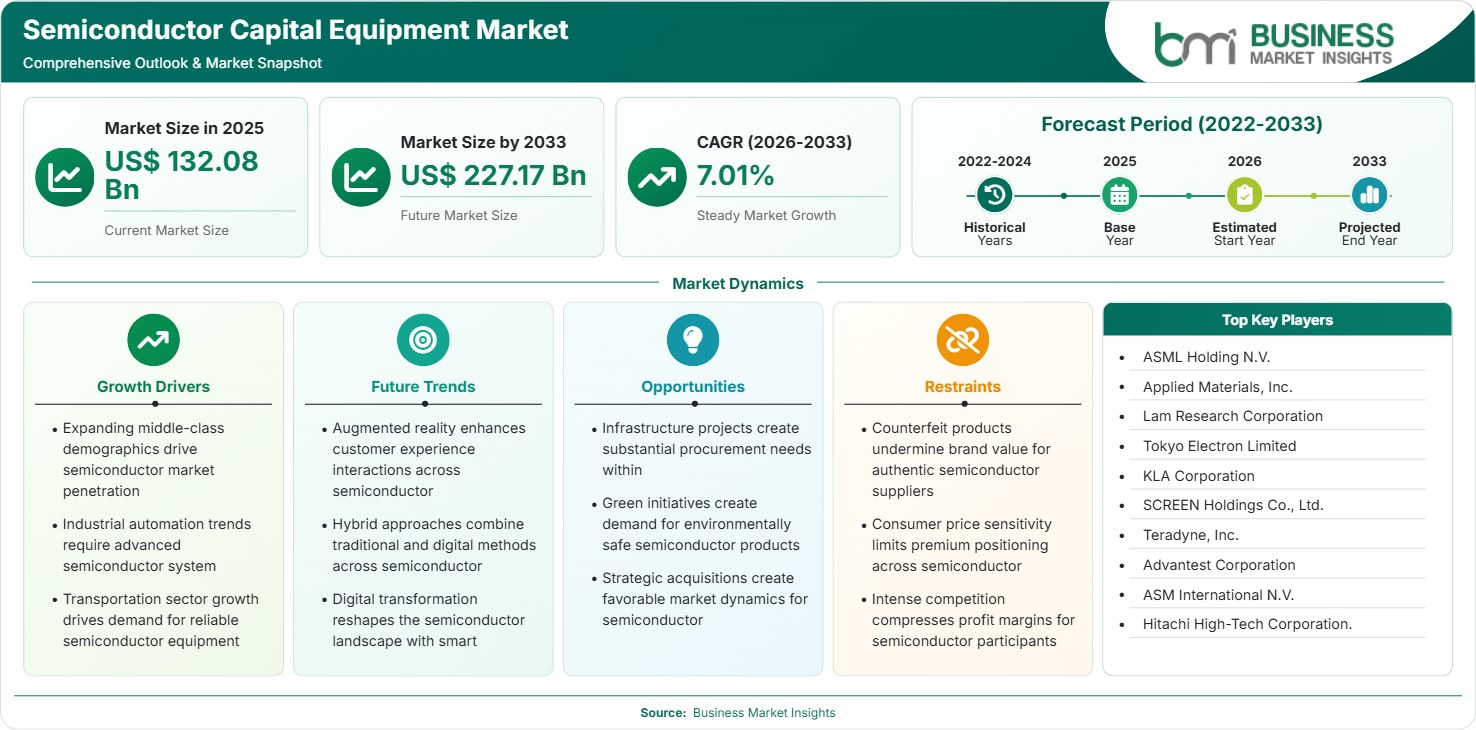
The Semiconductor Capital Equipment Market size was valued at US$ 132.08 Billion in 2025 and is projected to reach US$ 227.17 Billion by 2033, growing at a CAGR of 7.01% during 2026–2033. Key drivers include AI semiconductor investments, advanced-node manufacturing, memory expansion, packaging innovation, and government incentives. Opportunities emerge from High-NA EUV adoption, heterogeneous integration, and regional fab localization strategies.

Report Coverage
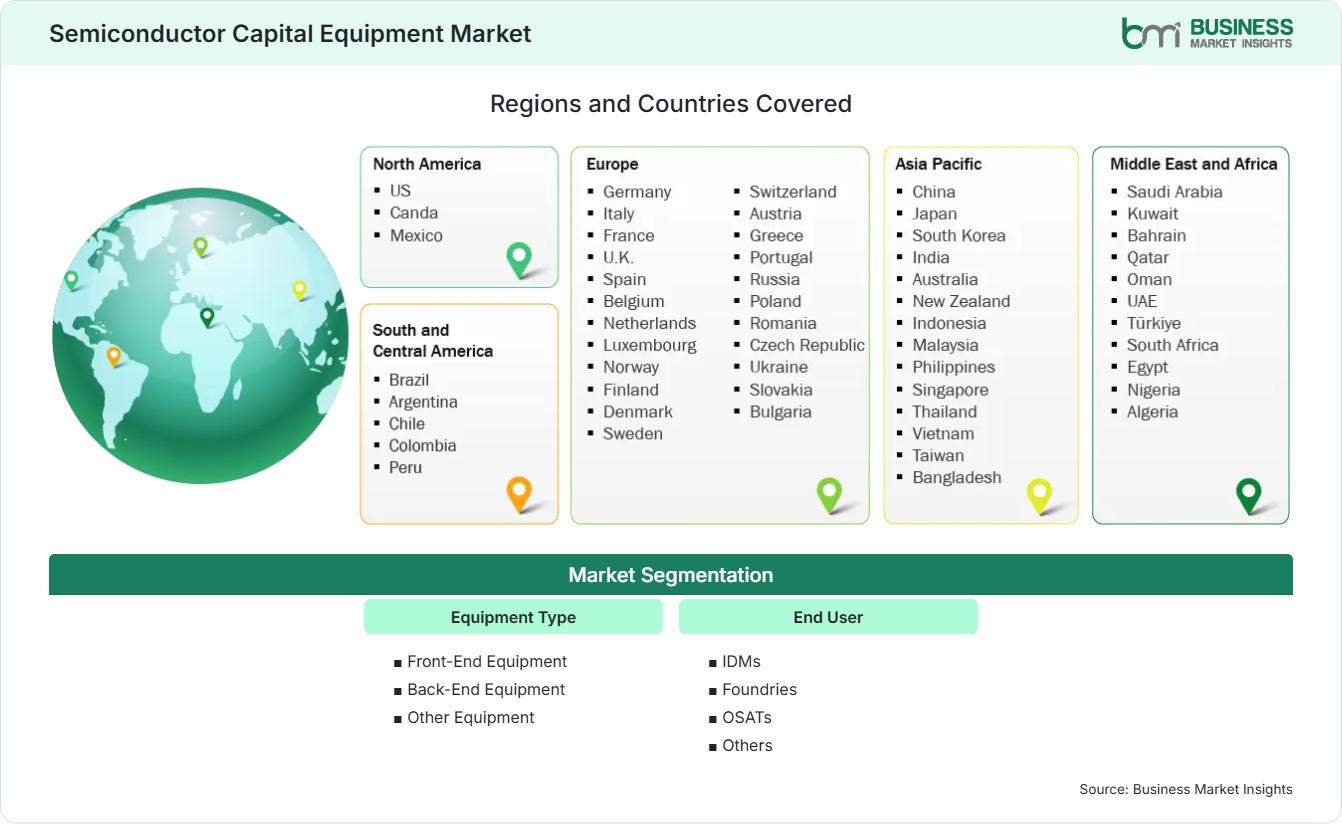
  • Equipment Type: Front-End Equipment, Back-End Equipment, Other Equipment
  • End User: IDMs , Foundries, OSATs , Others
US$ 132.08 Bn Market size in 2025
US$ 227.17 Bn Market Size by 2033
7.01% CAGR, 2026 - 2033
2026-2033 Forecast Period

AI Overview

Semiconductor Capital Equipment Market Summary

  • North America Region: Holds a market share of 22%–25% in 2025, growing at a CAGR of 6.3%–7.0% during 2026–2033. Demand is supported by CHIPS Act-backed fab construction, AI processor capacity additions, domestic equipment sourcing, leading-edge process investments, packaging ecosystems, supplier localization, research partnerships, and next-generation lithography deployment initiatives. US market benefits from advanced logic investments, packaging expansion, and AI infrastructure spending, recording 6.4%–7.1% CAGR.
  • Fastest Growing Region: Asia Pacific holds a Semiconductor Capital Equipment Market share of 48%–52% in 2025, growing at a CAGR of 7.8%–8.6% during 2026–2033. Growth stems from foundry expansions, memory manufacturing investments, advanced packaging deployment, regional semiconductor self-sufficiency programs, increasing wafer capacity, AI accelerator demand, technology localization, equipment upgrades, and sustained electronics production activity.
  • Leading Segment: Front-End Equipment accounts for 67%–71% share in 2025 and advances at a CAGR of 6.8%–7.5% during 2026–2033. Strong adoption reflects advanced node transitions, lithography intensity, deposition requirements, etch complexity, yield optimization efforts, process integration needs, capacity expansion programs, and ongoing investments across fabrication facilities globally.
  • High Growth Segment: Foundries represent 38%–42% of the Semiconductor Capital Equipment Market share in 2025 and expand at a CAGR of 7.9%–8.7% during 2026–2033. Investments in contract manufacturing, AI chips, automotive semiconductors, advanced process nodes, geographic diversification, customer outsourcing strategies, capacity additions, and technology leadership programs support sustained momentum globally.
  • Key Market Opportunity: Accelerating adoption of advanced packaging, chiplet architectures, hybrid bonding, and heterogeneous integration creates substantial equipment demand across fabrication and assembly stages, supporting higher productivity, performance scaling, and supplier differentiation.
  • Major Market Players: ASML Holding N.V., Applied Materials, Inc., Lam Research Corporation, Tokyo Electron Limited, KLA Corporation, SCREEN Holdings Co., Ltd., Teradyne, Inc., Advantest Corporation, ASM International N.V., Hitachi High-Tech Corporation.
Strategic Insights

Semiconductor Capital Equipment Market: Strategic Insights

Semiconductor Capital Equipment Market Strategic Framework
FREE PDF
Request your free sample
Request free sample
Stakeholder View

Key Takeaways

  • The industry value chain is becoming increasingly interconnected, with lithography, inspection, deposition, and packaging equipment suppliers collaborating more closely with chipmakers to accelerate process qualification cycles.
  • Advanced packaging, wafer-level integration, and chiplet-based architectures offer some of the strongest revenue upside for equipment manufacturers serving both wafer fabrication and assembly environments.
  • Research activity is shifting toward High-NA EUV lithography, atomic-layer deposition, hybrid bonding, and AI-enabled process control technologies to improve yield and manufacturing scalability.
  • Asia Pacific remains the most compelling expansion destination due to large-scale foundry investments, while North America offers attractive opportunities through publicly supported fab construction initiatives.
  • Strategic acquisitions increasingly target software analytics, metrology, process control, and specialty manufacturing capabilities to strengthen end-to-end production portfolios.
  • Equipment service revenue is becoming a larger profit contributor as fabs extend asset lifecycles and prioritize predictive maintenance, upgrades, and productivity optimization.
Geographic Outlook

Semiconductor Capital Equipment Market Regional Highlights

North America Semiconductor Capital Equipment Market

North America accounted for 22%–25% of global revenue in 2025 and is projected to expand at a CAGR of 6.3%–7.0% through 2033. The region benefits from large-scale wafer-fabrication investments, advanced research infrastructure, and strong equipment supplier presence. Semiconductor Capital Equipment Market share remains supported by incentives encouraging domestic semiconductor production. Growth is driven by AI-focused chip manufacturing, advanced packaging deployment, and increasing process-control requirements. Equipment spending is concentrated in the United States, while ecosystem partnerships across Canada and Mexico strengthen supply-chain resilience and technology commercialization.

  • CHIPS-related investments continue supporting new fab construction, increasing demand for lithography, deposition, metrology, and process-control systems across advanced manufacturing facilities.
  • Growth in AI servers and data-center accelerators requires additional advanced-node capacity, creating sustained equipment procurement activity among leading semiconductor producers.
  • Regional universities and national laboratories strengthen innovation pipelines through collaborative research on next-generation process technologies and manufacturing efficiency.
  • Equipment upgrades targeting higher yield rates and reduced defect density are encouraging replacement demand across mature and advanced process environments.

US Semiconductor Capital Equipment Market

The United States accounts for 82%–86% of North American revenues and is expected to grow at a CAGR of 6.4%–7.1% through 2033. The involvement of logic producers, IDM operators, and technology innovators is favorable for future capital investments. Substantial investments in advanced packaging technologies, semiconductors for military applications, and AI hardware manufacturing capabilities. Public funding initiatives and private-sector commitments continue driving equipment procurement and facility modernization.

  • Major fab announcements continue creating long-term opportunities for equipment vendors serving lithography, etch, deposition, and metrology applications.
  • Expansion of domestic packaging ecosystems supports demand for assembly, bonding, and test-related production tools.
  • AI hardware manufacturing priorities contribute to increased investment in advanced process technologies and production scalability.
  • Supply-chain localization programs encourage broader participation from equipment suppliers, component manufacturers, and engineering service providers.

Europe Semiconductor Capital Equipment Market

Europe commands a market share of 18%-21% in 2025 and is expected to record a CAGR of 6.5%-7.3% through 2033. Europe benefits from a high level of expertise in equipment engineering, along with initiatives to establish semiconductor sovereignty in the region. Germany remains the dominant player in the market, but Ireland and Italy show stronger growth momentum, with estimated growth rates exceeding the regional average. Demand is supported by automotive electronics, industrial automation, and specialty semiconductor manufacturing. Regional policies encourage the expansion of fabrication and technology development partnerships.

  • Germany leads regional spending owing to established semiconductor manufacturing and equipment-development capabilities.
  • Ireland records strong capacity additions supported by multinational semiconductor investments and favorable operating conditions.
  • Automotive semiconductor requirements continue stimulating equipment demand for power devices and industrial electronics.
  • Public-private partnerships support research into advanced lithography, process control, and semiconductor sustainability initiatives.
  • Strategic diversification efforts reduce dependency on external production networks while strengthening supply-chain resilience.

Asia Pacific Semiconductor Capital Equipment Market

Asia Pacific commands 48%–52% of global revenue in 2025 and is anticipated to record the fastest CAGR of 7.8%–8.6% through 2033. The region dominates foundry operations, memory manufacturing, and electronics production. Taiwan leads equipment spending, while India represents the highest-growth investment destination. Semiconductor Capital Equipment Market growth in the region is fueled by advanced node migration, memory expansion projects, and growing government support for semiconductor self-sufficiency. Strong manufacturing ecosystems continue attracting supplier investments.

  • Taiwan remains the largest equipment-consuming country due to continued leadership in advanced foundry production.
  • South Korea supports strong demand through memory and high-bandwidth memory investments linked to AI infrastructure.
  • China continues expanding domestic semiconductor manufacturing capabilities despite export-control challenges.
  • India is emerging as a high-growth destination through fab incentives, packaging investments, and localization strategies.
  • Southeast Asian countries attract backend manufacturing and assembly investments, strengthening regional supply networks.

Rest of World Semiconductor Capital Equipment Market

Rest of World accounts for 8%–11% of revenue in 2025 and is projected to expand at a CAGR of 6.9%–7.7% through 2033. South and Central America are gradually improving participation through electronics manufacturing activity and supply-chain diversification initiatives.

The Middle East and Africa are attracting strategic investments into technology manufacturing, research centers, and semiconductor ecosystem development. Israel leads regional innovation activity, while Saudi Arabia and the UAE are emerging growth markets supported by technology diversification agendas.

  • Brazil remains a leading market in South America due to electronics manufacturing and industrial semiconductor demand.
  • Israel benefits from strong semiconductor R&D capabilities and technology commercialization activities.
  • Saudi Arabia is increasing investments in advanced technology ecosystems and industrial digitization programs.
  • UAE initiatives targeting knowledge-based industries support semiconductor ecosystem development opportunities.
  • Regional diversification strategies create niche opportunities for manufacturing equipment suppliers and service providers.
Global Market Geography
FREE PDF
Request your free sample
Request free sample
Segment Analysis

Semiconductor Capital Equipment Market Segmentation

Equipment Type

This segment accounted for 69% to 72% of demand in 2025 in front-end processes and will grow at a 6.8% to 7.5% CAGR. The market scope for semiconductor capital equipment is expanding as new device designs need more processing, tighter tolerances, and increased production accuracy. This market still sees investments in fabrication technologies for advanced node scaling.

  • Front-End Equipment: Includes lithography, deposition, etch, cleaning, and process-control systems essential for wafer fabrication. Demand benefits from advanced-node transitions, AI semiconductor production, and capacity expansion programs.
  • Back-End Equipment: Packaging, assembly, bonding, and testing tool demand is increasing as chiplet architectures and heterogeneous integration become central to performance scaling strategies.

End User

End-user demand varies according to manufacturing models, capacity utilization, and technology roadmaps. The foundries have a market share of 38%-42% in 2025 and are estimated to achieve the highest CAGR of 7.9%-8.7%. The Semiconductor Capital Equipment Market trends are being driven by outsourcing business models and increasing specialization across design, fabrication, assembly, and testing activities.

  • IDMs (Integrated Device Manufacturers): Continue investing in strategic production capacity, particularly for automotive, industrial, memory, and logic devices requiring tighter vertical integration.
  • Foundries: Benefit from outsourcing demand, advanced-node leadership, AI processor manufacturing, and diversified customer requirements spanning multiple semiconductor applications.
  • OSATs (Outsourced Semiconductor Assembly & Test): Growing packaging complexity and higher testing requirements support investment in advanced assembly, inspection, and qualification equipment.
Market Forces

Semiconductor Capital Equipment Market Dynamics

Key Market Drivers

AI Infrastructure Driving Leading-Edge Equipment Demand

AI applications are driving a greater need for higher-performance computing processors, high-bandwidth memory components, and accelerators, all of which require highly advanced manufacturing capabilities. Industry investment initiatives undertaken by major foundry and memory companies are driving up procurement of lithography, deposition, etching, and metrology equipment. SEMI and industry projections continue to signal healthy spending on wafer-fabrication equipment driven by growth in AI capacity additions. The move toward 2nm-class processes is making the manufacturing process even more complicated and equipment-intensive per wafer. With AI load scaling up across cloud, enterprise, and edge segments, companies are investing more in production readiness and yield improvement.

Advanced Node Scaling and Process Complexity

The shift from FinFET technology to gate-all-around devices entails additional process complexity and greater accuracy. Semiconductor manufacturers have been using more advanced metrology, inspection, deposition, and etching equipment to maintain yields at smaller dimensions. A higher number of layers in memory chips and increased patterning needs increase capital costs. It is beneficial for equipment suppliers, as the advancement of manufacturing technologies does not depend solely on material development. Consistent demands for defect management, wafer uniformity, and increasing performance provide opportunities for replacement cycles and new equipment acquisitions.

Government Incentives Expanding Global Fab Capacity

Semiconductor national programs in North America, Europe, Asia, and developing nations are contributing to the growth of fabrication investments. Government policies reduce the risks associated with project implementation and motivate companies to build geographically diverse fabrication networks. Construction of new fabs requires the comprehensive acquisition of equipment for wafer fabrication, inspection, and packaging. Moreover, national government policy assistance improves supply chain and manpower development initiatives. With governments' efforts to ensure technology resilience and semiconductor sovereignty, equipment manufacturers enjoy larger customer pools. This enables expansion of opportunities beyond traditional manufacturing centers throughout the forecast period.

Key Market Opportunities

Advanced Packaging and Hybrid Bonding Adoption

Chiplet designs are revolutionizing the economics of semiconductor manufacturing by enabling various chip components to operate as an integrated system. The trend is creating higher demand for wafer bonding, advanced packaging, inspection, and assembly tools. The concept of heterogeneous integration is boosting performance and reducing manufacturing limitations associated with scaling. The Semiconductor Capital Equipment Market forecasts emphasize the backend innovations as the main investment opportunity. Manufacturers capable of providing integrated packaging services have opportunities to generate revenue from wafer fabrication tools and packaging solutions.

Emerging Manufacturing Hubs Beyond Traditional Centers

The new semiconductor programs in India, Southeast Asia, and the Middle East provide opportunities for equipment companies that enter underserved regions. Governments have been helping with infrastructure development, talent development, and localized supply chain programs. Such programs need a large volume of equipment procurement for fabrication, assembly, testing, and process control applications. Early entry in such ecosystems helps equipment providers build lasting relationships with their clients and policymakers. Increased geographical spread of regional manufacturing facilities helps to diversify risk and widen addressable demand.

Digital Manufacturing and AI-Enabled Process Control

Manufacturers use software-based analytics, machine learning, and predictive maintenance to boost manufacturing performance. Equipment providers can increase revenue by offering digital solutions that boost throughput and reduce downtime. AI-driven defect detection and process optimization can help speed up qualification and improve yield. Given the growing intricacy of the fabrication process, data analytics play an increasingly critical role. The use of hardware, combined with advanced software platforms, enables differentiation and engagement. It is therefore vital for equipment vendors to embrace automation technologies to improve their margins and efficiency.

Market Restraints and Challenges

Export Controls and Technology Transfer Restrictions

Factor: Expanding export-control regulations affect the movement of advanced semiconductor manufacturing technologies across certain markets. Impact: Equipment suppliers face uncertainty in planning regional sales strategies and customer support operations. Compliance requirements increase operational complexity and may delay procurement decisions. Restrictions on leading-edge technologies can alter investment patterns and create uneven market access. Manufacturers must adjust supply chains, product portfolios, and deployment models to address changing regulatory environments. Although demand fundamentals remain positive, geopolitical considerations introduce variability that influences project timelines, equipment qualification schedules, and long-term commercialization strategies across multiple semiconductor manufacturing regions.

High Capital Intensity and Cyclical Investment Patterns

Factor: Semiconductor fabrication facilities require multibillion-dollar investments and extended implementation periods. Impact: Producers may delay equipment purchases during periods of softer utilization or macroeconomic uncertainty. Capital intensity creates exposure to industry cycles, especially for suppliers concentrated in specific process categories. Equipment demand can fluctuate based on memory pricing, inventory conditions, and customer spending priorities. Long sales cycles and qualification requirements further extend revenue realization timelines. Vendors must maintain significant research investments despite demand variability, creating pressure on profitability and resource allocation during periods of slower semiconductor manufacturing expansion.

Company Analysis

Competitive Landscape

Semiconductor Capital Equipment Market analysis indicates a competitive environment characterized by technology leadership, process specialization, service capabilities, and long-term relationships with semiconductor manufacturers.

Company Name

Overview

Products and Services relevant to this market

ASML Holding N.V.

Global leader in semiconductor lithography systems enabling advanced logic and memory manufacturing.

EUV lithography, DUV lithography, metrology support, software, installation and maintenance services.

Applied Materials, Inc.

Major provider of materials engineering solutions across semiconductor fabrication processes.

Deposition, etch, CMP, inspection, packaging equipment and process optimization services.

Lam Research Corporation

Leading supplier of wafer fabrication equipment for advanced chip manufacturing.

Etch, deposition, cleaning systems, process technologies, manufacturing support solutions.

Tokyo Electron Limited

Broad portfolio provider serving global semiconductor fabrication facilities.

Coater/developer, etch, deposition, cleaning, test and packaging-related equipment.

KLA Corporation

Specialist in process control and yield management technologies.

Inspection, metrology, analytics software, defect detection and process control systems.

SCREEN Holdings Co., Ltd.

Recognized supplier of semiconductor cleaning and production systems.

Wafer cleaning equipment, inspection solutions and manufacturing process technologies.

Teradyne, Inc.

Prominent provider of semiconductor testing and automation solutions.

Semiconductor test systems, production testing platforms and automation technologies.

Advantest Corporation

Global leader in semiconductor testing equipment.

SoC testers, memory testers, verification tools and support services.

ASM International N.V.

Focused on advanced deposition technologies and process innovation.

Atomic layer deposition, epitaxy systems and semiconductor process solutions.

Hitachi High-Tech Corporation

Provides inspection, metrology, and analytical technologies.

Electron microscopes, defect review systems, metrology tools and process analytics.

Trust & Transparency

Research Methodology

The market analysis combines proprietary research with secondary data from government agencies, company disclosures, regulatory filings, industry databases and expert interviews. Market estimates are validated through data triangulation, cross-market benchmarking and analyst review.

View Full Research Methodology

Questions Answered

Frequently Asked Questions

What does the Semiconductor Capital Equipment Market Report typically evaluate?

The Market Report assesses technology adoption, regional investment activity, competitive positioning, segmentation performance, regulatory developments, and long-term industry demand drivers.

Which region leads global equipment spending?

Asia Pacific maintains leadership due to its concentration of foundry operations, memory manufacturing facilities, electronics production capacity, and government-backed semiconductor investment programs.

What role does advanced packaging play in industry expansion?

Advanced packaging enables chiplets and heterogeneous integration, improving performance and power efficiency while creating substantial demand for bonding, assembly, testing, and inspection equipment.

Which end-user category presents the strongest growth potential?

Foundries exhibit strong growth potential because cloud computing, AI, automotive electronics, and fabless semiconductor outsourcing continue expanding advanced manufacturing demand.

What is driving equipment demand in advanced semiconductor manufacturing?

AI processors, advanced memory, and 2nm-class technologies require more process steps, tighter tolerances, and sophisticated lithography, deposition, etch, and inspection capabilities, increasing equipment intensity across fabrication facilities.

Access the Full Semiconductor Capital Equipment Market Report

Get segment-level forecasts, regional estimates, competitive benchmarking, company profiles and downloadable Excel datasets.

Access the full Semiconductor Capital Equipment Market Report
350 pages PDF & Excel | 2026-08-31
Similar Research

Related Market Reports