Market Summary
Executive Summary and Global Market Analysis
Advanced cleaning systems for semiconductor fabrication refer to specialized equipment designed to eliminate microscopic contaminants from wafer surfaces and packaging components. These systems employ chemical, physical, and plasma-based processes to ensure defect-free production environments, supporting the precision requirements of microelectronic device manufacturing.
Rising utilization of high-performance semiconductors has intensified the need for ultra-clean processing conditions. As device architectures continue shrinking, contamination tolerance levels have become increasingly stringent, requiring more advanced cleaning technologies. This shift has accelerated the integration of precision cleaning systems within fabrication workflows to maintain production efficiency and yield consistency.
Segmentation trends outline wet cleaning technologies maintaining a dominant position due to their effectiveness in particle removal and chemical residue elimination. Dry cleaning solutions are expanding deployment in advanced nodes where minimal moisture exposure is required. Application analysis highlights wafer cleaning as the central operation, while packaging and MEMS processes demonstrate growing reliance on specialized cleaning techniques. End-use patterns indicate integrated device manufacturers and foundries as primary adopters due to their extensive fabrication operations.
Technological evolution within the sector focuses on single-wafer processing, advanced chemistry formulations, and automation integration. Equipment designs increasingly incorporate precision fluid control and real-time monitoring capabilities, enabling enhanced process consistency. These innovations support reduced defect rates and improved throughput within complex semiconductor production environments.
Segment Analysis
Microelectronics Cleaning Equipment Market Segmentation
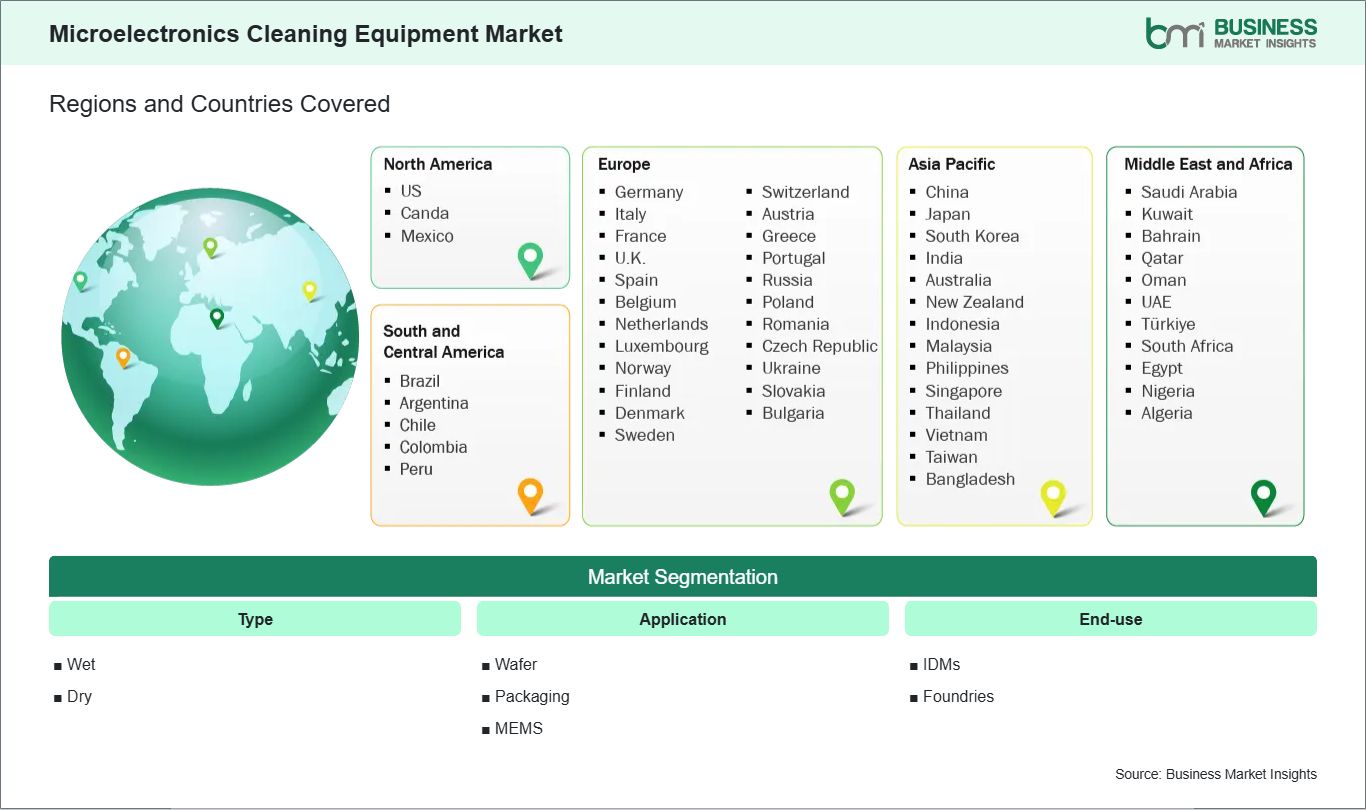
The market is segmented based on type, application, and end-use frameworks.
By Type
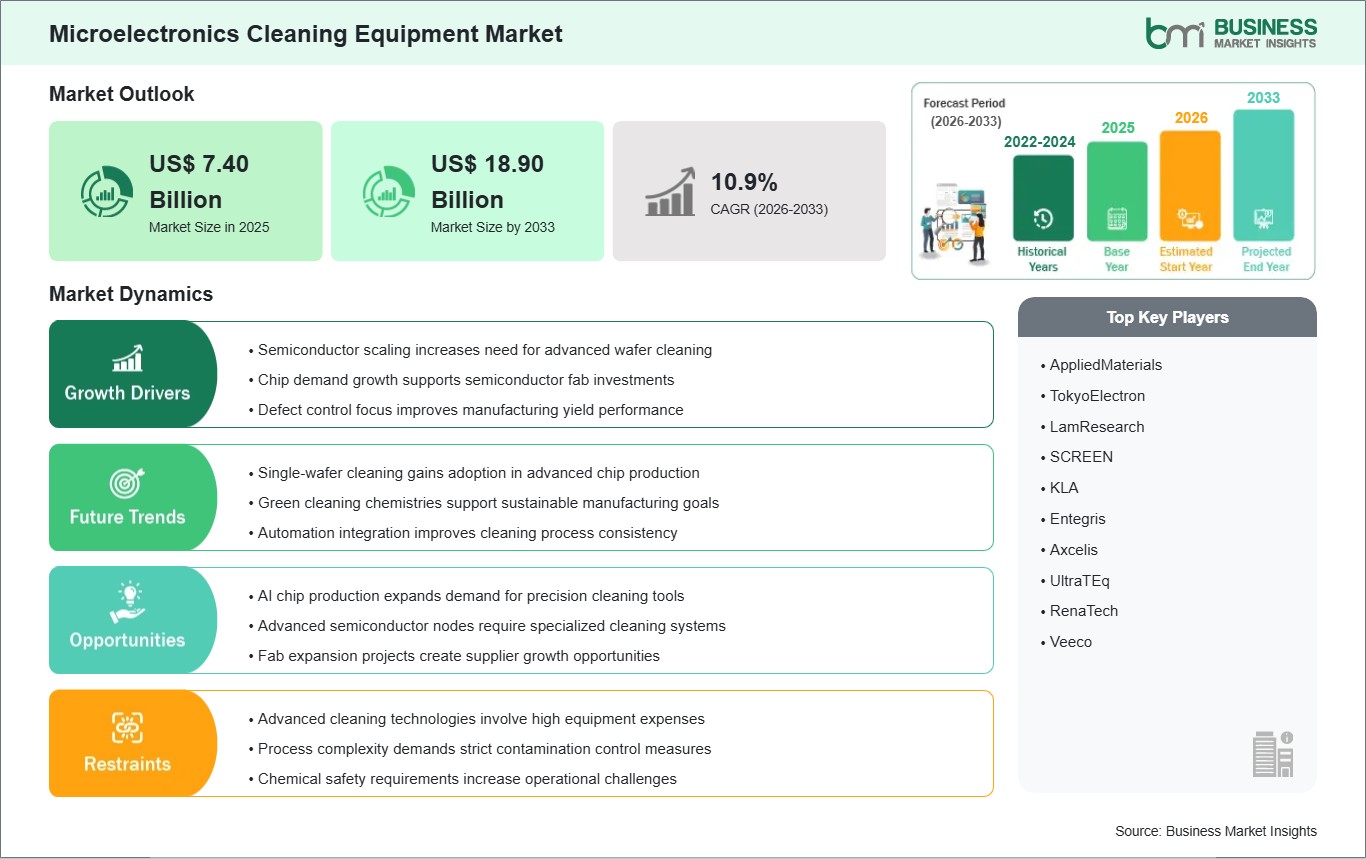
- Wet - Removes particles and residues using chemical solutions with high process efficiency
- Dry - Enables contamination removal without liquid exposure for advanced node applications
By Application
- Wafer - Central cleaning stage ensuring defect-free semiconductor fabrication processes
- Packaging - Maintains cleanliness during final assembly and integration stages
- MEMS - Supports precision cleaning for micro-scale mechanical components
By End-use
- IDMs - Integrate cleaning equipment within full-scale semiconductor manufacturing facilities
- Foundries - Utilize high-throughput systems for contract-based chip fabrication services
Market Forces
Microelectronics Cleaning Equipment Market Drivers and Opportunities
Advanced semiconductor scaling intensifying cleanliness requirements
The progression toward smaller semiconductor nodes has significantly increased sensitivity to contamination. Even minimal particle presence can disrupt circuit performance and reduce yield efficiency. This has created a necessity for highly controlled cleaning environments and precision equipment capable of addressing complex contamination challenges during fabrication processes.
This requirement has reinforced the integration of advanced cleaning technologies across production lines. Fabrication facilities are continuously upgrading equipment to match evolving design standards. As chip complexity increases, the role of efficient cleaning systems becomes increasingly central to maintaining production reliability and achieving consistent operational outcomes.
Emergence of AI and advanced computing expanding cleaning applications
Growing emphasis on high-performance computing and artificial intelligence has reshaped semiconductor design priorities. These applications require sophisticated chip architectures that demand stricter cleanliness during production. Cleaning equipment innovations are evolving to support these requirements through enhanced process precision and automation integration.
Looking ahead, expansion of semiconductor manufacturing capacity will further increase deployment of advanced cleaning systems. Investment in fabrication facilities and next-generation technologies provides opportunities for scalability. This progression enhances system utilization while improving production efficiency across multiple semiconductor applications.
Size and Share Analysis
Microelectronics Cleaning Equipment Market Size and Share Analysis
The Microelectronics Cleaning Equipment Market was valued at US$ 7.40 Billion in 2025 to reach US$ 18.90 Billion by 2033, at a CAGR of 10.9% from 2026 to 2033. This notable expansion reflects increasing reliance on precision cleaning within semiconductor manufacturing ecosystems. Growth momentum aligns with technological advancements and expanding fabrication capacity globally.
Segment dominance highlights wet cleaning processes maintaining leadership due to established performance efficiency. Dry cleaning technologies continue gaining traction as semiconductor nodes advance and process requirements become more specialized.
Application-level insights indicate wafer cleaning as the primary demand generator given its fundamental role in fabrication. Packaging and MEMS segments demonstrate incremental growth as semiconductor applications diversify across industries requiring high-performance micro-scale components.
Report Coverage
Microelectronics Cleaning Equipment Market Report Coverage and Deliverables
The "Microelectronics Cleaning Equipment Market Size and Forecast (2022-2033)" report provides a detailed analysis of the market covering below areas:
- Market size and forecast at global, regional, and country levels for all market segments covered under the scope
- Market trends, as well as drivers, restraints, and opportunities
- Market analysis covering key trends, global and regional framework, major players, regulations, and recent developments
- Industry landscape and competition analysis covering market concentration, heat map analysis, prominent players, and recent developments for the market
- Detailed company profiles, including SWOT analysis
Geographic Insights
Microelectronics Cleaning Equipment Market Geographic Insights
The Microelectronics Cleaning Equipment market shows diverse regional adoption patterns influenced by semiconductor manufacturing concentration, technological investment intensity, and supply chain infrastructure. Regions with established fabrication hubs demonstrate higher integration of advanced cleaning systems, while emerging economies are gradually expanding their adoption to support industrial growth.
North America maintains a technologically advanced landscape supported by research and development investments in semiconductor fabrication. The presence of high-end manufacturing facilities has encouraged deployment of innovative cleaning technologies. This regional focus emphasizes precision engineering and automation integration for optimized production performance.
Asia Pacific accounts for a substantial share of manufacturing activity, driven by extensive semiconductor fabrication capacity. Countries within this region prioritize scaling production capabilities, resulting in widespread implementation of advanced cleaning equipment. Continuous infrastructure expansion and investment in fabrication facilities contribute to consistent demand for high-efficiency systems.
Europe exhibits a balanced approach centered on technological refinement and regulatory compliance within semiconductor production processes. Meanwhile, regions such as the Middle East, Africa, and South America demonstrate gradual adoption aligned with industrial diversification efforts. These markets present opportunities as semiconductor manufacturing capabilities expand globally.
Industry Activity
Recent Developments
The Microelectronics Cleaning Equipment market is evaluated by gathering qualitative and quantitative data post primary and secondary research, which includes important corporate publications, association data, and databases. Recent developments and news in the market include:
- In April 2026, Applied Materials advanced its materials engineering portfolio for next-generation AI and sub-10nm logic chips, introducing atomic-level surface modification solutions like the Producer Viva, which combines gentle chemical radicals with precise heat for ultra-clean processing.
- In November 2024, Tokyo Electron (TEL) restructured its organization to accelerate technological development, pushing its advanced semiconductor cleaning and processing portfolio for deep sub-micron and sub-10nm nodes to meet complex device manufacturing requirements.
Trust & Transparency
Research Methodology
The market analysis combines proprietary research with secondary data from government agencies, company disclosures, regulatory filings, industry databases and expert interviews. Market estimates are validated through data triangulation, cross-market benchmarking and analyst
review.
View Full Research Methodology
Key Sources Referred:
Semiconductor industry technical reportsGovernment semiconductor policy frameworksEngineering and microfabrication journalsCompany filings and product announcementsCompany WebsitesCompany Annual ReportsCompany Investor Presentations