Micromachining Equipment Market Regional Highlights
North America Micromachining Equipment Market
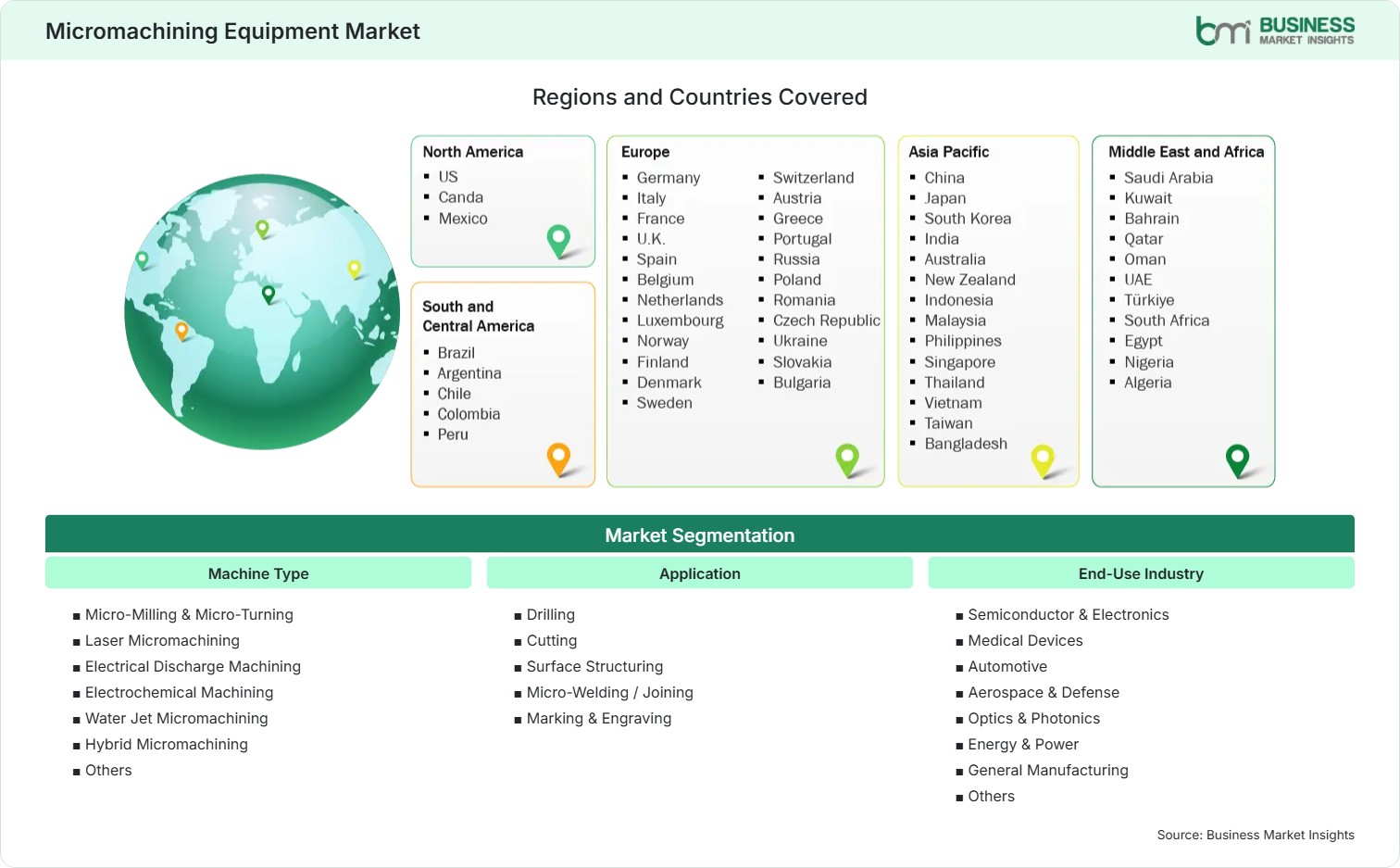
North America represents a 22%–25% Micromachining Equipment Market share in 2025 and records a 6.1%–6.7% CAGR during 2026–2033. The region benefits from semiconductor localization, aerospace manufacturing, medical-device production, and automation investment. The United States remains the principal demand center, while Canada and Mexico contribute through specialized manufacturing and supply-chain diversification. Buyers increasingly prioritize equipment flexibility, process qualification, digital monitoring, and service responsiveness.
- Semiconductor investment is encouraging equipment upgrades for micro-drilling, fine structuring, advanced packaging, and substrate processing, increasing demand for systems capable of repeatable processing across difficult materials.
- Aerospace and defense manufacturers prioritize tight tolerances and complex geometries, supporting adoption of laser, micro-EDM, and hybrid systems for lightweight structures, thermal-management components, and precision assemblies.
- Medical-device manufacturers favor highly controlled machining processes because miniature components require repeatable dimensions, clean edges, traceability, and consistent surface quality across production batches.
US Micromachining Equipment Market
The U.S. Micromachining Equipment Market accounts for 68%–72% of North American demand in 2025 and records a 6.0%–6.6% CAGR during 2026–2033. Equipment capable of integrating automation, inspection, software, and application engineering can gain preference where qualification costs and production continuity materially influence purchasing decisions.
- Semiconductor manufacturing supports demand for high-precision drilling, structuring, and glass processing equipment as advanced packaging introduces increasingly demanding geometries and material combinations.
- Aerospace and defense production creates opportunities for systems capable of processing advanced alloys, composites, and miniature components while maintaining dimensional stability and repeatability.
- Medical-device production favors equipment platforms that combine precise material removal with automated inspection, documentation, and traceability, strengthening demand for digitally integrated manufacturing cells.
Europe Micromachining Equipment Market
Europe holds a 24%–27% Micromachining Equipment Market share in 2025 and expands at a 5.8%–6.4% CAGR through 2033. Germany remains the leading manufacturing base, while Switzerland, France, Italy, and the United Kingdom provide specialized precision-engineering capabilities. Germany records approximately 6.0%–6.5% CAGR, while Switzerland and France offer high-value opportunities through precision components, medical technologies, optics, and industrial automation.
- Germany benefits from established machine-tool expertise and industrial automation, supporting demand for micro-milling, laser processing, precision motion systems, and digitally connected production equipment.
- Switzerland maintains a strong opportunity base in precision engineering, medical components, watchmaking-related technologies, and high-value miniature parts requiring exceptional dimensional control.
- France and the United Kingdom provide opportunities across aerospace, defense, photonics, and medical manufacturing, where complex geometries and advanced materials support specialized machining requirements.
- European sustainability priorities encourage suppliers to improve energy efficiency, material utilization, process yield, and equipment lifecycle performance while maintaining stringent production quality.
Asia Pacific Micromachining Equipment Market
Asia Pacific commands a 43%–47% Micromachining Equipment Market share in 2025 and achieves a 7.2%–7.8% CAGR during 2026–2033, making it the fastest-growing regional market. China and Taiwan benefit from electronics and semiconductor ecosystems, Japan from precision engineering, South Korea from electronics and advanced components, and India from expanding manufacturing capabilities.
- China benefits from extensive electronics, automotive, semiconductor, and precision-component manufacturing, creating broad demand for laser micromachining, EDM, micro-milling, and automated production systems.
- Japan’s precision-engineering ecosystem supports premium equipment demand, particularly where manufacturers require high repeatability, sophisticated motion control, and stable processing of miniature components.
- South Korea and Taiwan provide strong semiconductor and electronics opportunities, supporting equipment adoption for micro-drilling, advanced substrates, packaging structures, and precision surface processing.
- India is developing a broader precision-manufacturing base, creating opportunities for equipment suppliers serving electronics, automotive, aerospace, medical, and industrial component manufacturers.
Rest of World Micromachining Equipment Market
South and Central America represent a developing portion of global demand, with Brazil and Mexico providing the strongest manufacturing opportunities. The Middle East and Africa remain smaller but increasingly relevant through aerospace, energy, medical, and industrial diversification. Combined, Rest of World holds a 7%–10% share in 2025 and records a 5.4%–6.1% CAGR during 2026–2033. Investment is concentrated where advanced manufacturing programs can justify specialized equipment.
- Mexico benefits from proximity to North American manufacturing networks, creating opportunities for precision equipment used in automotive, electronics, aerospace, and industrial component production.
- Brazil provides demand potential across automotive, medical, aerospace, and general manufacturing, particularly where local producers seek improved precision and process consistency.
- Saudi Arabia and the United Arab Emirates are developing advanced industrial capabilities, creating selective opportunities in aerospace, energy, medical manufacturing, and high-value engineering.
- South Africa offers niche potential in aerospace, medical, mining-related engineering, and industrial manufacturing where specialized precision-processing capabilities can improve component performance.