
Discrete Semiconductor Market Outlook: Size, Share, Trends, Growth Analysis, Competitive Landscape & Forecast, 2026-2033

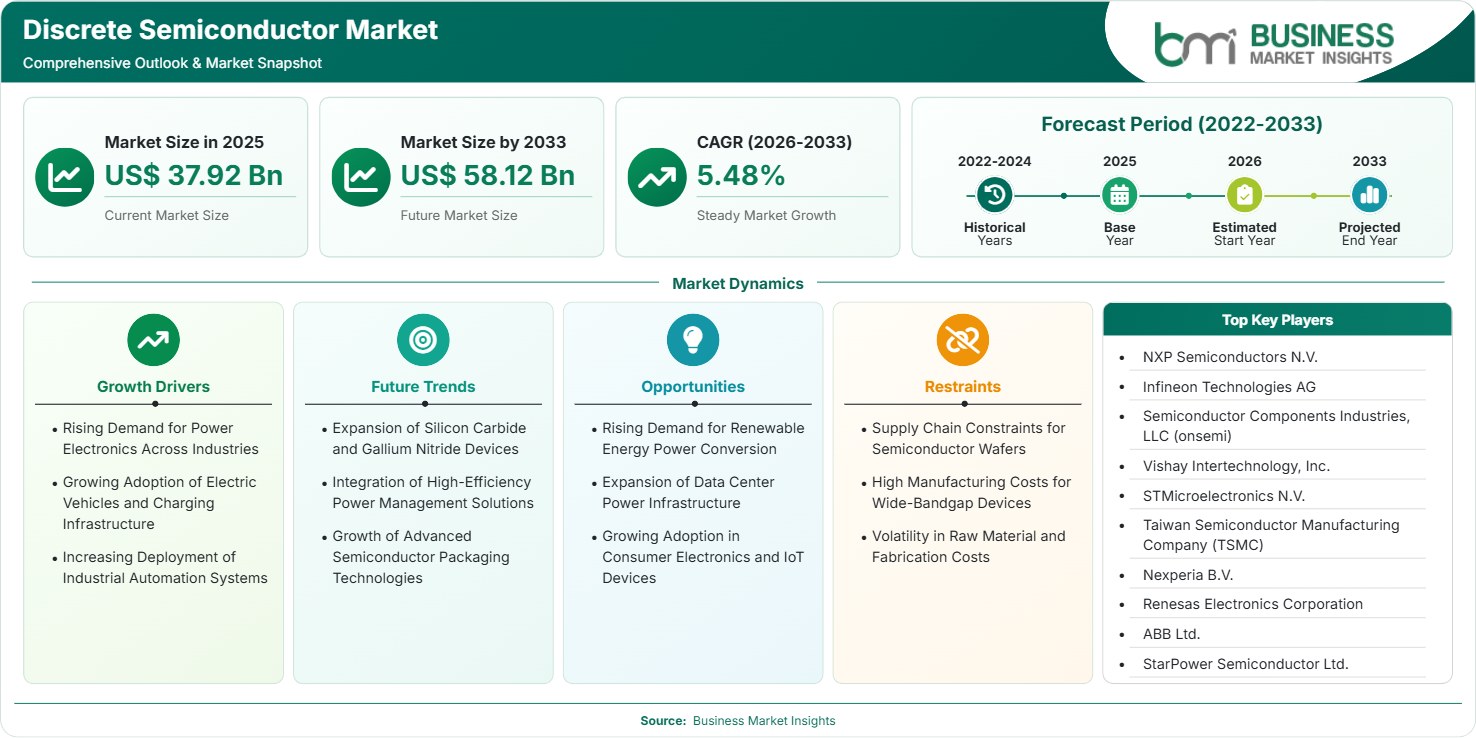
The Discrete Semiconductor Market size was valued at US$ 37.92 Billion in 2025 and is projected to reach US$ 58.12 Billion by 2033, growing at a CAGR of 5.48% during 2026–2033. Rising demand for power management solutions, increasing adoption of electric vehicles, growing industrial automation activities, and expanding deployment of communication infrastructure are supporting market growth globally.

Report Coverage
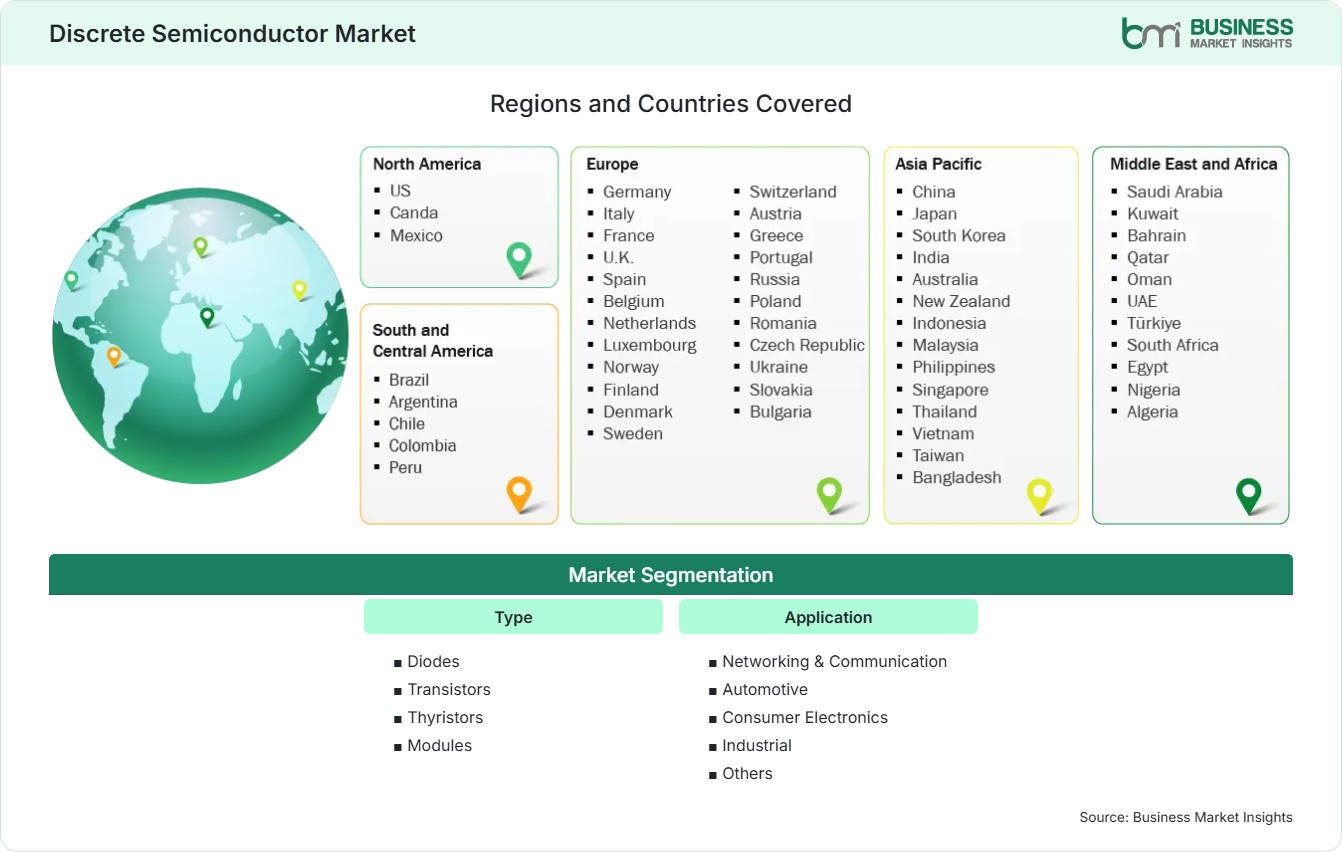
  • Type: Diodes, Transistors, Thyristors, Modules
  • Application: Networking & Communication, Automotive, Consumer Electronics, Industrial, Others
US$ 37.92 Bn Market size in 2025
US$ 58.12 Bn Market Size by 2033
5.48% CAGR, 2026 - 2033
2026-2033 Forecast Period

01 AI Overview

Discrete Semiconductor Market Summary

  • North America Region: North America holds a discrete semiconductor market share of 34%–37% in 2025, growing with a CAGR of 5.0%–5.6% during 2026–2033. Strong demand from automotive electronics, telecommunications infrastructure, industrial automation, and defense applications continues supporting regional leadership. The U.S. market is expected to register a CAGR of 5.1%–5.7%.
  • Fastest Growing Region: Asia Pacific accounts for 29%–32% share in 2025 and is projected to grow at a CAGR of 6.3%–6.9% through 2033. Expansion of semiconductor manufacturing, increasing EV production, rapid industrialization, and strong consumer electronics demand continue driving regional growth.
  • Leading Segment: Transistors represent 38%–41% share in 2025 and are expected to grow at a CAGR of 5.5%–6.1% through 2033. Extensive adoption in power management, switching applications, signal amplification, and automotive electronics continues supporting segment dominance.
  • High Growth Segment: Automotive accounts for 18%–21% share in 2025 and is forecast to grow at a CAGR of 7.2%–7.8% during 2026–2033. Increasing vehicle electrification, ADAS deployment, battery management requirements, and electronic content per vehicle are accelerating growth.
  • Key Market Opportunity: Growing adoption of wide-bandgap semiconductor technologies, EV power electronics, renewable energy systems, and advanced industrial automation is creating substantial growth opportunities.
  • Major Market Players: NXP Semiconductors N.V., Infineon Technologies AG, Semiconductor Components Industries, LLC (onsemi), Vishay Intertechnology, Inc., STMicroelectronics N.V., Taiwan Semiconductor Manufacturing Company (TSMC), Nexperia B.V., Renesas Electronics Corporation, ABB Ltd., StarPower Semiconductor Ltd.
02 Strategic Insights

Discrete Semiconductor Market: Strategic Insights

Discrete Semiconductor Market Strategic Framework
FREE PDF
Request your free sample
Request free sample
03 Stakeholder View

Key Takeaways

  • Discrete semiconductors remain essential components supporting power management and signal control functions across multiple industries.
  • Transistors continue representing the largest product category due to broad deployment across electronic systems.
  • Automotive applications are emerging as the fastest-growing end-user segment driven by electrification trends.
  • Asia Pacific continues strengthening its position as a major manufacturing and consumption hub.
  • Energy efficiency requirements are accelerating innovation in semiconductor materials and device architectures.
  • Renewable energy systems, EV infrastructure, and industrial automation remain major demand-generating sectors.
04 Geographic Outlook

Discrete Semiconductor Market Regional Highlights

North America Discrete Semiconductor Market

North America accounts for 34%–37% Discrete Semiconductor Market share in 2025 and is projected to grow at a CAGR of 5.0%–5.6% through 2033. Strong adoption of advanced electronics, expansion of EV production, increasing telecommunications investments, and industrial modernization initiatives continue supporting regional leadership.

  • Automotive manufacturers continue increasing semiconductor content in vehicles to support electrification, safety systems, and advanced electronics.
  • Telecommunications infrastructure upgrades are generating demand for power management and RF-related semiconductor components.
  • Industrial automation projects continue expanding utilization of discrete power devices across manufacturing facilities.
  • Renewable energy investments are supporting demand for power conversion and energy management semiconductors.
  • Data centers increasingly require efficient power management systems utilizing advanced semiconductor technologies.
  • Ongoing innovation in power electronics is strengthening market opportunities across multiple industries.

US Discrete Semiconductor Market

The United States contributes approximately 84%–88% of North American revenue and is expected to register a CAGR of 5.1%–5.7% through 2033. Strong semiconductor innovation, automotive electronics demand, industrial automation development, and communication infrastructure investments continue supporting discrete semiconductor market growth.

  • EV production growth continues driving demand for power semiconductors and battery management systems.
  • Industrial operators are expanding automation initiatives requiring advanced semiconductor solutions.
  • Renewable energy projects are increasing deployment of discrete devices for power conversion applications.
  • Telecommunications companies continue investing in advanced network infrastructure.
  • Technological innovation remains focused on efficiency, reliability, and miniaturization.

Europe Discrete Semiconductor Market

Europe represents 24%–27% of global revenue in 2025 and is anticipated to expand at a CAGR of 5.4%–6.0% through 2033. Strong automotive manufacturing capabilities, industrial automation leadership, and sustainability-focused investments continue supporting regional growth. Germany remains the leading market while Poland demonstrates stronger growth momentum.

  • Germany continues leading demand through automotive electronics production and industrial manufacturing activities.
  • Poland is among the fastest-growing markets and is estimated to record a CAGR of 6.5%–7.1% during the forecast period.
  • Increasing EV adoption is driving semiconductor demand across mobility applications.
  • Renewable energy infrastructure investments continue supporting deployment of power semiconductors.
  • Industrial digitalization initiatives remain an important source of demand.
  • Advanced manufacturing technologies continue supporting semiconductor innovation.

Asia Pacific Discrete Semiconductor Market

Asia Pacific accounts for 29%–32% of global revenue in 2025 and is expected to achieve the fastest CAGR of 6.3%–6.9% through 2033. Expanding electronics manufacturing, growing EV production, industrial development, and increasing semiconductor investments continue supporting strong market growth.

  • China remains the largest regional market due to strong electronics manufacturing capabilities and extensive industrial demand.
  • India is projected to achieve approximately 7.1%–7.7% CAGR, supported by growing industrialization, electronics manufacturing initiatives, and EV adoption.
  • Consumer electronics production continues driving substantial semiconductor demand.
  • Automotive electrification programs are increasing deployment of advanced power devices.
  • Government-backed semiconductor manufacturing initiatives continue supporting regional expansion.
  • Telecommunications infrastructure growth remains an important market driver.

Rest of World Discrete Semiconductor Market

Rest of World accounts for 8%–11% of global revenue in 2025 and is projected to expand at a CAGR of 5.5%–6.1% through 2033. Increasing industrial modernization, renewable energy investments, and automotive sector development continue supporting market growth.

  • Brazil continues generating semiconductor demand through industrial and automotive applications.
  • The UAE is witnessing increased investment in technology and infrastructure modernization projects.
  • Saudi Arabia is expected to achieve approximately 6.3%–6.9% CAGR through 2033 due to industrial diversification initiatives.
  • Renewable energy projects are creating additional opportunities for power semiconductor deployment.
  • Industrial automation adoption continues expanding market demand.
  • Growing electronics consumption supports long-term industry growth.
Global Market Geography
FREE PDF
Request your free sample
Request free sample
05 Segment Analysis

Discrete Semiconductor Market Segmentation

Type

The type segment forms the technological backbone of the discrete semiconductor industry, supporting power conversion, switching, rectification, signal processing, voltage regulation, and circuit protection functions across numerous electronic systems. The segment accounts for approximately 38%–41% share in 2025 and is projected to grow at a CAGR of 5.6%–6.2% through 2033. The expanding Discrete Semiconductor Market scope is being driven by increasing electrification trends, growing deployment of power electronics, expansion of industrial automation systems, and rising demand for energy-efficient electronic devices across automotive, industrial, and consumer sectors.

  • Diodes: Diodes continue witnessing strong demand due to their extensive use in rectification, voltage regulation, circuit protection, power supplies, and consumer electronic devices.
  • Transistors: Transistors remain the dominant segment owing to their widespread deployment in switching applications, amplification systems, power management devices, automotive electronics, industrial equipment, and communication infrastructure.
  • Thyristors: Thyristors continue serving important roles in motor control systems, industrial drives, power conversion equipment, renewable energy installations, and high-power switching applications.
  • Modules: Semiconductor modules are increasingly adopted in electric vehicles, renewable energy systems, industrial automation equipment, and advanced power management solutions due to their ability to integrate multiple semiconductor functions within compact packages.

Application

Application diversity remains one of the strongest characteristics of the discrete semiconductor industry. The segment accounts for approximately 41%–44% share in 2025 and is expected to register a CAGR of 5.8%–6.4% through 2033. Current Discrete Semiconductor Market trends indicate increasing adoption across electrification, digitalization, industrial modernization, and advanced communication infrastructure projects.

  • Networking & Communication: Discrete semiconductors play a critical role in telecommunications equipment, networking infrastructure, 5G systems, RF modules, signal processing equipment, and data transmission platforms.
  • Automotive: Automotive represents the fastest-growing application segment due to increasing vehicle electrification, battery management requirements, ADAS deployment, infotainment systems, onboard charging technologies, and powertrain electronics.
  • Consumer Electronics: Smartphones, laptops, televisions, gaming systems, wearables, and household appliances continue generating significant demand for power management and signal control devices.
  • Industrial: Industrial applications utilize discrete semiconductors extensively within motor drives, automation systems, robotics, power supplies, manufacturing equipment, and industrial control systems.
  • Others: Additional applications include renewable energy systems, medical devices, defense electronics, aerospace systems, data centers, and smart infrastructure projects.
06 Market Forces

Discrete Semiconductor Market Dynamics

Key Market Drivers

Rising Demand for Power Electronics Across Industries

Power electronics are gaining prominence in the modern economy as organizations focus on achieving high energy efficiency, electrification, and system performance. Discrete semiconductors are an important component in power electronics such as power conversion, switching, voltage regulation, and energy management systems which are widely applied in transport, telecommunications, energy utilities, industrial automation, and consumer electronics. Energy efficiency is a key consideration by governments and companies looking to lower costs and achieve their sustainability goals, hence boosting demand for semiconductors. Digitalization has also resulted in higher power consumption by various electronic equipment and systems, offering new prospects for using semiconductor devices. The companies are developing new semiconductor device designs that increase efficiency and thermal performance, while minimizing energy losses. With growing power consumption and electrification efforts around the world, the demand for discrete semiconductors will be favorable in the forecast period.

Growing Adoption of Electric Vehicles and Charging Infrastructure

Increased demand for semiconductors used in powertrains, batteries, charging stations, energy conversion devices, and other electronics in cars is driven by the growing trend of global electrification of transportation. Electric cars need more semiconductors than traditional ones because of the complicated energy management in them and the presence of many advanced electronics systems in them. At present, many governments around the world encourage the adoption of EVs by various regulatory measures, infrastructure development, and carbon dioxide emission reduction goals. The growing network of EV chargers creates a demand for semiconductors that provide efficient energy transfer. Manufacturers of semiconductors are actively designing new products tailored to the needs of the automotive electrification industry. With further development of production of electric cars and the networks of chargers around the globe, the automotive industry will remain one of the main drivers of the discrete semiconductor industry growth.

Increasing Deployment of Industrial Automation Systems

The industrial automation technology is still evolving and making advancements in the manufacturing, logistics, energy, and process industry by using smart equipment, robotic devices, digital controls, and manufacturing technologies. The discrete semiconductor devices have great significance in the field of motor drives, programmable controller, industrial sensors, robotics, and power management systems. Companies are now looking at automation not only to improve the efficiency and productivity but also to reduce cost and solve their work force related issues. With the emergence of the Industry 4.0 era, the need for automation based on electronic components and power devices is increasing rapidly. The adoption of artificial intelligence, industrial internet of things, and predictive maintenance is also enhancing the need for semiconductor technologies.

Key Market Opportunities

Rising Demand for Renewable Energy Power Conversion

The global shift toward renewable energy sources is creating substantial opportunities for discrete semiconductor manufacturers. Solar photovoltaic systems, wind energy installations, battery energy storage projects, and grid integration infrastructure all require sophisticated power conversion and energy management technologies. Discrete semiconductors enable efficient conversion of generated electricity, optimization of energy transmission, and effective management of power flows throughout renewable energy ecosystems. Governments worldwide continue increasing investments in renewable energy infrastructure to address climate objectives and strengthen energy security. As renewable installations become larger and more technologically advanced, demand for high-performance semiconductor devices capable of improving system efficiency and reliability is expected to increase significantly. This trend is likely to remain one of the most attractive long-term opportunities within the market.

Expansion of Data Center Power Infrastructure

The rapid growth of cloud computing, artificial intelligence, edge computing, and digital services is driving substantial expansion of data center infrastructure worldwide. Data centers require highly efficient power conversion, voltage regulation, backup power systems, cooling solutions, and energy management technologies to support reliable operations. Discrete semiconductors are essential components within these systems because they influence energy efficiency, operational reliability, and infrastructure scalability. As operators seek to improve energy utilization and reduce operating expenses, demand for advanced semiconductor solutions continues increasing. The ongoing development of hyperscale facilities and AI-focused computing environments is expected to further strengthen opportunities for discrete semiconductor suppliers.

Growing Adoption in Consumer Electronics and IoT Devices

Consumer electronics and Internet of Things ecosystems continue expanding rapidly as connected technologies become more integrated into everyday life. Smartphones, wearable devices, smart home products, connected appliances, sensors, and portable electronics all depend on discrete semiconductors for power management, signal control, charging functions, and energy efficiency. Manufacturers are continually developing smaller, more capable, and more energy-efficient devices that require advanced semiconductor solutions. The growth of connected living environments and intelligent consumer devices is expected to create sustained demand across multiple product categories. Long-term Discrete Semiconductor Market Forecasts remain favorable as IoT adoption continues accelerating globally.

Market Restraints and Challenges

Supply Chain Constraints for Semiconductor Wafers

Factor: Semiconductor manufacturing relies on highly specialized raw materials, fabrication facilities, equipment suppliers, and wafer production ecosystems. Supply chain disruptions, geopolitical uncertainties, manufacturing bottlenecks, and fluctuations in wafer availability can significantly affect production capacity and delivery schedules. Growing global demand across multiple electronics sectors can further increase pressure on supply chains. Impact: Component shortages and longer lead times may delay product manufacturing, increase costs, and affect customer procurement strategies. Supply chain risks remain an important challenge influencing market stability and operational planning across the semiconductor industry.

High Manufacturing Costs for Wide-Bandgap Devices

Factor: Advanced semiconductor technologies such as silicon carbide and gallium nitride devices offer superior efficiency, thermal performance, and power handling capabilities. However, manufacturing these devices involves complex production processes, specialized materials, advanced fabrication equipment, and stringent quality control requirements. These factors significantly increase production costs compared with traditional silicon-based alternatives. Impact: Higher product prices may limit adoption among cost-sensitive customers and delay commercialization within certain applications. While long-term efficiency benefits often justify investment, cost considerations continue representing a challenge for wider deployment of next-generation semiconductor technologies.

07 Company Analysis

Competitive Landscape

The Discrete Semiconductor Market analysis is characterized by intense competition among global semiconductor manufacturers, power electronics specialists, and integrated device suppliers. Companies are focusing on power efficiency, thermal performance, miniaturization, wide-bandgap semiconductor technologies, automotive electrification solutions, and advanced industrial applications to strengthen their competitive positions. Growing demand from electric vehicles, renewable energy systems, industrial automation platforms, communication infrastructure, and consumer electronics continues driving product innovation and manufacturing capacity expansion across the industry. Strategic investments in silicon carbide (SiC), gallium nitride (GaN), and next-generation power semiconductor technologies are further reshaping competitive dynamics.

Company Name

Overview

Products and Services relevant to this market

NXP Semiconductors N.V.

Semiconductor company providing solutions for automotive, industrial, communication, and embedded applications.

Power transistors, diodes, automotive semiconductors, industrial control solutions, and power management devices.

Infineon Technologies AG

Global semiconductor manufacturer specializing in power systems, automotive electronics, and industrial applications.

Power semiconductors, IGBT modules, MOSFETs, diodes, automotive power devices, and industrial semiconductor solutions.

Semiconductor Components Industries, LLC (onsemi)

Semiconductor company focused on intelligent power and sensing technologies.

Discrete power devices, transistors, diodes, automotive semiconductors, power modules, and energy management solutions.

Vishay Intertechnology, Inc.

Manufacturer of discrete semiconductors and passive electronic components.

Rectifiers, diodes, MOSFETs, transistors, power management devices, and industrial semiconductor solutions.

STMicroelectronics N.V.

Semiconductor company serving automotive, industrial, communication, and consumer markets.

Power transistors, diodes, semiconductor modules, automotive electronics, and energy-efficient power devices.

Taiwan Semiconductor Manufacturing Company (TSMC)

Semiconductor manufacturing company supporting advanced device production across multiple industries.

Semiconductor fabrication services, discrete semiconductor manufacturing support, power device production, and advanced process technologies.

Nexperia B.V.

Manufacturer focused on discrete, logic, and power semiconductor products.

Diodes, transistors, MOSFETs, protection devices, automotive semiconductors, and power management solutions.

Renesas Electronics Corporation

Semiconductor supplier serving automotive, industrial, and infrastructure applications.

Discrete devices, power semiconductors, automotive electronics, industrial control solutions, and energy-efficient semiconductor products.

ABB Ltd.

Electrification and industrial technology company supporting power electronics and automation applications.

Power semiconductor modules, industrial power conversion solutions, automation systems, and energy management technologies.

StarPower Semiconductor Ltd.

Power semiconductor manufacturer focused on industrial, renewable energy, and transportation applications.

IGBT modules, power semiconductor devices, industrial power electronics, renewable energy solutions, and transportation power systems.

10 Trust & Transparency

Research Methodology

The market analysis combines proprietary research with secondary data from government agencies, company disclosures, regulatory filings, industry databases and expert interviews. Market estimates are validated through data triangulation, cross-market benchmarking and analyst review.

View Full Research Methodology

11 Questions Answered

Frequently Asked Questions

How are renewable energy systems influencing semiconductor demand?

Renewable energy systems rely heavily on discrete semiconductors for power conversion, voltage regulation, inverter operation, battery storage integration, and energy management functions, creating substantial long-term growth opportunities for manufacturers.

What does this Discrete Semiconductor Market Report cover?

This report covers type analysis, application segmentation, regional trends, competitive landscape assessment, market dynamics, growth opportunities, restraints, and future market prospects through 2033.

Why is the automotive application segment growing rapidly?

The automotive segment is experiencing strong growth because of rising electric vehicle production, increasing deployment of ADAS technologies, growth in battery management systems, and expanding electronic content per vehicle.

Which type segment dominates the market?

Transistors represent the leading segment due to their widespread use in switching applications, power management systems, signal amplification, automotive electronics, industrial automation equipment, and communication infrastructure.

What is driving growth in the discrete semiconductor market?

Rising demand for power electronics across industries, growing adoption of electric vehicles and charging infrastructure, increasing deployment of industrial automation systems, and expansion of renewable energy installations are the primary drivers supporting market growth.

Access the Full Discrete Semiconductor Market Report

Get segment-level forecasts, regional estimates, competitive benchmarking, company profiles and downloadable Excel datasets.

Access the full Discrete Semiconductor Market Report
350 pages PDF & Excel | 2026-08-12