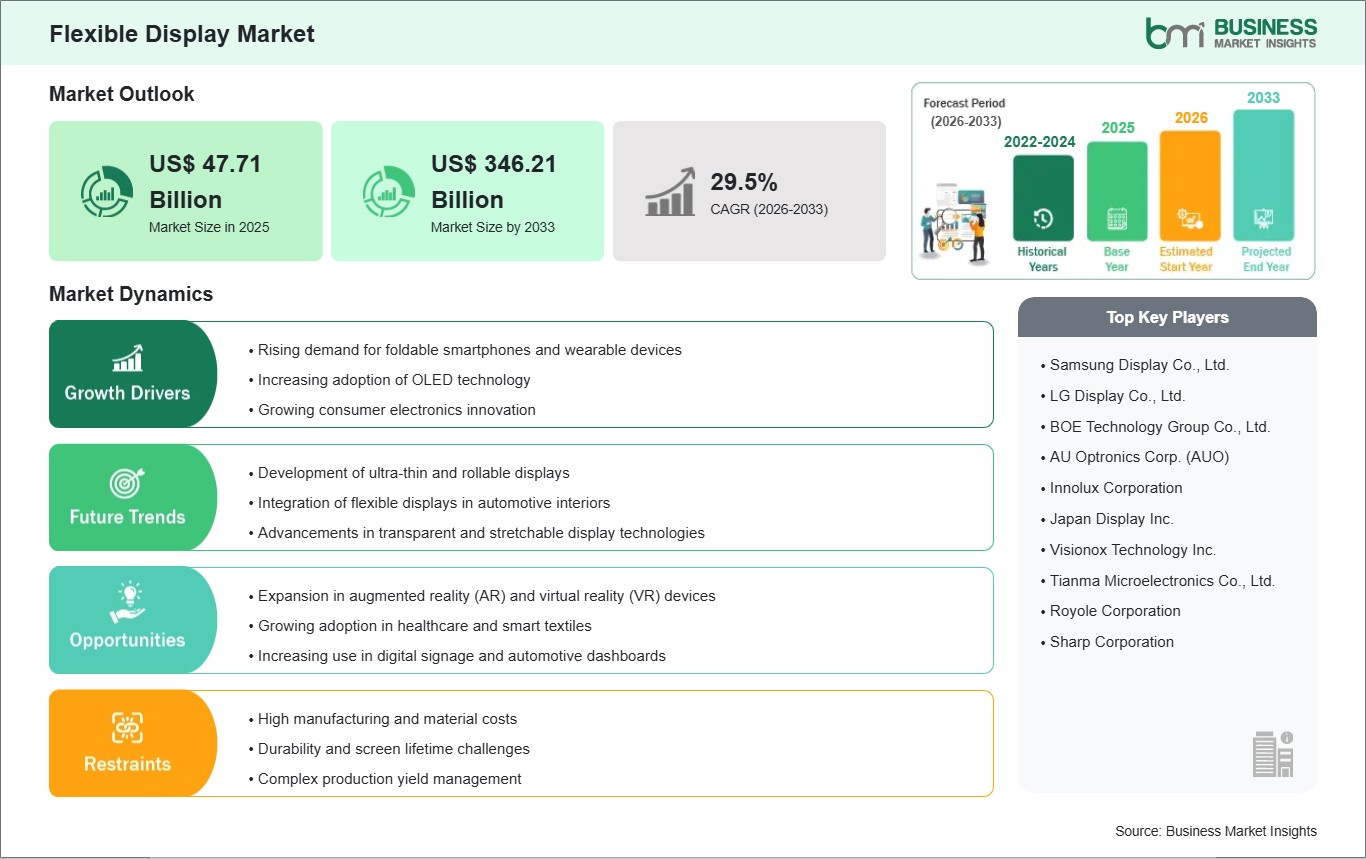
The Flexible Display market size is expected to reach US$ 346.21 billion by 2033 from US$ 47.71 billion in 2025. The market is estimated to record a CAGR of 29.53% from 2026 to 2033.
Flexible display technology refers to the integrated application of advanced screen solutions engineered to resist cracking, bending, and folding while maintaining high-fidelity visual performance. By utilizing flexible substrates, primarily plastic polyimide or ultra-thin glass, these systems replace traditional rigid glass backplanes with resilient, multi-layer materials that allow for innovative form factors. This technology is fundamental to the operational architecture of foldable smartphones, rollable televisions, and curved automotive infotainment systems. Market expansion is being propelled by the rapid global transition toward portable and versatile consumer electronics, the rising institutional requirement for durable and lightweight military and medical displays, and the increasing integration of organic light-emitting diode (OLED) technology.
However, several factors may restrain market progression. The high capital intensity associated with complex multi-stage manufacturing, specifically the delicate process of thin-film encapsulation (TFE) to protect organic layers from moisture, remains a primary hurdle for scaling production. The industry also faces persistent technical challenges regarding long-term durability, as repeated mechanical stress on hinges and display layers can lead to visible creasing or catastrophic material fatigue over time. Additionally, the lack of optimized application software for variable screen interfaces has intensified concerns regarding fragmented user experiences across different device ecosystems. These hurdles, compounded by the strategic risks of yield losses in large-panel polyimide production and the sensitivity of flexible materials to extreme temperatures, increase the total cost of ownership and may lengthen the replacement cycles for premium consumer devices.
Despite these hurdles, the market outlook remains highly favorable as the sector transitions toward hybrid and autonomous display form factors. Opportunities are emerging through the adoption of Rollable and Scrolling Displays; the market is witnessing a surge in prototypes and commercial units that allow screens to expand or retract into a compact housing, offering a dynamic balance between portability and large-screen utility. The automotive segment is gaining significant traction, with a rising requirement for Pillar-to-Pillar flexible dashboards that conform to the interior curvature of the vehicle to enhance driver ergonomics and safety. Furthermore, the growth of IoT-Connected Flexible Signage, which can be wrapped around urban infrastructure for real-time public information, aligns with global goals for smart city development and enhanced digital connectivity.

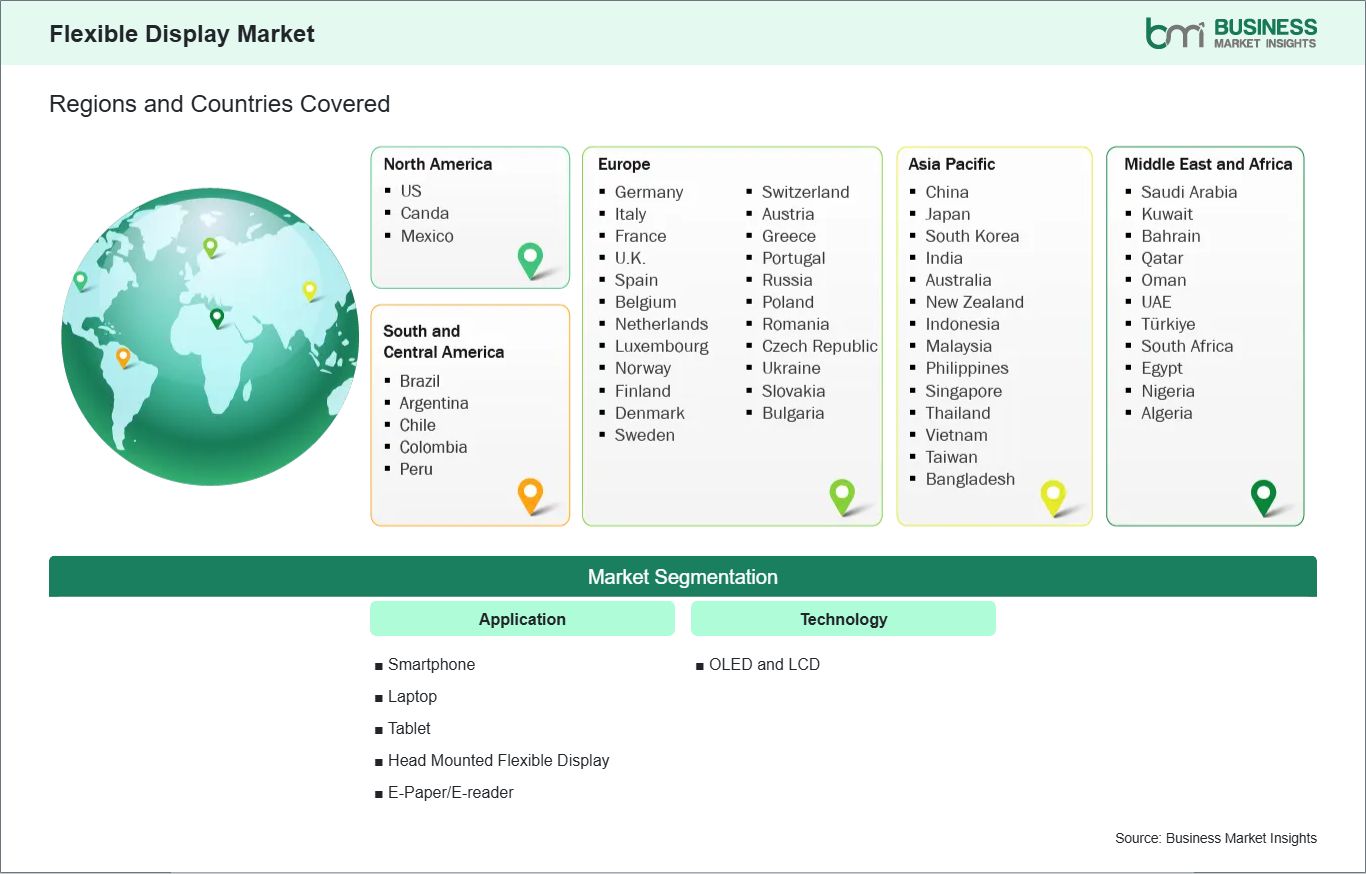
Key segments that contributed to the derivation of the Flexible Display market analysis are application and technology.
The flexible display market is being driven by the growing need for portability, product innovation, and energy efficiency across consumer electronics, automotive, healthcare, and industrial sectors. Flexible displays, based on OLED, AMOLED, and e‑paper technologies, enable bendable, foldable, and rollable form factors that redefine user experiences. The rapid expansion of smartphones, tablets, and wearables is amplifying adoption, as consumers seek lightweight, durable devices with enhanced functionality. Automotive applications are reinforcing growth, with flexible displays integrated into dashboards, infotainment systems, and heads‑up displays to improve safety and aesthetics. Healthcare is also fueling demand, as flexible displays support wearable medical devices and patient monitoring systems. Additionally, sustainability initiatives are propelling investment in energy‑efficient, eco‑friendly display technologies that reduce power consumption and extend device lifespans. The rise of digital signage and smart retail is further driving adoption, with flexible displays offering creative, space‑saving solutions. Collectively, portability priorities, innovation requirements, and efficiency goals are fueling sustained growth in the global flexible display market.
Opportunities in the flexible display market are expanding through the integration of IoT ecosystems, artificial intelligence, and emerging cross‑industry applications. IoT‑enabled devices are opening lucrative opportunities by embedding flexible displays into smart homes, wearables, and connected appliances. AI‑driven platforms are gaining traction, enabling adaptive interfaces, personalized content delivery, and predictive analytics for user engagement. The growing emphasis on digital transformation is fueling demand for interoperable flexible displays that enhance smart cities, autonomous vehicles, and next‑generation consumer electronics. Emerging applications in healthcare are driving innovation, as flexible displays support real‑time diagnostics, telemedicine, and wearable biosensors. Retail and advertising sectors are reinforcing opportunities, where flexible displays enable immersive, interactive customer experiences. Additionally, sustainability trends are encouraging deployment of recyclable, energy‑efficient display materials that align with global environmental goals. The expansion of AR/VR ecosystems, foldable laptops, and advanced robotics is creating new pathways for adoption. Vendors who focus on IoT‑ready, AI‑driven, and industry‑specific flexible display solutions are well‑positioned to capture growth. The convergence of IoT, AI, and innovative form factors underscores a transformative trajectory for the global flexible display market.

The Flexible Display market demonstrates steady growth, with size and share analysis revealing evolving trends and competitive positioning among key players. The report examines subsegments categorized within application and technology, offering insights into their contribution to overall market performance.
Based on Application, the Smartphone subsegment dominates adoption, as flexible displays are indispensable for foldable and rollable devices that enhance portability and user experience. Smartphones with flexible screens offer durability, lightweight design, and innovative form factors, driving consumer demand. The Laptop subsegment is essential for next‑generation computing, enabling thinner, lighter, and more versatile devices. The Tablet subsegment anchors demand in education and professional use, where flexible displays provide larger screen areas without compromising portability. The Head‑Mounted Flexible Display subsegment is critical for AR/VR applications, offering immersive experiences with lightweight and adaptable designs. The E‑Paper/E‑Reader subsegment supports demand in publishing and education, providing energy‑efficient, eye‑friendly displays. Together, these applications highlight the versatility of flexible displays across consumer electronics and immersive technologies
| Report Attribute | Details |
|---|---|
| Market size in 2025 | US$ 47.71 Billion |
| Market Size by 2033 | US$ 346.21 Billion |
| Global CAGR (2026 - 2033) | 29.5% |
| Historical Data | 2022-2024 |
| Forecast period | 2026-2033 |
| Segments Covered | By Application
|
|
Regions and Countries Covered
| |
| North America | US, Canada, Mexico |
| Europe | Belgium, Austria, Finland, Denmark, Greece, Poland, Romania, Russia, Ukraine, Czech Republic, Slovakia, Bulgaria, Italy, Luxembourg, Germany, Switzerland, France, Netherlands, Norway, Portugal, Spain, Sweden, United Kingdom |
| Asia-Pacific | Australia, China, India, Japan, South Korea, Indonesia, Malaysia, Philippines, Singapore, Thailand, Vietnam, Bangladesh, New Zealand, Taiwan |
| South and Central America | Brazil, Argentina, Peru, Chile, Colombia |
| Middle East and Africa | Bahrain, Kuwait, Oman, Qatar, Saudi Arabia, United Arab Emirates, Turkiye, South Africa, Egypt, Algeria, Nigeria |
| Market leaders and key company profiles |
|
The “Flexible Display Market Size and Forecast (2022–2033)” report provides a detailed analysis of the market covering below areas:
The geographical scope of the Flexible Display market report is divided into five regions: North America, Asia Pacific, Europe, Middle East & Africa, and South & Central America.
North America maintains a preeminent position within the global industry, a status reinforced by the region's high consumer purchasing power and the rapid adoption of premium electronic devices. The regional landscape is characterized by a significant market share in the United States and Canada, where the transition toward foldable, rollable, and bendable interfaces has become a primary driver for product differentiation. This market leadership is supported by a robust ecosystem of technology pioneers, including Corning Incorporated, Universal Display Corporation, Kent Displays, and HP Inc., who collaborate with global panel manufacturers to integrate flexible OLED and e-paper solutions into next-generation hardware.
Industrial and consumer trends in the region reflect a decisive shift toward Form Factor Innovation and Device Portability. Users are increasingly moving away from rigid, static screens to adopt multifunctional gadgets that combine large-display experiences with compact footprints, such as foldable smartphones and hybrid tablets. Furthermore, the region is witnessing an escalating demand for Flexible Displays in Automotive and Wearable Technology. This focus on Conformable Interfaces is driving the integration of curved dashboards and wrap-around smartwatches that offer enhanced ergonomics and aesthetic appeal while maintaining high durability and energy efficiency.

The Flexible Display market is evaluated by gathering qualitative and quantitative data post primary and secondary research, which includes important corporate publications, association data, and databases. A few of the key developments in the Flexible Display market are:
The Flexible Display Market is valued at US$ 47.71 Billion in 2025, it is projected to reach US$ 346.21 Billion by 2033.
As per our report Flexible Display Market, the market size is valued at US$ 47.71 Billion in 2025, projecting it to reach US$ 346.21 Billion by 2033. This translates to a CAGR of approximately 29.5% during the forecast period.
The Flexible Display Market report typically cover these key segments-
The historic period, base year, and forecast period can vary slightly depending on the specific market research report. However, for the Flexible Display Market report:
The Flexible Display Market is populated by several key players, each contributing to its growth and innovation. Some of the major players include:
The Flexible Display Market report is valuable for diverse stakeholders, including:
Essentially, anyone involved in or considering involvement in the Flexible Display Market value chain can benefit from the information contained in a comprehensive market report.
Please tell us your area of interest
(Market Segments/ Regions and Countries/ Companies)