Market Summary
Executive Summary and Global Market Analysis
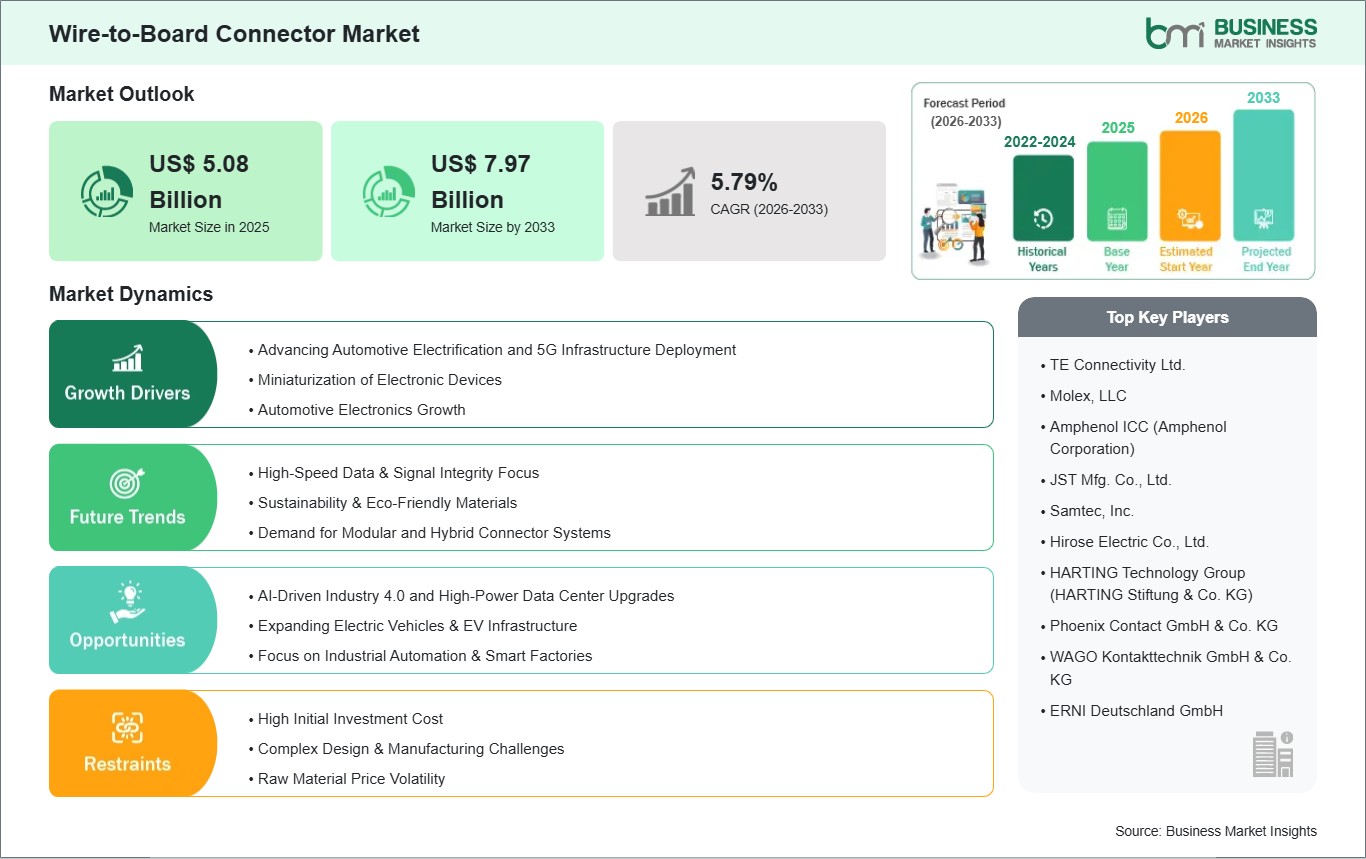
A Wire-to-Board Connector is a precision-engineered solution that connects a wire, often from a wire harness, to a printed circuit board (PCB). These connectors have two main components: a housing or plug attached to the wire and a header or socket mounted on the PCB. Market growth is driven by the rapid expansion of EV battery management systems, the miniaturization of AI-enabled wearables, and large-scale 5G and data center infrastructure projects. Additionally, the adoption of high-current connectors (above 6A), which are experiencing significant CAGR, is greatly enhancing power delivery efficiency in high-performance computing environments.
However, several challenges can restrain market growth: PCB real-estate shrinkage is reaching its physical limits, making it difficult to find landing pads for even the smallest connectors (sub-0.4 mm). Volatile raw material pricing for high-grade copper and engineering plastics continues to lead to unpredictable project budgeting and margin compression for Tier-2 suppliers. Additionally, the industry faces constraints due to solder-joint reliability concerns in under-hood automotive environments, where extreme thermal cycling above 125°C can cause connection failures, requiring expensive specialized materials.
Despite these hurdles, the market holds immense opportunities in the universal mandate for green energy transition and the accelerating deployment of Low-Earth-Orbit (LEO) satellites. The expansion of robotic automation in "brownfield" factories and the development of smart, diagnostic connectors that can report their own connection status are expected to create significant opportunities for market growth.
Segment Analysis
Wire-to-Board Connector Market Segmentation
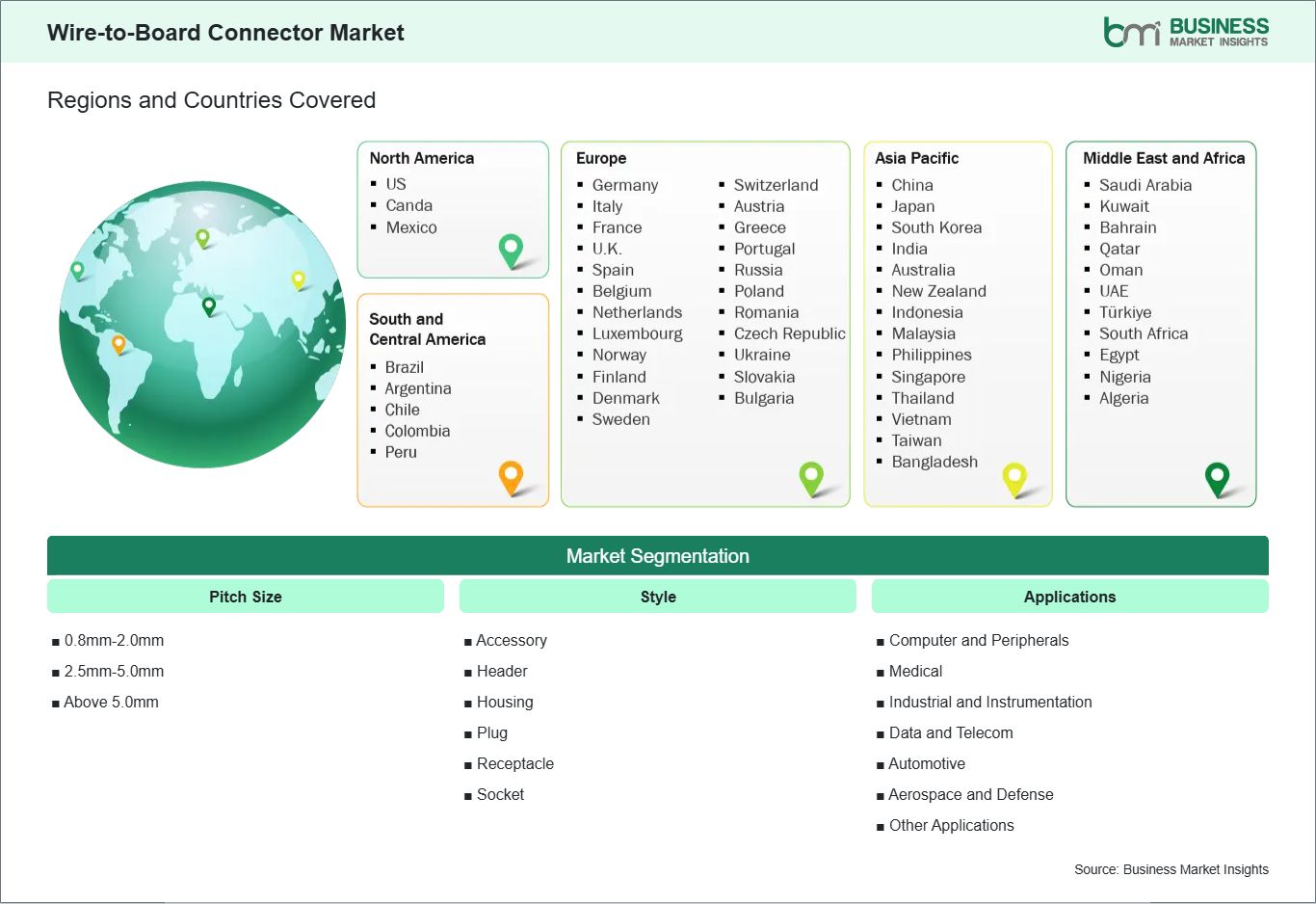
Key segments that contributed to the derivation of the Wire-to-Board Connector market analysis are pitch size, style, and applications.
- By Pitch Size, the market is segmented into 0.8mm-2.0mm, 2.5mm-5.0mm, and Above 5.0mm.
- By Style, the market is divided into Accessory, Header, Housing, Plug, Receptacle, and Socket.
- By Applications, the market is categorized into Computer and Peripherals, Medical, Industrial and Instrumentation, Data and Telecom, Automotive, Aerospace and Defense, and Others Application.
Market Forces
Wire-to-Board Connector Market Drivers and Opportunities
Advancing Automotive Electrification and 5G Infrastructure Deployment
The primary driver for the Wire-to-Board Connector Market is the accelerating transition toward electric vehicles (EVs) and the global expansion of 5G telecommunications infrastructure. In the automotive sector, the move from internal combustion engines to battery-electric platforms has made wire-to-board connectors non-discretionary for battery management systems (BMS), traction inverters, and high-resolution infotainment units. Each EV utilizes significantly more connectors than traditional vehicles to manage complex power and data flows, ensuring safe and efficient operation. Simultaneously, the deployment of 5G networks is fueling demand for high-reliability connectors in base stations and edge computing hardware, where they are used for high-speed signal processing and power distribution. This momentum is further amplified by the relentless miniaturization of consumer electronics, such as smartphones, wearables, and AR/VR headsets, which requires ultra-compact, fine-pitch connectors (sub-2 mm) to pack more functionality into shrinking device footprints. Together, these cross-industry shifts toward electrification and high-speed connectivity ensure a sustained and high-velocity growth path for the market.
AI-Driven Industry 4.0 and High-Power Data Center Upgrades
A significant high-value opportunity lies in the convergence of Wire-to-Board Connectors with AI-driven industrial automation and Industry 4.0. As manufacturing plants integrate sophisticated robotics and smart sensors, there is a burgeoning market for ruggedized, vibration-resistant connectors that can maintain stable performance in harsh factory environments. There is also a major growth frontier in the expansion of Hyperscale Data Centers to support AI workloads. These facilities require specialized high-current and high-speed connectors, such as those supporting 112 Gbps PAM4 signaling, to manage the massive power density and data throughput of modern GPU clusters. Furthermore, the rise of Medical Electronics and Single-Use Disposables presents a lucrative opportunity; the demand for low-cost, high-reliability micro-connectors for endoscopes and wearable health monitors is scaling rapidly as healthcare providers target cross-contamination risks. Manufacturers who focus on modular, tool-free installation designs and those pioneering "green" materials to comply with tightening RoHS and REACH regulations are positioned to lead the most innovative and high-margin segments.
Size and Share Analysis
Wire-to-Board Connector Market Size and Share Analysis
p>Based on pitch size, the 0.8mm-2.0mm subsegment holds a significant market presence, serving as the industry benchmark for miniaturized, high-density electronics. 0.8mm-2.0mm pitch connectors are indispensable for the Computer and Peripherals sector, where they provide the compact footprint required for thin-profile laptops and ultra-portable tablets. A notable trend is the surge in the Above 5.0mm subsegment, which is registering a higher CAGR as heavy industries and the Automotive sector scale up high-voltage electric vehicle (EV) production. These larger pitch connectors are becoming essential for battery management systems (BMS) and power inverters, allowing for the increased creepage and clearance distances required to safely handle the 800V architectures.
Report Coverage
Wire-to-Board Connector Market Report Coverage and Deliverables
The "Wire-to-Board Connector Market Size and Forecast (2022 - 2033)" report provides a detailed analysis of the market covering below areas:
- Wire-to-Board Connector market size and forecast at global, regional, and country levels for all the key market segments covered under the scope
- Wire-to-Board Connector market trends, as well as market dynamics such as drivers, restraints, and key opportunities
- Wire-to-Board Connector market analysis covering key market trends, global and regional framework, major players, regulations, and recent market developments
- Industry landscape and competition analysis covering market concentration, heat map analysis, prominent players, and recent developments for the Wire-to-Board Connector market
- Detailed company profiles, including SWOT analysis
Geographic Insights
Wire-to-Board Connector Market Geographic Insights
The geographical scope of the Wire-to-Board Connector market report is divided into five regions: North America, Asia Pacific, Europe, Middle East and Africa, and South and Central America.
The Asia-Pacific Wire-to-Board Connector Market is segmented into China, Japan, South Korea, India, Australia, and the Rest of Asia. This region is the primary engine for technological advancement, particularly in the development of ultra-miniature connectors (sub-2 mm pitch). China and India are experiencing a surge in demand due to massive investments in 5G infrastructure and the localization of EV battery management system (BMS) production. Meanwhile, Southeast Asian nations like Vietnam and Indonesia are emerging as critical secondary manufacturing hubs as global OEMs diversify their supply chains.
Growth is further bolstered by a significant shift toward high-power and high-density designs among industrial users looking to optimize board space while handling higher current loads. The integration of IoT-enabled connectivity and the rising demand for vibration-resistant connectors in the automotive and aerospace sectors, alongside the push for automated manufacturing processes, solidifies Asia-Pacific as a critical hub for innovation and the future scaling of the Wire-to-Board Connector industry.
Industry Activity
Recent Developments
The Wire-to-Board Connector market is evaluated by gathering qualitative and quantitative data post primary and secondary research, which includes important corporate publications, association data, and databases. A few of the key developments in the Wire-to-Board Connector market are:
- In December 2025, Molex launched its MX-DaSH Modular Wire-to-Wire and Wire-to-Board Connectors, featuring a cartridge-based, hybrid design that consolidates power, signal, and high-speed data connections in a single interface. The solution reduces wiring complexity, lowers costs, and supports the transition to automotive zonal architectures, driving global adoption among OEMs.
- In May 2025, Molex partnered with Prusa Research to support rapid growth in 3D printing using Molex CLIK-Mate wire-to-board connectors. These high-performance, compact connectors streamline production, ensure secure connections, and enable flexible upgrades across more than 20 Prusa printer designs, reinforcing Molex`s role in expanding wire-to-board applications in consumer and industrial devices.
Trust & Transparency
Research Methodology
The market analysis combines proprietary research with secondary data from government agencies, company disclosures, regulatory filings, industry databases and expert interviews. Market estimates are validated through data triangulation, cross-market benchmarking and analyst
review.
View Full Research Methodology
Key Sources Referred:
World Bank - Global Trade IndicatorsWorld Trade Organization (WTO)International Monetary Fund (IMF)International Trade Administration (ITA)Company websiteCompany annual reportsCompany investor presentations