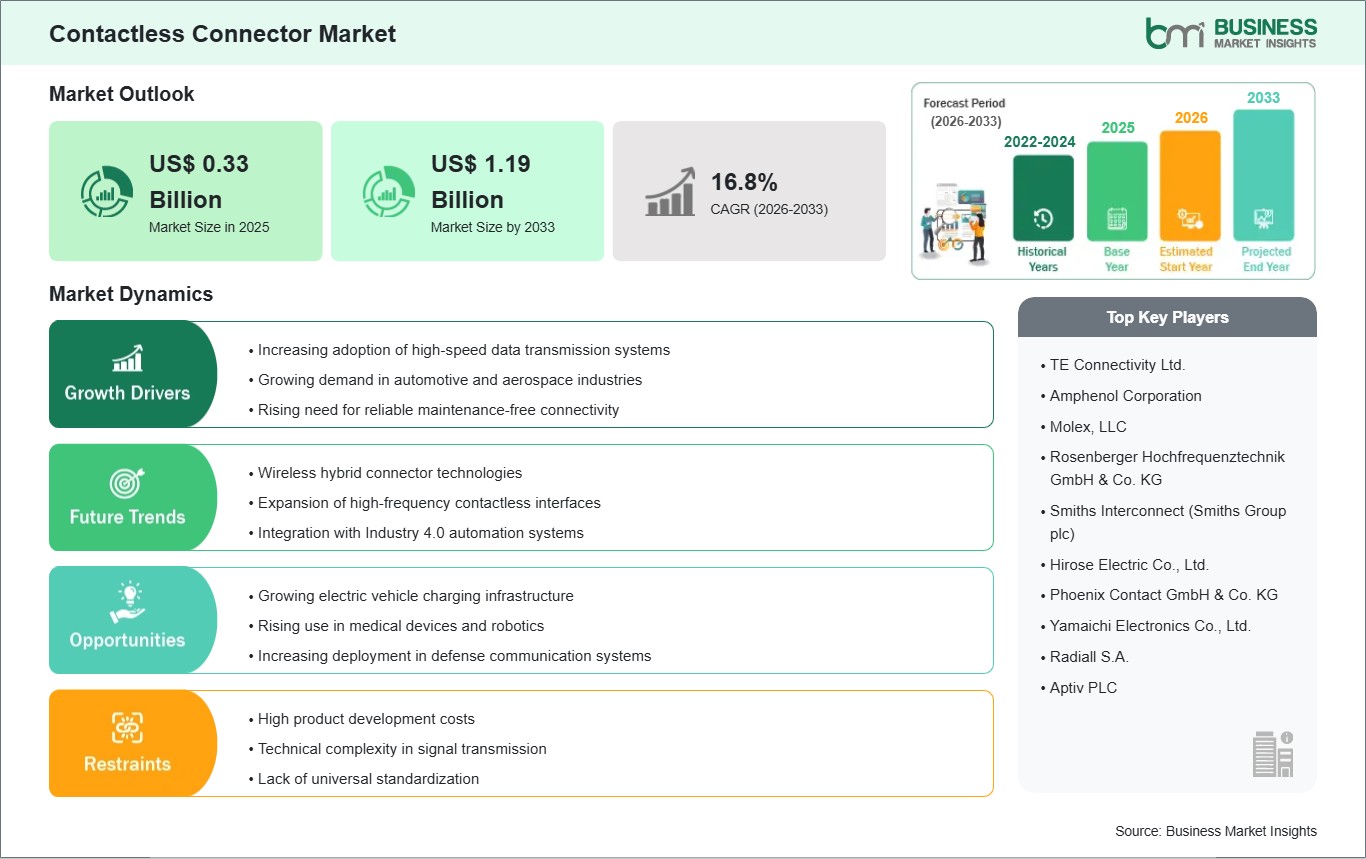
The Contactless Connector market size is expected to reach US$ 1.19 billion by 2033 from US$ 0.33 billion in 2025. The market is estimated to record a CAGR of 16.8% from 2026 to 2033.
Contactless connectors refer to the integrated application of electromagnetic and optical technologies engineered to facilitate the transfer of data and power without the requirement for physical metallic contact. By utilizing various coupling methods, including inductive, capacitive, magnetic, and 60GHz millimeter-wave (mmWave) radio frequency, these systems eliminate the mechanical wear, pin damage, and debris accumulation associated with traditional interconnects. This technology is fundamental to the operational architecture of industrial robotics with rotating joints, hermetically sealed medical devices, and high-reliability automotive sensors. Market expansion is being propelled by the rapid global transition toward Industry 4.0 automation, the rising institutional requirement for ingress-protected (IP68+) connectivity in harsh environments, and the increasing integration of connector-less designs in slim consumer electronics and wearables.
However, several factors may restrain market progression. The high capital intensity associated with the initial implementation of contactless systems, which involve sophisticated transceivers, antennas, and specialized power-management ICs, remains a primary hurdle compared to cost-effective passive wired solutions. The industry also faces persistent technical challenges regarding alignment sensitivity and power transfer efficiency, as any significant displacement between the primary and secondary units can lead to signal degradation or thermal losses. Additionally, the lack of unified global standardization protocols has intensified concerns regarding cross-vendor compatibility, potentially slowing adoption in multi-tier supply chains. These hurdles, compounded by the strategic risks of electromagnetic interference (EMI) in dense industrial environments and the complexity of managing heat dissipation in miniaturized housings, increase the total cost of ownership and may lengthen the qualification cycles for mission-critical aerospace and defense applications.
Despite these hurdles, the market outlook remains highly favorable as the sector transitions toward high-bandwidth and autonomous architectures. Opportunities are emerging through the adoption of 60GHz mmWave technology; the market is witnessing a surge in protocol-agnostic transceivers capable of multi-gigabit data rates for real-time 8K video and industrial Ethernet without physical ports. The automotive segment is gaining significant traction, with a rising requirement for AEC-Q100 compliant contactless links to support high-speed data transfer in rotating LiDAR sensors and steer-by-wire systems. Furthermore, the growth of Solid-State Wireless Connections, which integrate the antenna directly into the semiconductor package, aligns with global goals for extreme miniaturization and enhanced reliability in portable medical diagnostics and smart factory modules. Collectively, these innovations position the contactless connector industry for sustained long-term development as a cornerstone of the modern, ruggedized, and hyper-mobile global electronic landscape.

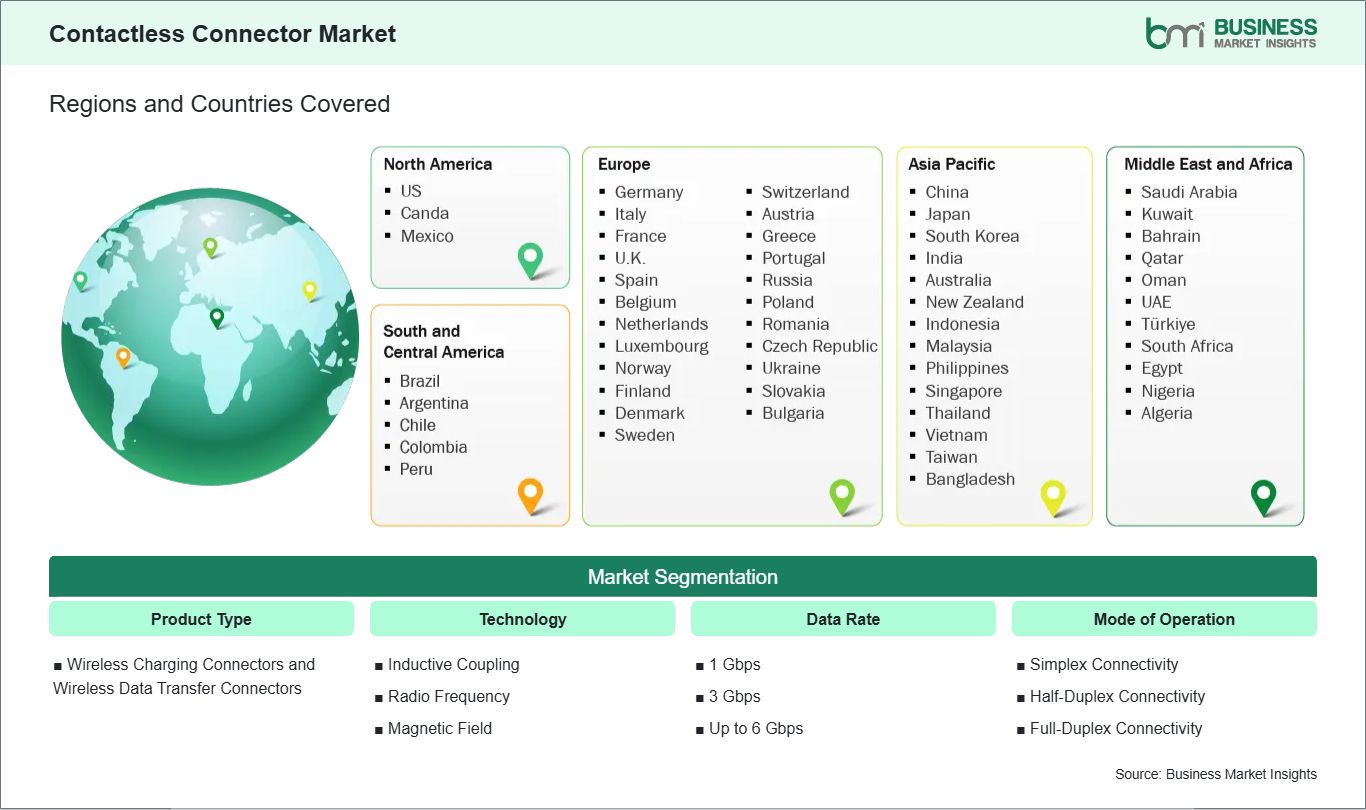
Key segments that contributed to the derivation of the Contactless Connector market analysis are product type, technology, data rate, and mode of operation.
The contactless connector market is being driven by the growing need for reliable, miniaturized, and high‑speed connectivity across consumer electronics, automotive, industrial automation, and healthcare sectors. Contactless connectors enable data and power transfer without physical contact, reducing wear and tear while improving durability and performance. The rapid expansion of smartphones, wearables, and IoT devices is amplifying adoption, as manufacturers seek compact solutions that support seamless communication and charging. Automotive applications, including electric vehicles, ADAS, and infotainment systems, are reinforcing demand for robust connectors that withstand vibration, dust, and moisture. Industrial automation and robotics are also fueling growth, with contactless connectors supporting precise control systems and real‑time communication in harsh environments. Healthcare facilities are leveraging these connectors for sterile, contamination‑free medical equipment connections. Additionally, stricter regulatory standards for safety and reliability are propelling investment in advanced connector designs. Collectively, miniaturization trends, reliability requirements, and connectivity priorities are fueling sustained growth in the global contactless connector market.
Opportunities in the contactless connector market are expanding through the integration of IoT ecosystems, electric vehicle infrastructure, and emerging cross‑industry applications. IoT‑enabled devices are opening lucrative opportunities by requiring compact, energy‑efficient connectors for seamless communication between sensors, modules, and controllers. The rollout of EVs is fueling demand for high‑power contactless connectors that support charging systems, battery management, and onboard electronics. The growing emphasis on smart cities and digital transformation is driving innovation, as contactless connectors enable reliable performance in surveillance systems, smart grids, and intelligent transportation. Healthcare is another key growth area, where connectors support medical imaging, diagnostic equipment, and wearable health devices by ensuring contamination‑free connectivity. Aerospace and defense sectors are reinforcing opportunities, as ruggedized connectors deliver performance in mission‑critical applications. Additionally, sustainability trends are encouraging deployment of eco‑friendly, energy‑efficient connector designs that align with global environmental goals. The expansion of industrial robotics, renewable energy systems, and next‑generation consumer electronics is creating new pathways for adoption. Vendors who focus on IoT‑ready, EV‑optimized, and industry‑specific contactless connector solutions are well‑positioned to capture growth. The convergence of IoT, EV infrastructure, and smart electronics underscores a transformative trajectory for the global contactless connector market.

The Contactless Connector market demonstrates steady growth, with size and share analysis revealing evolving trends and competitive positioning among key players. The report examines subsegments categorized within type, destination, and end user, offering insights into their contribution to overall market performance.
Based on Product Type, the Wireless Charging Connectors subsegment holds a strong presence, as they are indispensable in consumer electronics, automotive, and industrial applications. These connectors enable safe and efficient power transfer without physical contact, supporting durability and convenience. The Wireless Data Transfer Connectors subsegment is essential for high‑speed communication in smartphones, laptops, and IoT devices, offering secure and reliable connectivity. Data transfer connectors anchor demand in industries requiring seamless communication, such as healthcare and aerospace. Together, both product types highlight the versatility of contactless connectors in enabling power and data transmission across diverse applications.
| Report Attribute | Details |
|---|---|
| Market size in 2025 | US$ 0.33 Billion |
| Market Size by 2033 | US$ 1.19 Billion |
| Global CAGR (2026 - 2033) | 16.8% |
| Historical Data | 2022-2024 |
| Forecast period | 2026-2033 |
| Segments Covered | By Product Type
|
|
Regions and Countries Covered
| |
| North America | US, Canada, Mexico |
| Europe | Belgium, Austria, Finland, Denmark, Greece, Poland, Romania, Russia, Ukraine, Czech Republic, Slovakia, Bulgaria, Italy, Luxembourg, Germany, Switzerland, France, Netherlands, Norway, Portugal, Spain, Sweden, United Kingdom |
| Asia-Pacific | Australia, China, India, Japan, South Korea, Indonesia, Malaysia, Philippines, Singapore, Thailand, Vietnam, Bangladesh, New Zealand, Taiwan |
| South and Central America | Brazil, Argentina, Peru, Chile, Colombia |
| Middle East and Africa | Bahrain, Kuwait, Oman, Qatar, Saudi Arabia, United Arab Emirates, Turkiye, South Africa, Egypt, Algeria, Nigeria |
| Market leaders and key company profiles |
|
The Contactless Connector Market Size and Forecast (2022& 2033)& report provides a detailed analysis of the market covering below areas:
The geographical scope of the Contactless Connector market report is divided into five regions: North America, Asia Pacific, Europe, Middle East & Africa, and South & Central America.
North America maintains a preeminent position within the global industry, a status reinforced by the region's advanced technological infrastructure and robust research and development investments. The regional landscape is characterized by high-density adoption in the United States and Canada. This market leadership is supported by an ecosystem of prominent technology pioneers, including Molex, TE Connectivity, and Amphenol Corporation, who are driving the transition from traditional mechanical interfaces to high-reliability wireless coupling systems.
Industrial and enterprise trends in the region reflect a decisive shift toward Hygienic and Wear-Resistant Connectivity in Medical and Industrial Automation. As organizations prioritize system uptime, there is an escalating demand for connectors that eliminate physical contact points, thereby mitigating mechanical wear, contamination, and the risk of failure in harsh environments. Furthermore, the region is witnessing a rapid expansion in Contactless Power and High-Speed Data Transfer for the automotive sector. This focus on Sealed Reliability is particularly evident in the development of electric vehicle (EV) charging interfaces and autonomous driving sensors, where connectors must maintain signal integrity despite exposure to moisture, dust, and continuous vibration.

The Contactless Connector market is evaluated by gathering qualitative and quantitative data post primary and secondary research, which includes important corporate publications, association data, and databases. A few of the key developments in the Contactless Connector market are:
The Contactless Connector Market is valued at US$ 0.33 Billion in 2025, it is projected to reach US$ 1.19 Billion by 2033.
As per our report Contactless Connector Market, the market size is valued at US$ 0.33 Billion in 2025, projecting it to reach US$ 1.19 Billion by 2033. This translates to a CAGR of approximately 16.8% during the forecast period.
The Contactless Connector Market report typically cover these key segments-
The historic period, base year, and forecast period can vary slightly depending on the specific market research report. However, for the Contactless Connector Market report:
The Contactless Connector Market is populated by several key players, each contributing to its growth and innovation. Some of the major players include:
The Contactless Connector Market report is valuable for diverse stakeholders, including:
Essentially, anyone involved in or considering involvement in the Contactless Connector Market value chain can benefit from the information contained in a comprehensive market report.
Please tell us your area of interest
(Market Segments/ Regions and Countries/ Companies)