Market Summary
Executive Summary and Global Market Analysis
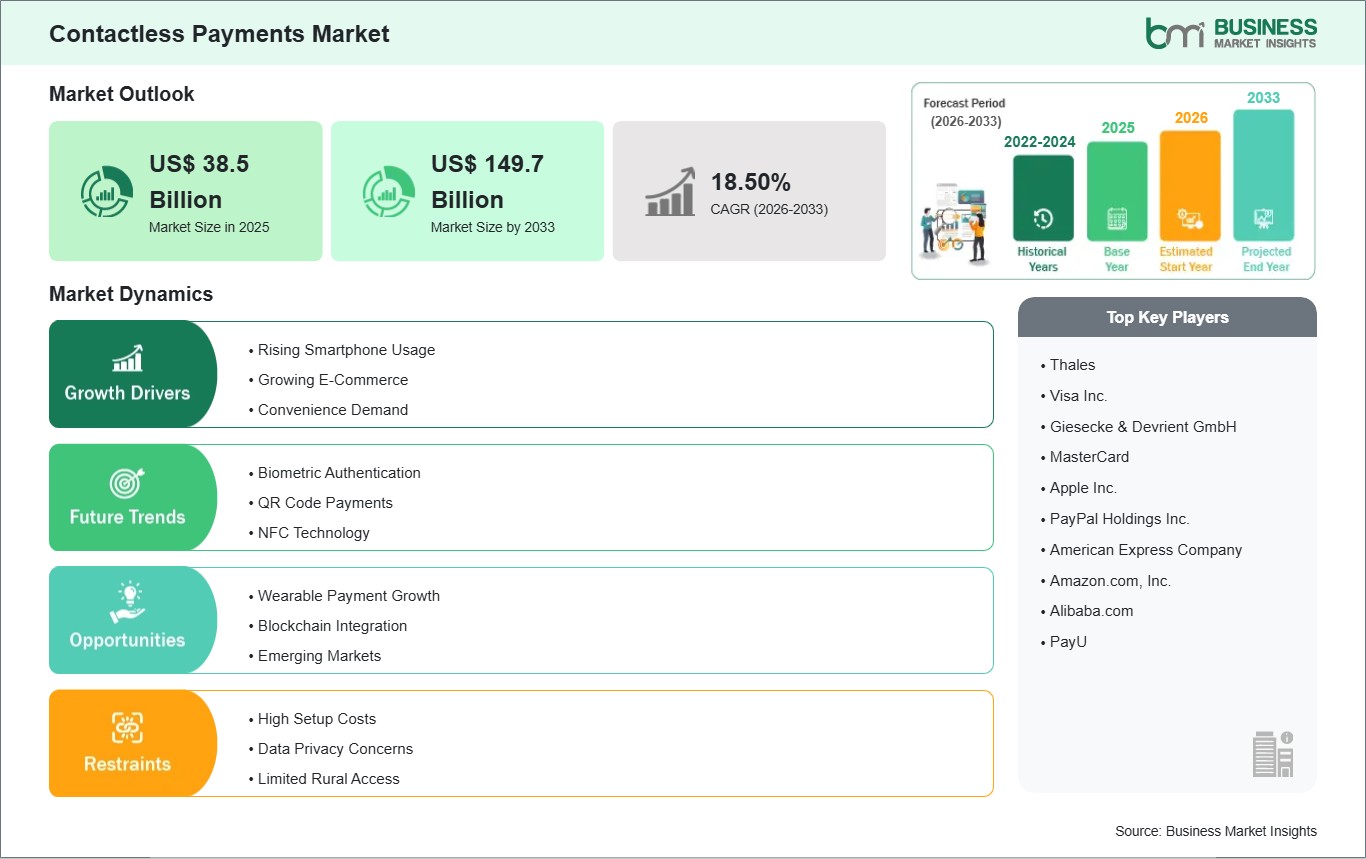
Contactless Payment systems utilize technologies like Near Field Communication (NFC) and Radio Frequency Identification (RFID) to enable secure, tap-and-go transactions without physical contact between the card/device and the Point-of-Sale (POS) terminal. This includes payments made via contactless-enabled cards, smartphones (mobile wallets like Apple Pay, Google Pay), and wearable devices.
The Contactless Payments market is experiencing rapid acceleration, primarily driven by the massive surge in consumer preference for faster, more hygienic, and convenient transaction methods. This growth is significantly bolstered by the widespread global penetration of NFC-enabled smartphones and the strategic shift by governments and financial institutions to promote digital and cashless economies. Enhanced security features, such as tokenization and biometric authentication, are further increasing consumer trust and expanding the market's reach across various high-volume sectors like retail, transportation, and hospitality.
Segment Analysis
Contactless Payments Market Segmentation
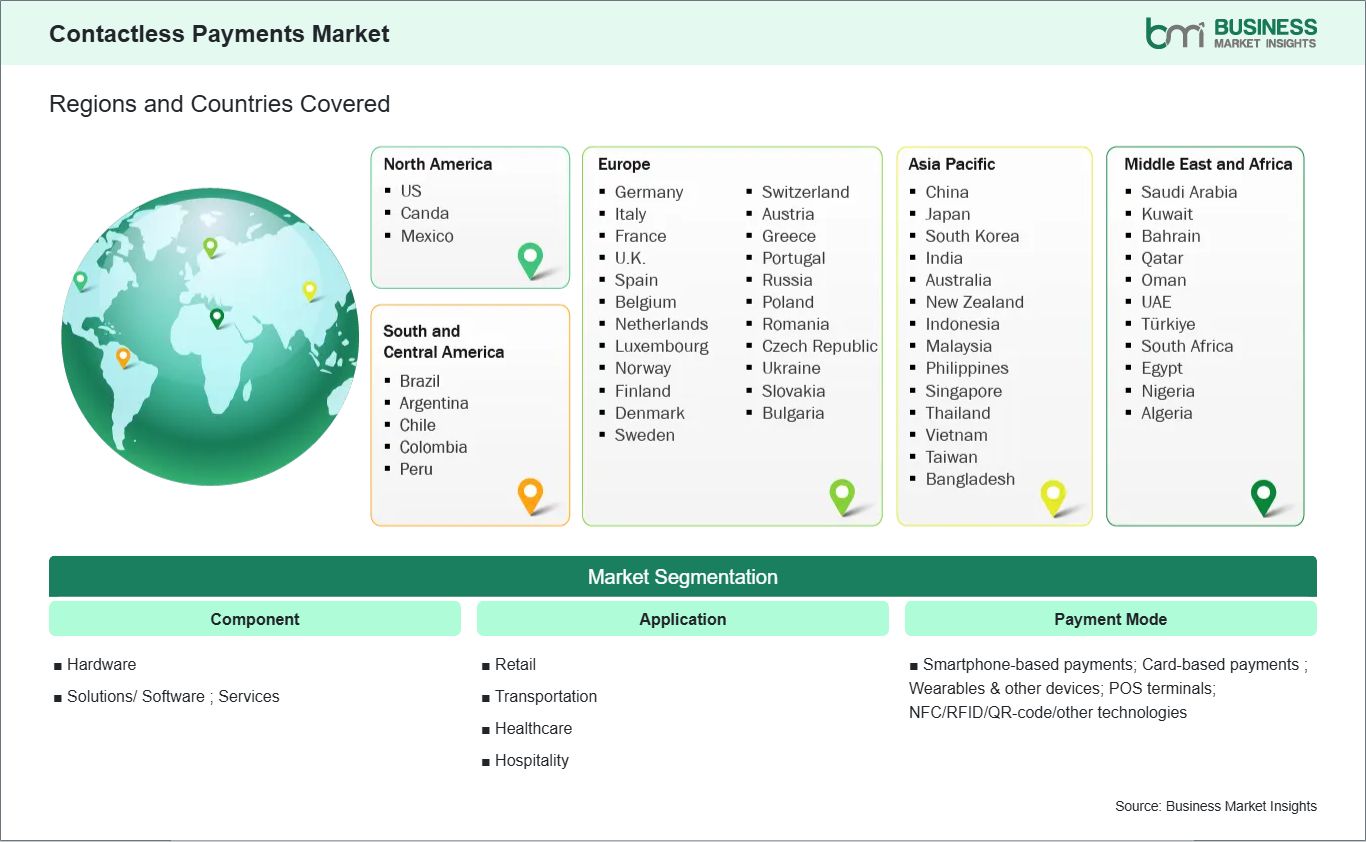
Key segments that contributed to the derivation of the Contactless Payments Market analysis are component, application, and payment mode.
- By Component, the market is segmented into Hardware (cards, POS, readers), Solutions/ Software (Wallets, POS Software, APIs), Services (Integration, Security/Fraud Management, Analytics, and Support.
- By Application, the market is segmented into Retail, Transportation, Healthcare, and Hospitality.
- By Payment Mode, the market is segmented into Smartphone-based payments, Card-Based Payments (Credit/Debit/Others), Wearables & Other Devices, POS Terminals, NFC/RFID/QR-code/Other Technologies.
Market Forces
Contactless Payments Market Drivers and Opportunities
Increasing Consumer Preference for Speed, Convenience, and Hygiene
The market driver is the profound and lasting shift in consumer behavior toward transactional speed, ease of use, and a demand for hygienic practices. Contactless payments significantly reduce transaction times, drastically cutting down queues in high-volume environments like grocery stores and Quick Service Restaurants (QSRs). Furthermore, the touch-free nature of the transaction appeals strongly to hygiene-conscious consumers, who view "tapping to pay" as a safer alternative to handling cash or physically interacting with a POS keypad. This combination of speed, convenience, and perceived safety establishes contactless methods as the preferred, and often expected, mode of payment for daily transactions globally.
Emerging Economies and Low-Value Transactions
These economies, mostly in the Asia-Pacific region, offer a once-in-a-lifetime market growth opportunity. Such geographies have a large, young, and increasingly digitally literate population, with skyrocketing smartphone penetration. This might be coming at the complete expense of traditional banking infrastructure, as mobile-first payment solutions are favored instead. The QR code payments and 'Tap to Phone' solutions have very low implementation costs, and thus are rapidly deployable in a very fragmented retail and small business environment. The global opportunity is in replacing the huge volume of low-value, cash-dominated transactions with contactless digital payments, thus pushing the addressable market well beyond traditional credit/debit card usage.
Size and Share Analysis
Contactless Payments Market Size and Share Analysis
The contactless payments market demonstrates steady growth, with size and share analysis revealing evolving trends and competitive positioning among key players. The report further examines subsegments categorized within component, application, and payment mode, offering insights into their contribution to overall market performance.
For instance, smartphone-based payments are typically used for daily consumer transactions and are expected to grow due to rising mobile penetration. International (cross-border) payments involve the movement of funds across borders and play a vital role in supporting global e-commerce and tourism. Retail and healthcare industries utilize contactless terminals for high-volume transactions and temperature-sensitive medical billing, requiring strict security and timely processing.
Report Coverage
Contactless Payments Market Report Coverage and Deliverables
The "Contactless Payments Market Size and Forecast (2022 - 2033)" report provides a detailed analysis of the market covering below areas:
- Contactless Payments Market size and forecast at global, regional, and country levels for all the key market segments covered under the scope
- Contactless Payments Market trends, as well as market dynamics such as drivers, restraints, and key opportunities
- Contactless Payments Market analysis covering key market trends, global and regional framework, major players, regulations, and recent market developments
- Industry landscape and competition analysis covering market concentration, heat map analysis, prominent players, and recent developments for the Contactless Payments Market
- Detailed company profiles, including SWOT analysis
Geographic Insights
Contactless Payments Market Geographic Insights
The geographical scope of the Contactless Payments Market report is divided into five regions: North America, Asia Pacific, Europe, Middle East & Africa, and South & Central America.
Europe often leads in adoption and market share due to mature NFC infrastructure and strong regulatory pushes for digital transactions, such as the UK's high contactless limit. North America holds a substantial market share, primarily driven by the United States, where widespread merchant adoption of NFC-enabled POS terminals and the dominance of mobile wallets (Apple Pay, Google Pay) have accelerated growth, particularly post-pandemic.
However, Asia Pacific is projected to be the fastest-growing region during the forecast period. This rapid expansion is fueled by massive growth in smartphone penetration, the proliferation of cost-effective QR code payment systems, and strong government initiatives promoting financial inclusion and a cashless society across countries like China, India, and Singapore. The market's overall growth is robustly distributed across all regions, reflecting a global transition away from cash.
Industry Activity
Recent Developments
The Contactless Payments Market is evaluated by gathering qualitative and quantitative data post primary and secondary research, which includes important corporate publications, association data, and databases. A few of the key developments in the Contactless Payments Market are:
- In December 2025, Apple announced that Tap to Pay on iPhone is available in Singapore, enabling thousands of merchants to use iPhone to seamlessly and securely accept quick, in-person contactless payments. In collaboration with payment platforms, app developers, and payment networks, Tap to Pay on iPhone makes it easy for businesses of any size, ranging from local street food stalls to large retailers and restaurant chains, to accept quickpayments from contactless credit and debit cards, Apple Pay, and other digital wallets using only their iPhone and a partner-enabled iOS app with no additional hardware or payment terminal required.
- In July 2025, Curve and Thales announced they were deepening their long-standing technological collaboration to deliver secure modern payment solutions for financial institutions. This partnership comes on the back of Curve launching Curve Pay on iOS, marking a watershed moment in mobile payments. This partnership is a significant step to reshaping everyday spending, allowing Curve customers to benefit from NFC payment directly in the Curve App for contactless payments in store for all end-users on iOS and Android.
- In May 2025, G+D introduced a solution for fraud prevention with its new Convego® SecureCode payment card. This innovative card equips banks and financial institutions with a powerful tool to combat fraudulent transactions while enhancing security and user experience.
Trust & Transparency
Research Methodology
The market analysis combines proprietary research with secondary data from government agencies, company disclosures, regulatory filings, industry databases and expert interviews. Market estimates are validated through data triangulation, cross-market benchmarking and analyst
review.
View Full Research Methodology
Key Sources Referred:
World Bank - Global Trade IndicatorsWorld Trade Organization (WTO)International Monetary Fund (IMF)International Trade Administration (ITA)Company WebsitesCompany Annual ReportsCompany Investor Presentations