Market Summary
Executive Summary and Global Market Analysis
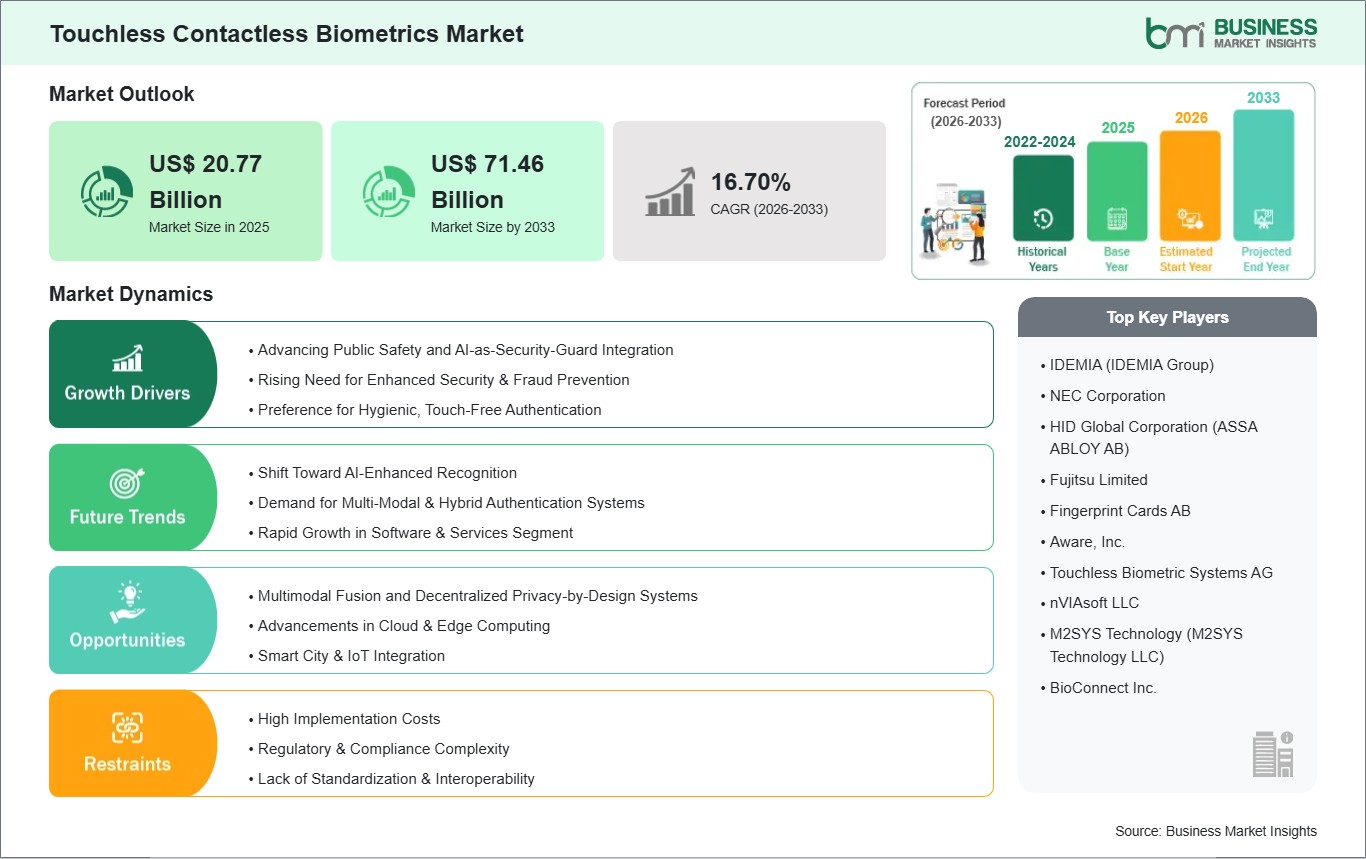
Touchless and contactless biometrics are identity verification technologies that authenticate individuals without any physical interaction with sensor hardware. These systems provide strategic value by offering a hygienic, frictionless, and secure method of authentication for border control, healthcare patient ID, and financial transactions. Market expansion is driven by the global surge in government digital-ID mandates, rapid growth of biometric-enabled payment wallets, and increased use of AI-driven behavioral analytics for passive authentication. The shift to cloud-based Biometrics-as-a-Service (BaaS) is also improving scalability for enterprises, allowing deployment of advanced identity solutions without heavy localized server infrastructure.
However, several challenges can restrain market growth. Stringent data privacy regulations, such as the EU's GDPR and various US state-level biometric laws like BIPA, impose heavy compliance burdens on data storage and user consent. Algorithm bias and accuracy concerns, especially higher false rejection rates for diverse skin tones, remain a barrier to universal public trust and adoption. The industry also faces high initial implementation costs for specialized 3D and infrared sensors, which can limit large-scale rollouts in price-sensitive emerging markets.
Despite these hurdles, the market holds strong opportunities in the push for smart airport e-gates and the growing deployment of biometric-integrated smart cars for personalized driver settings. The expansion of contactless palm-vein scanners in clinical settings to prevent medical identity theft and the development of encrypted, decentralized biometric wallets on blockchain are also expected to create significant opportunities for long-term market growth.
Segment Analysis
Touchless Contactless Biometrics Market Segmentation
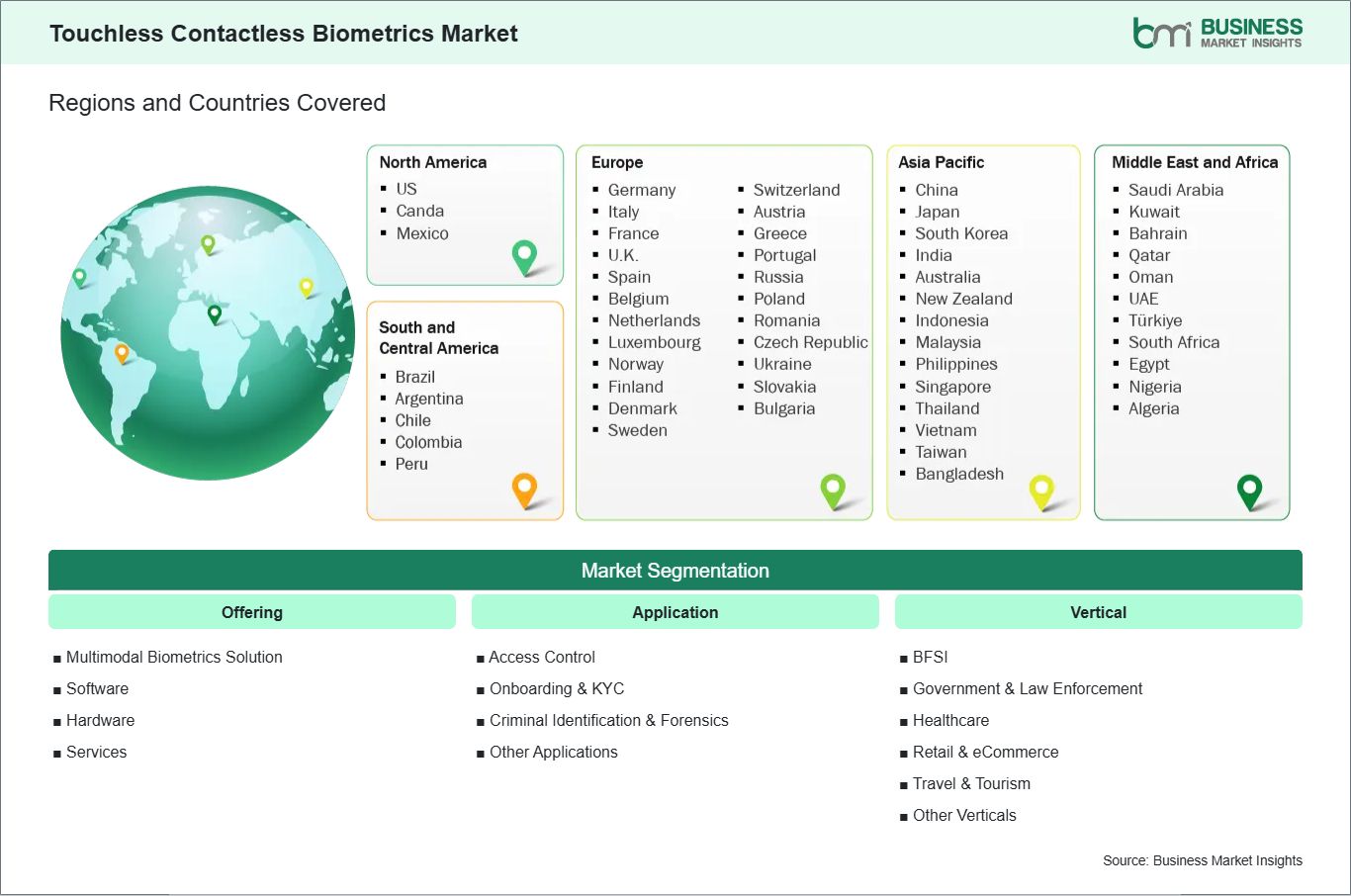
Key segments that contributed to the derivation of the Touchless Contactless Biometrics market analysis are offering, application, and vertical.
- By Offering, the market is segmented into Multimodal Biometrics Solution, Software, Hardware, and Services.
- By Application, the market is divided into Access Control, Onboarding & KYC, Criminal Identification & Forensics, and Other Applications.
- By Vertical, the market is categorized into BFSI, Government & Law Enforcement, Healthcare, Retail & eCommerce, Travel & Tourism, and Other Verticals.
Market Forces
Touchless Contactless Biometrics Market Drivers and Opportunities
Advancing Public Safety and AI-as-Security-Guard Integration
The primary driver for the Touchless Contactless Biometrics Market is the global requirement for high-throughput, secure authentication that eliminates the operational bottlenecks of traditional PINs, cards, or touch-based sensors. The scaling of Agentic AI acts as a major catalyst; these systems now utilize deep learning to continuously adapt to changes in user appearance, such as aging, surgical masks, or varying lighting, ensuring near-perfect accuracy in real-time. This momentum is further fueled by Government Digital-ID Mandates, particularly in Europe and Asia-Pacific, where national initiatives are obliging member states to issue biometric wallets and utilize touchless enrollment for border control and citizen services. In the travel sector, the Global Rollout of Airport E-Gates serves as a critical driver, with major hubs implementing biometric corridors that allow passengers to clear security and boarding without ever presenting a physical document.
Furthermore, the Push for Infection Control in Healthcare has made contactless systems a non-discretionary requirement for patient identification, effectively eradicating shared-surface contact in clinical environments. Together, these factors, regulatory tailwinds, AI-driven precision, and the demand for frictionless travel, ensure that touchless biometrics remain a foundational pillar of the modern security landscape.
Multimodal Fusion and Decentralized Privacy-by-Design Systems
A significant opportunity lies in the convergence of Contactless Biometrics with Multimodal Fusion and Edge AI. By combining facial analytics with iris or palm vein data at the hardware level, next-generation terminals can provide layered security that is nearly impossible to spoof with deepfakes or silicone masks. There is also major growth in developing Decentralized and Blockchain-Based Biometric Identity Systems; these solutions let users keep ownership of their encrypted biometric templates on their own devices, addressing privacy concerns and aligning with Self-Sovereign Identity (SSI) frameworks.
The expansion of Biometric Payment Cards and Naked POS Terminals presents a lucrative opportunity for retail and fintech, as consumers increasingly prefer to authorize high-value transactions with only a palm scan or facial check. Beyond traditional security, the rise of In-Cabin Automotive Personalization is a significant frontier, where smart vehicles use touchless biometrics to automatically adjust seats, mirrors, and infotainment for the detected driver. Manufacturers focusing on Interoperable Open-Standard APIs and pioneering Anti-Bias Algorithms that ensure high accuracy across all demographics are positioned to lead the most innovative and high-margin segments of the touchless contactless biometrics market.
Size and Share Analysis
Touchless Contactless Biometrics Market Size and Share Analysis
The Touchless Contactless Biometrics market demonstrates steady growth, with size and share analysis revealing evolving trends and competitive positioning among key players. The report further examines subsegments categorized within offering, application, and vertical, offering insights into their contribution to overall market performance.
Based on offering, the Software and Multimodal Biometrics Solutions subsegment holds a significant market share, serving as the industry benchmark for modern authentication. Software is indispensable for the IT & Telecom vertical, where it orchestrates the complex fusion of data from various sensors to provide a unified identity profile. A notable trend is the surge in the Services subsegment, which is registering higher interest. These services, including consulting and privacy compliance auditing, are becoming essential for Large Enterprises navigating the complex regulatory frameworks of data protection laws, providing a strategic roadmap for deploying large-scale biometric systems that remain compliant with evolving global standards.
Report Coverage
Touchless Contactless Biometrics Market Report Coverage and Deliverables
The "Touchless Contactless Biometrics Market Size and Forecast (2022–2033)" report provides a detailed analysis of the market covering below areas:
- Touchless Contactless Biometrics market size and forecast at global, regional, and country levels for all the key market segments covered under the scope
- Touchless Contactless Biometrics market trends, as well as market dynamics such as drivers, restraints, and key opportunities
- Touchless Contactless Biometrics market analysis covering key market trends, global and regional framework, major players, regulations, and recent market developments
- Industry landscape and competition analysis covering market concentration, heat map analysis, prominent players, and recent developments for the Touchless Contactless Biometrics market
- Detailed company profiles, including SWOT analysis
Geographic Insights
Touchless Contactless Biometrics Market Geographic Insights
The geographical scope of the Touchless Contactless Biometrics market report is divided into five regions: North America, Asia Pacific, Europe, Middle East & Africa, and South & Central America.
North America holds the largest revenue share, driven by the early implementation of advanced security systems in government and defense sectors, as well as increased biometric payment deployments. The Asia Pacific region represents the fastest-growing market, fueled by large-scale digital identification mandates in India and China, the integration of biometrics into multifunctional applications, and a strong manufacturing base for consumer electronics. Europe ranks next, emphasizing privacy-focused biometric solutions, with financial institutions proactively adopting these technologies to prevent fraud and comply with stringent data protection regulations.
The Asia-Pacific touchless and contactless biometrics market is segmented into China, Japan, South Korea, India, Australia, and the rest of the region. China leads regional expansion through extensive deployment of facial recognition technologies in retail and public surveillance. India`s Aadhaar-based ecosystem is advancing toward touchless modalities, including iris and facial scanning. Japan and South Korea prioritize hygiene-oriented biometrics in healthcare and the development of advanced biometric entry systems for the automotive sector. Australia demonstrates significant adoption in transportation, particularly through the implementation of airport e-gates to enhance border control efficiency.
Industry Activity
Recent Developments
The Touchless Contactless Biometrics market is evaluated by gathering qualitative and quantitative data post primary and secondary research, which includes important corporate publications, association data, and databases. A few of the key developments in the Touchless Contactless Biometrics market are:
- In February 2026, Tencent Cloud partnered with Treeal to launch the PalmAI contactless biometric service in Brazil, offering high-precision palm-vein recognition for secure, frictionless payments and access control. The collaboration enhances adoption of contactless biometric technology, strengthening innovation and market growth in the contactless biometrics sector.
- In September 2025, Mitsubishi Electric developed a new contactless body sensor capable of high-precision monitoring of vital signs such as heart rate and respiration without skin contact. The technology leverages radio waves and AI-based sensing algorithms, offering applications in wellness, workplace productivity, and health monitoring, strengthening innovation in the contactless biometrics market.
Trust & Transparency
Research Methodology
The market analysis combines proprietary research with secondary data from government agencies, company disclosures, regulatory filings, industry databases and expert interviews. Market estimates are validated through data triangulation, cross-market benchmarking and analyst
review.
View Full Research Methodology
Key Sources Referred:
World Bank – Global Trade IndicatorsWorld Trade Organization (WTO)(International Monetary Fund )IMFInternational Trade Administration (ITA)Company websiteCompany annual reportsCompany investor presentations