Market Summary
Executive Summary and Global Market Analysis
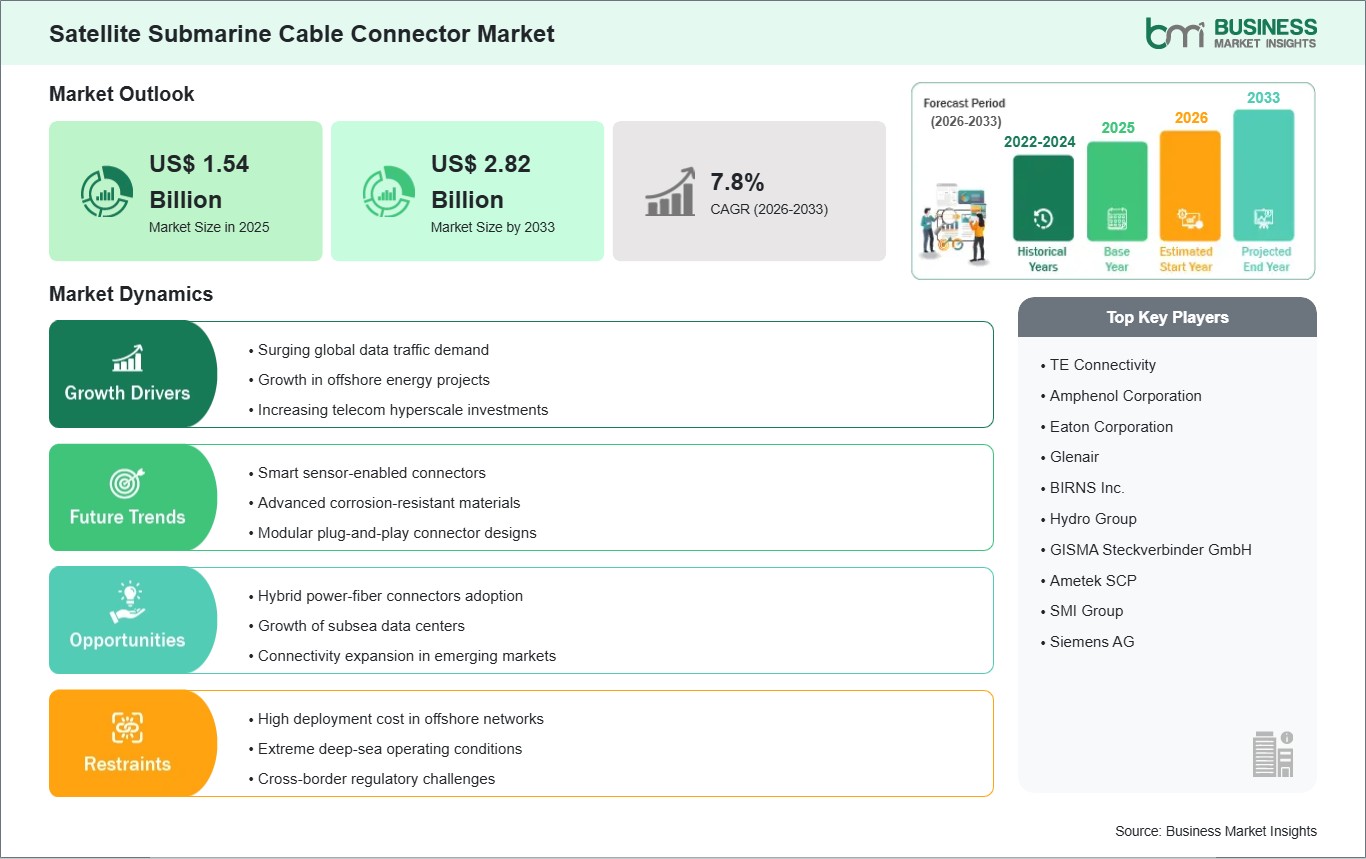
Satellite submarine cable connectors are highly engineered interconnect solutions designed to interface high-capacity fiber optic or power cables with the complex hardware used in both orbital and subsea environments. These components deliver immense strategic value by enabling a unified global communications grid that bridges space-based assets with deep-sea networks, ensuring data redundancy and low-latency transmission for mission-critical defense, scientific research, and hyperscale cloud services. Market expansion is primarily attributed to the global surge in cross-continental data traffic, the rapid acceleration of offshore renewable energy projects requiring subsea power links, and the increasing deployment of private subsea cables by tech giants such as Meta, Google, and Amazon. Furthermore, the shift toward high-voltage direct current (HVDC) systems and ultra-high-speed fiber optics is substantially driving the demand for specialized connectors that can handle increased power loads and bandwidth without signal degradation.
However, several challenges can restrain market growth: high installation and specialized vessel costs create significant barriers for new infrastructure projects, particularly in remote maritime corridors. Strict regulatory and environmental compliance for seabed installations can lead to prolonged permitting cycles and increased project complexity. Additionally, the industry faces constraints due to the extreme technical difficulty of repairing deep-sea connectors at great depths, necessitating expensive ROV operations and specialized technical teams.
Despite these hurdles, the market holds immense opportunities in the universal push for global 5G/6G densification and the accelerating deployment of subsea data centers. The expansion of oceanographic monitoring networks for climate research and the development of miniaturized, lightweight connectors for next-generation satellite ground stations are expected to create significant opportunities for long-term market growth.
Segment Analysis
Satellite Submarine Cable Connector Market Segmentation
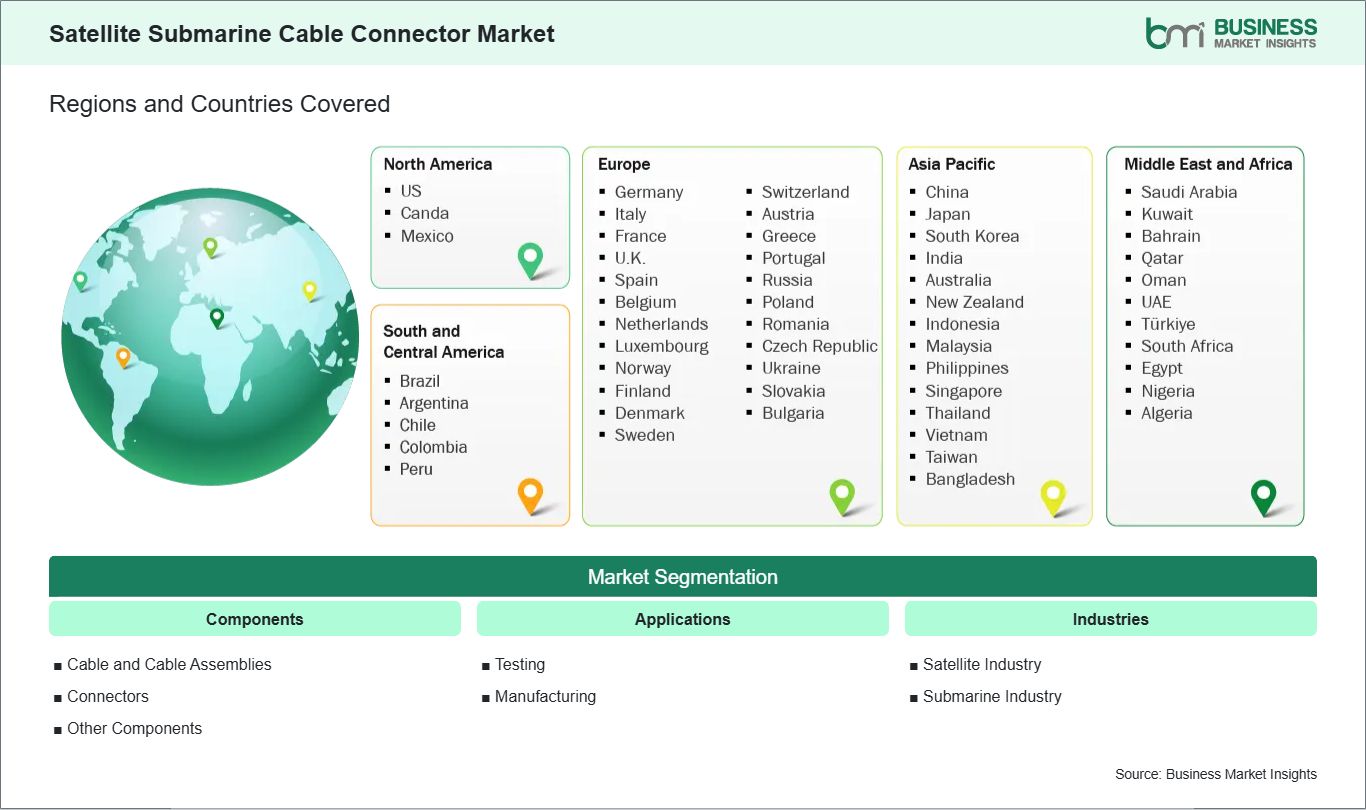
Key segments that contributed to the derivation of the Satellite Submarine Cable Connector market analysis are components, applications, and industries.
- By Components, the market is segmented into Cable and Cable Assemblies, Connectors, and Others.
- By Applications, the market is divided into Testing and Manufacturing.
- By Industries, the market is categorized into satellite industry and submarine industry.
Market Forces
Satellite Submarine Cable Connector Market Drivers and Opportunities
Advancing Global Data Densification and Offshore Modernization
The primary driver for the Satellite Submarine Cable Connector Market is the systemic requirement for uninterrupted, high-bandwidth data transmission across both terrestrial and maritime borders. The global demand for Hyperscale Cloud Connectivity acts as a dominant force, as companies like Google and Meta invest heavily in subsea infrastructures that require advanced connectors to link oceanic cables with inland satellite ground stations. This momentum is further propelled by the Rapid Expansion of Offshore Renewable Energy; subsea connectors are now non-discretionary for connecting offshore wind farms and floating solar arrays to the global grid, requiring they withstand extreme pressures and corrosive saline environments. In the defense sector, the Modernization of Naval and Underwater Surveillance Systems serves as a significant catalyst, with increased spending on Remotely Operated Vehicles (ROVs) and Autonomous Underwater Vehicles (AUVs) that rely on precision connectors for sensor-to-satellite data relay. Furthermore, the Trend toward Satellite Miniaturization and the rollout of Low Earth Orbit (LEO) constellations have created a need for specialized ground-to-cable interfaces that can process massive data throughput with near-zero latency. Together, these factors, data densification, energy transition, and military modernization, ensure a robust growth path for advanced connector technologies.
Hybrid Fiber-Power Integration and AI-Native Health Monitoring
A significant high-value opportunity lies in the convergence of Submarine Connectors with Hybrid Fiber-Electric Architectures. By integrating data and power into a single, compact connector unit, manufacturers can drastically reduce the spatial footprint and installation complexity of deep-sea hubs. There is also a major growth frontier in the development of Smart Connectors with Embedded AI Diagnostics; these units can monitor their own structural integrity, temperature, and seal quality in real-time, alerting operators to potential failures before they occur in remote, unreachable depths. Furthermore, the expansion of Deep-Sea Mining and Resource Exploration presents a lucrative opportunity for connectors that are rated for ultra-deep-water operations and can handle the mechanical stress of continuous movement. Beyond traditional telecommunications, the rise of Quantum-Secure Subsea Links offers a long-term frontier, as next-generation connectors must be designed to maintain the delicate phase of quantum-encrypted photons over long distances. Manufacturers who focus on Corrosion-Resistant Alloys and those pioneering Inductive (Non-Contact) Underwater Charging for robotic fleets are positioned to lead the most innovative and high-margin segments of the global connectivity landscape.
Size and Share Analysis
Satellite Submarine Cable Connector Market Size and Share Analysis
The Satellite Submarine Cable Connector market demonstrates steady growth, with size and share analysis revealing evolving trends and competitive positioning among key players. The report further examines subsegments categorized within components, applications, and industries, offering insights into their contribution to overall market performance.
Based on components, Cable and Cable Assemblies and Connectors subsegment holds a significant market share, serving as the industry benchmark for signal integrity in harsh environments. Cables and Cable Assemblies are indispensable for the Submarine vertical, where specialized armoring and multi-layer insulation are required to protect optical fibers from corrosive saltwater and deep-sea seismic activity. A notable trend is the surge in the Connectors subsegment, which is registering higher traction in the Satellite sector. These components are becoming essential for CubeSat and SmallSat platforms, providing a modular and plug-and-play path for integrating diverse sensor payloads while maintaining the electromagnetic interference (EMI) shielding necessary for high-frequency RF transmissions.
Report Coverage
Satellite Submarine Cable Connector Market Report Coverage and Deliverables
The "Satellite Submarine Cable Connector Market Size and Forecast (2022 - 2033)" report provides a detailed analysis of the market covering below areas:
- Satellite Submarine Cable Connector market size and forecast at global, regional, and country levels for all the key market segments covered under the scope
- Satellite Submarine Cable Connector market trends, as well as market dynamics such as drivers, restraints, and key opportunities
- Satellite Submarine Cable Connector market analysis covering key market trends, global and regional framework, major players, regulations, and recent market developments
- Industry landscape and competition analysis covering market concentration, heat map analysis, prominent players, and recent developments for the Satellite Submarine Cable Connector market
- Detailed company profiles, including SWOT analysis
Geographic Insights
Satellite Submarine Cable Connector Market Geographic Insights
The geographical scope of the Satellite Submarine Cable Connector market report is divided into five regions: North America, Asia Pacific, Europe, Middle East & Africa, and South & Central America.
North America is a significant growth center, with the market influenced by substantial private investments from technology companies in subsea data links and advancements in satellite component miniaturization for defense and commercial constellations. Europe holds the largest market share in the power segment, supported by an extensive network of cross-border grid connections and a highly developed offshore wind energy sector. The Asia Pacific region demonstrates the fastest overall growth, driven by a robust electronics manufacturing base and proactive government initiatives to extend high-speed fiber networks to archipelagos and rural islands.
The Asia-Pacific Satellite Submarine Cable Connector Market is divided into China, Japan, South Korea, India, Australia, and the Rest of Asia Pacific. China serves as the primary regional driver, emphasizing energy security and the development of self-sufficient semiconductor supply chains that necessitate ruggedized connectors for challenging maritime conditions. India is experiencing increased demand as a result of the Digital India initiative, which includes the deployment of extensive subsea fiber to connect remote island territories. In Japan and South Korea, efforts are concentrated on advancing satellite-submarine integration, where high-speed connectors are critical for real-time data transmission between low-earth orbit (LEO) satellites and subsea monitoring stations.
Industry Activity
Recent Developments
The Satellite Submarine Cable Connector market is evaluated by gathering qualitative and quantitative data post primary and secondary research, which includes important corporate publications, association data, and databases. A few of the key developments in the Satellite Submarine Cable Connector market are:
- In January 2026, Prysmian acquired Spain-based ACSM to strengthen its vertical integration in submarine cable installation and surveying services. The acquisition enhances Prysmian’s capabilities in subsea route planning, seabed preparation, and installation, supporting more secure and efficient deployment of submarine cable infrastructure for telecom and energy applications.
- In November 2025, Alcatel Submarine Networks and ELWAVE entered a strategic partnership to develop and deploy electric-field sensor technology for enhanced monitoring and inspection of subsea telecommunication cables. The collaboration improves cable detection, burial assessment, and maintenance efficiency, strengthening the reliability and security of submarine cable infrastructure supporting global connectivity.
Trust & Transparency
Research Methodology
The market analysis combines proprietary research with secondary data from government agencies, company disclosures, regulatory filings, industry databases and expert interviews. Market estimates are validated through data triangulation, cross-market benchmarking and analyst
review.
View Full Research Methodology
Key Sources Referred:
World Bank - Global Trade Indicators World Trade Organization (WTO) International Monetary Fund (IMF) International Trade Administration (ITA) Company website Company annual reports Company investor presentations