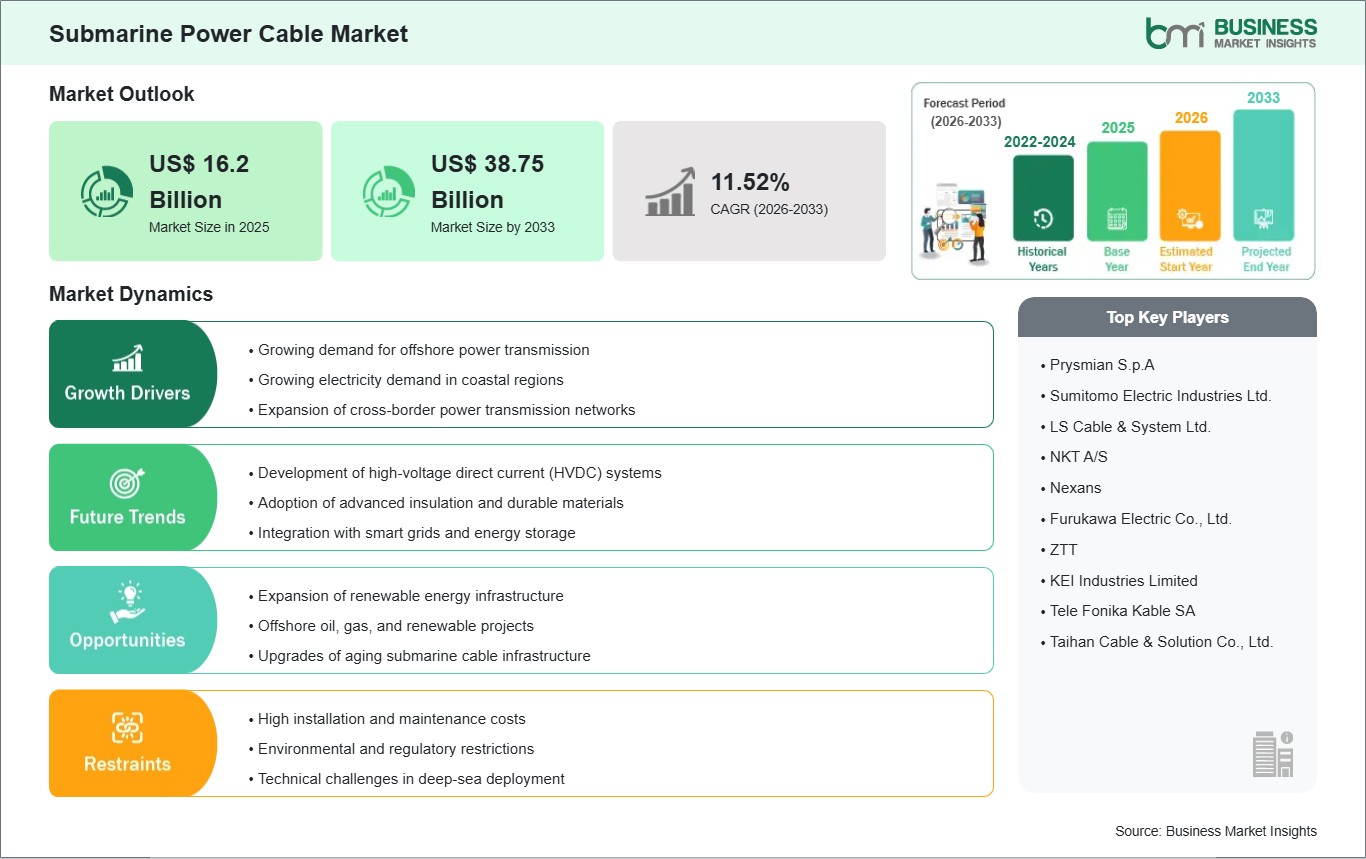
The Submarine Power Cable Market size is expected to reach US$ 38.75 billion by 2033 from US$ 16.2 billion in 2025. The market is estimated to record a CAGR of 11.52% from 2026 to 2033.
The global submarine power cable market is growing rapidly because of the increasing demand for dependable, long-distance electricity transmission across seas and oceans. Submarine power cables, which are used for high-voltage AC and DC transmission, play a crucial role in connecting islands, offshore renewable energy projects, and cross-border power networks. More investments in offshore wind farms, renewable energy integration, and intercontinental grid connections are major factors driving this market growth. Technological progress is influencing market development. Modern submarine cables now use high-quality insulation materials, better conductors, and protective armoring that can endure tough marine conditions. High-voltage direct current (HVDC) systems are becoming more popular than traditional AC systems because they offer greater efficiency, lower transmission losses, and better long-distance power delivery. Improvements in installation methods, cable monitoring, and maintenance are also boosting the reliability and lifespan of submarine power cables.
The market is driven by the global movement toward clean energy, electrification of remote areas, and international efforts to enhance energy security. Offshore wind, tidal, and solar-to-grid projects are increasing the demand for HVDC and AC submarine cabling solutions. Additionally, government policies, regulatory measures, and collaborations between public and private sectors that promote sustainable energy infrastructure are speeding up deployment. This positions submarine power cables as essential parts of modern, strong, and efficient electricity transmission networks around the world.

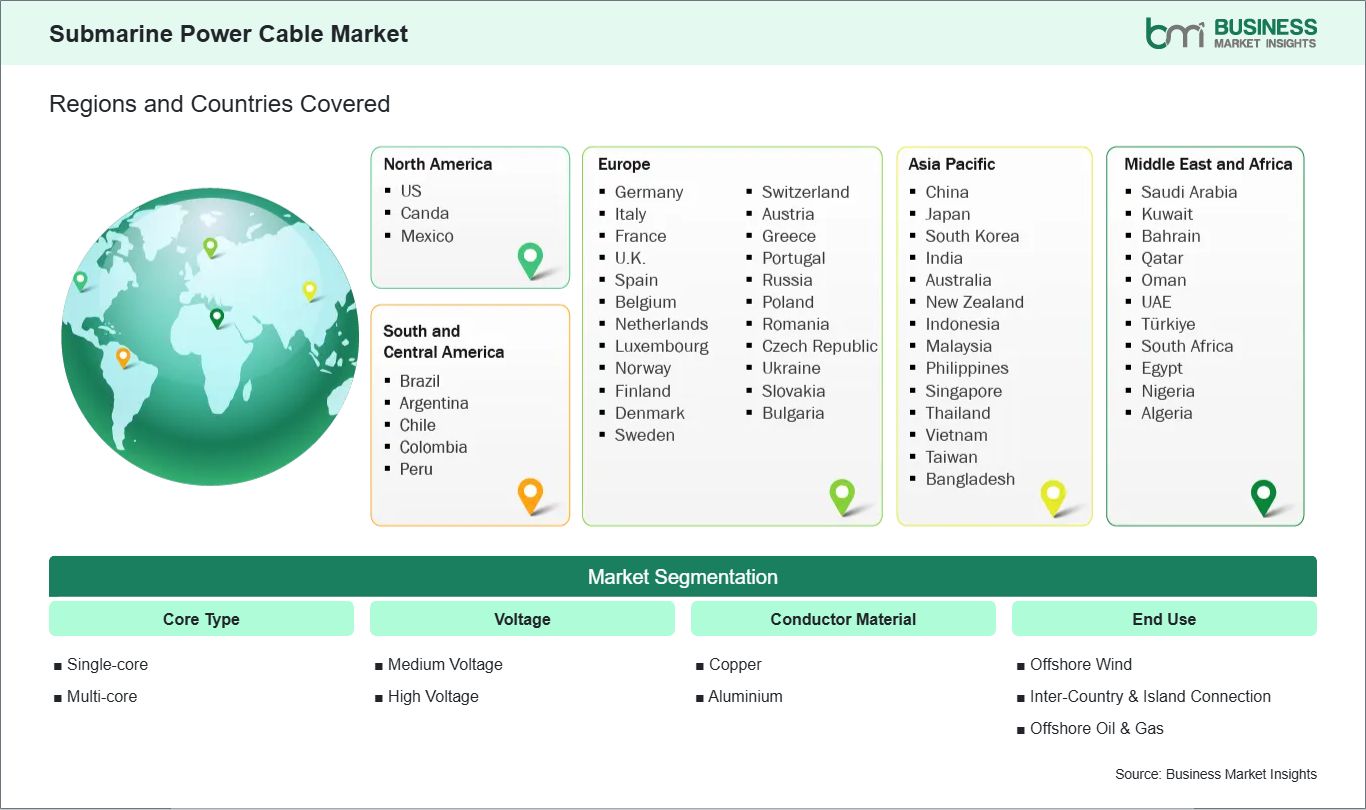
Key segments that contributed to the derivation of the submarine power cable market analysis are core type, voltage, conductor material, end use, and type.
The global submarine power cable market is driven by increasing demand for efficient offshore power transmission. As energy generation moves further into offshore locations, submarine cables are essential to transfer electricity to onshore grids safely and reliably. These systems provide a stable, efficient pathway for electricity, reducing transmission losses compared to other alternatives. Growing industrial, commercial, and residential energy needs along coastal and island areas are creating a consistent requirement for long-distance, high-capacity cable systems. Submarine power cables are being designed to handle these demands while operating reliably in complex marine environments. In addition, technological advancements in insulation, high-voltage capabilities, and cable durability are enabling more efficient and flexible power transmission. These improvements allow energy operators to implement scalable and resilient infrastructure that supports long-term growth in offshore energy supply. Submarine power cables are increasingly recognized as critical components of modern electricity networks.
The expansion of renewable energy infrastructure globally is a major driver for the submarine power cable market. Offshore wind, tidal, and other marine-based renewable energy projects rely on submarine cables to deliver electricity to onshore grids efficiently and securely. These cables are key to integrating clean energy into broader energy systems. Operators are focusing on high-capacity, durable, and flexible cable solutions to accommodate variable power generation from renewable sources. Reliable submarine cables ensure continuous energy flow and reduce interruptions caused by fluctuating output, supporting the stability and efficiency of modern power networks. Furthermore, ongoing innovation in cable design, installation, and maintenance enhances operational lifespan and performance. Environmentally considerate deployment practices and advanced materials help ensure that submarine cables meet the growing needs of renewable energy infrastructure while minimizing environmental impact. These developments solidify submarine power cables as a backbone for global sustainable energy growth.
The Submarine Power Cable Market demonstrates steady growth, with size and share analysis highlighting evolving trends and competitive dynamics among key players. The report examines subsegments categorized within core type, voltage, conductor material, end use, and type, offering insights into their contribution to overall market performance.
Core Type, the multi‑core subsegment dominated the market in 2025, driven by higher capacity and flexibility for long-distance power transmission.
Voltage, the high voltage subsegment dominated the market in 2025, driven by increasing offshore energy projects and interconnection requirements.
Conductor Material, the copper subsegment dominated the market in 2025, driven by better conductivity and reliability for submarine power transmission.
End Use, the offshore wind subsegment dominated the market in 2025, driven by rising investments in offshore wind energy and renewable initiatives.
Type, the AC subsegment dominated the market in 2025, driven by widespread adoption for subsea power transmission in regional and offshore networks.
| Report Attribute | Details |
|---|---|
| Market size in 2025 | US$ 16.2 Billion |
| Market Size by 2033 | US$ 38.75 Billion |
| Global CAGR (2026 - 2033) | 11.52% |
| Historical Data | 2022-2024 |
| Forecast period | 2026-2033 |
| Segments Covered | By Core Type
|
|
Regions and Countries Covered
| |
| North America | US, Canada, Mexico |
| Europe | Belgium, Austria, Finland, Denmark, Greece, Poland, Romania, Russia, Ukraine, Czech Republic, Slovakia, Bulgaria, Italy, Luxembourg, Germany, Switzerland, France, Netherlands, Norway, Portugal, Spain, Sweden, United Kingdom |
| Asia-Pacific | Australia, China, India, Japan, South Korea, Indonesia, Malaysia, Philippines, Singapore, Thailand, Vietnam, Bangladesh, New Zealand, Taiwan |
| South and Central America | Brazil, Argentina, Peru, Chile, Colombia |
| Middle East and Africa | Bahrain, Kuwait, Oman, Qatar, Saudi Arabia, United Arab Emirates, Turkiye, South Africa, Egypt, Algeria, Nigeria |
| Market leaders and key company profiles |
|
The "Submarine Power Cable Market Size and Forecast (2022 - 2033)" report provides a detailed analysis of the market covering below areas:
The geographical scope of the Submarine Power Cable Market report is divided into North America, Asia Pacific, Europe, Middle East & Africa, and South & Central America. North America held the largest share in 2025.
Regional adoption of submarine power cables is influenced by renewable energy projects, offshore infrastructure, and cross-border grid development. North America dominates the market, with the United States and Canada investing heavily in offshore wind connections, island electrification projects, and transnational electricity networks. Advanced manufacturing capabilities and robust regulatory support drive adoption of HVDC and high-capacity AC submarine cables.
Asia Pacific is a rapidly growing market due to increasing offshore wind farms, solar-to-grid projects, and growing electricity demand in coastal regions. China, Japan, South Korea, and India are deploying submarine cables to interconnect islands, support offshore renewable energy, and enhance grid stability.
Europe emphasizes offshore renewable energy integration and cross-border interconnectivity, with Germany, the United Kingdom, and France leading investments in high-capacity HVDC cables for offshore wind farms and regional power networks.
Middle East & Africa is gradually adopting submarine power cables for desalination plants, island electrification, and energy export initiatives, particularly in the UAE, Saudi Arabia, and South Africa.
South & Central America is investing in submarine cable networks to connect islands, improve coastal grid reliability, and integrate renewable energy projects, with Brazil, Chile, and Mexico driving regional adoption of advanced HVDC and AC submarine cabling infrastructure.

The Submarine Power Cable Market is evaluated by gathering qualitative and quantitative data post primary and secondary research, which includes important corporate publications, association data, and databases. A few of the key developments in the spatial light Modulator market are:
The Submarine Power Cable Market is valued at US$ 16.2 Billion in 2025, it is projected to reach US$ 38.75 Billion by 2033.
As per our report Submarine Power Cable Market, the market size is valued at US$ 16.2 Billion in 2025, projecting it to reach US$ 38.75 Billion by 2033. This translates to a CAGR of approximately 11.52% during the forecast period.
The Submarine Power Cable Market report typically cover these key segments-
The historic period, base year, and forecast period can vary slightly depending on the specific market research report. However, for the Submarine Power Cable Market report:
The Submarine Power Cable Market is populated by several key players, each contributing to its growth and innovation. Some of the major players include:
The Submarine Power Cable Market report is valuable for diverse stakeholders, including:
Essentially, anyone involved in or considering involvement in the Submarine Power Cable Market value chain can benefit from the information contained in a comprehensive market report.
Please tell us your area of interest
(Market Segments/ Regions and Countries/ Companies)