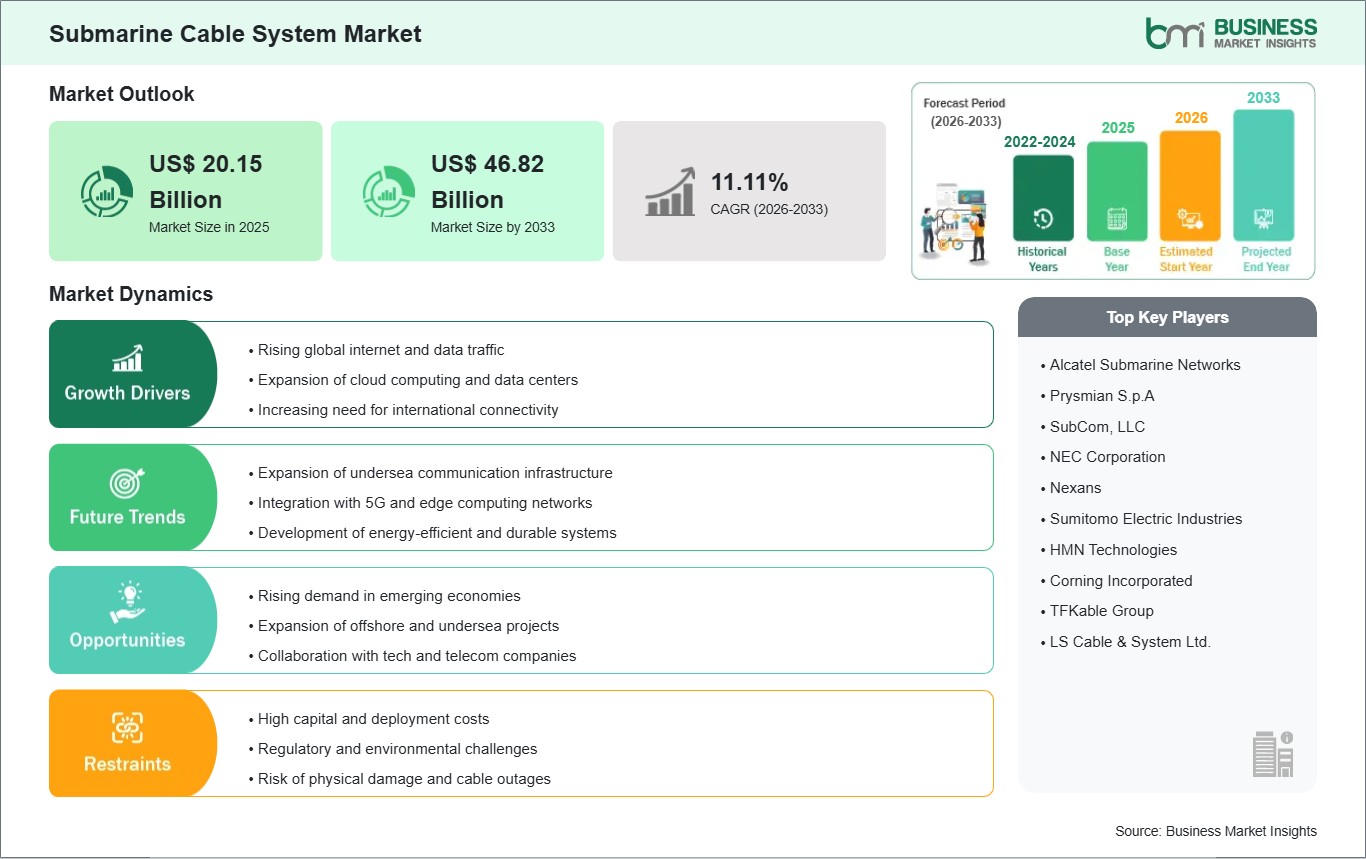
The Submarine Cable System Market size is expected to reach US$ 46.82 billion by 2033 from US$ 20.15 billion in 2025. The market is estimated to record a CAGR of 11.11% from 2026 to 2033.
The submarine cable system market is experiencing strong growth driven by increasing demand for high-capacity international connectivity, cloud computing, and cross-border data transfer. Submarine cables are critical infrastructure for global telecommunications, providing reliable, high-speed transmission of internet, voice, and data traffic across continents. With digital transformation, streaming services, and cloud adoption surging globally, submarine cable networks are essential to support bandwidth-intensive applications and reduce latency for international communications. Technological advancements in fiber optic materials, wavelength-division multiplexing (WDM), and repeaters have significantly increased transmission capacity, reach, and reliability of submarine cable systems. Modern cables are designed to accommodate scalable network expansions, support low-latency connections, and integrate advanced monitoring systems for real-time fault detection and maintenance.
Market growth is further driven by investments from telecom operators, hyperscale cloud providers, and governments to enhance global internet connectivity and redundancy. Initiatives to connect underserved regions and emerging markets, coupled with rising demand for secure and high-speed data links for finance, e-commerce, and digital media, are accelerating submarine cable deployment. As digital globalization intensifies, submarine cable systems are increasingly recognized as strategic infrastructure for enabling international trade, economic growth, and resilient communication networks.

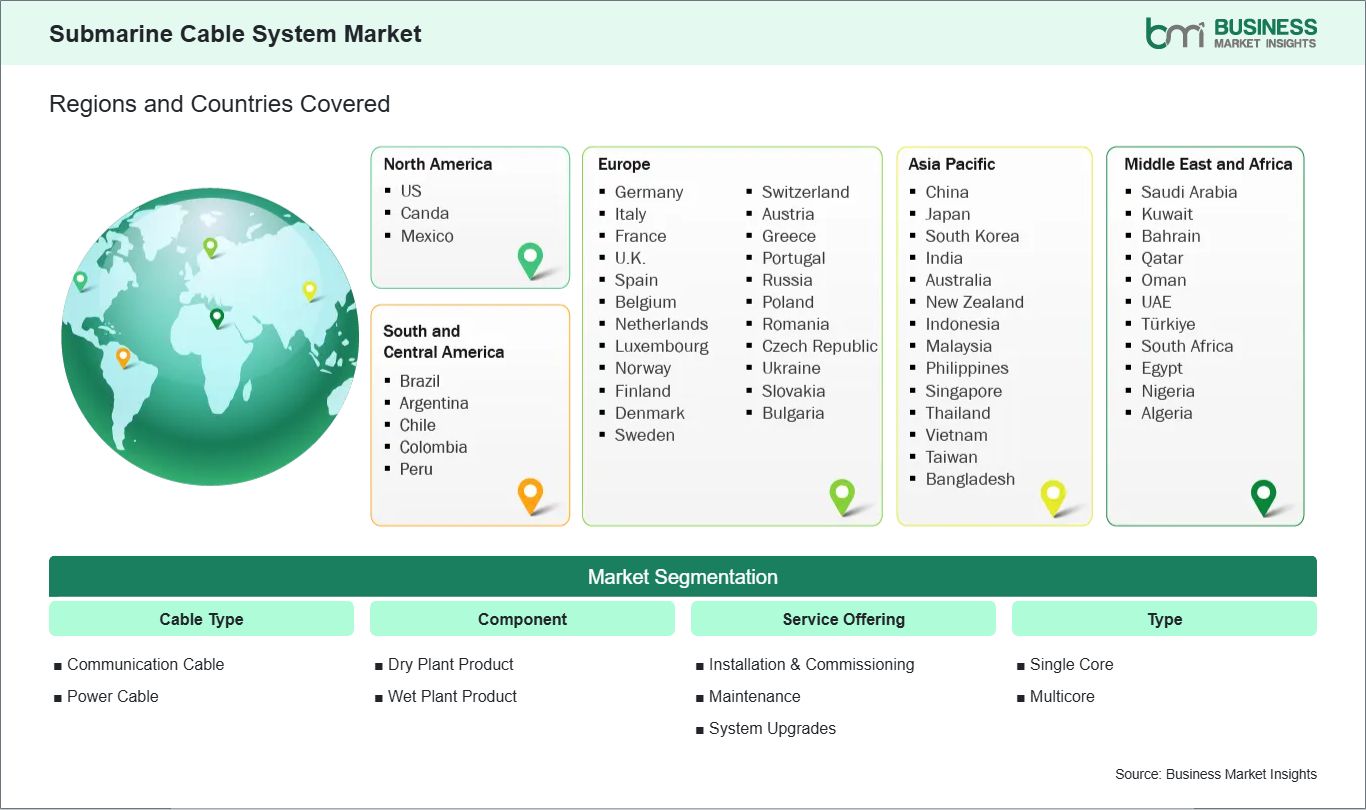
Key segments that contributed to the derivation of the submarine cable system market analysis are cable type, component, service offering, type, voltage, insulation, and end‑use application.
The global submarine cable system market is driven by the continuous growth of internet and data traffic across all industries. Businesses, governments, and service providers are increasingly relying on digital platforms, cloud services, and real-time communication, which places greater demands on international data transmission networks. Submarine cables serve as the backbone of this digital connectivity, enabling seamless global communication and efficient information exchange across long distances. As organizations expand their digital presence, the need for high-capacity and low-latency communication infrastructure has become critical. Submarine cable systems provide reliable pathways for large volumes of data, ensuring consistent performance for both corporate and consumer applications. The proliferation of connected devices and digital applications is creating an ongoing requirement for faster, more efficient undersea data channels. The market continues to evolve to meet these needs, with innovations focused on enhancing the speed, reliability, and scalability of submarine cable systems.
The expansion of undersea communication infrastructure is a key driver of the submarine cable system market. Growing digitalization and the demand for continuous, uninterrupted global connectivity are motivating investments in new cable networks and upgrades to existing systems. Submarine cables enable robust international communication, supporting everything from business operations to online services and global collaboration. Innovations in cable design, transmission technology, and deployment methods are improving the capacity and resilience of these networks. This ensures that submarine cables can handle increasing volumes of data traffic while maintaining stability and reliability. Moreover, as global digital services continue to grow, the expansion of submarine cable infrastructure remains essential. It allows businesses and service providers to deliver seamless communication, support digital ecosystems, and strengthen international connectivity, making undersea networks a critical component of the global digital economy.
The Submarine Cable System Market demonstrates steady growth, with size and share analysis highlighting evolving trends and competitive dynamics among key players. The report examines subsegments categorized within cable type, component, service offering, type, voltage, insulation, and end‑use application, offering insights into their contribution to overall market performance.
By Cable Type, the communication cable subsegment dominated the market in 2025, driven by high demand for data transmission and connectivity between continents and islands.
Based on component, the wet plant product subsegment dominated the market in 2025, driven by its essential role in subsea cable deployment and network reliability.
In terms of service offering, the installation & commissioning subsegment dominated the market in 2025, driven by increasing infrastructure development and submarine cable projects globally.
On the Basis of Type, the multicore subsegment dominated the market in 2025, driven by better capacity and efficiency for long-distance power and data transmission.
Voltage, the high voltage subsegment dominated the market in 2025, driven by growing renewable energy projects and offshore power transmission requirements.
By Insulation, the cross‑linked polyethylene subsegment dominated the market in 2025, driven by superior durability, flexibility, and performance under harsh subsea conditions.
Based on End‑use Application, the offshore wind power generation plants subsegment dominated the market in 2025, driven by rising investments in offshore wind farms and renewable energy initiatives.
| Report Attribute | Details |
|---|---|
| Market size in 2025 | US$ 20.15 Billion |
| Market Size by 2033 | US$ 46.82 Billion |
| Global CAGR (2026 - 2033) | 11.11% |
| Historical Data | 2022-2024 |
| Forecast period | 2026-2033 |
| Segments Covered | By Cable Type
|
|
Regions and Countries Covered
| |
| North America | US, Canada, Mexico |
| Europe | Belgium, Austria, Finland, Denmark, Greece, Poland, Romania, Russia, Ukraine, Czech Republic, Slovakia, Bulgaria, Italy, Luxembourg, Germany, Switzerland, France, Netherlands, Norway, Portugal, Spain, Sweden, United Kingdom |
| Asia-Pacific | Australia, China, India, Japan, South Korea, Indonesia, Malaysia, Philippines, Singapore, Thailand, Vietnam, Bangladesh, New Zealand, Taiwan |
| South and Central America | Brazil, Argentina, Peru, Chile, Colombia |
| Middle East and Africa | Bahrain, Kuwait, Oman, Qatar, Saudi Arabia, United Arab Emirates, Turkiye, South Africa, Egypt, Algeria, Nigeria |
| Market leaders and key company profiles |
|
The "Submarine Cable System Market Size and Forecast (2022 - 2033)" report provides a detailed analysis of the market covering below areas:
The geographical scope of the Submarine Cable System Market report is divided into North America, Asia Pacific, Europe, Middle East & Africa, and South & Central America. North America held the largest share in 2025.
Regional adoption of submarine cable systems depends on internet penetration, cross-border connectivity requirements, and data infrastructure investment. North America dominates the market due to the presence of major data hubs, hyperscale cloud providers, and high international bandwidth demand. The United States leads in deploying transatlantic and transpacific cables to Europe, Asia Pacific, and Latin America, supporting both enterprise and consumer digital traffic. Asia Pacific is a high-growth region driven by internet expansion, e-commerce, and digital infrastructure projects. China, Japan, South Korea, and Singapore are actively investing in submarine cables to enhance intra-Asia connectivity and link with global networks, supporting the region’s growing digital economy.
Europe focuses on secure and high-capacity links for financial centers, cloud services, and international communications. Germany, the United Kingdom, and France are investing in upgraded fiber optic systems to improve transcontinental connectivity and redundancy. Middle East & Africa is gradually expanding submarine cable deployment to improve internet access, support data centers, and strengthen cross-border communication, particularly in the UAE, Saudi Arabia, and South Africa. South & Central America is adopting submarine cables to connect with North America and Europe, with Brazil, Mexico, and Chile leading infrastructure expansion to enhance broadband services, digital economy growth, and international connectivity.

The Submarine Cable System Market is evaluated by gathering qualitative and quantitative data post primary and secondary research, which includes important corporate publications, association data, and databases. A few of the key developments in the spatial light Modulator market are:
The Submarine Cable System Market is valued at US$ 20.15 Billion in 2025, it is projected to reach US$ 46.82 Billion by 2033.
As per our report Submarine Cable System Market, the market size is valued at US$ 20.15 Billion in 2025, projecting it to reach US$ 46.82 Billion by 2033. This translates to a CAGR of approximately 11.11% during the forecast period.
The Submarine Cable System Market report typically cover these key segments-
The historic period, base year, and forecast period can vary slightly depending on the specific market research report. However, for the Submarine Cable System Market report:
The Submarine Cable System Market is populated by several key players, each contributing to its growth and innovation. Some of the major players include:
The Submarine Cable System Market report is valuable for diverse stakeholders, including:
Essentially, anyone involved in or considering involvement in the Submarine Cable System Market value chain can benefit from the information contained in a comprehensive market report.
Please tell us your area of interest
(Market Segments/ Regions and Countries/ Companies)