Market Summary
Executive Summary and Global Market Analysis
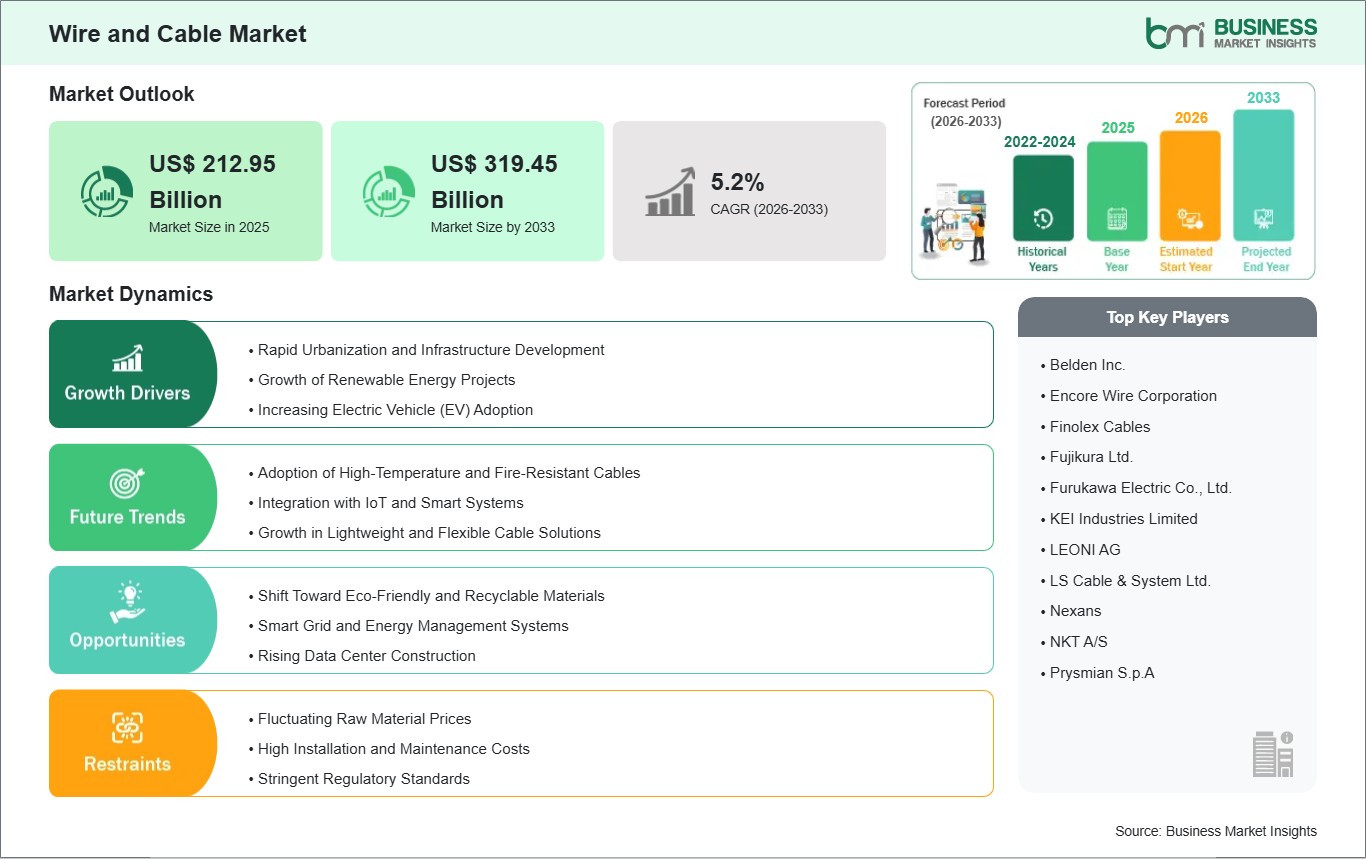
The global wire and cable market is experiencing steady expansion, driven by the foundational role these products play in electrification, connectivity, and infrastructure development across all economic sectors. Wires and cables are indispensable for transmitting power and data, supporting everything from residential buildings and industrial plants to telecommunications networks and renewable energy farms.
Key drivers include massive global investments in power grid modernization and expansion, the accelerating deployment of renewable energy sources requiring extensive transmission infrastructure, and the ongoing rollout of 5G and broadband networks. Furthermore, urbanization and smart city projects are fueling demand for building wiring and underground cabling. The market faces challenges such as volatile prices of key raw materials like copper and aluminum, stringent environmental and safety regulations, and intense competition from regional players. However, significant opportunities are emerging from the development of high-voltage direct current (HVDC) cables for long-distance power transmission, the demand for fire-resistant and low-smoke zero-halogen (LSZH) cables in critical infrastructure, and the growth of electric vehicle charging networks.
Segment Analysis
Wire and Cable Market Segmentation
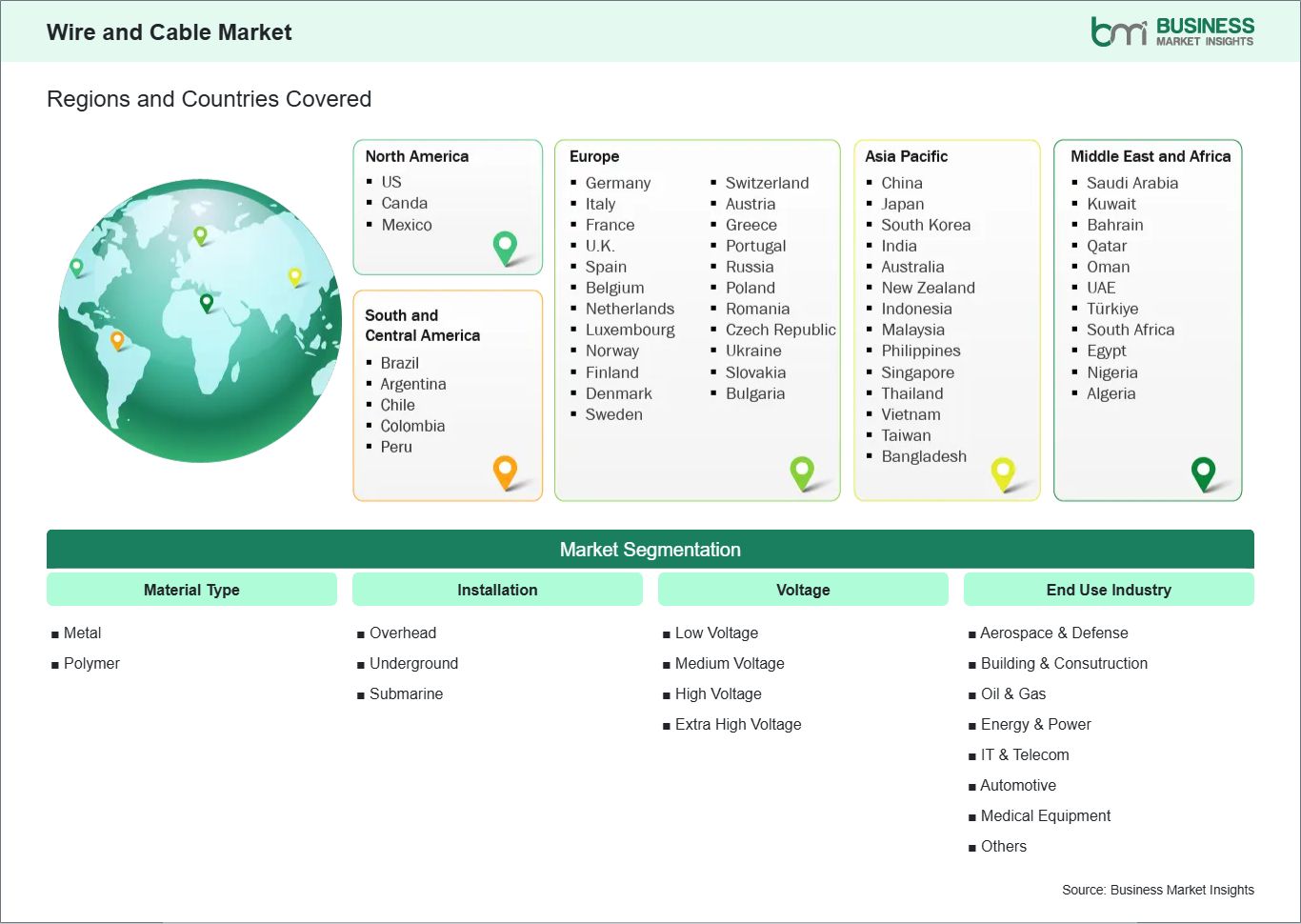
Key segments that contributed to the derivation of the wire and cable market analysis are material type, installation, voltage, and end use industry.
- By material type, the wire and cable market is segmented into metal and polymer. The metal segment dominated the market in 2024.
- By installation, the market is classified into overhead, underground, and submarine. The overhead segment held the largest share in the wire and cable market in 2024.
- By voltage, the market is categorized into low voltage, medium voltage, high voltage, and extra high voltage. The low voltage segment held the largest share in the wire and cable market in 2024.
- By end use industry, the market includes aerospace & defense, building & construction, oil & gas, energy & power, IT & telecom, automotive, medical equipment, and others. The energy & power segment held the largest share in the wire and cable market in 2024.
Market Forces
Wire and Cable Market Drivers and Opportunities
Global Energy Transition and Grid Modernization
The worldwide shift towards renewable energy sources and the concomitant need to modernize aging power grids represent the most significant driver for the wire and cable market. The integration of distributed energy resources like solar and wind farms requires extensive new transmission and distribution networks, including both overhead lines and underground/submarine cables for grid interconnection and offshore wind projects. Simultaneously, governments and utilities are investing heavily in smart grid technologies to improve efficiency, reliability, and resilience, which involves upgrading existing infrastructure with advanced monitoring and control capabilities embedded within new cable systems. This dual focus on building new renewable capacity and modernizing legacy grids creates sustained, long-term demand for a wide range of cable types, from medium-voltage distribution cables to extra-high-voltage transmission lines.
Rise of Digital Infrastructure and Data-Driven Economies
The explosive growth of data consumption, cloud computing, and the Internet of Things (IoT) is fueling an unprecedented build-out of digital infrastructure, creating a substantial and high-value opportunity for specialized data and telecom cables. The rollout of 5G networks demands dense fiber-optic backhaul and sophisticated coaxial cables for small cells. The construction and expansion of hyperscale data centers require massive quantities of high-speed data cables, including copper for power and fiber for connectivity. Furthermore, the proliferation of smart buildings and cities relies on complex structured cabling systems for building automation, security, and IT networks. This trend drives continuous innovation in cable design for higher bandwidth, better shielding, and improved power efficiency, positioning the wire and cable industry as a critical enabler of the global digital transformation.
Size and Share Analysis
Wire and Cable Market Size and Share Analysis
Based on material type, the wire and cable market is segmented into metal and polymer. The metal segment, predominantly copper and aluminum, leads due to its irreplaceable role as a conductive core in virtually all power and many data cables, driven by its excellent electrical conductivity.
Based on installation, the market is classified into overhead, underground, and submarine. Overhead installation holds the largest share for long-distance power transmission due to its lower cost, though underground installation is growing rapidly in urban areas and for renewable integrations for aesthetic and reliability reasons.
By voltage, the market is dominated by the low voltage segment, as it encompasses the vast majority of cables used in building wiring, appliance power cords, automotive applications, and consumer electronics. The high and extra-high voltage segments, while smaller in volume, represent high-value markets critical for national power grids.
By end use industry, the energy & power sector is the largest, encompassing utilities, renewable energy, and grid infrastructure. The building & construction and IT & telecom industries are also major consumers, driving demand for building wires and data communication cables, respectively.
Report Coverage
Wire and Cable Market Report Coverage and Deliverables
The Wire and Cable Market Size and Forecast (2022–2033) report provides a detailed analysis of the market covering below areas:
- Wire and Cable Market size and forecast at global, regional, and country levels for all the key market segments covered under the scope
- Wire and Cable Market trends, as well as market dynamics such as drivers, restraints, and key opportunities
- Wire and Cable Market analysis covering key market trends, global and regional framework, major players, regulations, and recent market developments
- Industry landscape and competition analysis covering market concentration, heat map analysis, prominent players, and recent developments for the wire and cable market
- Detailed company profiles, including SWOT analysis
Geographic Insights
Wire and Cable Market Geographic Insights
The Asia-Pacific region is the largest and fastest-growing market for wires and cables, driven by rapid industrialization, massive investments in power infrastructure, and booming construction activities. Countries like China, India, Japan, and South Korea are leading in renewable energy installations, smart city projects, and telecom network expansions, creating immense demand for all cable types. China, in particular, dominates both as a producer and consumer.
North America remains a mature yet significant market, characterized by ongoing grid modernization projects, shale gas exploration requiring specialized cables, and investments in data center and 5G infrastructure. The United States and Canada are focused on upgrading aging transmission networks and deploying EV charging infrastructure, supporting steady demand for medium and high-voltage cables.
Europe represents a steady market with a strong focus on sustainability and energy efficiency. The European Union's Green Deal and targets for offshore wind power in the North Sea are driving demand for submarine and high-voltage cables. Countries like Germany, France, the UK, and Italy also have robust automotive and industrial sectors that require advanced cabling solutions, supported by strict regulations on material safety and recyclability.
Industry Activity
Recent Developments
The Wire and Cable Market is evaluated by gathering qualitative and quantitative data post primary and secondary research, which includes important corporate publications, association data, and databases. A few of the key developments in the wire and cable market are:
- In June 2025, Prysmian held a groundbreaking ceremony to kick off its $500 million investment at the Encore Wire campus over five years. Included in the figure is the $249 million Prysmian Board of Director’s approved during the Capital Market Day event in March. This marks a significant advancement for the company, nearly a year after Prysmian’s acquisition of Encore Wire to serve electrical customers in North America through Encore’s outstanding service model.
- In January 2025, Cycle-Tek, a Teknor Apex company, announced the launch of two new grades specifically formulated for flexible cord and IMSA applications: Cycle-Tek® 20401-82A BLK 1 and Cycle-Tek® 20401-82A FR BLK 1. Made with up to 50% recycled content, these new compounds add new options for wire & cable manufacturers looking to incorporate more sustainable materials in their cable design.
Trust & Transparency
Research Methodology
The market analysis combines proprietary research with secondary data from government agencies, company disclosures, regulatory filings, industry databases and expert interviews. Market estimates are validated through data triangulation, cross-market benchmarking and analyst
review.
View Full Research Methodology
Key Sources Referred:
World Bank – Global Trade Indicators
World Trade Organization (WTO)
(International Monetary Fund )IMF
International Trade Administration (ITA)
Company website
Company annual reports
Company investor presentations