Market Summary
Executive Summary and Global Market Analysis
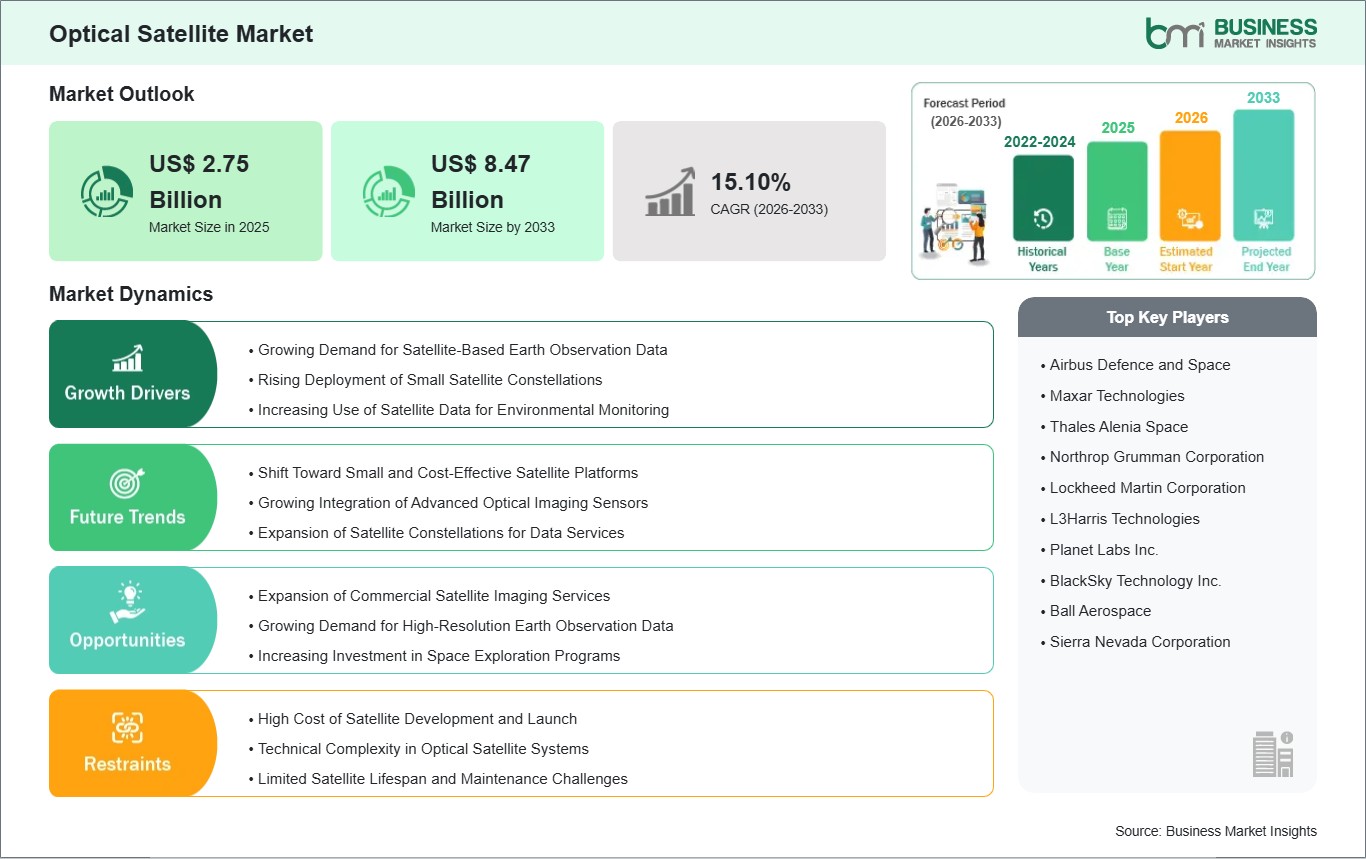
The optical satellite market is expanding as organizations increasingly rely on satellite-based imaging and communication technologies for earth observation and data services. Optical satellites use advanced sensors and imaging systems to capture detailed images of the earth’s surface. These satellites support a wide range of applications including environmental monitoring, disaster management, mapping, agriculture analysis, and infrastructure planning. The ability to provide high-resolution imagery and accurate geospatial data makes optical satellites valuable tools for both government and commercial users.
Growing demand for real-time earth observation data and increasing investments in satellite technology are supporting market growth. Governments and private companies are launching new satellites to expand monitoring capabilities and improve data coverage. Technological advancements in imaging systems and optical communication technologies are also enhancing satellite performance. As industries increasingly rely on satellite data for planning and decision making, the demand for optical satellite systems continues to rise across various sectors.
Segment Analysis
Optical Satellite Market Segmentation
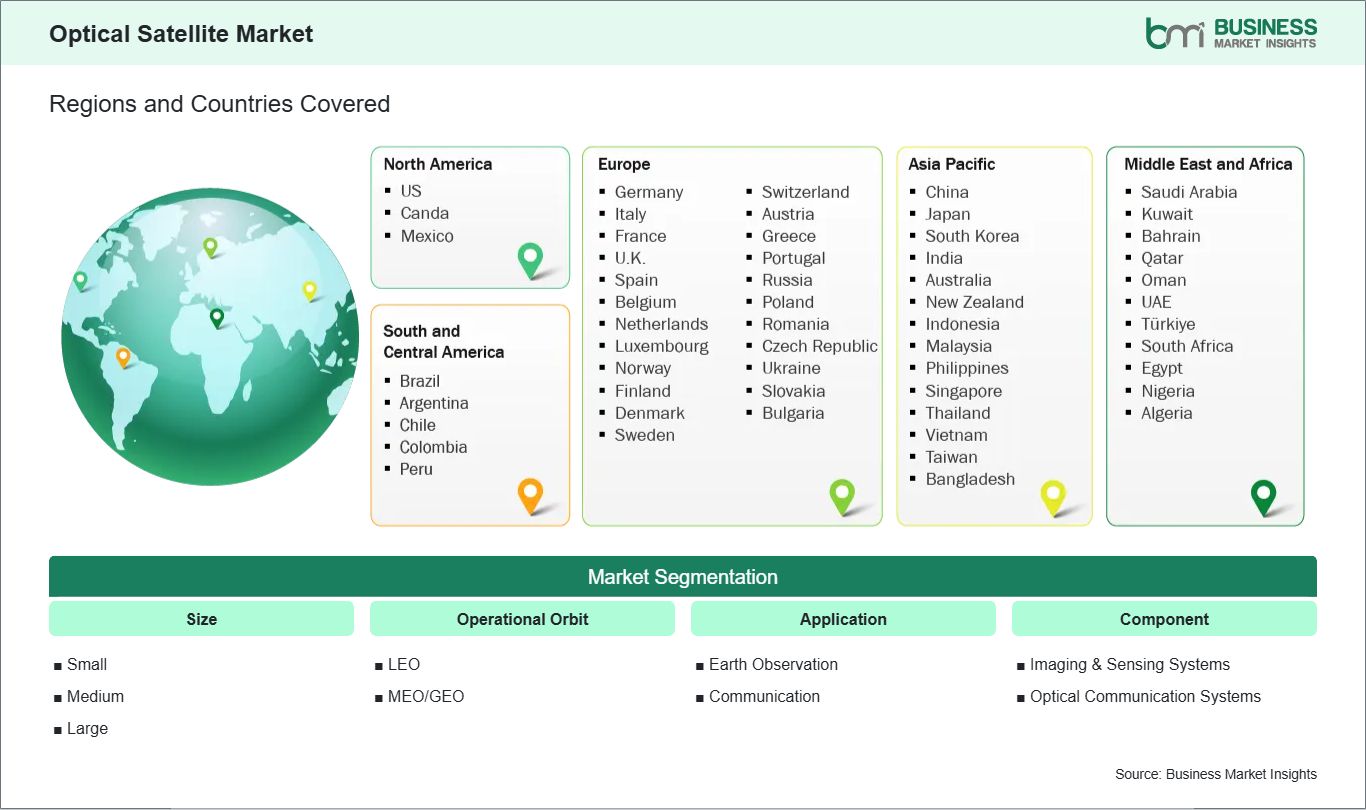
Key segments that contributed to the derivation of the optical satellite market analysis are size, operational orbit, application, component, end user
- By size, the optical satellite market is segmented into small, medium, and large satellites. The small satellites segment dominated the market in 2025.
- By operational orbit, the market is classified into LEO and MEO/GEO. The LEO segment dominated the market in 2025.
- By application, the market is segmented into earth observation and communication. The earth observation segment dominated the market in 2025.
- By component, the market is segmented into imaging and sensing systems and optical communication systems. The imaging and sensing systems segment dominated the market in 2025.
- By end user, the market is segmented into commercial, government, and defense. The government segment dominated the market in 2025.
Market Forces
Optical Satellite Market Drivers and Opportunities
Growing Demand for Satellite-Based Earth Observation Data
The growing demand for satellite-based earth observation data is a major driver for the optical satellite market. Optical satellites capture images and collect data about the earth’s surface using advanced imaging sensors. Governments, research organizations, and commercial companies use this data for environmental monitoring, land mapping, disaster management, and resource planning. The ability of optical satellites to provide detailed and timely information makes them essential for many industries. Many sectors rely on satellite imagery to improve decision making and planning. Agriculture companies use satellite images to monitor crop conditions and land use. Environmental agencies use optical satellite data to track climate patterns, forest changes, and natural disasters. Urban planners and infrastructure developers also use this information to support city development and land management projects. In addition, the increasing need for real-time and accurate geospatial data is encouraging investment in satellite technologies. Satellite operators are launching new optical satellites with improved imaging capabilities to meet the growing demand for earth observation services. As industries continue to depend on satellite data for monitoring and analysis, the demand for optical satellite systems is expected to increase.
Expansion of Commercial Satellite Imaging Services
The expansion of commercial satellite imaging services presents significant opportunities for the optical satellite market. Private companies are increasingly launching satellites to provide imaging services for industries such as agriculture, environmental monitoring, infrastructure planning, and disaster management. Optical satellites capture high-resolution images that help organizations analyze land use, monitor environmental conditions, and support decision making.
Commercial satellite imaging providers are developing new platforms that deliver frequent and detailed earth observation data. These services help businesses and government organizations gain insights into environmental changes, infrastructure development, and resource management. Companies can use satellite images to monitor large areas quickly and efficiently without relying on ground-based observation systems.
In addition, growing demand for geospatial data across industries is encouraging investment in commercial satellite programs. Advances in satellite technology and data processing are making satellite imaging services more accessible to businesses and research organizations. As the need for accurate and timely earth observation information increases, the commercial satellite imaging sector is expected to create strong growth opportunities for the optical satellite market.
Size and Share Analysis
Optical Satellite Market Size and Share Analysis
The global optical satellite market is experiencing steady growth, with market size and share analysis reflecting evolving treatment preferences and competitive dynamics among key players. The report evaluates important subsegments categorized within size, operational orbit, application, component, end user, highlighting their respective contributions to overall market performance.
By size, the small satellites subsegment dominated the market in 2025, due to increasing deployment of compact and cost-effective satellites for earth observation and communication missions by commercial and government organizations.
By operational orbit, the LEO subsegment dominated the market in 2025, because low earth orbit satellites enable faster data transmission, lower latency communication, and more efficient earth observation capabilities.
By application, the earth observation subsegment dominated the market in 2025, driven by increasing demand for high-resolution imaging, environmental monitoring, disaster management, and mapping services.
By component, the imaging and sensing systems subsegment dominated the market in 2025, due to the widespread use of optical sensors and imaging technologies for satellite-based monitoring and data collection.
By end user, the government subsegment dominated the market in 2025, as government agencies widely use optical satellites for environmental monitoring, space research, mapping, and national security operations.
Report Coverage
Optical Satellite Market Report Coverage and Deliverables
The "Optical Satellite Market Size and Forecast (2022 - 2033)" report provides a detailed analysis of the market covering below areas:
- Optical Satellite market size and forecast at the regional and country levels for segments covered under the scope
- Optical Satellite market trends, as well as drivers, restraints, and opportunities
- Optical Satellite market analysis covering key trends, regional framework, major players, regulations, and recent developments
- Industry landscape and competition analysis covering market concentration, heat map analysis, prominent players, and recent developments for the Optical Satellite market
- Detailed company profiles, including SWOT analysis
Geographic Insights
Optical Satellite Market Geographic Insights
The geographical scope of the optical satellite market report is divided into: North America, Asia Pacific, Europe, Middle East & Africa, and South & Central America. North America held the largest share in 2025.
North America dominates the optical satellite market due to strong space technology capabilities and significant investments in satellite development. The region is home to leading aerospace companies, satellite manufacturers, and space research organizations that actively develop advanced satellite technologies. Government agencies and defense organizations in North America use optical satellites for earth observation, environmental monitoring, mapping, and national security operations. The region also benefits from strong participation of commercial satellite companies that provide earth observation data and imaging services. Many private organizations are launching satellite constellations to deliver high-resolution geospatial data for industries such as agriculture, urban planning, and environmental research. These commercial initiatives support the growth of satellite imaging and data services across the region. In addition, continuous investment in space exploration, satellite research, and advanced imaging technologies supports innovation in the optical satellite sector. Collaboration between government agencies, research institutions, and private companies further strengthens technological development. These factors help North America maintain a leading position in the global optical satellite market.
Industry Activity
Recent Developments
The optical satellite market is evaluated by gathering qualitative and quantitative data post primary and secondary research, which includes important corporate publications, association data, and databases. A few of the key developments in the Optical Satellite market are:
- In June 2025, Mynaric announced that it delivered more than 100 CONDOR Mk3 optical communications terminals to customers, including a complete launch set for the Space Development Agency’s Tranche 1 program, supporting high-speed laser communication links between satellites.
- In March 2025, Mynaric announced that it is ramping up production and customer deliveries of its CONDOR Mk3 optical communications terminals to support satellite constellation programs and expanding demand for space-based laser communications.
Trust & Transparency
Research Methodology
The market analysis combines proprietary research with secondary data from government agencies, company disclosures, regulatory filings, industry databases and expert interviews. Market estimates are validated through data triangulation, cross-market benchmarking and analyst
review.
View Full Research Methodology
Key Sources Referred:
World BankAcademic JournalsCompany WebsitesCompany Annual ReportsCompany Investor Presentations