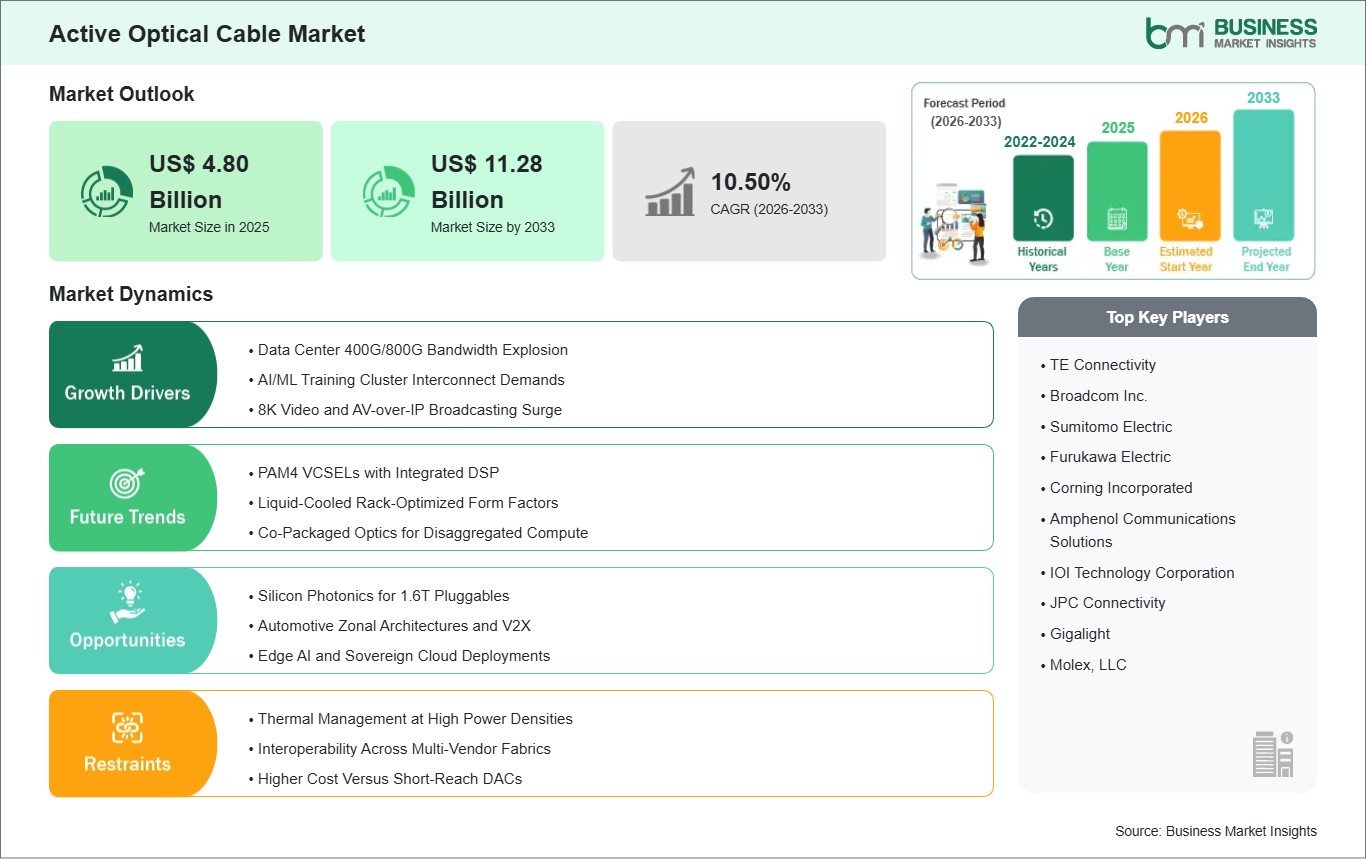
The active protection system market size is expected to reach US$ 11.28 billion by 2033 from US$ 4.80 billion in 2025. The market is estimated to record a CAGR of 10.25% from 2026 to 2033.
The global active optical cable market leverages integrated optical engines and multimode fibers to facilitate fast data transmission for bandwidth, heavy applications. These cables come with lasers, VCSELs, and transceivers enabling 100G+ speeds over the distances that copper cannot. Hence, data center, 8K display, and 5G fronthaul connectivity’s are performed at low latency. Among the most significant benefits are EMI immunity, 70% weight reduction when compared to DACs, and plug and play simplicity, which position AOCs as a must, have for AI clusters, hyperscale clouds, and immersive AV ecosystems.
A solid increase accompanies the 400G/800G ramps, edge computing spreading, and AV, over, IP broadcasting as the volume of unstructured data is skyrocketing. The main drivers are data center expansions by AWS and Alibaba, along with 4K/8K TV penetration, while the scaling of the fab reduces the cost of VCSELs. On the downside, thermal management at 100W+ and interoperability standards are among the problems that the industry is currently facing. Beyond that, there exist tremendous opportunities for silicon photonics integration, 1.6T AOCs, and automotive infotainment networks.

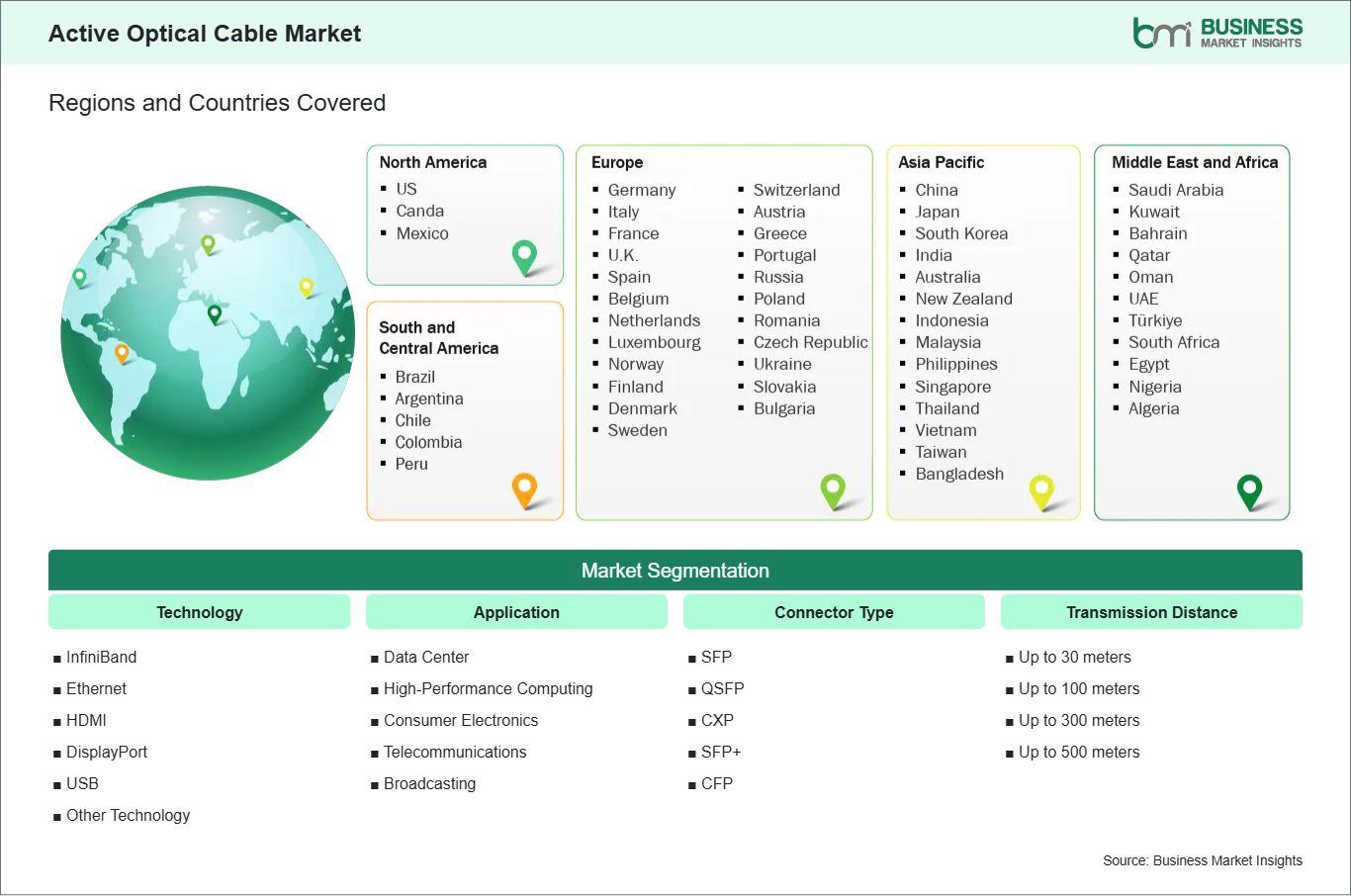
Key segments shaping the global active optical cable market include technology, application, connector type, and transmission distance.
The active optical cables segment is being driven by hyperscale data center builds on an explosive scale and AI accelerator deployments, as operators are focused on low-power, high-density 400G+ interconnects. Credo and MaxLinear QSFP, DD AOCs connect NVIDIA DGX clusters with NVLink switches; thus, they achieve latency within the sub-100ns range across 100m spans, which is very critical for trillion-parameter LLMs. Due to Asia-Pacific colocation regulations, there will be a 25% annual port upgrade rate alongside a backlog of over 5M units by 2030.
With the aid of CHIPS Act subsidies, US local fabs are closing the gap, thus mixing Ethernet AOCs with InfiniBand for GPU, direct storage in contested semiconductor supply chains. PAM4 VCSELs work perfectly well under 70 °C server farm conditions, whereas upgrading from the old CX4/DAC to the retrofitted ones quickly opens up profit possibilities; therefore, positioning AOCs as zero-touch fabric facilitators to handle exabytes, scale operations, liquid-cooled racks, and sustainable PUE targets below 1.2.
The Ukrainian energy crises further unveil the ground realities of energy crises and hence revolves around the issue of urgent grid stability. Hybrid SAW arrays, through the combination of humidity, pressure, and vibration sensors, help ensure pipeline integrity, thereby, leakages in the pipelines used for transporting gas in the regions that are under the control of adversaries are prevented. Gallium Nitride (GaN) based transducers are pretty much at home in the high electromagnetic interference (EMI) environments such as those created by electric arc furnaces, where they turn out signal, to, noise ratios of above 30% compared to the standard quartz crystals.
HDMI/DisplayPort AOCs are presupposed to be the main beneficiaries of the 8K broadcasting and automotive cockpit networks, reopening the entry of an entirely new world of applications in stadium LED walls and zonal architectures. Open standards have enabled QSFP AOCs to be fused with AVB for remote production, which in turn has resulted in a reduction of venue cabling by 60% when compared to copper HDBaseT for FIFA/Super Bowl streams. Mandates from consumer electronics, such as EU energy labelling, have increased the market for USB4 optical extenders under $20/meter. In contrast, Level 3+ autonomy has been the reason for 100G CFP links for LiDAR fusion costing less than $100/unit. Silicon photonics brings the dimension of chips down to 0.5mm, leading to a decrease in BOMs by 50% for edge AI gateways. Broadcasting verticals take advantage of CXP in 12G, SDI trucks following 360 UHD, R, being in line with SMPTE 2110. Such dynamics are setting the stage for suppliers to secure contracts worth $15B through 2034, with AOCs turning into pluggable hubs for disaggregated computing and immersive realities.

By technology, the global active optical cable market segments into InfiniBand, Ethernet, HDMI, DisplayPort, USB, and Others. The Ethernet segment dominated in 2024. Powers 90% cloud traffic; PAM4 scalability drives hyperscaler adoption across 400G fabrics.
By application, segments are Data Center, High-Performance Computing, Consumer Electronics, Telecommunications, and Broadcasting. The Data Center segment led in 2024. Consumes 70% bandwidth; AI/ML workloads demand massive server-to-server interconnect scaling.
By connector type, divisions include SFP, QSFP, CXP, SFP+, and CFP. The QSFP segment held the largest share in 2024. Versatile 40G/100G/400G support enables seamless rack-scale fabric migrations globally.
By transmission distance, categories are Up to 30 meters, Up to 100 meters, Up to 300 meters, Up to 500 meters. The Up to 100 meters segment topped in 2024. Matches intra-data center rack-to-rack spans in mega-scale deployments.
| Report Attribute | Details |
|---|---|
| Market size in 2025 | US$ 4.80 Billion |
| Market Size by 2033 | US$ 11.28 Billion |
| Global CAGR (2026 - 2033) | 10.50% |
| Historical Data | 2022-2024 |
| Forecast period | 2026-2033 |
| Segments Covered | By Technology
|
| Regions and Countries Covered | North America
|
| Market leaders and key company profiles |
|
The "Active Optical Cable Market Size and Forecast (2022–2033)" report provides a detailed analysis of the market covering below areas:
The geographical scope of the active optical cable market report is divided into five regions: North America, Asia Pacific, Europe, the Middle East & Africa, and South & Central America. The active optical cable market in North America registered the highest market share in 2024.
North America is leading through the three giant public cloud providers and AI research labs, divided among the US, Canada, and Mexico. Deployments in the US are booming with 800G QSFP, DD AOCs powering xAI's Memphis superclusters and AWS Snowball Edge expansions enabling tactical edge AI. In contrast, Canadian hyperscalers like Equinix incorporate 400G Ethernet for ML training pipelines. Mexico's maquiladora electronics manufacturing uses USB 3.2 AOCs to scale a Tier 1 automotive supplier.
Europe has made great progress with GDPR compliant Ethernet fabrics and green data center directives, partly by Germany's Nokia and Infineon developing QSFP28 for the industrial edge, and alongside the UK's broadcast CXP adoption for BBC 8K OB trucks as well as Pinewood Studios virtual production. OVHcloud of France is focusing on low-power DisplayPort AOCs for sovereign AI. The Middle East is fiercely building sovereign clouds, as is the case of Saudi Arabia's stc deploying QSFP InfiniBand for NEOM's smart city backbone and the UAE's du integrating CFP2 for 5G XHaul aggregation.
Asia Pacific is booming through China's 6G field trials and national chip ambitions, with Alibaba Cloud employing 1.6T Ethernet AOCs. Meanwhile, India's Jio and Reliance are constructing 10EF data centers with cost-efficient USB4 optical extenders, but they are still behind the Western markets in advanced CFP2 pluggables due to fab maturity gaps. South and Central America are also registering market growth during the forecast period.

The active optical cable market is evaluated by gathering qualitative and quantitative data post primary and secondary research, which includes important corporate publications, association data, and databases. A few of the key developments in the active optical cable market are:
The Active Optical Cable Market is valued at US$ 4.80 Billion in 2025, it is projected to reach US$ 11.28 Billion by 2033.
As per our report Active Optical Cable Market, the market size is valued at US$ 4.80 Billion in 2025, projecting it to reach US$ 11.28 Billion by 2033. This translates to a CAGR of approximately 10.50% during the forecast period.
The Active Optical Cable Market report typically cover these key segments-
The historic period, base year, and forecast period can vary slightly depending on the specific market research report. However, for the Active Optical Cable Market report:
The Active Optical Cable Market is populated by several key players, each contributing to its growth and innovation. Some of the major players include:
The Active Optical Cable Market report is valuable for diverse stakeholders, including:
Essentially, anyone involved in or considering involvement in the Active Optical Cable Market value chain can benefit from the information contained in a comprehensive market report.
Please tell us your area of interest
(Market Segments/ Regions and Countries/ Companies)