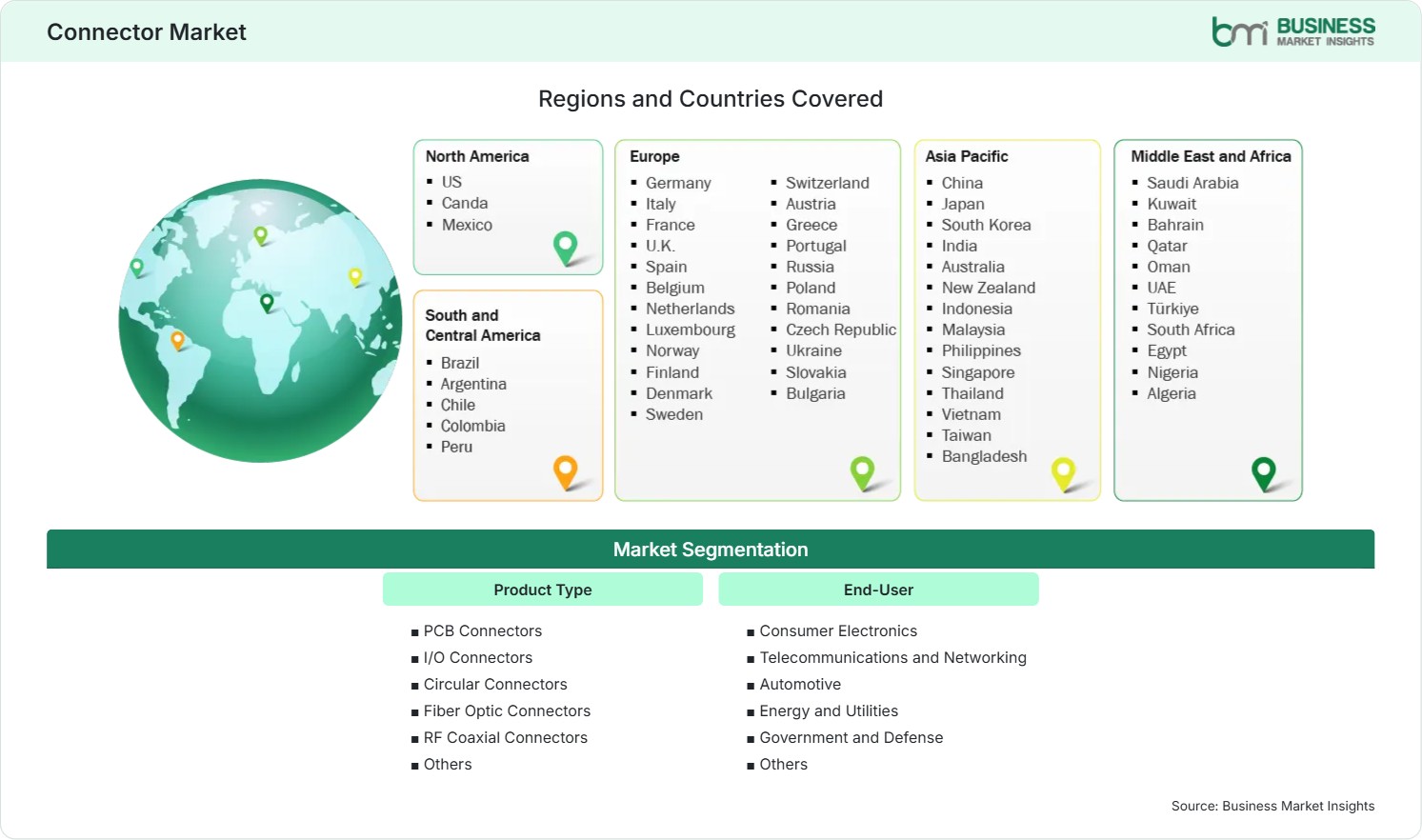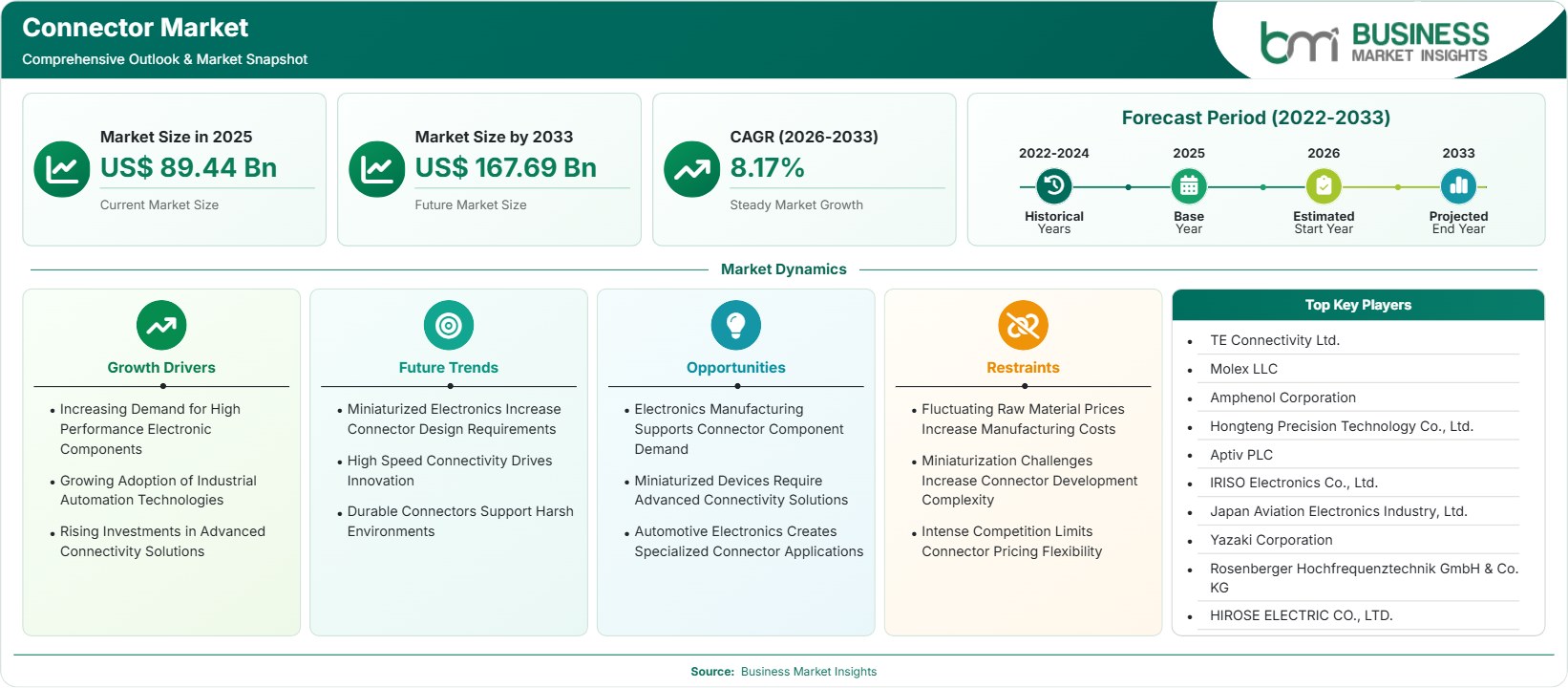
Connector Market Regional Highlights
North America Connector Market
North America accounted for approximately 33%–36% of global Connector Market revenue in 2025 and is expected to register a CAGR of 7.2%–7.8% during 2026–2033. The high demand for this industry comes from aerospace systems, defense modernization initiatives, cloud technology, industrial automation initiatives, and electric vehicle production. This region has the advantage of having skilled engineering workforces, heavy R&D spending, and an established electronics industry. Upgrades to telecommunication technology and AI computing platforms contribute to the growth in this market.
- Hyperscale data center investments across the United States and Canada continue increasing demand for high-speed interconnect solutions supporting cloud computing, AI workloads, and low-latency networking architectures.
- Aerospace and defense manufacturers are integrating advanced electronic systems requiring ruggedized, high-reliability components capable of operating under extreme environmental and mission-critical conditions.
- Industrial digitalization initiatives across manufacturing facilities are encouraging adoption of intelligent machinery and connected equipment requiring dependable signal and power transmission technologies.
- Growing electric vehicle production capacity and battery manufacturing investments are creating additional opportunities for suppliers specializing in high-voltage and high-current connectivity solutions.
- The region maintains the largest Connector Market share due to technology leadership, advanced electronics infrastructure, and strong demand from mission-critical industrial sectors.
US Connector Market
The United States represents approximately 78%–82% of North American Connector Market demand and is projected to expand at a CAGR of 7.3%–7.9% through 2033. Substantial investments in the production of semiconductors, AI infrastructure, defense electronics, and advanced mobility systems help drive continued growth in the market. Competitiveness is aided by innovative capabilities at home and active involvement from major technology players. The use of next-generation communication systems and cloud computing platforms also helps boost continued demand for interconnects.
- Federal incentives supporting semiconductor production are strengthening domestic electronics ecosystems and encouraging long-term investments in advanced manufacturing and component supply capabilities.
- Defense modernization programs require increasingly complex electronic architectures, creating consistent demand for highly reliable and secure connectivity technologies across military applications.
- Expanding EV manufacturing facilities are increasing consumption of specialized automotive interconnect systems designed for power management, safety systems, and communication networks.
- Data center expansion and AI infrastructure deployment continue generating demand for high-bandwidth connectivity products supporting next-generation computing environments.
Europe Connector Market
Europe held approximately 24%–27% share in 2025 and is forecast to grow at a CAGR of 7.4%–8.0% during 2026–2033. Electric vehicles, industrial automation, renewable energy utilization, and advancements in manufacturing processes are the main growth drivers. Germany is the leader in terms of earnings in the region because of its robust automobile industry and industries in general, whereas Eastern European countries are fast-growing manufacturing hubs. Sustainability, energy efficiency, and technological innovation are still driving the region.
- Germany remains the leading country, supported by advanced automotive production and industrial engineering capabilities, while maintaining a projected CAGR of approximately 7.2%–7.8%.
- Poland and the Czech Republic are attracting electronics manufacturing investments, supporting higher regional production capacity and strengthening component supply chain resilience.
- Renewable energy projects require dependable connectivity technologies for power transmission, monitoring systems, and grid modernization initiatives throughout European markets.
- Industrial automation adoption across manufacturing sectors continues supporting demand for durable, high-performance solutions capable of operating in demanding environments.
- Regulatory focus on sustainability and energy efficiency encourages development of innovative products aligned with evolving environmental compliance requirements.
Asia Pacific Connector Market
Asia Pacific accounted for approximately 28%–31% of global revenue in 2025 and is anticipated to achieve the fastest CAGR of 9.5%–10.2% during 2026–2033. The area has access to electronics manufacturing expertise, investments in semiconductors, telecom infrastructure build-out, and the production of electric vehicles. China is the major revenue earner, whereas India and Southeast Asian economies are the fastest-growing. The use of smart manufacturing solutions also adds another edge to demand fundamentals in the region.
- China continues leading regional demand through extensive electronics production capacity and integrated supply chain networks serving domestic and export-oriented markets.
- India is among the fastest-growing countries, supported by electronics manufacturing incentives, telecommunications expansion, and increasing domestic technology consumption.
- Southeast Asian economies are attracting production relocation initiatives seeking supply chain diversification and enhanced manufacturing resilience.
- Rapid deployment of 5G networks and broadband infrastructure projects strengthens demand for advanced communication-related connectivity solutions.
- Strong automotive electrification trends and battery manufacturing investments support long-term expansion opportunities throughout the regional ecosystem.
Rest of World Connector Market
Rest of World represented approximately 10%–13% of global revenue in 2025 and is expected to grow at a CAGR of 7.8%–8.5% during 2026–2033.
South and Central America benefit from expanding industrial automation, renewable energy installations, and telecommunications modernization programs. Brazil remains the leading regional contributor due to its manufacturing base and infrastructure investments.
Middle East and Africa markets are supported by smart city developments, energy diversification initiatives, and increasing digital infrastructure deployment. Saudi Arabia and the United Arab Emirates exhibit strong growth prospects as technology investment programs continue accelerating.
- Brazil remains the largest market within South and Central America, supported by industrial modernization initiatives and increasing investment in advanced manufacturing technologies.
- Telecommunications infrastructure expansion across emerging economies supports rising adoption of advanced connectivity systems and associated electronic components.
- Gulf Cooperation Council countries are investing heavily in smart infrastructure projects requiring reliable communication and power transmission technologies.
- Renewable energy and utility modernization projects create long-term demand for robust industrial connectivity solutions across multiple end-use sectors.
- Increasing digital transformation initiatives across Africa are supporting gradual adoption of advanced electronics and communication infrastructure technologies.