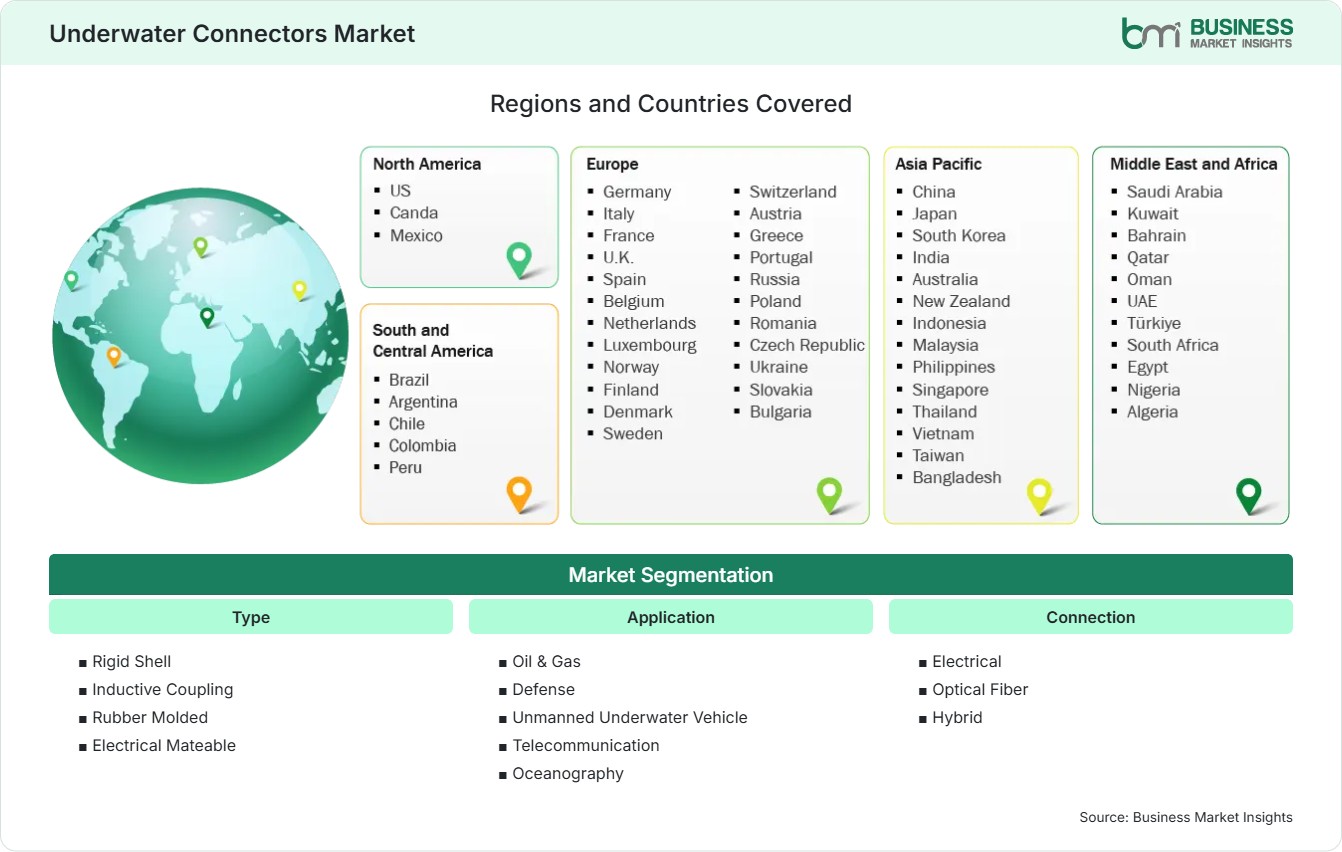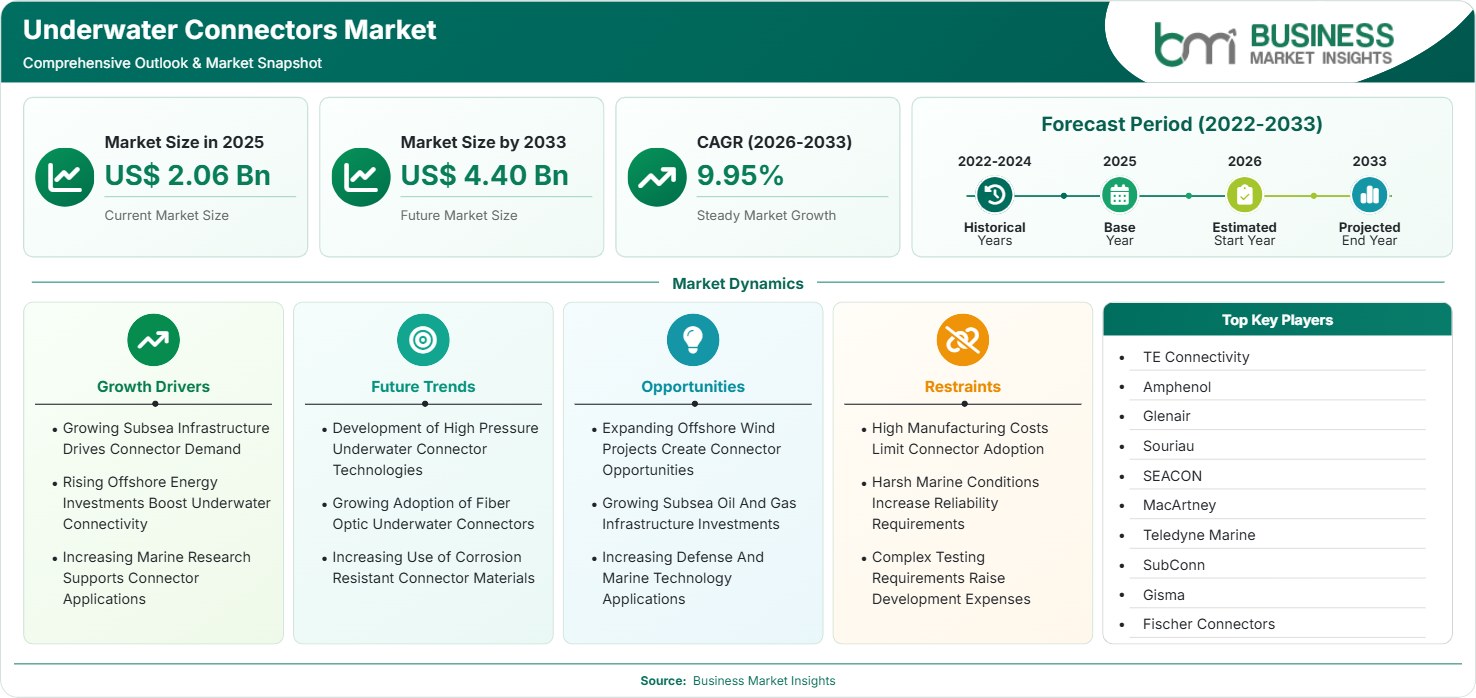
Underwater Connectors Market Regional Highlights
North America Underwater Connectors Market
North America holds a 31%–35% share in 2025 and is projected to grow at a 8.6%–9.5% CAGR through 2033. Demand is supported by offshore energy systems, naval programs, subsea communications, oceanographic research, and autonomous marine equipment.
- The United States remains the principal regional demand center, supported by naval modernization, offshore infrastructure, underwater surveillance, research programs, and extensive deployment of remotely operated and autonomous marine systems.
- Canada contributes through offshore energy development, marine research, fisheries monitoring, defense applications, and subsea engineering requirements associated with challenging coastal and deep-water operating environments.
- Advanced wet-mateable designs are gaining relevance where operators require equipment servicing without retrieving complete subsea assemblies, particularly across intervention systems and underwater robotic platforms.
- Specialized connector demand is strengthened by procurement requirements emphasizing environmental qualification, pressure resistance, corrosion protection, and reliable performance throughout extended deployment periods.
US Underwater Connectors Market
The U.S. represents approximately 78%–83% of North American demand in 2025 and is projected to grow at a 8.8%–9.7% CAGR through 2033. Demand spans defense, offshore energy, telecommunications, oceanography, and unmanned underwater systems.
- Defense applications remain important because underwater platforms require dependable power and signal interfaces for sensors, navigation equipment, communications, surveillance systems, and mission-specific payloads operating in demanding environments.
- Offshore energy applications create recurring requirements for subsea control systems, remotely operated equipment, inspection platforms, and intervention technologies where connection reliability directly influences maintenance efficiency.
- Research institutions and marine technology developers increasingly require compact interfaces compatible with autonomous platforms, distributed sensors, imaging systems, and underwater monitoring equipment used during extended deployments.
Europe Underwater Connectors Market
Europe holds a 24%–28% share in 2025 and is projected to grow at a 8.9%–10.0% CAGR through 2033. The United Kingdom, Norway, Germany, France, and Denmark remain important markets, with Norway and Denmark offering comparatively stronger expansion prospects.
- The United Kingdom Underwater Connectors Market benefits from offshore wind development, subsea communications, defense modernization, marine science, and established offshore engineering capabilities requiring durable underwater connectivity across distributed infrastructure.
- Norway maintains strong demand through offshore energy, subsea engineering, marine technology, and ocean observation, while its advanced offshore ecosystem supports adoption of specialized high-reliability connector architectures.
- Germany and France provide opportunities through defense, oceanographic research, industrial automation, telecommunications infrastructure, and marine technology development requiring dependable electrical and optical connectivity.
- Denmark offers higher-growth potential through offshore renewable energy projects, maritime engineering, subsea infrastructure, and increasing requirements for reliable connections within offshore equipment.
Asia Pacific Underwater Connectors Market
Asia Pacific holds a 25%–29% share in 2025 and is projected to grow at a 10.2%–11.3% CAGR through 2033. China, Japan, South Korea, Australia, and India lead regional demand, while Southeast Asia provides additional expansion potential.
- China combines offshore energy, naval modernization, marine research, telecommunications, and underwater robotics, creating broad application requirements for electrical, optical, and hybrid connection architectures.
- Japan supports demand through advanced marine engineering, oceanographic research, robotics, defense technologies, and sophisticated equipment manufacturing requiring compact and environmentally resilient underwater interfaces.
- South Korea benefits from shipbuilding, offshore engineering, naval systems, and marine technology development, supporting demand for connectors designed for integration into complex vessel and subsea equipment architectures.
- Australia offers opportunities through offshore energy, marine research, defense, mining-related subsea operations, and remote equipment deployment across challenging marine environments.
Rest of World Underwater Connectors Market
South and Central America provide demand through offshore energy, marine research, telecommunications, and underwater inspection activity. Brazil represents the principal regional opportunity, while Mexico and other coastal markets provide additional applications across energy and marine infrastructure.
Middle East and Africa demand is shaped by offshore energy, maritime security, oceanographic programs, and subsea communications. The Underwater Connectors Market share is supported by project-specific deployments, with Gulf economies and South Africa providing comparatively stronger opportunities.
- Brazil benefits from deepwater offshore activity, subsea engineering, remotely operated equipment, and marine service requirements requiring reliable connections across demanding operating conditions.
- Mexico provides opportunities through offshore energy, subsea inspection, telecommunications, and marine maintenance applications supported by an established offshore services ecosystem.
- Gulf markets benefit from offshore energy infrastructure and maritime security requirements, encouraging adoption of connectors engineered for harsh conditions and extended deployment cycles.
- South Africa provides regional potential through oceanographic research, defense, offshore services, telecommunications, and marine equipment servicing across southern African markets.